
Aluminum profiles are used for housing, protecting, cooling, and improving LED strip lighting systems. In practical terms, they act as a structural channel for LED strips, help transfer heat away from the LEDs, improve the finished appearance, support diffusers, and make installation safer and more reliable.
If you work with LED strip projects, you already know the problem. A bare LED strip may look fine on the bench, but on a real job site it can lead to poor heat control, weak adhesion, dotting, wire exposure, and callbacks. That gets expensive fast. The solution is simple: use the right aluminum profile for the application.
In our lab tests using integrating spheres, we’ve seen that profile selection affects not only appearance, but also thermal behavior and long-term lumen maintenance. This matters because a neat, stable installation protects your margin, your timeline, and your reputation.
Beyond the visible benefits, profiles also provide a predictable mechanical and thermal interface that simplifies specification and procurement.

Rather than treating the strip as an isolated part, specifying the channel as part of the system reduces on-site surprises and ensures consistent performance across multiple units.
1. Why are aluminum profiles used with LED strips?
Aluminum profiles are mainly used to turn flexible LED strips into a more durable lighting fixture. That sounds basic, but it solves several field problems at once. We often see installers struggle with exposed strips under cabinets, on shelves, or inside joinery where dust, accidental contact, and uneven mounting surfaces shorten service life. A profile creates a straight, stable base and gives the strip a professional housing.
There are three common usage reasons. One is mechanical support. On long runs, especially in retail shelving or display cabinets, the profile keeps the strip aligned. Another is appearance.
In hotel furniture, kitchens, and reception desks, a profile hides wiring and gives the system a clean architectural line. The third is serviceability. If the strip needs replacement, a well-designed channel makes access easier than peeling tape from wood or painted surfaces.
From our manufacturing floor perspective, the profile is not just an accessory. It is part of the LED system. Ignoring it often leads to warped mounting, visible light dots, and adhesive failure after a few months.
| Primary Use | What the Profile Does | Typical Project Example |
|---|---|---|
| Structural support | Keeps strip straight and secure | Shelf lighting |
| Finished appearance | Hides strip and wiring | Kitchen cabinet lighting |
| Protection | Reduces contact and dust exposure | Retail display lighting |
| Service access | Makes maintenance easier | Commercial joinery projects |

2. How do aluminum profiles help with heat dissipation?
LED strips produce less heat than traditional sources, but they still generate heat at the PCB level. If that heat is trapped, chip temperature rises, lumen output drops faster, and color shift can appear over time.
Aluminum profiles are used as passive heat sinks. They absorb heat from the strip’s PCB and spread it across a larger surface area.
This is where it gets interesting. Many buyers think low-watt strips do not need a profile. In reality, even 9.6W/m or 14.4W/m strips can suffer on wood, plastic, or painted surfaces with poor thermal transfer.
When we tested this against a standard 12V strip mounted directly on MDF, the strip in profile ran noticeably cooler than the strip mounted without metal backing. Lower operating temperature usually means better lifespan stability.
In our lab tests using integrating spheres and thermal imaging cameras, we focus on temperature rise after aging cycles. A profile will not perform like an active cooling system, but it can make the difference between a stable project and early depreciation.
| Mounting Surface | Heat Transfer Quality | Risk Level for LED Strip |
|---|---|---|
| Aluminum profile | Good | Low |
| Steel surface | Moderate | Medium |
| MDF or wood | Poor | High |
| Plastic panel | Poor | High |

A practical note: the tighter the strip-to-profile contact, the better the heat path. That is why quality adhesive backing and correct profile size matter.
For higher wattage applications, consider using thermal adhesive tapes, thermal pads, or mechanical clips that press the PCB into the metal. Proper surface preparation—cleaning grease and dust—improves adhesion and thermal transfer.
3. What protection do aluminum profiles provide?
Protection is one of the most overlooked reasons people ask what are aluminum profiles used for. They shield LED strips from accidental touch, cleaning chemicals, dust buildup, moisture exposure in the right IP construction, and impact during routine use. In commercial interiors, that matters more than many spec sheets suggest.
Take three examples.
- In a clothing store shelf, staff often move product trays and hangers close to the light source. An exposed strip can be scraped or partially detached.
- In a staircase handrail recess, cleaning tools can catch wire tails or connectors.
- In workshop furniture, dust settles quickly on open LEDs and reduces the clean look of the installation. A profile with diffuser solves much of this.
But there’s a catch. A profile is not automatically waterproof. The full protection level depends on the channel design, end caps, diffuser fit, and sealing method.
We once saw a facade accent project fail because the buyer assumed any aluminum channel was suitable for humid outdoor use. It was not. Water entered through unsealed ends and caused corrosion at solder points.
So the profile should be treated as part of the protection strategy, not the whole strategy. Consider the diffuser material (polycarbonate vs PMMA), UV resistance, gasket choices, and whether anodized or powder-coated finishes are needed for corrosion resistance in coastal environments.
| Protection Need | How Profile Helps | Extra Requirement |
|---|---|---|
| Dust reduction | Covers exposed strip | Proper diffuser fit |
| Mechanical contact | Shields LEDs from touch | Strong mounting clips |
| Splash resistance | Supports enclosed design | End cap sealing |
| Cleaner maintenance | Prevents direct wiping on LEDs | Suitable lens material |

4. How do aluminum profiles improve lighting quality and appearance?
A bare LED strip emits light, but a profile often makes that light usable in premium spaces. The aluminum body provides a straight line, while the diffuser softens glare and reduces visible LED dots.
This is why profiles are widely used in hospitality, cabinetry, retail fixtures, and office details where visual comfort matters.
We often see installers struggle with the same issue: they select a good strip, then lose the visual benefit because the diodes remain visible. In a luxury hotel corridor, that creates a cheap look. In a residential wardrobe, it causes uncomfortable pin-point glare. In museum casework, it can reflect harshly on glass.
Profiles help in three ways. They support opal, frosted, or clear covers. They define beam presentation. They also make linear runs look precise, especially around corners and long joinery lines.
Our Chief Engineer notes that heat dissipation is often ignored in profile choice, but optical finish is ignored almost as often. If you want a continuous line of light, COB strip plus a deep profile and quality diffuser usually works far better than a shallow channel with wide-pitch SMD strip.
image: aluminum profiles improve lighting quality
Additional considerations include color mixing for RGB or tunable white strips—diffuser choice can significantly affect color uniformity. For applications requiring precise beam control, lens attachments or narrow-slotted diffusers further shape the output.
When specifying, balance transmission percentage against dot masking: higher transmission gives more output but less dot concealment.
| Optical Goal | Recommended Profile Feature | Typical Application |
|---|---|---|
| Reduce glare | Frosted or opal diffuser | Office shelves |
| Hide LED dots | Deeper channel depth | Hotel corridors |
| Maximum brightness | Clear cover | Task lighting |
| Decorative line effect | Slim architectural channel | Wall details |
5. Where are aluminum profiles commonly used in LED lighting projects?
Aluminum profiles are used across a wide range of indoor and outdoor LED lighting applications. The most common locations include under cabinets, wardrobes, shelves, display counters, stair nosings, wall grooves, ceilings, handrails, mirror frames, and furniture details. In commercial work, they are also common in exhibition booths, retail gondolas, and product display systems.
Here’s the real story. The profile type changes with the mounting condition. Surface-mounted channels are common under kitchen cabinets and retail shelves. Recessed profiles suit joinery and gypsum details where the client wants the light source hidden in the architecture. Corner profiles are often used in cabinets and glass showcases to aim light at 45 degrees. Suspended profiles go into offices, conference rooms, and architectural linear systems.
We once saw a supermarket shelf project where the team used adhesive-only strips without channels. After repeated cleaning cycles and heat buildup, sections sagged and gave uneven light. The retrofit with slim aluminum profiles solved alignment and improved maintenance.
The question is not whether profiles are used. It is where they create the most value. When planning, map out access points and potential interference from other trades—plumbing, HVAC, or cabinetry hardware can affect channel selection.
| Application Area | Common Profile Type | Main Benefit |
|---|---|---|
| Under cabinet | Surface profile | Fast install and clean finish |
| Joinery groove | Recessed profile | Hidden architectural look |
| Display case | Corner profile | Better beam direction |
| Office linear light | Suspended profile | Uniform professional appearance |
6. What types of aluminum profiles are available for LED lighting?
The market offers many profile types, but most projects fall into a manageable group. You will typically choose among surface, recessed, corner, plaster-in, suspended, bendable, and stair profiles. The right selection depends on substrate, viewing angle, service access, and required visual effect.
A recessed profile sits flush and works well in furniture panels or gypsum slots. A surface profile is the easiest option when routing is not possible. A corner profile changes beam direction and is useful in under-cabinet work. Suspended profiles create standalone linear fixtures. Stair profiles add both lighting and edge definition.
Common Myth: a larger profile always gives better performance.
Reality: profile size should match strip wattage, diffuser requirement, and available space. An oversized channel may waste space and budget, while an undersized one may trap heat or show dotting. We explain this because ignoring physical fit often leads to redesign costs or client rejection.
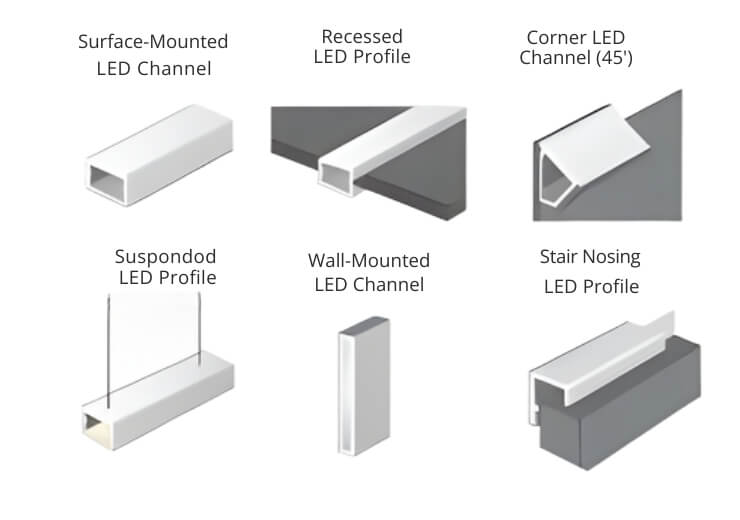
There are also customized extrusions for specific brand aesthetics, anodized finishes for increased durability, and modular connector systems for long continuous runs. Bendable or flexible profiles enable curved-linear applications, useful in signage and curved ceilings.
| Profile Type | Best Use Case | Main Limitation |
|---|---|---|
| Surface | Retrofit and simple mounting | More visible body |
| Recessed | Flush furniture or wall detail | Needs routing or slot |
| Corner | 45-degree light direction | Limited width options |
| Suspended | Ceiling linear systems | More hardware needed |
| Stair | Step edge lighting | Specific structural fit |
7. How do you choose the right aluminum profile for a project?
Choosing the right profile means looking at thermal load, strip width, diffuser need, installation method, environment, and maintenance access together. Too often, people select by appearance alone. That is where callbacks start.
- I usually start with five checks. What is the strip wattage per meter?
- What is the PCB width?
- Is the project visible at eye level, meaning glare and dotting matter more?
- Is the location dry, humid, or exposed?
Does the installer need easy access later? These questions narrow the choice quickly.
For example, a 5W/m decorative shelf light can use a slim profile. A 20W/m task light over a workbench needs more aluminum mass. A bathroom mirror project may need corrosion-aware design and sealed accessories. A hotel joinery project may prioritize flawless diffuser appearance over minimal cost.
From our manufacturing floor perspective, one of the biggest mistakes is mismatch between strip width and channel inner width. Installers then force the strip in place, wrinkle the PCB, or weaken adhesion.
| Selection Factor | What to Check | Why It Matters |
|---|---|---|
| Strip width | Inner channel dimension | Proper fit and adhesion |
| Wattage | Thermal capacity | Better lifespan |
| Diffuser need | Dot-free or high transmission | Visual quality |
| Mounting method | Surface, recessed, suspended | Labor and design fit |
| Environment | Indoor, humid, outdoor | Protection level |
Quick calculation tip: add up wattage per meter and multiply by total run length to estimate total heat.
If total heat density is high, move to a profile with larger cross-section or specify mechanical fixing that improves conduction. When in doubt, prototype a 1–2m run and measure surface temperature after a few hours of operation.
8. How do aluminum profiles affect installation speed and maintenance?
Installation efficiency is a direct cost factor, especially on repeat commercial jobs. Aluminum profiles are used to standardize LED strip installation, reduce rework, and improve future maintenance. A clean mounting base often saves more labor than buyers expect.
We often see installers struggle with uneven cabinet surfaces, hand-cut strip placement, and loose wire management. On site, that turns into slow fitting and alignment problems. A pre-cut profile with clips, diffuser, and end caps creates a repeatable process.
In one retail rollout, teams installed profile-based shelf lighting faster because each unit had fixed geometry and cable exit points. In another furniture project, maintenance staff replaced only the diffuser and strip without damaging the panel. In a reception desk build, the profile also protected the strip during later trades.

Ready for the good part? Better maintenance means lower total ownership cost. If a strip fails inside a routed wooden groove with no removable profile system, access can become destructive. With the right channel, service is controlled and cleaner.
| Installation Task | Without Profile | With Profile |
|---|---|---|
| Alignment | Manual and inconsistent | Straight reference line |
| Wire concealment | Often exposed | Cleaner cable management |
| Diffuser fitting | Not available | Built-in option |
| Future replacement | Can damage substrate | Easier access |
9. What technical mistakes should you avoid when using aluminum profiles?
Most failures do not come from the aluminum itself. They come from wrong specification, poor assembly, or bad assumptions. This section matters because small technical mistakes can create visible defects, premature aging, or safety concerns.
The most common mistake is choosing a profile that is too shallow for the strip pitch and then complaining about visible dots. Another is using high-power strips in lightweight channels with minimal heat mass.
We also see end caps omitted, which leaves a project looking unfinished and allows dust ingress. On longer runs, poor expansion allowance or rough cutting can cause cover fit issues.
Here is a field example.
A contractor used a narrow recessed profile for a wide COB strip. The strip edges lifted and thermal contact was poor. In another project, a clear lens was selected for a hospitality corridor, and glare became the complaint, not brightness. In a humid vanity installation, unsealed cable exits let vapor enter and stain contacts.
Pro Tip from the VST Technical Team: always test one full assembly before mass installation. That means strip, profile, diffuser, end cap, mounting method, and power supply together.
| Common Failure Mode | Likely Cause | Practical Fix |
|---|---|---|
| Visible LED dots | Channel too shallow | Use deeper profile or COB strip |
| Early lumen drop | Poor heat dissipation | Use larger profile body |
| Strip lifting | Width mismatch or weak adhesion | Match channel width and prep surface |
| Dust or moisture ingress | Missing seals or end caps | Use proper accessories and sealing |
10. Are aluminum profiles worth the extra cost?
Yes, in most professional LED strip projects, aluminum profiles are worth the extra cost because they reduce risk, improve appearance, and support longer service life. The real comparison is not profile cost versus no profile cost. It is profile cost versus callback cost, replacement labor, client dissatisfaction, and reduced lighting quality.
Let’s be real. On a low-visibility temporary installation, an exposed strip might be acceptable. But in furniture, hospitality, retail, office, and architectural work, the profile usually pays back through cleaner results and fewer problems.
image: worth
We once saw a distributor compare two shelf-lighting packages. The cheaper one used bare strips and had more field complaints about sagging, dust, and inconsistent finish. The profile-based package carried a higher unit cost but lower return rate.
A simple cost review helps.
| Cost Element | Bare LED Strip | LED Strip with Aluminum Profile |
|---|---|---|
| Initial material cost | Lower | Higher |
| Appearance quality | Basic | Professional |
| Thermal support | Weak | Better |
| Maintenance effort | Higher | Lower |
| Risk of callbacks | Higher | Lower |
And here is the mandatory comparison many buyers ask for.
| Feature | LED Strip Only vs LED Strip in Profile |
|---|---|
| Cooling | Limited vs improved heat spreading |
| Protection | Exposed vs enclosed |
| Light comfort | More glare vs diffuser support |
| Installation finish | Rougher vs cleaner |
| Service life stability | Lower vs better |
A profile is not always mandatory. Still, for most visible and permanent projects, it is a smart specification.
Aluminum profiles are used for far more than holding an LED strip in place. They manage heat, protect the light source, improve visual comfort, support cleaner installation, and reduce failure risk over time.
If your project involves visible linear lighting, furniture integration, or long operating hours, profile selection should be part of the lighting design from the start.
If you are unsure about profile size, diffuser choice, or thermal limits for your layout, send your drawings to an engineering team for a manual review before installation.
Conclusion
Aluminum profiles are used for far more than holding an LED strip in place.
They manage heat, protect the light source, improve visual comfort, support cleaner installation, and reduce failure risk over time.
If your project involves visible linear lighting, furniture integration, or long operating hours, profile selection should be part of the lighting design from the start.
If you are unsure about profile size, diffuser choice, or thermal limits for your layout, send your drawings to an engineering team for a manual review before installation.
FAQ
Q1: What are aluminum profiles in LED lighting?
Aluminum profiles are metal channels designed to hold LED strips. They usually include a diffuser, mounting parts, and end caps, helping with heat transfer, protection, and a cleaner finish.
Q2: Do all LED strip lights need aluminum profiles?
No. Low-cost temporary or hidden applications may work without them. Still, visible, long-running, or higher-power installations usually perform better with profiles.
Q3: Do aluminum profiles make LED strips brighter?
Not directly. The aluminum does not increase lumen output by itself. However, a good diffuser and better thermal behavior can improve usable light quality and long-term performance.
Q4: Can aluminum profiles be used outdoors?
Yes, but only with the right design. Outdoor use depends on sealing, end caps, diffuser fit, corrosion resistance, and the IP rating of the full assembly.
Q5: How do I choose between surface and recessed aluminum profiles?
Choose surface profiles for faster retrofit installation and recessed profiles for a flush architectural look. The decision depends on substrate, labor method, and desired visual finish.
