
LED channel letters are three-dimensional illuminated sign letters made from metal or acrylic returns, a face or back panel, and internal LED modules used as the light source. They are widely used on shopfronts, malls, hotels, offices, restaurants, and commercial buildings because they offer strong visibility, low power use, long service life, and a professional brand image.
If you are comparing sign options, the problem is usually not finding a sign that lights up. The real issue is choosing a letter system that looks right, performs well outdoors, and does not create callbacks from dim sections, water ingress, or power supply failure.
That can turn into project delays, rework costs, and reputation damage. This article solves that by explaining what LED channel letters are, how they work, which types exist, what specs matter, and what to check before you order or install them.
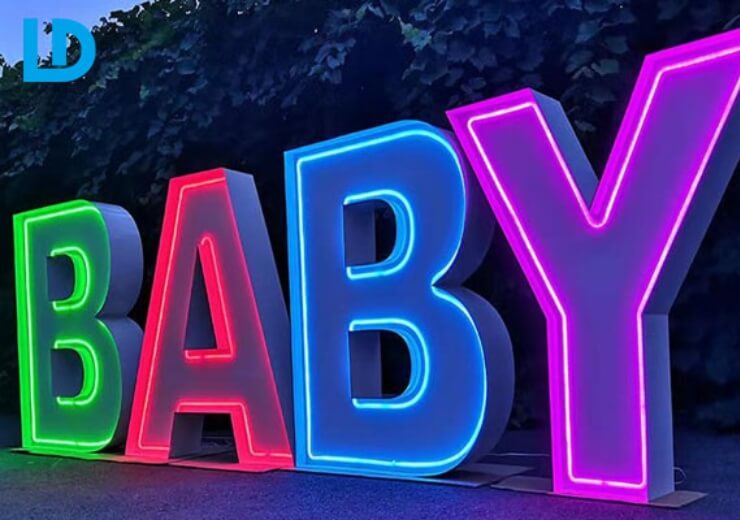
In our lab tests using integrating spheres and thermal checks on LED systems, we often see that sign performance depends less on appearance alone and more on heat control, driver quality, and build details.
1. What are LED channel letters and why are they used?
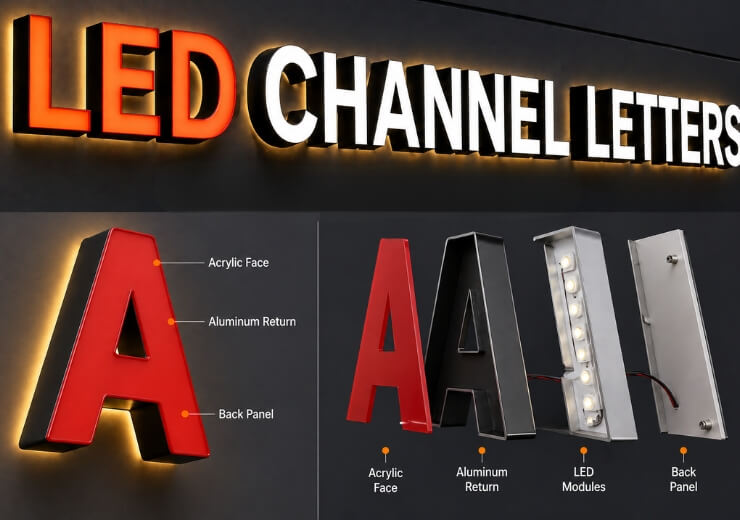
LED channel letters are fabricated sign letters with depth. Each letter is built like a small light box. The body is usually aluminum or stainless steel. The face is often acrylic. Inside, LED modules create even illumination. The result is a clean, highly visible sign that can be read day and night.
They are used because flat printed signs have limits. In a retail street, a pharmacy, a hotel facade, or a corporate reception wall, brand visibility matters. Raised illuminated letters look more premium and are easier to identify from a distance.
We often see installers struggle with older fluorescent letter systems because of maintenance access, lamp replacement, and inconsistent brightness. LED channel letters solve many of those issues.
Typical reasons businesses choose them include:
- Better nighttime visibility
- Lower energy use than neon or fluorescent systems
- Long LED lifetime
- Flexible shape and color options
- Stronger brand presentation
- Easier integration with timers and controllers
| Feature | LED Channel Letters | Flat Non-Lit Sign |
|---|---|---|
| Night visibility | High | None |
| Brand impact | Strong | Moderate |
| Energy use | Low to moderate | None |
| Dimensional look | Yes | No |
| Maintenance frequency | Low | Low |
Beyond these benefits, LED channel letters also provide design flexibility for multi-material combinations (e.g., metal returns with acrylic faces and translucent vinyl overlays).
They can incorporate programmable effects where allowed by local codes—useful for limited animations on logos or for seasonal messaging. Permitting and local signage codes should always be checked early because some municipalities restrict illumination levels, color choices, or moving light effects.
When designed and permitted correctly, channel letters deliver a high-return marketing asset that typically outperforms non-illuminated alternatives in both day and night environments.
2. How do LED channel letters work?
The working principle is simple. LEDs mounted inside each letter convert electrical energy into light. A low-voltage LED module, usually 12V or 24V DC, is powered by an external LED driver or power supply. The light is directed through the acrylic face, out from the back halo, or both, depending on the letter type.
Here’s the deal. Good illumination is not just about placing LEDs inside a shell. Spacing, module angle, face material, inside reflectivity, and return depth all affect uniformity. In our lab tests using integrating spheres, light output can differ sharply when low-grade modules are overdriven or badly spaced.
In a luxury hotel lobby sign, uneven lighting will be noticed immediately. On an outdoor bank sign, dark spots can create a poor brand impression from the street.
A standard system includes:
- Letter shell
- Acrylic face or back
- LED modules
- Wiring
- Transformer or LED driver
- Mounting template or raceway
- Sealant for outdoor use
| Component | Function |
|---|---|
| Aluminum return | Forms the side wall and structure |
| Acrylic face | Diffuses front light |
| LED module | Produces illumination |
| Driver/power supply | Converts mains power to low voltage DC |
| Back panel | Supports mounting and wiring |
| Trim cap | Holds face and improves finish |

On the electrical side, two common driver types are constant voltage (CV) and constant current (CC). Most letter systems use constant voltage drivers (12V or 24V DC) feeding modular LED strips or modules; constant current drivers are typically used for high-power LED arrays where current regulation is critical.
Dimming and control compatibility (0-10V, PWM, DMX, or proprietary smart controllers) should be specified early if you plan to integrate the sign with building automation or timed dimming. Connectors, solder quality, and strain relief also matter; poor connections are frequent causes of early failure in field environments.
3. What are the main types of LED channel letters?
Not all LED channel letters look the same. The major types are front-lit, back-lit, front and back-lit, open-face, and mini channel letters. Your choice depends on viewing distance, brand style, local code, and budget.
Front-lit letters are the most common. They use an acrylic face to emit light forward. Back-lit letters, often called halo-lit letters, project light behind the letter onto the wall for a softer premium effect. Front and back-lit letters combine both.
Open-face letters have visible LEDs or exposed acrylic fronts and are often used where a vintage or bold visual style is wanted. Mini channel letters are compact versions for interior branding or close-range viewing.
We once saw a project fail because the customer selected halo-lit letters on a dark, uneven stone wall without checking reflection performance. The letters worked, but the halo effect was weak and inconsistent. A front-lit style would have performed better.
| Type | Light Direction | Typical Use | Visual Effect |
|---|---|---|---|
| Front-lit | Forward | Shops, malls, chains | Bright and direct |
| Back-lit | Backward | Offices, hotels | Soft halo |
| Front/back-lit | Both | Premium facades | High-end layered look |
| Open-face | Forward/exposed | Restaurants, themed branding | Bold and decorative |
| Mini letters | Forward or halo | Indoor signs | Fine detail |

Local regulations can influence type selection. For example, historic districts or mixed-use zones may restrict halo/back-lit installations, or they might limit brightness to avoid glare at night. Also consider the mounting surface: halo-lit letters show best on smooth, uniform backgrounds; where the substrate is rough or textured, a stronger front-lit solution or a backer panel can maintain appearance consistency.
4. What materials are used in LED channel letters?
Materials affect durability, weight, finish, and cost. The return, which is the side wall of the letter, is commonly made from aluminum, stainless steel, or galvanized steel. The face is usually acrylic because it diffuses light well and can be cut precisely. The back may be aluminum composite, PVC, or acrylic depending on the letter design.
From our manufacturing floor perspective, material choice changes field performance more than many buyers expect.
Aluminum is widely preferred because it is lightweight, corrosion resistant, and easy to fabricate. Stainless steel gives a premium finish, especially for halo letters, but it costs more and weighs more. Acrylic thickness also matters. Too thin, and the face may deform. Too thick, and light transmission can drop if the wrong grade is used.
Common material choices include:
- Aluminum returns for outdoor letters
- Stainless steel for premium indoor or halo-lit projects
- Acrylic faces in white or translucent colors
- PVC or aluminum backs depending on mounting method
- Vinyl overlays for custom face colors
| Material | Common Position | Strength | Limitation |
|---|---|---|---|
| Aluminum | Returns/back | Light, corrosion resistant | Can dent if too thin |
| Stainless steel | Returns | Premium finish, durable | Higher cost |
| Acrylic | Face/back | Good diffusion, easy forming | Can crack if poorly handled |
| PVC | Back panel | Low cost, easy machining | Less robust outdoors |
| ACP | Back panel | Strong, stable | Needs proper cutting |
Finishing processes also matter for longevity and appearance: powder coating, anodizing, and marine-grade paints offer UV and corrosion resistance that standard paints do not.

For coastal or chemically harsh environments, specify marine-grade fasteners, sealed electrical housings, and sacrificial anodes where appropriate. In many cases, a mid-range material combined with a high-quality finish outperforms an untreated premium metal in long-term exposure.
5. What technical specifications matter most?
This is where it gets interesting. Many sign failures start with ignored specs. Buyers often focus on size and color, yet the better decision comes from checking voltage, wattage, IP rating, LED spacing, driver loading, face depth, and thermal behavior.
For outdoor LED channel letters, IP rating matters because water ingress can shorten module life or corrode connections. Voltage selection matters too. On larger signs, 24V systems often help reduce current and wiring loss compared with 12V, though module compatibility must be checked. We explain this because ignoring voltage drop leads to dim letters at the far end of a run, especially on long raceways.
- Common Myth: higher wattage always means better brightness.
- Reality: it depends on lumen efficiency, module layout, face diffusion, and internal reflectivity. When we tested this against a standard 12V strip in signage mockups, a more efficient lower-watt module produced more even and usable brightness than a higher-watt low-efficiency option.
| Specification | Why It Matters | Typical Range |
|---|---|---|
| Input voltage | Affects wiring and driver choice | 12V or 24V DC |
| IP rating | Outdoor moisture protection | IP65 to IP67 |
| Color temperature | Sets visual tone | 2700K to 10000K |
| LED spacing | Controls uniformity | Based on depth and module lens |
| Return depth | Affects light spread | Often 50mm to 120mm |
| Driver load | Prevents overload | Keep safety margin |
Beyond these, request LED performance documentation such as LM-79 (photometric data) and LM-80 (LED lumen maintenance) where available, and ask for predicted L70 life calculations if longevity is a key requirement.
Burn-in testing (72 hours or more at elevated temperatures) on assembled letters can reveal early failures before installation.
Also consider corrosion ratings for metal parts and UL or CE certifications for the electrical components if you’re exporting or working in regulated markets.
6. How do 12V and 24V systems compare for channel letters?
The answer depends on sign size and wiring length. Small letters with short runs often work well on 12V. Larger signs, long cable paths, or multi-letter layouts often benefit from 24V because current is lower for the same power, which helps reduce voltage drop and heat in conductors.
We often see contractors use 12V by habit on large facade signage, then face uneven brightness across the installation. But there’s a catch. Switching to 24V is only useful if the modules, driver, and design all match. Mixing system voltage is a common field mistake.
Three practical examples stand out. A compact cafe sign with six short letters usually works well with 12V. A shopping center tenant board with twenty letters and longer feeds often performs better on 24V. An airport wayfinding sign may use centralized power planning, where voltage drop calculation becomes even more critical.
| Item | 12V System | 24V System |
|---|---|---|
| Best for | Small to medium signs | Medium to large signs |
| Current level | Higher | Lower |
| Voltage drop risk | Higher on long runs | Lower on long runs |
| Wiring size pressure | Greater | Lower |
| Common use | Simple installations | Larger layouts |
If you need a simple rule of thumb: keep 12V runs short—generally under 5–10 meters without upsizing conductors—and plan for step-downs or multiple feed points on longer runs.
For 24V, designers commonly allow longer contiguous runs and fewer feed points, reducing installation complexity and visible wiring. Use voltage drop calculators or consult an experienced electrical designer; a few simple calculations up front prevent uneven illumination and reduce rework costs.
7. What are the installation methods and common mistakes?
LED channel letters are usually installed in one of three ways: direct mount, raceway mount, or backer panel mount.
Direct mount fixes each letter to the wall individually and hides wiring inside the building. Raceway mount places multiple letters on a metal box that contains wiring and power supplies. Backer panels are often used when the surface is difficult or when the sign needs cleaner installation management.
What’s the real story?
Installation quality often decides whether the sign looks premium or problematic.
We often see installers struggle with poor templates, weak sealing around studs, and driver placement in hot enclosed spaces. In coastal projects, failure to seal entry points can lead to corrosion. In stone facades, inaccurate drilling can break alignment and create visible spacing errors.
A quick checklist helps avoid trouble:
| Installation Checkpoint | What to Verify | Why It Matters |
|---|---|---|
| Template accuracy | Letter spacing and hole positions | Prevents misalignment |
| Power supply loading | Driver not overloaded | Improves lifetime |
| Cable routing | No pinch points or exposed damage | Prevents shorts |
| Waterproof sealing | Proper sealant at entries | Reduces moisture ingress |
| Mounting strength | Anchors fit substrate | Prevents loosening |
| Ventilation | Driver heat can escape | Reduces thermal stress |
Other common mistakes include poor coordination with building services (leading to access issues for wiring), using inadequate anchors in weak substrates, and running drivers inside fully sealed enclosures without ventilation. It’s also important to label wiring and provide as-built documentation for maintenance teams.
Finally, always test letters on-site before final sealing—verify polarity, dimming operation, and uniformity, and take photographs for client sign-off.
8. How much do LED channel letters cost?
Cost depends on letter height, stroke width, material, finish, light type, complexity, and certification needs. A simple front-lit set is usually less expensive than a stainless steel front-and-back-lit design with custom paint and premium modules. Freight, packaging, installation hardware, and local electrical work also affect the final figure.
Here’s where buyers can make a mistake. They compare only unit price per letter and ignore operating cost, maintenance risk, and field labor.
A cheaper sign that needs service in twelve months can erase the initial saving very quickly. We once saw a chain store save on low-cost modules but lose that margin after repeated service calls for water ingress and patchy brightness.
Cost drivers usually include:
- Material thickness
- Letter depth
- LED module grade
- Driver brand and certification
- Finish quality
- Packaging for transport
- Installation complexity
| Cost Factor | Lower Cost Option | Higher Cost Option |
|---|---|---|
| Return material | Standard aluminum | Stainless steel |
| Lighting style | Front-lit | Front/back-lit |
| Finish | Standard paint | Custom premium finish |
| LED module | Generic | Branded high-efficiency |
| Mounting | Raceway | Direct custom mount |
| Certification | Basic local need | Multi-market compliance |
To give a rough idea (prices vary widely by region and project scale): a small set of simple front-lit letters for a local shop might start in the low hundreds to a few thousand dollars including basic installation, while large multi-letter facade systems with premium materials, custom finishes, and certified drivers can escalate into the tens of thousands.
Ask suppliers for a breakdown so you can compare apples-to-apples: fabrication, materials, LEDs, drivers, installation labor, and post-installation warranty coverage.
9. How long do LED channel letters last and what affects reliability?
A well-built LED channel letter system can last many years, often 30,000 to 50,000 hours or more for the LED modules, though actual field life depends on temperature, moisture control, driver quality, and operating hours.
In practice, the weakest part is not always the LED itself. It may be the power supply, poor solder joints, low-grade adhesive, or weak sealing. In our lab tests using thermal imaging cameras, we often find hot spots near overloaded drivers or tightly packed modules in shallow letters.
Heat is the enemy.
It lowers lumen output over time and can shorten electronic life. Our Chief Engineer notes that heat dissipation is often ignored in compact letter designs where customers want the thinnest possible profile. The result can be accelerated light decay.
Three field examples are common. Outdoor letters near coastal air need better corrosion resistance. South-facing signs in hot climates need stronger thermal planning. Indoor reception signs may run fewer hours and last longer, but driver noise and dimming compatibility can still matter.
| Reliability Factor | Positive Practice | Risk if Ignored |
|---|---|---|
| Heat management | Proper spacing and ventilation | Faster lumen decay |
| Waterproofing | Sealed joints and rated modules | Moisture failure |
| Driver sizing | Safety headroom | Overload and shutdown |
| Material quality | Corrosion-resistant shell | Rust and cosmetic damage |
| QC testing | Aging and inspection | Early field returns |
Planned maintenance extends life: schedule inspections every 6–12 months to check seals, connections, driver temperatures, and brightness uniformity.
Keep spare LED modules and a replacement driver on hand for quick field swaps. For critical installations, consider service contracts that include periodic cleaning (to remove dirt and biological growth), resealing, and electrical tests.
Good documentation from the manufacturer—assembly drawings, driver specs, and replacement part numbers—makes maintenance much faster and less costly.
10. How should you choose the right LED channel letters for a project?
Start with the application.
- Is the sign indoor or outdoor?
- Viewed from 3 meters or 50 meters?
- Mounted on glass, stone, ACP, or concrete?
- Does the client want direct brightness, a halo effect, or a refined brand look?
Those questions guide the right structure before price comparison even starts.
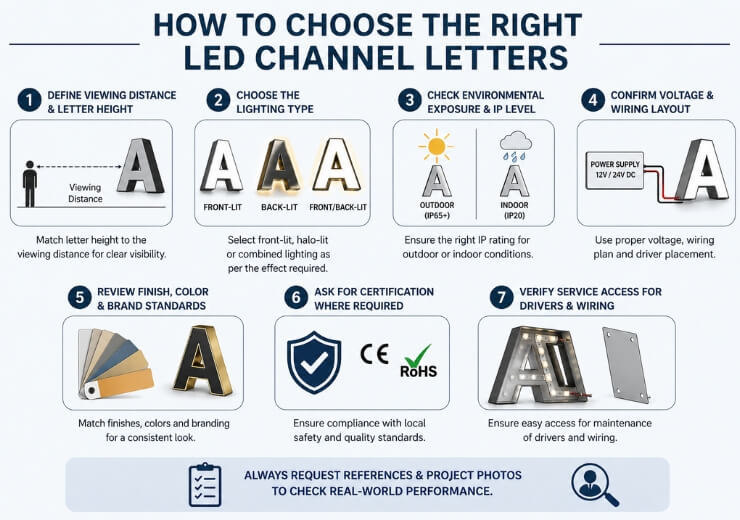
A practical selection method is:
- Define viewing distance and required letter height
- Choose front-lit, halo-lit, or combined lighting
- Check environmental exposure and IP level
- Confirm voltage and wiring layout
- Review finish, color, and brand standards
- Ask for certification where required
- Verify service access for drivers and wiring
We explain this step-by-step because poor specification causes margin erosion. Wrong letter depth can create hot spots. Wrong finish can fail in outdoor UV.
Wrong wiring plan can create callbacks. From our manufacturing floor perspective, the best projects are not the cheapest on paper. They are the ones where the sign performs consistently after installation.
If you are unsure about module spacing, voltage drop, or driver loading for your sign design, contact a technical team with your drawings before production.
That small step can save a lot of field trouble. Also ask potential suppliers for references and recent project photos—seeing installed examples in similar environments is a reliable indicator of how well their products perform long-term.
Conclusion
LED channel letters are illuminated 3D sign letters that combine visibility, brand impact, and efficient operation. The right result depends on type selection, material quality, voltage planning, waterproofing, and installation discipline.
If you treat them like a simple decorative item, problems show up later. If you specify them like an engineered product, they perform well for years. If you want help reviewing sign drawings, power layout, or material options, send the details to an engineering team and get the calculations checked before you commit.
FAQ
Q1: What is the difference between front-lit and halo-lit channel letters?
Front-lit letters shine through the face toward the viewer, while halo-lit letters project light behind the letter onto the mounting surface for a softer effect.
Q2: Are LED channel letters suitable for outdoor use?
Yes. Outdoor models are commonly built with aluminum or stainless steel, sealed joints, and IP-rated LED modules and power supplies.
Q3: How long do LED channel letters usually last?
Good-quality systems often use LED modules rated around 30,000 to 50,000 hours, but lifetime depends on heat, moisture protection, and driver quality.
Q4: Which is better for channel letters, 12V or 24V?
Neither is universally better. 12V suits smaller signs and short runs, while 24V is often preferred for larger layouts where voltage drop is a concern.
Q5: What is the biggest mistake when buying LED channel letters?
Focusing only on price. Many failures come from poor module quality, bad sealing, overloaded drivers, and weak installation planning rather than from the letter shell itself.
