
Many contractors, distributors, and project teams ask this after seeing LED tape installed directly onto wood, drywall, glass, or metal shelves. Bare strips may work initially, but heat, dust, handling damage, and uneven mounting can shorten service life and cause project delays, client complaints, margin loss, and reputation damage.
The solution is straightforward: use the right aluminium profile, diffuser, mounting method, and wiring plan. In lab tests using integrating spheres and thermal imaging cameras, we see clear differences between bare strips and strips installed in properly sized aluminium channels.
1. Why do LED strip lights need aluminium profiles?
LED strip lights need aluminium profiles because the strip alone is not a complete lighting fixture. The PCB carries LEDs and resistors but has limited mechanical strength and thermal mass. A quality LED strip extrusion turns flexible tape into a controlled lighting system with better heat control, protection, and visual finish.
Heat is the quiet killer. A 14.4W/m strip installed on painted wood can run much hotter than the same strip bonded into an aluminium channel. Higher temperature reduces lumen output, shifts color, dries adhesive, and shortens LED life, which is why LED assemblies often need a proper heat sink path instead of relying on tape alone.
The main benefits of aluminium channel for LED strip lighting appear in three practical ways:
- Pull heat away from the LED PCB
- Protect the strip from touch, dust, and small impacts
- Create straight, clean light lines for visible installations
Field examples illustrate this: retail shelves get scratched during stocking; exposed LED dots look cheap under reflective panels; tape stuck to wood may peel after heat cycles.
| Installation Method | Heat Control | Visual Finish | Service Risk | Best Use |
|---|---|---|---|---|
| Bare strip on wood | Low | Medium to low | High | Temporary or low-power hidden lighting |
| Bare strip on metal | Medium | Medium | Medium | Cost-sensitive hidden lighting |
| Strip in aluminium profile | High | High | Low | Commercial, retail, hospitality, furniture |
2. How do aluminium profiles improve heat dissipation?
Aluminium conducts heat far better than MDF, PVC, plasterboard, or painted timber, which is why many buyers compare aluminium vs plastic channels for LED lights before choosing a profile system. LEDs convert part of electrical power into light; the rest becomes heat. If heat cannot move away, junction temperature rises and performance drops.
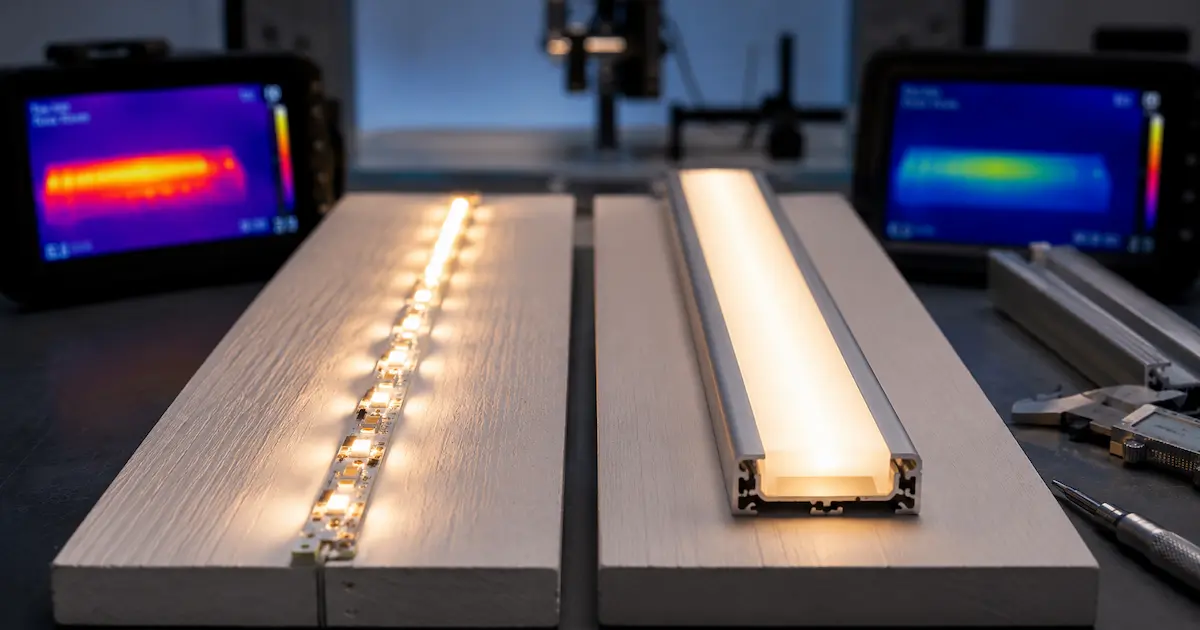
In thermal testing, bare strips show hot spots around LED packages, while strips in suitable profiles spread heat along the channel. Size matters: a slim 6mm decorative channel cannot handle the same load as a wide architectural channel. For high-density COB or 19.2W/m SMD strips, pick a LED strip channel with enough aluminium mass and surface area.
| Strip Power | Suggested Profile Type | Heat Risk Without Profile | Typical Application |
|---|---|---|---|
| 4.8W/m | Mini surface profile | Low | Display edge, signage |
| 9.6W/m | Standard surface or recessed profile | Medium | Cabinets, shelves |
| 14.4W/m | Wider aluminium channel | Medium to high | Retail, offices, coves |
| 19.2W/m+ | Heavy-duty profile with airflow path | High | Linear main lighting |
Pro Tip: If the customer can touch the profile after an hour and it feels warm but not painfully hot, the heat path is usually working; a cool profile with a hot strip suggests poor contact.
3. What visual benefits do profiles provide?
Profiles improve visual quality by holding the strip straight and supporting diffusers. Without a profile, tape can wave slightly and become a visible defect. A proper LED channel diffuser changes output: clear keeps brightness but shows dots; frosted softens; opal creates the smoothest line with more lumen loss.
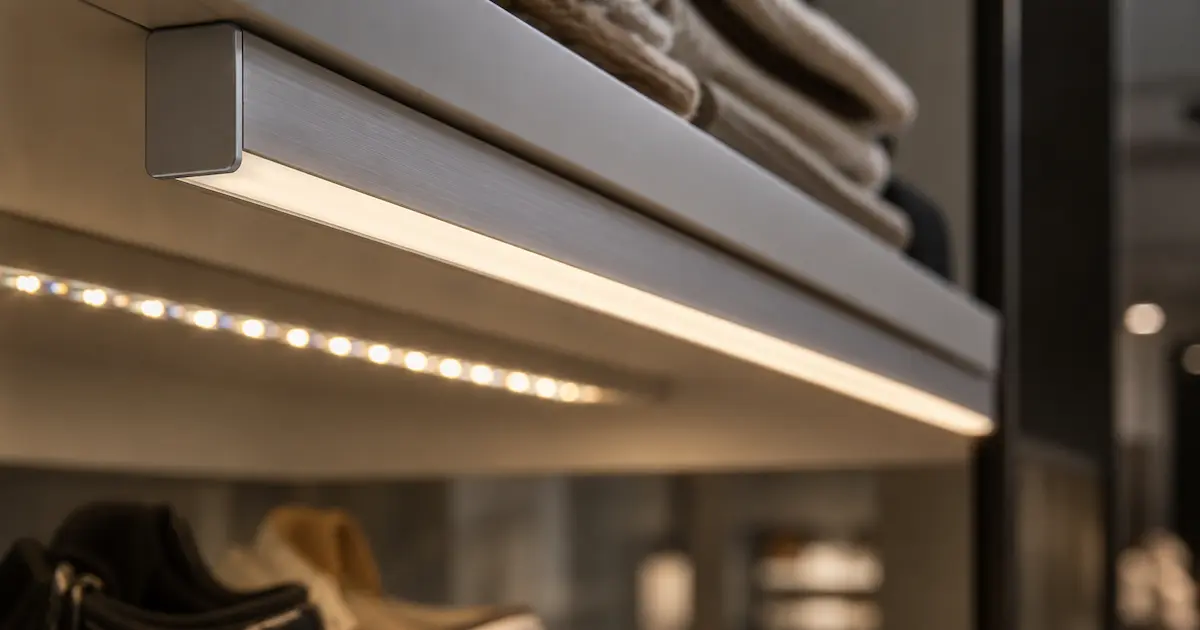
Common Myth: Higher wattage always means better brightness; for a neutral background, ENERGY STAR’s learn about LED lighting guide explains why LED performance also depends on heat control and product design. Reality: brightness depends on lumen efficiency, diffuser loss, thermal control, LED density, and geometry. A well-cooled 12W/m strip in a profile can look better and last longer than a poorly cooled 18W/m strip stuck to wood. For a practical visual explanation of common LED strip installation mistakes, this video shows why channels, diffusers, voltage planning, and heat control matter in real projects.
| Diffuser Type | Dot Visibility | Light Loss | Glare Control | Recommended Use |
|---|---|---|---|---|
| Clear | High | Low | Low | Hidden cove, maximum output |
| Frosted | Medium | Medium | Medium | Cabinets, retail shelves |
| Opal | Low | Higher | High | Visible linear lighting |
| Black diffuser | Low when off | Medium high | Medium | Dark ceilings, decorative lines |
4. How do profiles protect LED strips from damage?
Profiles protect strips from mechanical stress, dust, cleaning, and accidental contact. Bare strips expose solder pads and LEDs on a flexible PCB, making them vulnerable to pressure, abrasion, and vibration.
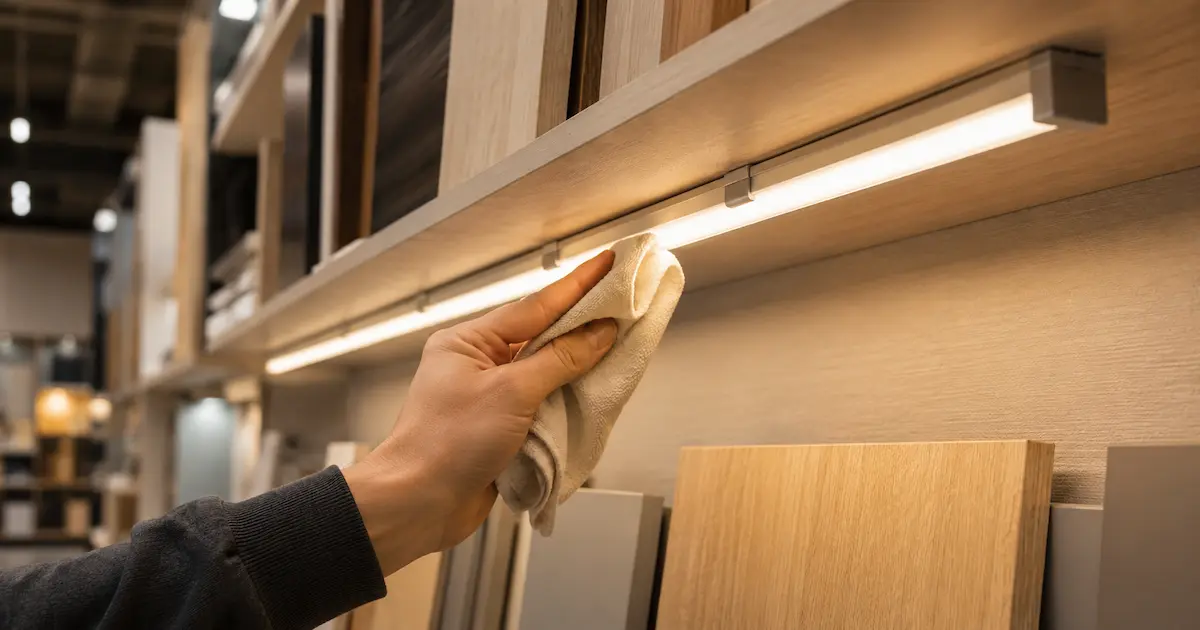
Profiles add a housing and diffuser that block fingers, cloths, and small objects. End caps protect cut ends and solder points. Mounting clips allow predictable removal for service rather than ripping tape from a surface.
High-risk areas benefiting from protection:
- Furniture production (transport and assembly)
- Retail displays (daily handling)
- Food service counters (cleaning chemicals and moisture)
| Risk Factor | Bare LED Strip | LED Strip in Profile | Business Impact |
|---|---|---|---|
| Finger contact | Components exposed | Diffuser blocks contact | Fewer intermittent faults |
| Cleaning cloth | Can catch LEDs | Smooth cover surface | Lower maintenance risk |
| Transport vibration | Solder pads stressed | Channel supports strip | Fewer warranty claims |
| Dust buildup | Direct on LEDs | Mostly on diffuser | Easier cleaning |
5. What role do profiles play in installation speed and accuracy?
Profiles make installation faster and repeatable by providing a fixed mechanical reference, especially when installers follow a proper how to install aluminium channel for LED strip lighting process. Instead of relying on precise hand placement, installers mount clips, screw the channel, insert the strip, connect wiring, and close the diffuser in sequence.Pre-cut profiles, pre-soldered strips, labeled leads, and matched diffusers significantly cut site labor. The profile becomes a process control tool, improving consistency across many rooms or fixtures.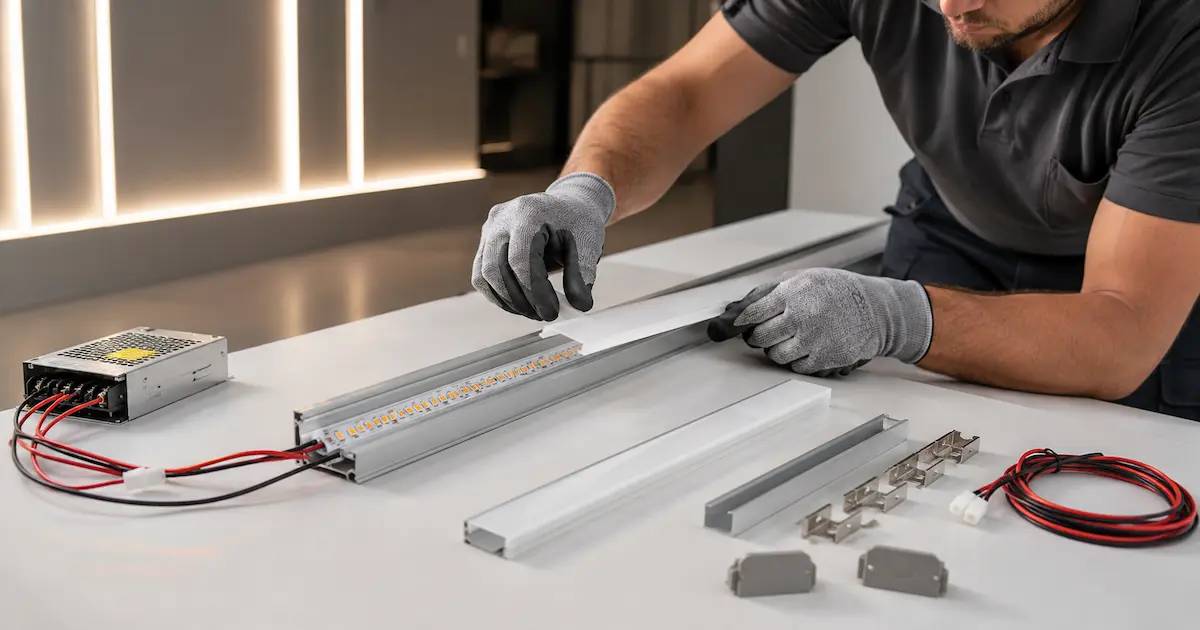
| Step | Action | Why It Matters | Check Point |
|---|---|---|---|
| 1 | Confirm profile length | Avoid site cutting errors | Match drawing code |
| 2 | Clean aluminium base | Better thermal contact | No dust or oil |
| 3 | Apply strip evenly | Straight light line | No waves or bubbles |
| 4 | Test before diffuser | Catch polarity or solder issues | Full strip lights up |
| 5 | Fit diffuser and caps | Protect strip | No gaps at ends |
| 6 | Run burn-in test | Find early faults | Stable output after warm-up |
6. Which aluminium profile types fit different projects?
Choose a shape based on mounting location, viewing angle, heat load, diffuser style, and access.
| Profile Type | Mounting Style | Strength | Typical Use | Notes |
|---|---|---|---|---|
| Surface profile | Screws or clips | Medium | Shelves, cabinets | Fast retrofit option |
| Recessed profile | Slot or routed groove | High visual quality | Furniture, walls | Needs accurate cutting |
| Corner profile | 45� angle | Medium | Under cabinet, display | Better beam direction |
| Pendant profile | Suspended | High | Office, retail | Can act like linear fixture |
| Flexible profile | Curved mounting | Medium | Signs, curved furniture | Check bend radius |
Select profiles early in design to avoid costly changes.
7. How do voltage and strip selection affect profile performance?
Voltage affects wiring and voltage drop but not heat-sinking directly. 24V reduces current and voltage drop for longer runs; 12V suits short sections. Profile choice should reflect wattage per meter and operating hours.
| Feature | 12V LED Strip | 24V LED Strip | Practical Note |
|---|---|---|---|
| Current at same wattage | Higher | Lower | 24V helps long runs |
| Cut length | Shorter sections | Longer sections | 12V suits small modules |
| Voltage drop risk | Higher | Lower | Feed from both ends if needed |
| Typical use | Small cabinets, signs | Long coves, shelves | Match layout and feed plan |
8. When is an aluminium profile not needed?
Profiles can be unnecessary for low-power, hidden, short, or temporary installs where the substrate provides good heat transfer and there is little contact or cleaning.
Skip profiles only when all apply:
- Power under ~4.8 7.2W/m
- Strip hidden from view
- Surface is clean, flat, and thermally friendly
- Runtime is limited
- No physical contact risk
If conditions change, add a profile to avoid rework.
9. What should buyers check before specifying profiles?
Verify dimensions, material grade, diffuser fit, finish, accessory quality, and packing. Common site problems stem from poor specification, and many of them come from common mistakes choosing LED strip channels, such as choosing a channel too narrow for PCB plus coating or using diffusers that crack during installation.
| Check Item | Target Question | Risk if Ignored |
|---|---|---|
| Internal width | Does the strip fit with coating and solder joints? | Strip lifting or poor contact |
| Profile depth | Can diffuser hide LED dots? | Visible spotting |
| Aluminium thickness | Is heat load supported? | Shorter LED life |
| Diffuser lock | Is the cover secure after vibration? | Site complaints |
| End cap design | Is cable routing clean? | Slow installation |
| Packing | Are long profiles protected? | Scratches and bending |
Request sample assemblies with the actual strip installed for sign-off.
10. How do profiles affect safety, compliance, and maintenance?
Profiles improve cable routing and protect low-voltage conductors. However, the full assembly must meet certifications and local rules, including CE, the RoHS Directive, and UL requirements. For damp or outdoor projects, the IP code, sealing method, and corrosion resistance are key. Profiles alone do not guarantee waterproof systems.
| Environment | Suggested Strip | Profile Requirement | Maintenance Note |
|---|---|---|---|
| Dry indoor | IP20 | Standard diffuser | Clean dust from cover |
| Kitchen/humid | IP54 IP65 | Sealed exits | Avoid harsh chemicals |
| Covered outdoor | IP65 | Corrosion-resistant finish | Plan drainage |
| Exposed outdoor | IP67 system | Sealed assembly | Test after rain |
| Food display | Coated strip | Smooth cover | Check cleaning agents |
11. How can you avoid common profile installation failures?
Failures often stem from heat, weak adhesion, wrong driver sizing, voltage drop, poor soldering, or mismatched accessories. Prevent them by testing and checking before bulk installation: measure voltage under load, run a heat test, inspect solder joints, and verify diffuser fit.
| Symptom | Likely Cause | Quick Test | Practical Fix |
|---|---|---|---|
| Far end dim | Voltage drop | Measure voltage at ends | Use 24V or dual feed |
| Strip peels | Dust or heat | Inspect adhesive | Clean base, use thermal tape |
| Early LED failure | Excess heat | Thermal imaging | Use larger profile or lower wattage |
| Visible dots | Low density or shallow profile | Visual on final distance | Use COB or deeper profile |
| Flicker | Driver mismatch | Swap test driver | Match dimming protocol |
| Diffuser falls | Poor fit | Pull test | Change diffuser/profile pair |
A short pre-installation test can prevent costly returns.
Conclusion
Aluminium profiles are a practical necessity when LED strips must perform reliably and look professional. They manage heat, improve durability, shape light, protect wiring, and speed installation. Treat the strip, profile, diffuser, driver, and wiring as a unified system: specify early, test a physical sample, and design for service access. Doing so reduces field failures, saves labor, and protects project margins.
FAQ
Q1: What is an aluminium profile for LED strip lights?
An aluminium profile is a channel that holds LED strip lights and typically includes a diffuser, end caps, and clips. It improves heat dissipation, protects the strip, and creates a cleaner line of light.
Q2: Do all LED strips need aluminium profiles?
Not all. Low-power, hidden strips can work without profiles in short-term or low-risk installs. For visible, high-power, long-run, or commercial jobs, profiles are strongly recommended.
Q3: Will an aluminium profile make LED strips brighter?
No. Diffusers usually reduce measured lumens. However, better cooling helps the strip maintain output over time and improves perceived uniformity.
Q4: Can aluminium profiles make LED strips waterproof?
No. Waterproofing requires IP-rated strips, sealed connections, correct end caps, and assembly methods. Profiles are part of a system but do not alone make a strip waterproof.
Q5: How do I choose the right aluminium profile size?
Match strip PCB width (including coating and solder joints), wattage per meter, LED density, diffuser type, mounting method, and service access. For high-power strips, select wider/heavier profiles and run thermal tests before bulk orders.
