
1. Why do lounge lighting projects fail even with good-looking LED strips?
Lounge spaces usually need calm, indirect light. The failure often starts when the strip is chosen only from a photo or a low unit price. A luxury hotel lobby may need continuous cove lighting across 18 meters. A restaurant lounge may need warm light behind timber panels. A corporate reception area may need clean linear light without dots. Each case has different heat, reflection, dimming, and access conditions.
We often see installers struggle with three problems: weak planning for voltage drop, poor diffuser selection, and no batch control for color temperature. One field example involved a lounge bar where the designer specified 3000K, but two shipment batches looked different after installation. The contractor had to replace a full wall run at night.
Here’s the deal: lounge lighting is judged by comfort, not just brightness. Before comparing strip types and technical specifications, this neutral interior-lighting overview shows how layering, placement, color temperature, and glare control work together to create a comfortable lounge atmosphere.
| Lounge Zone | Typical Goal | Suggested Strip Type | Risk if Wrong |
|---|---|---|---|
| Ceiling cove | Soft ambient glow | 24V high-efficiency strip | Dark ends, hot spots |
| Back bar shelves | Product accent | High CRI strip, short pitch | Poor bottle color rendering |
| TV wall | Low glare background | Low-output warm strip | Eye strain if too bright |
| Seating niches | Premium mood | COB or dense SMD | Visible dots on reflective surfaces |
| Reception counter | Clean linear detail | Profile with diffuser | Uneven line and shadow gaps |
2. Which LED strip type suits a lounge area best?
The best strip depends on the visual effect. Understanding what a COB LED strip is helps explain why it produces a smoother light line with fewer visible dots in premium lounge installations. Dense SMD strips also work well when used inside a deep aluminum profile with a milky diffuser. For hidden cove lighting, a 2835 or 3528 high-efficiency strip can be more cost-friendly and easier to cool.

In our lab tests using integrating spheres, we compare lumen output, CCT drift, and color rendering across sample reels. A strip may look bright on a desk, but after 500 hours on an aging rack, low-grade phosphor or weak solder joints can show real weakness. That matters because lounge areas often run for long hours each evening.
Common project examples help. An experienced COB LED strip light manufacturer can supply smooth, flexible lighting for curved hotel VIP lounge panels where visible dots and unwanted reflections must be avoided. In an airport lounge, 24V SMD strip in aluminum profile gives easier replacement. In a furniture showroom lounge, high CRI strip makes fabric and wood look accurate.
| Strip Type | Best Use in Lounge | Main Benefit | Watch Point |
|---|---|---|---|
| COB strip | Visible linear features | Dot-free light line | Needs good thermal path |
| 2835 SMD | Cove and general ambient | High lumen per watt | Dotting if profile is shallow |
| 3528 SMD | Low-output mood light | Gentle brightness | Limited output for high ceilings |
| RGBW strip | Scene lighting | Color plus white channel | Requires proper controller |
| Tunable white | Day-to-night lounge scenes | Adjustable CCT | Driver and control cost rises |
3. What voltage and power level should you specify?
Voltage decides how stable a long lounge run will be. For short decorative runs, 12V can work. For most commercial lounge area installations, 24V is the safer default because current is lower for the same power. Lower current means less voltage drop, less cable heat, and better brightness consistency along the strip.
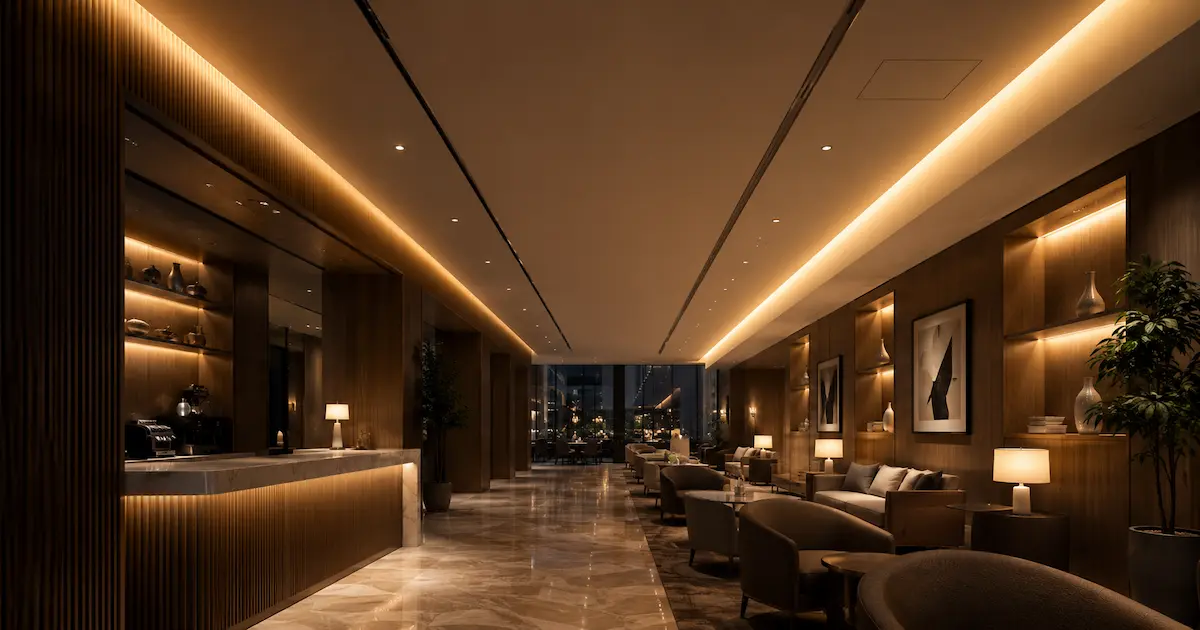
When we tested this against a standard 12V strip, a 10-meter run showed more visible end dimming than a similar 24V configuration. The result was clear in a dark lounge mock-up because the far end sat near a glossy wall. The client saw the difference before any meter reading was taken.
For power level, do not assume more watts always means better light. Common Myth: higher watts always give better brightness. Reality: lumen efficiency, diffuser loss, and heat control decide usable brightness.
| Option | Best Length Range | Current Load | Lounge Use | Practical Note |
|---|---|---|---|---|
| 12V strip | 1–5 m | Higher | Small furniture or niches | More feed points needed |
| 24V strip | 3–15 m | Medium | Cove, bar, reception | Balanced choice for many projects |
| 48V strip | 10–30 m | Lower | Long architectural runs | Check driver and local rules |
| Constant current strip | Long premium runs | Controlled | Large coves | Higher system cost |
4. How do CCT and CRI affect the lounge mood and client acceptance?
Understanding lighting color and spectrum helps explain how color temperature shapes comfort, atmosphere, material appearance, and the way people feel inside a lounge. Warm white around 2700K to 3000K gives a relaxed, premium mood. Neutral white around 3500K can suit office lounges and modern reception spaces. Cool white is rarely suitable unless the design calls for a crisp retail or tech brand feel.
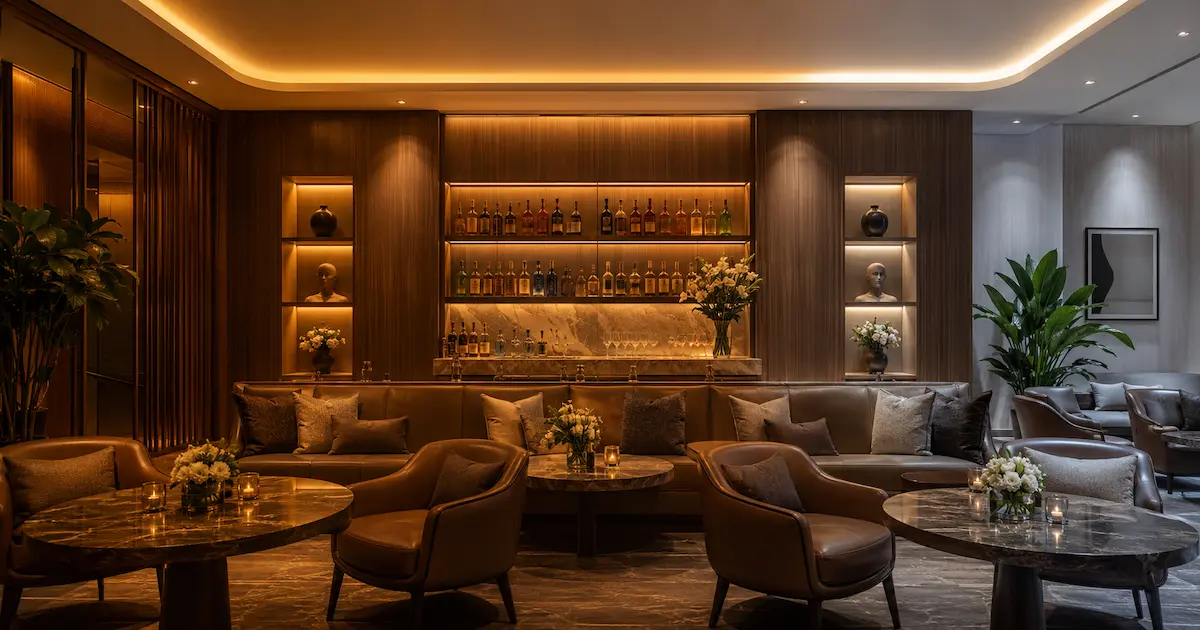
CRI affects how surfaces and skin tones appear. For hospitality lounges, CRI 90 or above is usually worth the cost. For larger jobs, 3-step MacAdam binning gives tighter color control than loose binning.
| CCT Range | Visual Feel | Suitable Lounge Scenario | Suggested CRI |
|---|---|---|---|
| 2400K | Candle-like warmth | Premium bar, spa lounge | 90+ |
| 2700K | Warm and relaxed | Hotel lounge, villa lounge | 90+ |
| 3000K | Warm but cleaner | Restaurant lounge, lobby seating | 90+ |
| 3500K | Balanced neutral | Office lounge, reception | 80+ or 90+ |
| 4000K | Bright modern | Airport or retail lounge | 80+ minimum |
5. Which aluminum profiles and diffusers give clean lines?
LED strip lights for lounge area projects need profiles, not just adhesive tape. The main reasons LED strips need aluminium profiles are to move heat away from the PCB, keep the strip straight, protect it from dust and touch, and support a cleaner diffused light line. They also decide whether the final look is premium or cheap.
Experienced aluminium LED profile manufacturers can help buyers select the correct profile depth, width, diffuser, and heat capacity for each lounge lighting application. A shallow profile with a low-density strip can show dots. A deeper profile with an opal diffuser blends light better, but it also reduces output.
| Profile Type | Use Case | Diffuser Choice | Benefit | Limitation |
|---|---|---|---|---|
| Surface profile | Under shelves, counters | Opal or frosted | Easy service | Visible hardware |
| Recessed profile | Wall slots, joinery | Opal | Clean built-in look | Needs accurate cutting |
| Corner profile | Back bar, cabinet angle | Frosted | Directs light neatly | Limited heat mass |
| Deep profile | Dot-free feature lines | Opal | Smooth output | Larger space needed |
| Flexible silicone sleeve | Curves and arcs | Milky silicone | Curved shapes | Heat control lower than aluminum |
Our Chief Engineer notes: “Heat dissipation is often ignored in decorative lounge lighting, yet it controls lumen maintenance, solder joint life, and color stability.”
6. How should dimming and controls be planned for a lounge area?
Dimming can make or break lounge comfort. A beautiful strip with a poor dimmer may flicker, buzz, or jump at low levels, so installers should understand how to fix LED strip lights flickering before completing a hotel, club, or commercial lounge project. For professional lounge areas, plan the dimming method before ordering the strip and driver.
Common control options include PWM, 0–10V, DMX, and DALI-2 systems and components for addressable lighting control in hotel, office, and commercial lounge projects. Test one full control chain before mass installation: strip, driver, dimmer, controller, cable length, and profile. A lounge mock-up saves much more money than late-stage replacement.
| Control Method | Best Lounge Use | Strength | Risk to Check |
|---|---|---|---|
| PWM dimming | Small to mid-size strip zones | Cost-friendly | Flicker frequency and camera effect |
| 0–10V | Commercial ambient zones | Simple wall control | Compatibility varies by driver |
| DALI | Hotel and office lounges | Addressable control | Commissioning skill needed |
| DMX | RGBW bars and clubs | Scene programming | More wiring planning |
| RF/Wi-Fi | Small private lounges | Easy retrofit | Signal and maintenance concerns |
7. What safety ratings and certifications matter for lounge installations?
The required Ingress Protection IP ratings depend on whether the LED strip is installed in a dry indoor lounge, beside a bar counter, inside a humid spa lounge, or in a covered outdoor seating area. A dry indoor lounge usually needs IP20 strip inside profiles. Near a bar counter, drink service zone, spa lounge, or humid area, IP65 or higher may be needed. For outdoor covered lounges, IP67 silicone extrusion or sealed neon flex can be suitable, but heat and sealing quality must be checked.
Professional lighting safety testing and certification is not just paperwork; it supports regulatory compliance, product approval, safer installation, and reduced liability for commercial lounge projects. CE, RoHS, UL, and CB relate to market access, material safety, and electrical compliance. Missing documents can delay approval or create liability after a failure.
| Rating / Document | Where It Matters | What It Proves | Business Risk if Missing |
|---|---|---|---|
| CE | Europe and related markets | Electrical conformity | Project approval delay |
| RoHS | Many regulated markets | Restricted substances control | Tender rejection |
| UL / ETL | US, Canada projects | Safety listing route | Liability concern |
| CB | Multi-country supply | Test basis for acceptance | Extra retesting cost |
| IP65/IP67 | Wet or humid zones | Dust and water resistance | Early failure near moisture |
8. How do you calculate voltage drop and driver capacity?
Voltage drop is one of the most common hidden causes of uneven lounge lighting. The longer the cable and strip run, the more voltage is lost before the end. The symptom is simple: the strip starts bright near the feed point and fades at the far end.
A correct LED profile driver calculation starts with strip power per meter, total installed length, operating voltage, feed position, and suitable driver headroom. Add headroom to driver sizing (10–25%). Use power injection for long runs. Feed from both ends or split the circuit into zones for even light.
| Calculation Item | Example Value | Why It Matters |
|---|---|---|
| Strip power | 12W/m | Sets driver size and heat load |
| Run length | 10 m | Affects voltage drop |
| Total load | 120W | Base driver requirement |
| Headroom | 20% | Reduces driver stress |
| Driver size | 150W | Practical selection for long life |
| Feed method | Both ends or split zones | Reduces end dimming |
9. How should installers mount and troubleshoot LED strips on site?
Good installation starts with surface preparation. Dust, oil, painted powder, and rough wood can weaken adhesive tape. For commercial lounge projects, use mechanical clips or profiles instead of trusting adhesive alone.
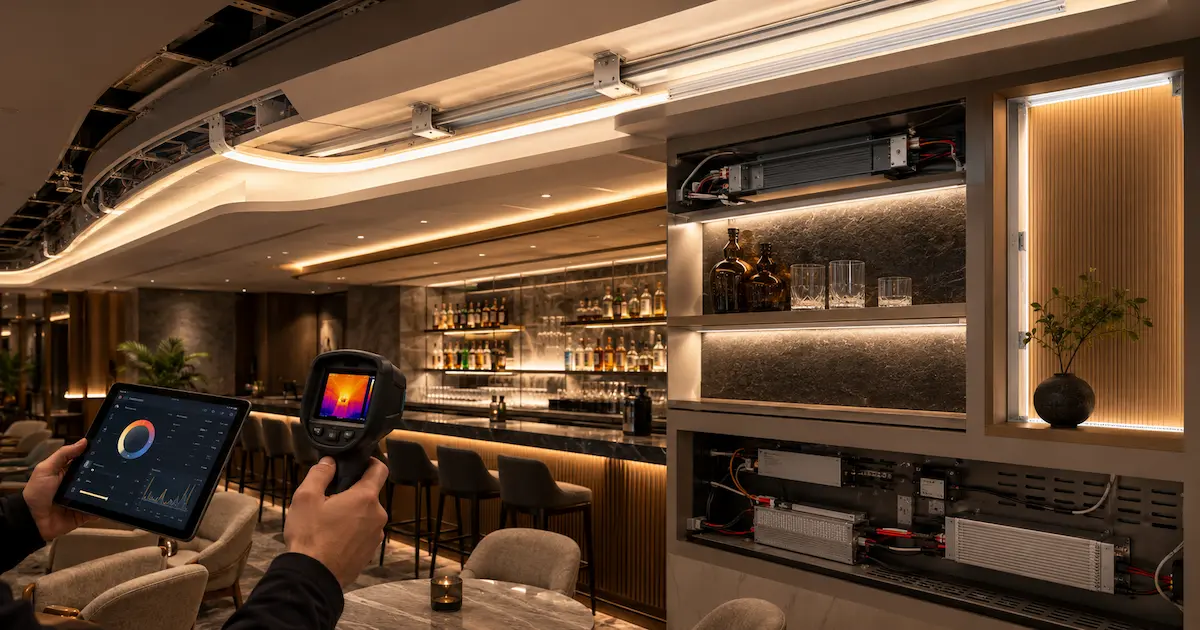
Before closing ceilings or panels, run a burn-in test. Check dimming range, color match, driver noise, and heat. Use a proper flicker meter for critical projects.
| Site Checklist / Fault | Quick Check | Likely Cause | Practical Fix |
|---|---|---|---|
| Strip falls from cove | Inspect adhesive surface | Dust or heat | Use profile or clips |
| Far end is dim | Measure voltage at end | Voltage drop | Feed both ends or split run |
| Visible dots | View through diffuser | Shallow profile | Use COB or deeper profile |
| Flicker at low dim | Test driver and dimmer | Compatibility issue | Change driver/control protocol |
| Color mismatch | Compare reels before install | Mixed bin batches | Request same bin for project |
| Hot profile | Use thermal camera | Excess power or poor airflow | Lower power or improve heat path |
10. How should you specify and order LED strip lights for lounge area projects?
A clear specification helps an LED strip light manufacturer control voltage, wattage, CCT, CRI, binning, IP rating, lead length, packaging, and other details that protect project margin. State voltage, watts per meter, CCT, CRI, LED density, binning, PCB width, IP rating, reel length, dimming method, profile type, lead length, connector style, label needs, and certification file requirements.
| Ordering Item | Recommended Detail |
|---|---|
| Voltage | 24V DC for most architectural runs |
| Wattage | Match lighting calculation, often 8–14W/m |
| CCT | 2700K, 3000K, or 3500K depending on mood |
| CRI | 90+ for hospitality lounges |
| Binning | 3-step MacAdam preferred |
| Profile | Aluminum, sized for wattage |
| Driver | Flicker-safe, dimmable, correct protocol |
| Packaging | Zone-labeled reels, matching leads |
Ask for sample approval before bulk production. Request production photos, test reports, aging status, and packing details. For repeat orders, keep the same bin and driver model where possible.
Conclusion
Specify the full system: strip type, voltage, CCT, CRI, profile, dimming, safety rating, driver capacity, and installation method. Early mock-ups, proper binning, and driver headroom reduce rework and protect margin. If you need help with voltage drop calculations or a mock-up review, send your drawings to our engineering team before ordering.
FAQ
Q1: What are the best LED strip lights for lounge area projects?
The best choice is usually 24V COB or high-density SMD strip, depending on the visual effect. Use COB for visible linear features and dense SMD inside aluminum profiles for coves. For premium hospitality spaces, specify 2700K to 3000K, CRI90+, stable binning, and a compatible dimming driver.
Q2: How does voltage affect LED strip lights in a lounge area?
Voltage affects current and voltage drop. A 24V strip usually performs better than 12V on longer runs because it carries lower current for the same power. This helps reduce end dimming, cable heating, and uneven brightness in long coves or wall features.
Q3: Should lounge LED strip lighting use aluminum profiles?
Yes, in most professional projects. Aluminum profiles improve heat transfer, keep the strip straight, protect it from dust and touch, and create a cleaner light line with the right diffuser. They also make service work easier than strips fixed only with adhesive tape.
Q4: What CCT is recommended for lounge lighting?
For relaxed lounge spaces, 2700K or 3000K is usually preferred. For office lounges or modern reception areas, 3500K can work well. Hospitality spaces with wood, leather, fabric, or stone finishes should usually use CRI90+ for better color appearance.
Q5: Why do LED strips flicker when dimmed?
Flicker usually comes from mismatched drivers, dimmers, controllers, or low PWM frequency. It can also appear when the driver is overloaded or wiring is poor. Test the complete control chain before mass installation, especially for hotels, bars, clubs, and camera-sensitive lounge spaces.
