
1. Is LED tape light channel lighting the right base for pop art?
Yes, in many cases. A properly selected LED tape light channel gives pop art designers a controlled way to frame shapes, letters, comic-style outlines, color blocks, and layered acrylic panels. The channel protects the LED strip, manages heat, and creates a more finished appearance than bare tape.
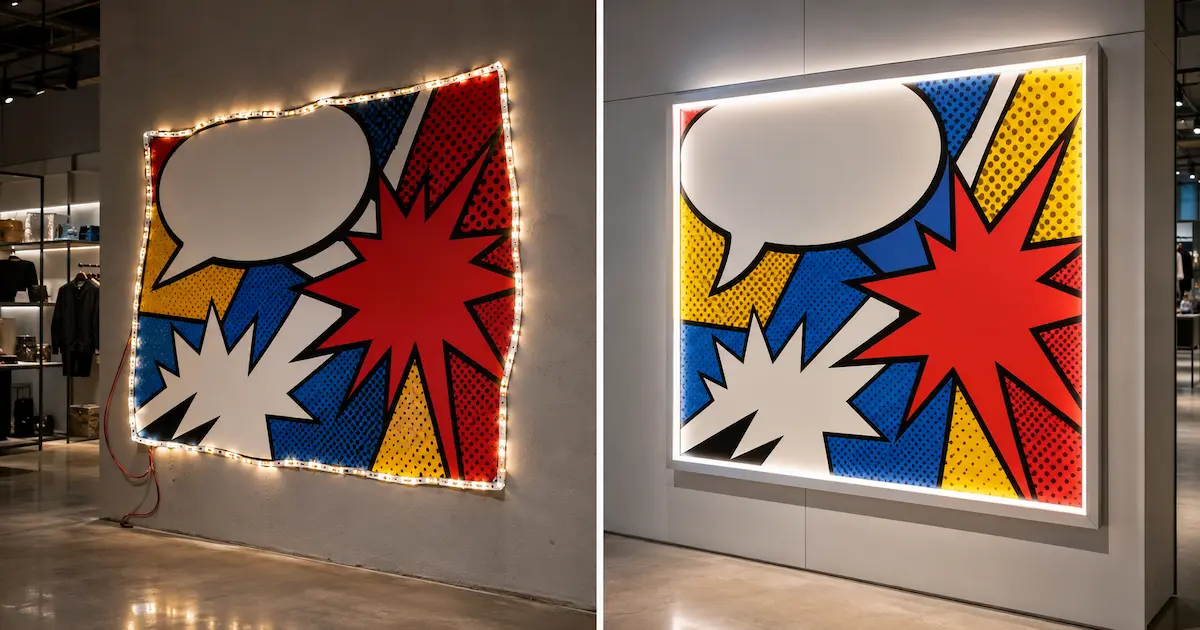
Here’s the deal: pop art draws heavily on the bold imagery, graphic forms, comic books, advertising, and popular culture that made the movement visually distinctive, so the lighting needs saturated color, sharp contrast, and repeatable brightness. Bare LED strip can work in mockups, but it often shows dots, adhesive failure, and uneven reflection after installation. A channel adds mechanical stability and makes the light behave like a purpose-built linear fixture.
Common field examples include:
- ● A retail sneaker wall using red, blue, and yellow linear borders around graphic panels
- ● A gallery mural with white backlighting around speech-bubble shapes
- ● A restaurant photo corner using RGBW tape inside black anodized channels
| Pop Art Requirement | Why Channel Lighting Helps | Risk Without Channel |
|---|---|---|
| Sharp graphic lines | Holds tape in a straight path | Wavy lines and uneven borders |
| Strong color blocks | Diffuser blends LED points | Visible dotting on close viewing |
| Long display hours | Aluminum pulls heat away | Faster lumen drop |
| Clean installation | Conceals solder joints and tape | Exposed wiring and weak finish |
For professional projects, the channel is not just a cosmetic accessory. It directly affects brightness, safety, and maintenance cost.
2. What makes pop art lighting different from standard accent lighting?
Pop art lighting has a different job than hotel cove lighting or office shelf lighting. It must support the artwork’s graphic language. That means bold color, high contrast, and tight placement accuracy. A 5 mm alignment error may look minor in a ceiling cove, but it can ruin a neon-style outline around a face, logo, or comic panel.
We often see installers struggle with three issues. The artwork is viewed at close range. The light runs have complex turns. The client expects the color to match a brand palette or art concept. These demands place more stress on LED tape light channel lighting than a basic decorative strip job.
In our lab tests using integrating spheres, we check lumen output and color data before recommending tape for projects that need uniform output. For pop art, CRI and the more recently developed colour fidelity index can help assess how accurately white light presents printed colors, while RGBW or addressable tape may be more important for animated pieces.
High LED density, such as 120 LEDs/m or COB tape, combined with LED tape light channels that provide seamless dot-free lighting, for smooth close-view effects
- ● Tight binning for white tones, usually 3-step or 5-step MacAdam
- ● High LED density, such as 120 LEDs/m or COB tape for dot-free effects
- ● 24V or 48V systems for longer runs with reduced voltage drop
- ● DMX, DALI, 0/1-10V, or SPI control depending on the installation
Pop art rewards precision. Poor lighting makes it look like temporary signage, not an art installation.
3. Which LED tape and channel specs matter most?
The best LED tape light channel lighting system starts with matching the tape and aluminum profile to the artwork, not the other way around. You need to check voltage, wattage, LED density, PCB width, diffuser type, channel depth, finish, and mounting method.
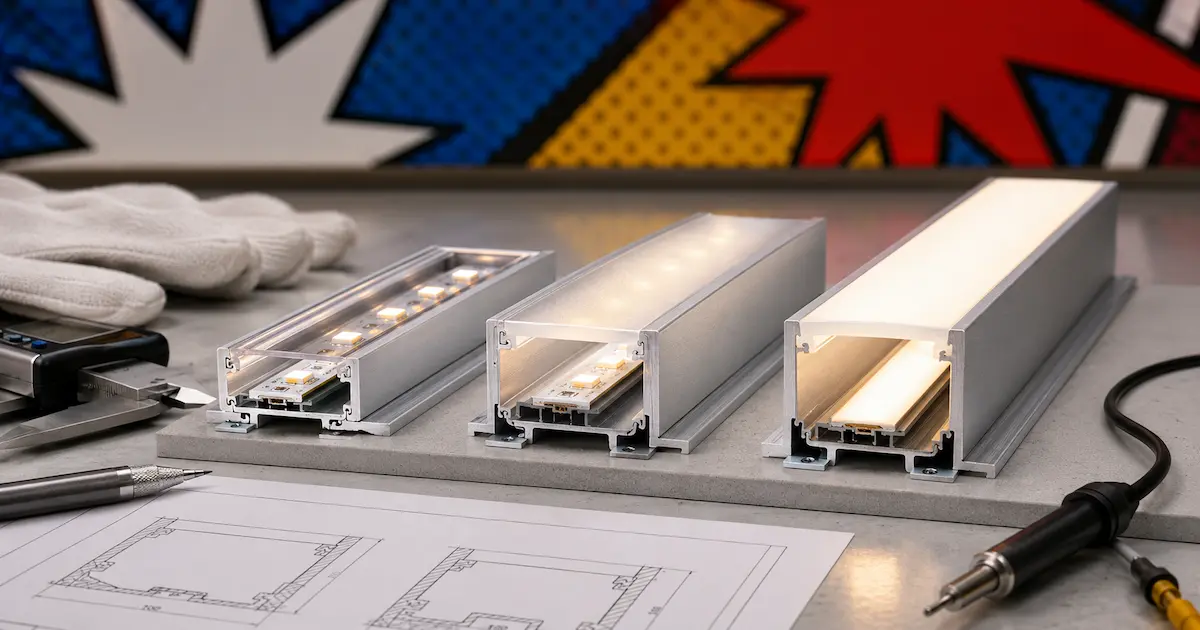
But there’s a catch. Higher wattage does not automatically mean better pop art lighting.
Common Myth: Higher wattage always means better brightness.
Reality: Brightness depends on lumen efficiency, diffuser loss, channel depth, heat control, and viewing distance. A 14.4 W/m strip in a deep frosted channel may look smoother and brighter than a 19.2 W/m strip trapped in a shallow profile with poor heat transfer.
When we tested this against a standard 12V strip, a 24V high-density strip showed better consistency on longer runs because voltage drop was lower. That matters when a comic-style outline runs around a large wall graphic.
| Specification | Recommended Range for Pop Art | Why It Matters |
|---|---|---|
| Voltage | 24V for most projects; 48V for long runs | Reduces voltage drop |
| LED density | 120 LEDs/m, 180 LEDs/m, or COB | Reduces visible dots |
| Wattage | 9.6–19.2 W/m for most indoor art | Balances brightness and heat |
| PCB width | 8 mm, 10 mm, 12 mm, or custom | Must fit the channel |
| Channel material | Aluminum 6063 or close grade | Supports heat transfer |
| Diffuser | Frosted, opal, or milky PC | Smooths light output |
Pro Tip from the VST Technical Team: “Treat the channel, diffuser, and strip as one thermal system. If you choose a high-output strip, select one of the channels that offer the best cooling for high-power LED tapes, with enough aluminum mass to carry heat away.”
4. How do voltage and power design affect pop art reliability?
Voltage design can make or break LED tape light channel lighting. Pop art installations often use long outlines, repeated shapes, and large frames. If the system uses the wrong voltage or power feed method, the beginning of the run may look bright while the end looks dull or color-shifted.
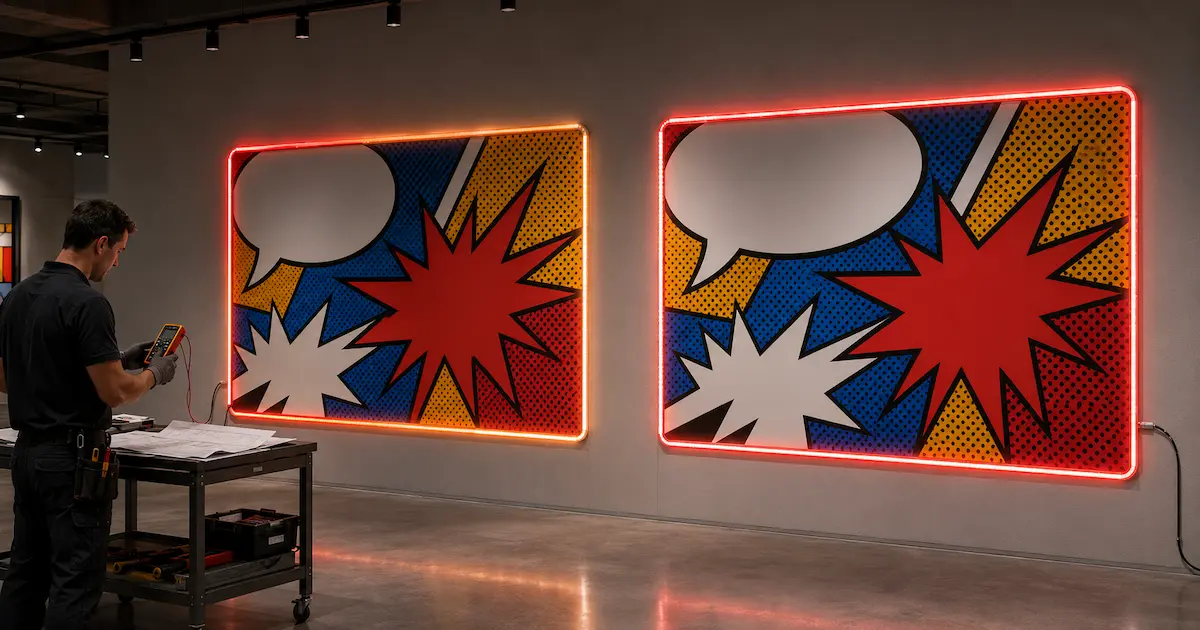
For short pieces under 3 meters, 12V can work. For most wall-scale pop art, 24V is safer and more efficient. For very long lines, 48V may reduce cable size and voltage drop, but it requires compatible tape and drivers.
Field example: we once saw a large retail mural use a single-ended 12V feed across a long red outline. The far end turned orange because red channels are sensitive to voltage loss. The installer had to reopen the channel, add extra feed points, and repaint parts of the wall. That type of rework kills profit.
| System Type | Best Use Case | Main Benefit | Watch Point |
|---|---|---|---|
| 12V vs 24V | 12V for small art; 24V for medium runs | 24V reduces current | 12V drops faster |
| 24V vs 48V | 48V for long architectural graphics | Longer runs possible | Driver and strip compatibility |
| Single feed vs dual feed | Dual feed for long loops | Better end brightness | More wiring planning |
| Constant voltage vs pixel control | CV for static color; SPI for animation | Proper control choice | Wrong driver causes flicker |
A good power plan protects your reputation. It also reduces service calls after opening night.
5. Which diffuser and profile style gives the best visual result?
The LED channel diffuser controls how the viewer sees the light by balancing brightness, LED-point concealment, and line smoothness. In pop art, this is a design decision and a technical decision at the same time. A clear cover gives maximum brightness but shows LED points. A frosted or opal diffuser reduces dotting but cuts output. A deeper profile improves blending but needs more space.
The best profile may not be the brightest. For close-viewed pop art, smoothness often matters more than raw lux. If the visitor can stand 30 cm from the piece, visible dots can cheapen the installation.
Profile styles to compare:
- ● Surface-mounted channels for outlines on panels or walls
- ● Recessed channels for clean flush graphics
- ● Corner channels for display boxes and angled accents
- ● A bendable LED profile for curves, comic outlines, and speech-bubble shapes
- ● Black, white, silver, or custom finishes to match the art frame
| Diffuser Type | Visual Effect | Light Loss Range | Best Application |
|---|---|---|---|
| Clear PC | Bright, visible LED points | 5–10% | Hidden indirect lighting |
| Frosted PC | Soft with some dot control | 15–25% | Medium viewing distance |
| Opal PC | Smooth line effect | 25–40% | Close-view pop art outlines |
| Silicone neon cover | Continuous glow | 30–50% | Curves and neon-style art |
From our manufacturing floor perspective, diffuser fit tolerance is often ignored. A loose cover can rattle or fall out during transport. A tight cover may crack during installation. Both create project delays.
6. Should you use white, RGB, RGBW, or pixel tape?
Color choice depends on the artwork’s purpose. Static pop art often looks best with high-quality white or single-color tape. Interactive and event-based installations may need RGBW or addressable pixel tape. The wrong choice can create a piece that is hard to control, hard to maintain, or visually inconsistent.

White tape works well when lighting printed art, acrylic panels, or product displays. Choose CRI 90+ if the art contains skin tones, reds, or branded colors. RGB tape creates saturated color, but it cannot make clean white. An RGBW COB LED strip adds a dedicated white channel while providing smoother continuous illumination, making it suitable for galleries, museums, premium retail spaces, and close-view pop-art outlines.
Addressable tape gives pixel-level animation and makes it possible to create custom effects with aluminum channel LED lighting, although these installations add more control and wiring complexity. You need data wiring, controllers, programming, and signal planning. For permanent installations, this must be documented clearly.
| Tape Type | Best For | Strength | Limitation |
|---|---|---|---|
| Single-color | Fixed graphic outlines | Simple and reliable | No color change |
| Tunable white | Gallery and art lighting | Adjustable CCT | Needs compatible control |
| RGB | Bold color effects | Strong saturation | Weak white tone |
| RGBW | Retail and gallery features | Color plus clean white | More channels to wire |
| SPI pixel tape | Animated pop art | Pixel effects | Higher design complexity |
If your client wants both daily operation and event modes, RGBW is often the safer middle path.
7. How do heat, adhesive, and mounting affect service life?
LED tape is small, but heat is never a small concern in a long commercial installation; understanding the underlying LED basics helps explain why thermal design, electrical efficiency, and operating conditions must be considered together. Heat affects lumen maintenance, color shift, adhesive strength, driver stress, and diffuser yellowing. LED tape light channel lighting helps because aluminum acts as a heat sink, but only if the tape contacts the profile correctly.
We often see installers struggle with dusty surfaces, painted MDF, rough concrete, and tight corners. Tape adhesive alone should not carry the whole installation for years. In a gallery or shopping mall, mechanical clips or screws should hold the channel. The tape then only needs to stay bonded inside the aluminum profile.
Three real-world problem cases:
- ● A café art wall ran 16 hours per day with high-wattage tape in a shallow plastic track; the diffuser yellowed within months
- ● A museum display used tape on raw wood; seasonal moisture caused lifting
- ● A retail logo used no expansion gap; the diffuser bowed after heat cycling
| Failure Mode | Likely Cause | Prevention Method |
|---|---|---|
| Tape lifting | Dust, heat, weak substrate | Clean channel with alcohol; press evenly |
| Color shift | Overheating or poor binning | Use aluminum profile and tested LED bins |
| Dark sections | Bad solder joint or overcurrent | Factory soldering and strain relief |
| Yellow diffuser | High heat or low-grade plastic | Use UV-stable PC or silicone cover |
| Flicker | Driver mismatch or overload | Use headroom and proper dimming protocol |
Safety and lifespan are linked. A cooler system lasts longer and protects the installation budget.
8. What controls and dimming systems are best for pop art venues?
Control should match the venue. A small retail wall may only need a wall dimmer or RF controller. A museum, event venue, or hotel lobby may need DMX512, 0/1-10V, smart scene control, or standardized DALI lighting control for scalable digital configuration, dimming, and management of multiple lighting zones. If the control method is chosen late, the wiring may already be wrong.
Many lighting callbacks are not complete LED failures; they are control, driver, or wiring mismatches that require a structured approach to fix LED strip lights flickering. A PWM dimmer with the wrong frequency can create camera flicker. A low-cost controller may reset after power loss. A weak signal line can cause random color changes on pixel tape.
For pop art used in photo zones, ask about cameras. Phone cameras and video equipment can reveal flicker that the eye does not see. Higher PWM frequency and proper drivers reduce that risk.
| Control Method | Typical Use | Benefit | Risk If Misused |
|---|---|---|---|
| RF remote | Small displays | Low cost and simple | Poor for multi-zone sites |
| 0/1-10V | Dimming white tape | Stable for fixed lighting | Limited color control |
| DALI | Galleries and premium interiors | Addressable zones | Needs commissioning |
| DMX512 | Color-changing installations | Strong scene control | Needs correct wiring topology |
| SPI | Pixel animation | Individual LED effects | Data planning is required |
Specify controller location, cable type, power injection, and backup settings before installation. That paperwork saves time on site.
9. How should contractors specify LED tape light channel lighting?
A clear specification reduces disputes. Instead of writing “LED strip in aluminum channel,” write the values that affect performance. This helps procurement, installation, and final acceptance.
A useful project specification should include voltage, wattage per meter, LED type, color temperature or RGBW data, CRI, IP rating, channel model, diffuser type, control protocol, driver capacity, run length, feed points, and mounting surface. It should also define acceptable color tolerance and sample approval.
Here’s a practical example. For a pop art wall in a shopping center, you might specify: 24V RGBW LED tape, 14.4 W/m, 10 mm PCB, opal diffuser, surface aluminum channel, DMX control, 20% driver headroom, dual-end feed above 8 meters, and shop drawings showing cable routes.
| Specification Item | Recommended Detail | Why It Protects the Project |
|---|---|---|
| LED tape model | Voltage, wattage, LED density, PCB width | Prevents wrong substitutions |
| Color data | CCT, CRI, RGBW channel data, binning | Reduces color mismatch |
| Channel | Depth, width, finish, diffuser | Confirms visual result |
| Driver | Output voltage, wattage, dimming type | Prevents flicker and overload |
| Layout | Run length, feed points, cable route | Controls voltage drop |
| Testing | Sample approval and burn-in | Catches problems early |
From our lab tests using integrating spheres and aging racks, we find that written specs reduce batch surprises more than verbal approval ever can.
10. When is LED tape light channel lighting not the best choice?
LED tape light channel lighting is strong, but it is not the answer for every pop art installation. Some projects need rigid LED bars, flexible neon, edge-lit panels, mini spotlights, or backlit fabric systems. The right choice depends on shape, viewing distance, brightness, service access, and budget.
Use another solution when the art requires extremely tight curves smaller than the channel bend radius. Silicone neon flex may be better. Use rigid bars when the installation needs long straight lines with factory-sealed connectors. Use edge-lit acrylic when the artwork needs a glowing panel rather than a line.
Outdoor pop art also needs extra care. IP65 tape may resist splashes, but it is not the same as IP67 or IP68 protection. UV exposure, drainage, condensation, and connector sealing matter. A channel without drainage can trap water and damage the tape.
| Alternative System | Better Use Case | Why It May Win |
|---|---|---|
| Silicone neon flex | Curved outlines and faux neon | Smooth, flexible glow |
| Rigid LED bar | Long straight commercial graphics | Factory alignment and stronger body |
| Edge-lit acrylic | Glowing panels and signs | Even sheet effect |
| Mini spotlights | Highlighting 3D art | Directional control |
| Backlit fabric | Large graphic walls | Broad uniform surface |
The real answer is not “tape versus everything.” It is system matching. Choose the light source that supports the artwork and lowers service risk.
Conclusion
LED tape light channel lighting is often the best choice for pop art when tape, channel, diffuser, driver, voltage, and control are specified together. Treat the channel as an integral part of the lighting system and test a sample before full installation. If you’re unsure about voltage drop, diffuser loss, or wiring, share drawings with our engineering team for review.
FAQ
Q1: Is LED tape light channel lighting good for museum pop art displays?
Yes. It works well when the channel hides the strip, manages heat, and gives a clean visual line. For museums, use high CRI white tape for printed art or RGBW for scene changes. Confirm flicker control if visitors will take photos or videos.
Q2: What voltage is best for pop art LED tape channels?
24V is the most common choice for medium installations because it reduces current and voltage drop compared with 12V. For very long outlines, 48V can work if the driver, tape, and safety plan are suitable.
Q3: Can LED tape light channels create a neon-like effect?
Yes, but the result depends on LED density, channel depth, and diffuser type. COB tape or high-density tape with an opal diffuser gives a smoother line. For tight curves, silicone neon flex may look better.
Q4: How do I avoid visible LED dots in pop art installations?
Use high-density or COB tape, deeper aluminum profiles, and opal diffusers. Also check viewing distance. A setup that looks smooth from 2 meters may still show dots from 30 cm.
Q5: What causes failures in LED tape light channel lighting?
Common causes include voltage drop, overheating, poor soldering, driver overload, weak adhesive, wrong dimming protocol, and low-grade diffusers. A good specification and pre-installation sample test reduce these risks.
