
Flexible LED profiles for circular ceiling lighting should bend smoothly, hold LED strips securely, manage heat, and deliver even light without dark spots. The best choices are bendable aluminum channels, silicone neon profiles, and segmented curved profiles, selected by ceiling radius, strip width, wattage, diffuser style, and mounting method.
That question usually appears after a project drawing shows a perfect circle, but the standard straight channel cannot follow the curve. If the wrong profile is used, installers may fight spring-back, visible joints, hot LED strips, light gaps, and client callbacks. That hurts margin and delays handover.
The solution begins with understanding what flexible LED profiles are and how they transform lighting design, then matching the profile to the radius and installation condition before sampling. In our lab tests using integrating spheres and thermal imaging cameras, we check light output, color rendering of light sources, color consistency, and heat behavior because ceiling rings are often viewed from below at close range.
1. Which flexible LED profile types work best for circular ceilings?
The best profile depends on how clean the circle must look and how tight the curve is. For premium indoor ceiling rings, a bendable flexible LED profile with an opal diffuser is usually the best fit. For decorative continuous lines, silicone neon flex profiles create a soft, dot-free effect and handle tighter curves more easily.

From our manufacturing floor perspective, we usually group circular ceiling profiles into three practical families:
● Bendable aluminum LED channels for recessed or surface-mounted rings
● Silicone neon LED profiles for seamless luminous circles
● Segmented rigid aluminum profiles for large-diameter rings with factory-cut arcs
| Flexible LED Profile Type | Best Use Case | Typical Advantage | Main Limitation |
|---|---|---|---|
| Bendable aluminum profile | Architectural ceiling rings | Better heat control and clean finish | Needs correct bending radius |
| Silicone neon profile | Dot-free decorative circles | Smooth continuous light | Lower heat dissipation than aluminum |
| Segmented curved aluminum profile | Large commercial ceiling circles | Accurate geometry and strong structure | Requires precise drawing and cutting |
| Flexible PCB strip without profile | Hidden cove lighting only | Low material cost | Poor protection and weaker heat control |
For visible circular ceiling lighting, bare strips are rarely appropriate; exposed rings need mechanical protection, diffusion, and thermal support. The following video provides a useful visual overview of how LED strips, channels, diffusers, and placement decisions work together to create clean architectural lighting.
2. How does bending radius affect profile selection?
Bending radius is the point where many circular ceiling lighting projects succeed or fail. If the radius is too tight for the profile, the channel may twist, the diffuser may pop out, or the LED strip may detach.
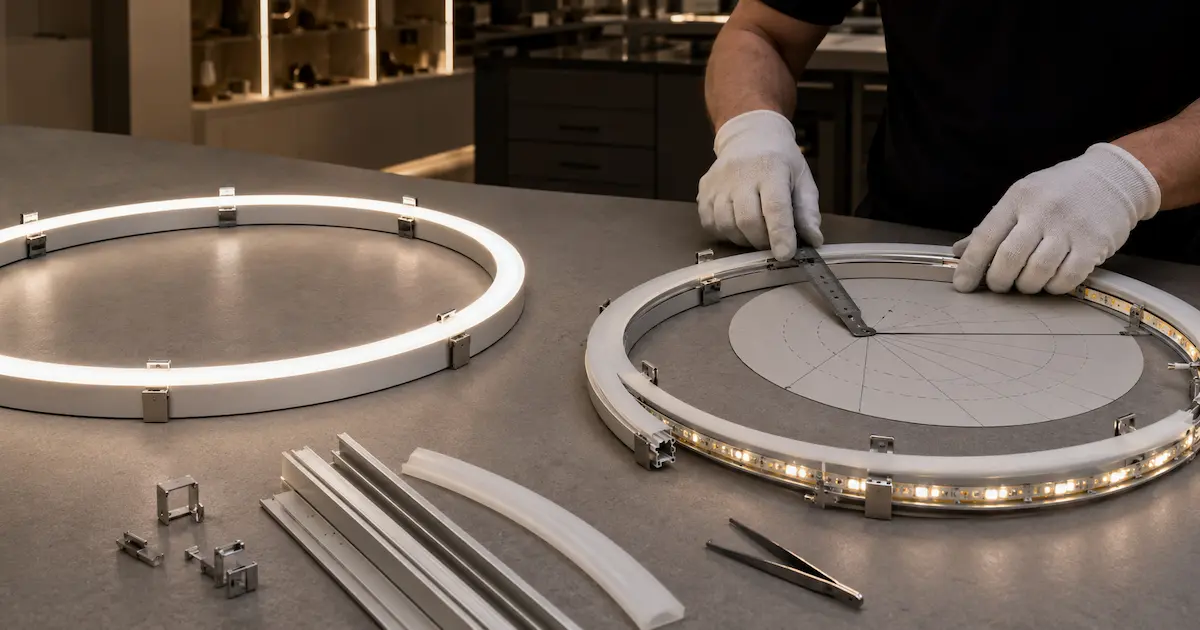
Use the inner radius of the circle, not just the outer diameter. Also check whether the profile bends horizontally or vertically. Some profiles are designed for side bending, while others are made for top bending, so installers should first confirm whether LED tape light channels are easy to install on curved ceilings for the required bending direction and radius.
| Ceiling Ring Diameter | Approx. Radius | Suitable Profile Choice | Notes for Installers |
|---|---|---|---|
| 300–600 mm | 150–300 mm | Silicone neon flex | Best for tight decorative rings |
| 600–1,200 mm | 300–600 mm | Small bendable aluminum or neon | Test diffuser fit before bulk order |
| 1,200–3,000 mm | 600–1,500 mm | Bendable aluminum profile | Good balance of heat and shape control |
| Above 3,000 mm | 1,500 mm+ | Segmented aluminum arcs | Better for large commercial ceilings |
A sample bend test before production can save a shipment from rejection. Radius data should appear in the quotation stage.
3. Should you use aluminum bendable channels or silicone neon profiles?
Aluminum and silicone both have a place. Aluminum moves heat away from the LED strip faster, while silicone is easier to bend and gives very uniform light, especially when using flexible LED profiles compatible with high-density COB LEDs.
Silicone profiles can trap heat if high-wattage strips are used for long hours. Aluminum reduces that risk by acting as a heat sink.
| Comparison Item | Bendable Aluminum LED Profile | Silicone Neon LED Profile |
|---|---|---|
| Heat dissipation | Better | Moderate |
| Dot-free appearance | Good with dense strip and opal cover | Very good |
| Tight radius bending | Moderate | Better |
| Mechanical strength | Strong | Flexible but softer |
| Maintenance access | Easier with removable diffuser | Depends on design |
For offices, hotels, malls and public spaces, aluminum is often the safer base; for artistic rings or soft halo effects, silicone works well if wattage is controlled.
4. Which LED strip voltage is better inside circular profiles?
Voltage affects brightness consistency around the circle. For small rings, 12V strips can work. For medium and large rings, 24V is usually better because voltage drop is lower over longer runs.
Calculate ring circumference before selecting voltage. For example, a 2 m diameter circle has about 6.28 m of strip; at 14.4 W/m this requires correct driver sizing and power injection. Feeding from one point may not be enough.
| Item | 12V LED Strip | 24V LED Strip |
|---|---|---|
| Best ring size | Small circles | Medium to large circles |
| Voltage drop | Higher | Lower |
| Cutting interval | Shorter | Longer |
| Driver current | Higher current | Lower current |
| Suggested use | 0.5–2 m circumference | 2 m+ circumference |
Pro Tip: For rings above 3 m circumference, use 24V with two-end feeding or balanced power injection.
5. How do diffuser choices affect the final ceiling ring appearance?
The diffuser controls glare, dot visibility, and line softness. Opal diffusers are common because they hide LED points. Clear covers give higher lumen output but can reveal dots, usually unacceptable for visible ceiling rings.
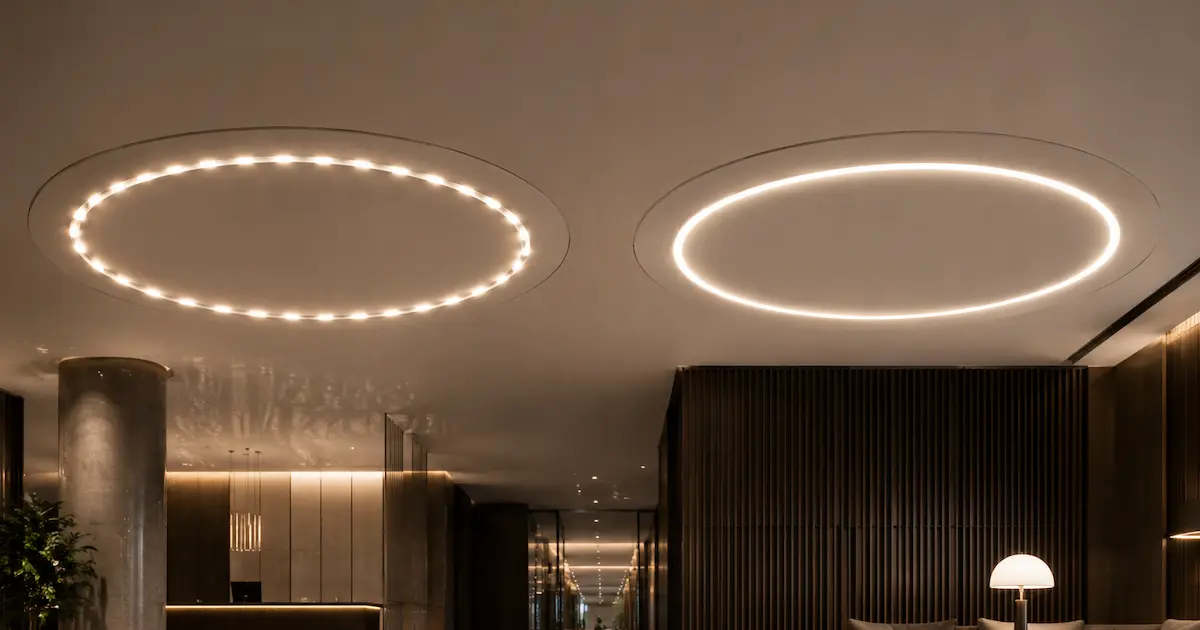
Diffuser transmission loss ranges typically between 15% and 40%; plan lumen output after diffuser loss, not before.
| Diffuser Type | Light Effect | Lumen Loss Range | Best Application |
|---|---|---|---|
| Opal PMMA | Soft, low glare | 25–40% | Visible circular ceiling rings |
| Frosted PC | Balanced output | 20–35% | Commercial interiors |
| Clear PC | High output, visible dots | 5–15% | Hidden coves or indirect light |
| Silicone milky cover | Very smooth | 25–45% | Decorative neon ring effects |
If a ceiling ring looks dotted after installation, the client may reject it even if the system works electrically.
6. What width and depth should a circular LED profile have?
Profile size must match strip width, diffuser target, and heat load. A 5 mm COB strip fits compact profiles; 10–12 mm high-output strips need wider channels. Deeper profiles reduce dotting but may be harder to bend and fit in shallow grooves.
| Profile Parameter | Common Range | Practical Recommendation |
|---|---|---|
| Inner width | 8–20 mm | Leave 1–2 mm clearance beyond strip width |
| Profile depth | 6–18 mm | Deeper channels reduce dot visibility |
| Diffuser type | Opal or frosted | Use opal for direct-view ceiling rings |
| Strip density | COB or 120–240 LED/m | Higher density gives smoother arcs |
| Wattage | 8–18 W/m | Match wattage to heat path and run time |
Small size saves material cost, but too small increases labor cost—an often missed trade-off.
7. How should heat dissipation be managed in circular ceiling lighting?
Heat is a common failure point. LED strips lose output faster when junction temperature rises; adhesive backings weaken and strips can sag. In a circle, gravity and bending stress worsen this.
Heat issues often stem from high-wattage strips, thin channels, and sealed installation spaces, making it important to choose flexible LED profiles with effective heat management for long-hour ceiling-ring applications. Use aluminum profiles as a heat sink for strips above 10 W/m when the ceiling lights operate for long hours. Keep driver loading around 80% of rated capacity and avoid packing drivers into sealed voids.
Field example: a restaurant ring failed after months because a 19.2 W/m strip was installed in a narrow sealed silicone profile. A lower-wattage COB strip inside aluminum would have been more stable.
8. What mounting methods are suitable for round ceiling designs?
Circular ceiling lighting can be recessed, surface-mounted, suspended, or hidden in a cove. Each method changes the profile choice. Recessed rings need accurate grooves; surface-mounted rings need clean clips; suspended circles require factory-curved segments.
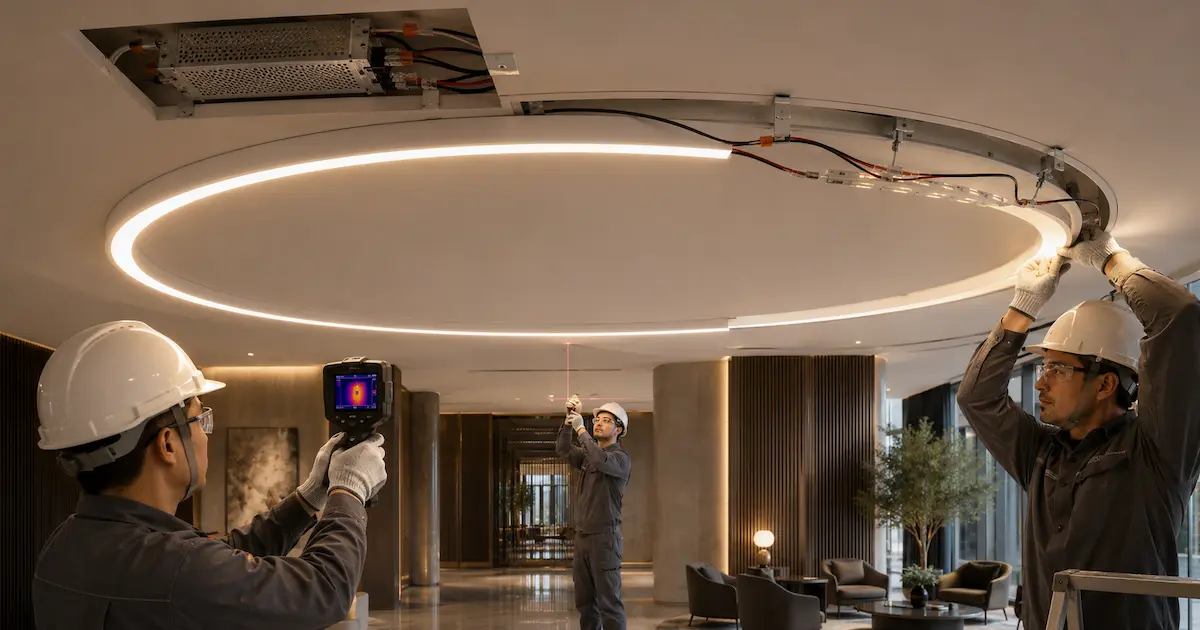
| Mounting Method | Best Profile Type | Site Risk | Practical Fix |
|---|---|---|---|
| Recessed ceiling ring | Flanged bendable aluminum | Uneven groove | Use CNC template or accurate cutting guide |
| Surface-mounted ring | Bendable aluminum with clips | Wavy circle | Short clip spacing and pre-marked radius |
| Suspended ring | Segmented curved aluminum | Joint misalignment | Factory arc cutting and connector kit |
| Cove circular halo | Flexible strip in aluminum or neon | Hidden voltage drop | Feed from two points |
A clean mounting plan reduces labor hours and improves margin for contractors.
9. What quality checks should buyers request before bulk orders?
Request samples and technical confirmation. A catalog photo cannot show bending behavior, diffuser grip, thermal stability, or color consistency. Ask for test reports and real sample curves, and confirm that your COB LED strip manufacturer can provide consistent CCT bins, aging-test results, wattage data, and compatibility information for the selected circular profile.
Ask for these checks:
● Minimum bending radius confirmation
● Diffuser lock strength after bending
● LED strip color bin and CCT tolerance
● 24–48 hour aging test photos
● Driver compatibility and dimming test results
● Packing method to protect curved profiles
| Quality Check | Why It Matters | Suggested Acceptance Point |
|---|---|---|
| Bending test | Prevents twisting and cover pop-out | No visible deformation at target radius |
| CCT check | Avoids mixed-color ceiling rings | 3-step or 5-step SDCM, per project level |
| Thermal test | Reduces early lumen loss | Stable surface temperature after warm-up |
| Aging test | Catches weak solder joints | No flicker or dead section |
| Packing review | Reduces transport damage | Profiles fixed and protected from crushing |
10. What installation checklist prevents circular ceiling lighting problems?
A strong checklist saves time on site. Circular ceiling lighting has more geometry risk than straight runs, so measure twice and install once. Start with radius confirmation, then check power layout, profile direction, strip polarity, diffuser fit, and dimmer compatibility.
Use this quick reference before installation:
| Problem or Checkpoint | Likely Cause | Fix Before Handover |
|---|---|---|
| Wavy ring shape | Clips too far apart or poor template | Use shorter clip spacing and accurate marking |
| Dark section | Bad solder joint or connector | Test strip before inserting diffuser |
| Brightness drop | Voltage drop around circle | Use 24V and feed from both ends |
| Visible LED dots | Shallow profile or low strip density | Use COB strip or deeper opal diffuser profile |
| Diffuser popping out | Radius too tight | Select softer diffuser or larger radius profile |
| Flicker on dimming | Driver and dimmer mismatch | Test the dimming protocol before installation |
Recommended sequence:
● Confirm radius and circumference from drawings
● Dry-fit the profile before applying strip
● Test every LED strip section on the floor
● Solder and insulate feeds carefully
● Run a 30-minute power test before closing the ceiling
● Install diffuser after temperature and brightness checks
Conclusion
The ideal flexible LED profiles for circular ceiling lighting depend on radius, voltage, diffuser, heat load, and mounting method. Bendable aluminum profiles suit most professional ceiling rings. Silicone neon works well for soft decorative circles. Segmented curved aluminum is best for large suspended designs. If you are unsure about voltage drop, heat, or bending radius for your project, send our engineering team your drawings and we’ll calculate the practical profile and power layout.
FAQ
Q1: What is the best flexible LED profile for circular ceiling lighting?
For most commercial interiors, a bendable aluminum LED profile with an opal diffuser is the best choice. It gives good heat dissipation, clean appearance, and easier maintenance. For very tight decorative circles, silicone neon profiles may be better.
Q2: Can LED aluminum profiles bend into a full circle?
Yes, but only if the profile is designed for bending and the circle radius is within its rated range. Standard rigid aluminum channels should not be forced into a circle because they may twist, crack the diffuser, or damage the LED strip.
Q3: Is 12V or 24V better for circular ceiling lighting?
24V is usually better for medium and large rings because it reduces voltage drop and keeps brightness more even. 12V can work for small circles where the strip length is short and current is manageable.
Q4: How can I avoid visible dots in a circular LED ceiling ring?
Use COB LED strip or high-density SMD strip, choose an opal diffuser, and select a profile with enough depth. Testing a short sample before bulk installation is the safest way to confirm the final effect.
Q5: Do flexible LED profiles need heat testing?
Yes. Heat testing is recommended, especially for strips above 10 W/m or lighting that runs many hours per day. Thermal checks help prevent lumen loss, color shift, adhesive failure, and future service calls.
