
1. What Makes Flexible LED Profile Lighting Different from Basic LED Strip Lighting?
Flexible LED profile lighting combines LED strip, bendable or semi-flexible profile, diffuser, end caps, clips, and driver selection into one working system. Basic LED strip lighting is only the light source. That difference changes efficiency, service life, and installation quality.
Boutique stores often need curved counters, arched shelving, display islands, fitting-room mirrors, and window frames, so the overall design should follow the same principles used when choosing lighting for retail spaces. A rigid aluminum channel may not follow those shapes. Flexible profiles can bend along architectural curves while still giving the strip a stable mounting surface. This keeps light lines clean and reduces dark spots that can make premium merchandise look cheap.
We often see installers struggle with exposed strips on painted wood or plastic displays. The tape adhesive weakens under heat, dust, or cleaning chemicals. Once the strip peels, the LED surface loses contact, heat rises, and lumen output drops faster.
| Lighting Option | Best Use in Boutique Stores | Energy Impact | Service Risk |
|---|---|---|---|
| Bare LED strip | Hidden coves with low heat | Can be efficient, but heat may reduce output | Medium to high |
| Rigid aluminum profile | Straight shelves, counters, walls | Strong heat control | Low |
| Flexible LED profile | Curves, arches, custom displays | Efficient when paired with correct strip | Low to medium |
| Neon flex | Decorative outlines, logos | Moderate, depends on design | Medium |
The bottom line is simple. Flexible LED profile lighting is not just decoration. It is a controlled optical and thermal system.
2. How Energy-Efficient Is Flexible LED Profile Lighting in Real Store Use?
Flexible LED profile lighting can cut energy use compared with halogen, fluorescent, and poorly placed track lights. A boutique often uses layered lighting: ambient light, accent light, shelf light, and window light. Linear profile lighting works well because it puts light near the product instead of flooding the whole room.
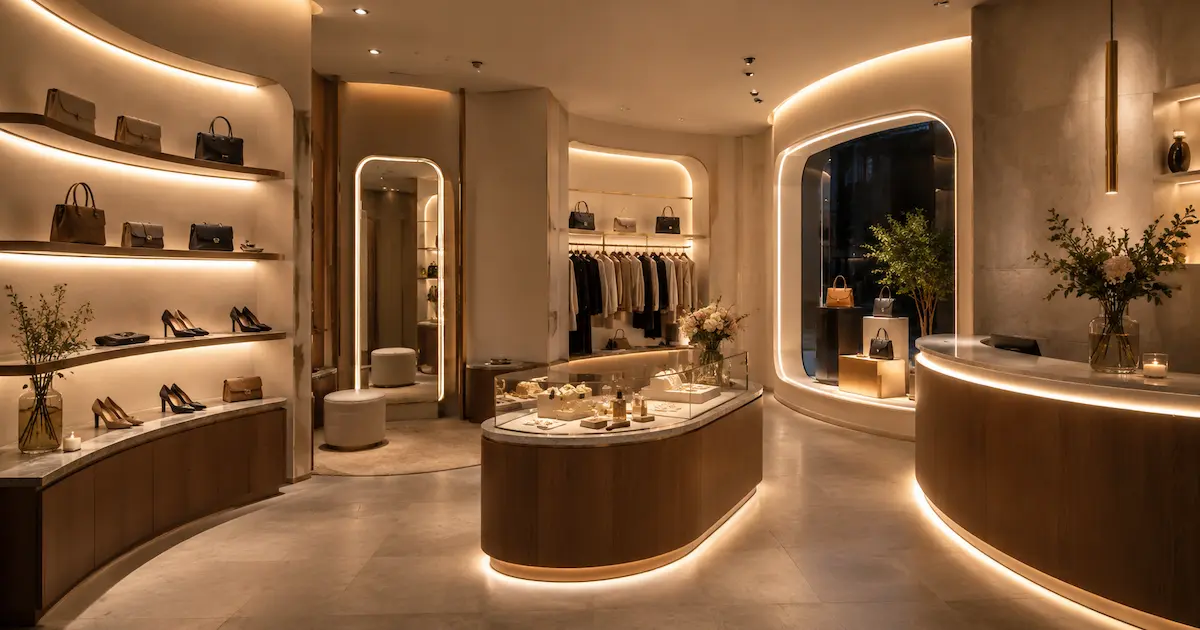
For example, a 12W/m LED strip inside a profile can light a perfume shelf more directly than a 35W track spotlight mounted two meters away. A 20-meter shelf system at 12W/m uses 240W before driver loss. If the same shelf area uses twenty 20W spotlights, the connected load becomes 400W. Over long operating hours, that gap affects operating cost.
In our lab tests using integrating spheres, we measure lumen output and lumen-per-watt data before and after thermal aging. A strip rated at 120 lm/W on paper may perform lower inside a sealed diffuser if heat is trapped. With a proper aluminum profile, the result is more stable.
| Store Area | Typical Old Load | LED Profile Load | Likely Saving Range |
|---|---|---|---|
| Display shelf, 20 m | 350–500W | 180–300W | 25–55% |
| Cash counter, 6 m | 120–180W | 50–90W | 30–60% |
| Fitting mirror, 8 m | 200–300W | 80–130W | 35–60% |
| Window outline, 12 m | 250–400W | 120–200W | 30–55% |
But there’s a catch. Energy efficiency only holds when the layout, voltage, driver loading, and dimming plan are correct.
3. Does 12V or 24V Flexible LED Profile Lighting Save More Energy?
For most boutique store runs, 24V flexible LED profile lighting is usually the better choice. It does not magically make each LED more efficient, but it reduces current for the same power. Lower current means less voltage drop, less cable heating, and more even brightness across long display lines.
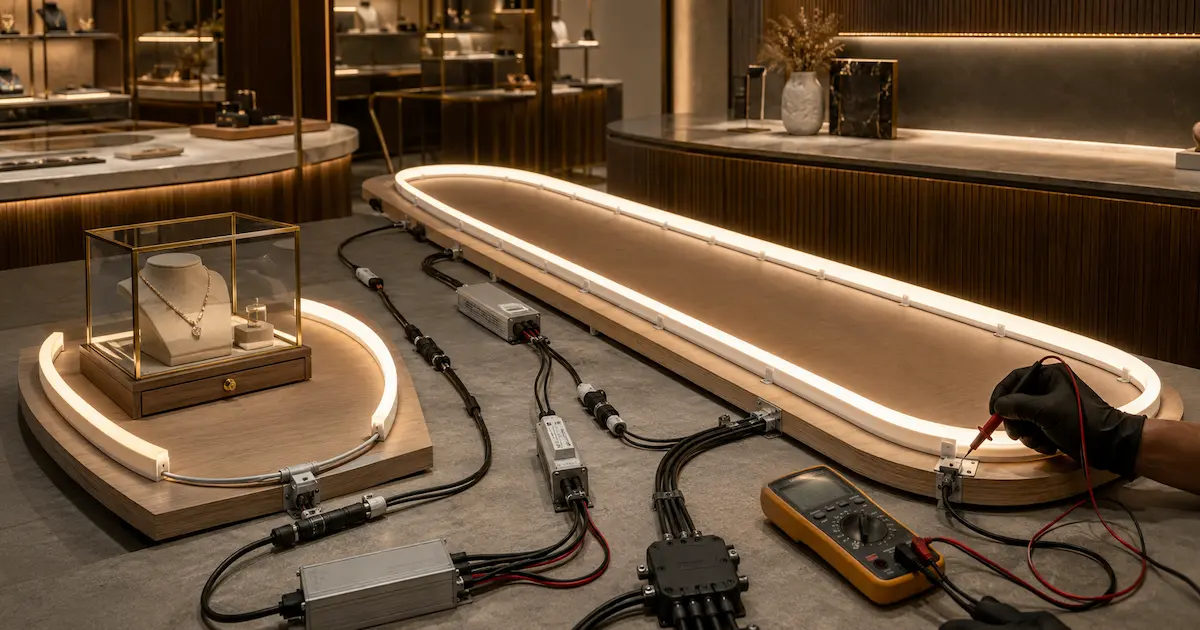
When we tested this against a standard 12V strip on a 10-meter display run, the 12V sample showed visible dimming near the far end when powered from one side. The 24V version kept brightness more balanced under the same wattage class. That matters in boutiques because uneven shelf lighting can make one handbag look richer than another, even when they are the same color.
A common field example is a jewelry wall with 15 meters of profile lighting. If installers use 12V strips without power injection, the last meters may look warmer and dimmer. The client may reject the work, and the contractor pays for return visits.
| Feature | 12V Flexible LED Profile | 24V Flexible LED Profile |
|---|---|---|
| Best run length | Short displays, small signs | Medium and long shelves |
| Voltage drop risk | Higher | Lower |
| Cable size demand | Higher current needs thicker cable | Lower current for same watts |
| Cutting interval | Often shorter | Often longer |
| Boutique use | Small showcases | Shelves, mirrors, counters |
For most commercial boutique projects, 24V gives a safer margin and cleaner results, but the final profile dimensions, strip compatibility, heat path, bend limits, and accessories should be confirmed with an experienced aluminium LED profile manufacturer.
4. Why Do Aluminum Profiles Improve LED Strip Energy Performance?
Aluminium profiles improve LED-strip performance because they move heat away from the LED board, so buyers should compare which flexible LED profiles offer the best heat management for LEDs before approving high-output boutique displays. Heat is one of the main reasons strips lose brightness over time. A cooler LED runs more steadily, keeps color closer to specification, and reduces the chance of early failure.
This is where it gets practical. LED efficiency drops as junction temperature rises. If a strip is stuck directly to MDF wood, painted metal with poor contact, or plastic, heat has fewer paths to escape. Inside a properly sized aluminum profile, the strip has a larger heat-spreading surface.
Common Myth: Higher wattage always means better brightness. Reality: lumen efficiency, optic design, diffuser loss, and heat control decide useful brightness. A 9.6W/m strip with good efficiency and proper profile may outperform a 14.4W/m strip installed on a heat-trapping surface after several months.
| Profile Type | Heat Control | Visual Effect | Typical Boutique Use |
|---|---|---|---|
| Slim surface profile | Medium | Clean visible line | Shelves, counters |
| Recessed profile | Good | Integrated architectural slot | Wall panels, cabinetry |
| Deep profile with diffuser | Strong | Dot-free line | Premium display walls |
| Flexible aluminum/PVC hybrid | Medium | Curved light line | Arches, rounded counters |
Our Chief Engineer notes that heat dissipation is often ignored because the light turns on during testing. The real test is how it performs after 3,000 store hours, not after 30 minutes.
5. How Do Drivers, Dimming, and Controls Affect Energy Savings?
Drivers and controls can decide whether a flexible LED profile lighting project saves money or wastes power. The driver converts AC mains to low-voltage DC. If it has low efficiency, poor power factor, or unstable output, it can create heat and shorten LED life.
A quality 24V driver may run at 88–94% efficiency. A weak driver may sit closer to 80–85%. On a small store this may look minor, but across multiple boutiques it affects yearly operating cost and warranty exposure. Driver loading also matters, and using a proper LED profile driver calculation helps contractors size the power supply from the real connected wattage, cable losses, dimming system, and recommended safety margin. Running a driver at 95–100% load for long hours can increase heat. Many engineers prefer 75–85% loading for commercial projects.
Dimming creates another layer of savings. A boutique may need full brightness during opening hours, softer levels after sunset, and stronger lighting only in window zones. Zoning helps staff highlight new products without running the whole store at peak output.
| Control Method | Energy Saving Potential | Best Boutique Scenario | Notes |
|---|---|---|---|
| manual wall dimmer | 5–20% | Small stores | Simple, low cost |
| 0-10V dimming | 10–35% | Multi-zone retail | Stable for commercial use |
| DALI | 15–45% | Chain stores | Good for scene control |
| PIR or presence sensor | 10–30% | Storage, fitting rooms | Avoid in main luxury displays |
| Timer control | 10–25% | Windows and signage | Reduces after-hours waste |
The following neutral commercial-energy presentation explains how lighting-power limits, zoning, automatic controls, occupancy response, and operating schedules work together to reduce energy use in commercial interiors.
Pro Tip from the VST Technical Team: “Select the driver after calculating real strip load, cable loss, dimming type, and maintenance access. Driver placement saves more service time than many people expect.”
6. What Color Temperature and CRI Support Both Efficiency and Product Appeal?
Energy efficiency should never damage product presentation. Boutique lighting sells texture, color, and mood. A high-efficiency LED with poor color rendering can make leather look flat, cosmetics look dull, or fabrics appear different from their real shade.
For most boutique stores, CRI 90+ is a strong choice for merchandise zones. CRI 80 may save a little energy, but it can reduce visual quality. For fashion stores, 3000K to 3500K often gives warmth and comfort. For jewelry and modern interiors, 3500K to 4000K may provide a cleaner look. Cosmetics areas may need higher color fidelity, sometimes with special attention to R9 red value.
We once saw a project fail because one batch of strips was 3000K and the next was closer to 3300K. On a curved feature wall, the mismatch was visible. The contractor had to replace full runs, not only a few meters.
In our lab tests using integrating spheres, we record CCT, CRI, and lumen output for production samples. We explain this specific binning process because ignoring it leads to visible color mismatch in boutique shelves and fitting rooms.
A practical balance looks like this:
| Merchandise Type | Suggested CCT | Suggested CRI | Efficiency Note |
|---|---|---|---|
| Leather goods | 3000K–3500K | CRI 90+ | Warm tone supports texture |
| Fashion apparel | 3000K–4000K | CRI 90+ | Match brand style |
| Jewelry | 3500K–5000K | CRI 90+ | Avoid harsh glare |
| Cosmetics | 3500K–4000K | CRI 95 preferred | Check skin tone rendering |
7. How Can Boutique Stores Reduce Glare and Wasted Light?
Wasted light is wasted energy. Glare also hurts the shopping experience. Flexible LED profile lighting can reduce both because it places light close to the product and uses diffusers or lenses to shape the beam.
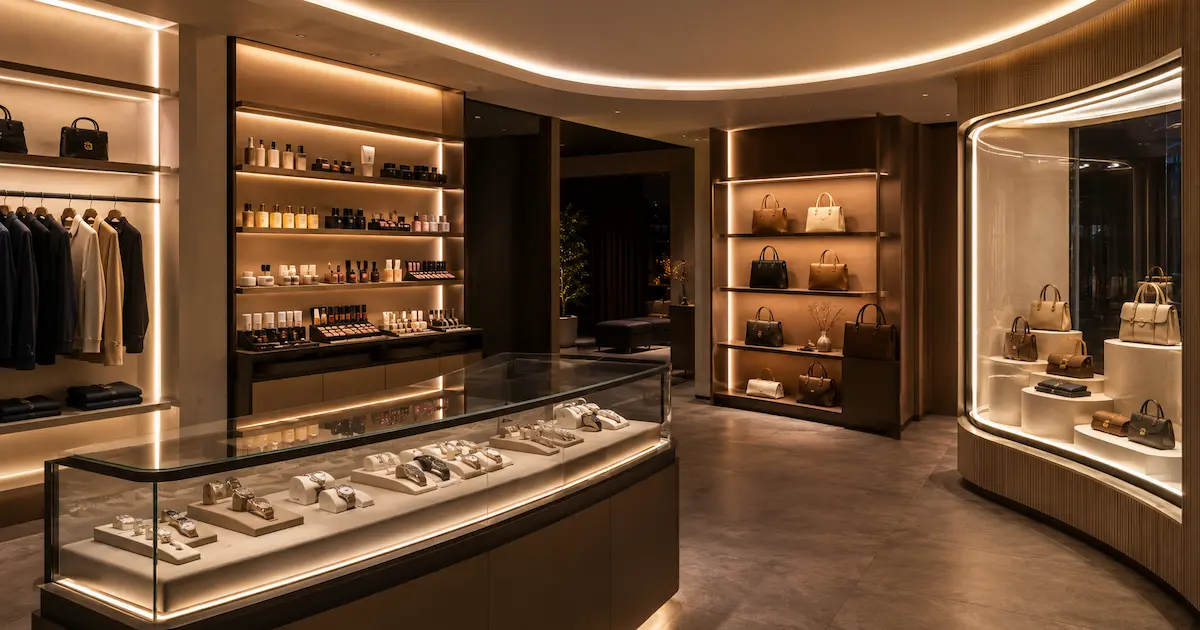
In a boutique, the goal is not to make every surface equally bright. The goal is to create contrast. A shelf can be brighter than the walkway. A window display can be brighter than the rear wall. A cash desk can feel clear without shining into the customer’s eyes.
This is why profile depth and diffuser choice matter, and retailers should compare which flexible LED profiles provide the best diffusers for soft light before specifying visible shelves, counters, mirrors, and window frames. A shallow diffuser may show LED dots. A deeper profile with a milky cover can create a smooth line but may lose more light through the cover. Clear covers pass more light but may create glare. Opal diffusers soften the line yet reduce transmitted lumen output.
Three field scenarios show the trade-off:
● A luxury watch counter may need a deeper profile and glare shield to avoid reflections on glass.
● A clothing shelf may use a 120-degree diffused strip for even vertical illumination.
● A window frame may use brighter output but a timer to cut usage after closing.
The best result is not always the brightest result. It is the most useful light per watt.
8. What Installation Practices Protect Efficiency and Reduce Callbacks?
Installation quality decides long-term efficiency. Poor wiring, weak adhesive preparation, tight bending, and overloaded drivers can turn a good product into a service problem. Flexible profiles help, but they cannot correct every installation mistake.
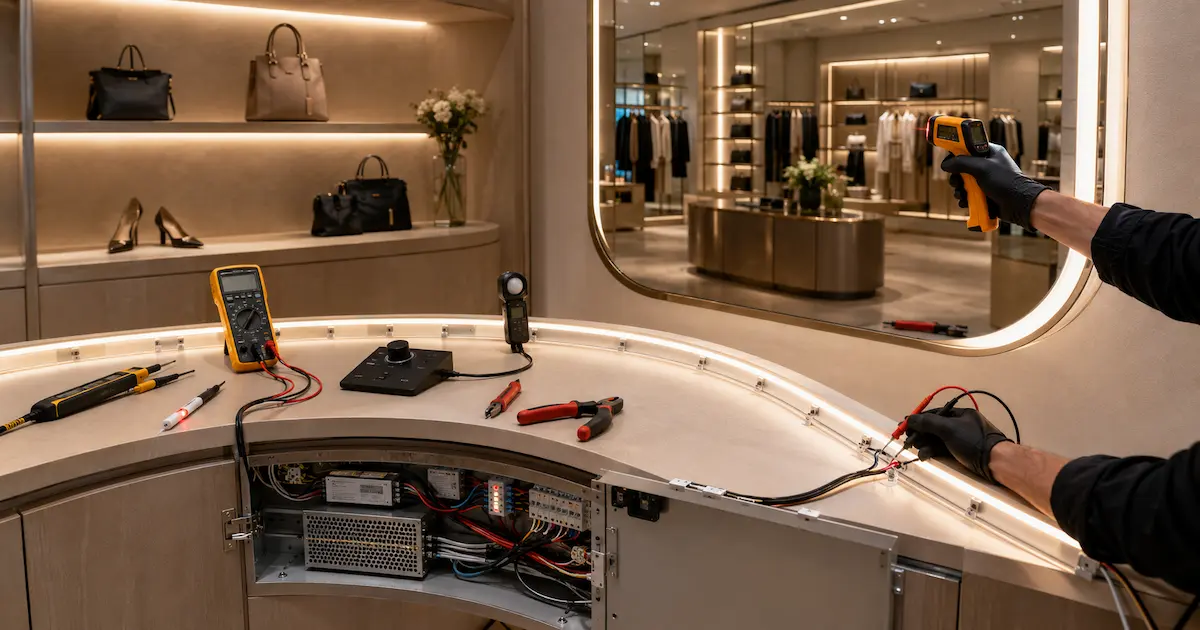
We often see installers struggle with long continuous runs. They connect 15 or 20 meters from one end, then wonder why the far end is dim. Power injection from both ends or from the middle solves many cases. Cable gauge also matters. A thin cable on a high-current run wastes power as heat.
Another common issue is bending radius. Flexible profiles and strips have limits. If the strip is bent too sharply, solder joints or copper tracks can crack. For curved boutique fixtures, request bending direction, radius, and drawing confirmation before production.
| Checklist Item | Correct Practice | Risk if Ignored |
|---|---|---|
| Driver load | Use about 75–85% of rated capacity | Heat, shutdown, short life |
| Voltage feed | Feed long runs from both ends or sections | Dim far end, color shift |
| Surface prep | Clean dust and oil before mounting | Strip peeling, poor heat path |
| Bend radius | Follow profile and strip limits | Cracked PCB, dark sections |
| Access panel | Keep driver reachable | High labor cost during repair |
| Polarity check | Test before closing cabinets | Rework and delays |
A clean install protects margin. It also protects your reputation when the store opens on schedule.
9. What Is the Real ROI for Boutique Store LED Profile Lighting?
ROI comes from energy saving, lower maintenance, fewer lamp replacements, better product presentation, and fewer callbacks. Energy is only one part of the calculation. For a boutique owner, lighting may also affect dwell time and perceived product value. For contractors and distributors, ROI includes reduced service visits.
Let’s use a simple example. A boutique runs lighting 11 hours per day, 330 days per year. A display system drops from 600W to 320W using flexible LED profile lighting and zoning. That saves 280W during operation. Yearly energy reduction equals about 1,016 kWh. At $0.18 per kWh, that is about $183 per year for that zone alone. In high-rate regions, the number is larger.
Now add maintenance. If old lamps need frequent replacement or access requires after-hours labor, profile lighting can save more through reduced visits. In one field example, a cosmetics display with poorly cooled strip needed partial replacement within one year. After moving to an aluminum profile and a lower-watt high-efficiency strip, the service interval improved.
| ROI Factor | Impact on Store | Impact on Contractor/Supplier |
|---|---|---|
| Lower wattage | Lower monthly bills | Stronger project proposal |
| Better heat control | Longer lumen stability | Fewer warranty claims |
| Zoning and dimming | Lower after-hours waste | More professional solution |
| Cleaner look | Better brand presentation | Higher client satisfaction |
The financial case is strongest where lighting runs long hours.
10. How Should You Specify Flexible LED Profile Lighting for a Boutique Project?
A strong specification starts with the store layout, followed by a review of the available LED lighting product details for voltage, wattage, profile size, diffuser type, CRI, CCT tolerance, drivers, accessories, and lead-wire options. List each zone: window, shelves, wall panels, fitting rooms, cash counter, signage, and storage. Then define brightness target, CCT, CRI, voltage, wattage per meter, profile type, diffuser, driver location, dimming protocol, and certification needs.
From our manufacturing floor perspective, unclear specifications cause most project disputes. For example, “warm white strip in flexible profile” is not enough. You need actual CCT tolerance, CRI level, LED density, input voltage, profile drawing, cover type, and cable length. Pre-soldered leads can save installers time, especially in display furniture where access is tight.
Here is a practical specification template:
| Specification Item | Recommended Detail | Why It Matters |
|---|---|---|
| Voltage | 24V for most medium runs | Reduces voltage drop |
| Wattage | 8–14.4W/m for many displays | Balances brightness and heat |
| CRI | 90+ for merchandise zones | Better color accuracy |
| CCT tolerance | 3-step or 5-step binning | Reduces visible mismatch |
| Profile | Flexible or rigid by fixture shape | Supports heat and appearance |
| Driver | CE/UL/CB/RoHS where needed | Supports compliance and safety |
| Lead wires | Pre-cut and pre-soldered | Saves site labor |
Ask for samples before full rollout. Test them in real store materials, not only on a workbench.
Conclusion
Flexible LED profile lighting is energy-efficient for boutique stores when the full system is designed with care: LED strip, profile, driver, dimming, wiring, heat path, and visual target. The best projects save power while keeping merchandise attractive and service risk low. If you are unsure about voltage drop, driver sizing, dimming zones, heat load, diffuser choice, or profile selection for a specific store, contact our engineering team and send the boutique drawings for a manual technical review. We’ll calculate the layout manually and help you avoid costly rework.
FAQ
Q1: Is flexible LED profile lighting more efficient than track lighting for boutique stores?
Often, yes. Profile lighting places light close to shelves, counters, and displays, so fewer watts may be needed for the same product visibility. Track lights still work well for accent beams, but linear profiles are usually better for continuous shelves and curved furniture.
Q2: Should boutique stores use 12V or 24V LED profile lighting?
For most medium and long runs, 24V is preferred. It reduces current, voltage drop, and brightness variation. 12V can still work for short showcases, small signs, or compact display boxes.
Q3: Does a diffuser reduce energy efficiency?
Yes, a diffuser absorbs part of the light, but it can reduce glare and hide LED dots. The right choice depends on the store’s visual goal. A smooth premium line may justify a small lumen loss.
Q4: What CRI is best for boutique merchandise?
CRI 90+ is a strong standard for fashion, leather goods, jewelry, and cosmetics. For cosmetics or skin-tone areas, CRI 95 and good R9 performance may be worth specifying.
Q5: How can I avoid voltage drop in long flexible LED profile runs?
Use 24V strips, correct cable gauge, shorter circuit sections, and power injection from both ends or the middle. Test voltage at the far end before closing the profile or furniture panel.
