
1. What job does an LED strip corner profile actually do?
An LED strip corner profile is a mounting channel designed for inside corners, cabinet edges, ceiling coves, shelves, stair nosing, and furniture joints. Most 45-degree LED profile models place the LED strip at an angled position, which spreads light across two surfaces instead of firing straight ahead.
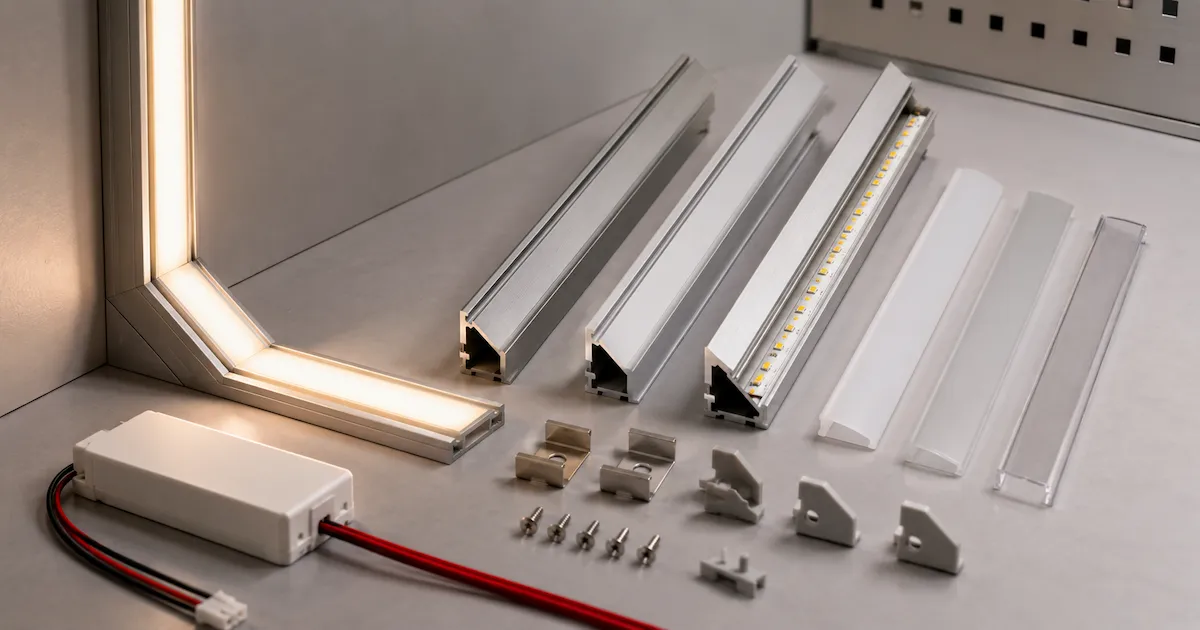
An aluminum LED channel and diffuser does more than hold tape; it creates a mechanical housing, protects solder joints, gives the diffuser a stable seat, and helps move heat away from the PCB. If the profile is poorly made, the strip may sag, the cover may pop out, or the adhesive may fail after months of thermal cycling.
We often see installers struggle with three field issues:
- LED strips peeling from dusty wood or painted surfaces
- Uneven light lines at cabinet corners
- Burn marks or lumen drop in high-power strips without enough heat path
In a luxury hotel lobby, a crooked corner line can trigger client rejection. In a supermarket shelf project, poor mounting can slow every installer. In a yacht or RV interior, vibration can loosen weak plastic housings.
| Profile Function | Why It Matters on Site | Business Impact |
|---|---|---|
| Heat spreading | Reduces LED junction temperature | Longer strip life, fewer returns |
| Mechanical mounting | Keeps strip straight and secure | Faster installation, cleaner handover |
| Light angle control | Directs light into the usable area | Better visual effect with fewer LEDs |
| Diffuser support | Reduces glare and dust entry | Better finish and easier cleaning |
| Cable protection | Shields solder joints and wire exits | Lower failure risk after service |
2. Why is aluminum used so often for LED strip corner profiles?
Aluminum is popular because it balances thermal performance, weight, workability, finish quality, and cost. It can be extruded into precise shapes, cut cleanly, anodized, powder coated, and packed in long lengths without excessive shipping weight.
For LED lighting, LED thermal management is the main reason aluminum wins so often. LED strips convert part of their input power into light and the rest into heat. If heat stays trapped on the PCB, the phosphor, solder joints, resistors, and adhesive all age faster. Aluminum gives that heat a wider path into the surrounding air.
In our lab tests using integrating spheres, we see lumen output drop faster when the same LED strip runs on insulating materials under equal current and ambient temperature. The difference becomes clearer above 10 W/m, especially in closed shelves, wardrobes, and coves with limited airflow.
Aluminum also handles production well. A distributor can order standard 2 m or 3 m lengths, custom punching, custom end caps, pre-cut kits, or matched finishes for furniture makers. That flexibility matters because project delays often start with small accessories, not the LED strip itself.
| Material Property | Aluminum Profile Result | Why Buyers Care |
|---|---|---|
| Thermal conductivity | Good heat transfer | Better life span for mid/high-power strips |
| Low weight | Easy shipping and handling | Lower freight pressure than steel |
| Extrusion accuracy | Consistent slot and cover fit | Less waste during installation |
| Surface treatment | Anodized or coated options | Better match with furniture and interiors |
| Corrosion behavior | Strong with proper finish | Suitable for many indoor commercial sites |
3. How does aluminum compare with plastic, steel, and silicone profiles?
Aluminum is not the only option, so buyers comparing aluminium vs plastic channels for LED lights should also consider steel channels and silicone sleeves based on wattage, environment, appearance, and installation method. The best choice depends on wattage, environment, appearance, and installation method.
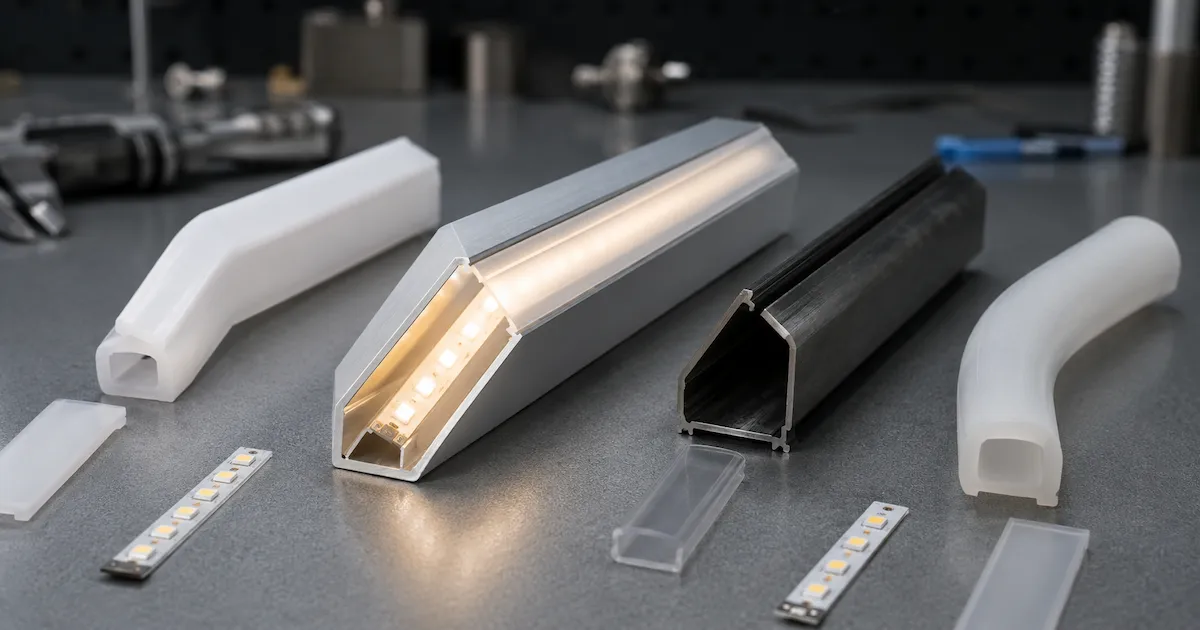
Plastic profiles are low cost and easy to cut, but they insulate heat. They can work with low-power strips, such as 4.8 W/m or decorative cabinet lighting. Problems appear when buyers use plastic with 14.4 W/m, 19.2 W/m, or dense COB strips in enclosed areas. The strip may still light up during acceptance, then lose brightness early.
Steel is strong, but it is heavier and harder to process. It may rust if coating is damaged. It also has lower thermal conductivity than aluminum. Silicone is flexible and useful for curved designs or wet-rated strips, yet it is not a rigid corner profile and does not spread heat like aluminum.
What’s the real story? Aluminum is the safest default for commercial corner profiles, but it is not magic. Profile mass, wall thickness, airflow, and strip wattage still matter.
| Material Vs. Aluminum | Heat Control | Rigidity | Finish Quality | Typical Use | Main Limitation |
|---|---|---|---|---|---|
| Aluminum | High | High | High | Cabinets, coves, retail, hotels | Needs correct size for wattage |
| Plastic | Low | Medium | Medium | Low-power decoration | Heat buildup and yellowing risk |
| Steel | Medium | Very high | Medium | Heavy-duty protection | Weight, rust risk, harder cutting |
| Silicone | Low | Low | Medium | Curved or wet areas | Poor structural support |
4. How much does aluminum improve heat dissipation?
To prevent LED strip lights overheating, heat dissipation should be checked based on surface area, profile thickness, contact quality, airflow, ambient temperature, and LED strip power. Aluminum helps because it spreads heat from a narrow PCB into a larger metal body. That reduces hot spots.
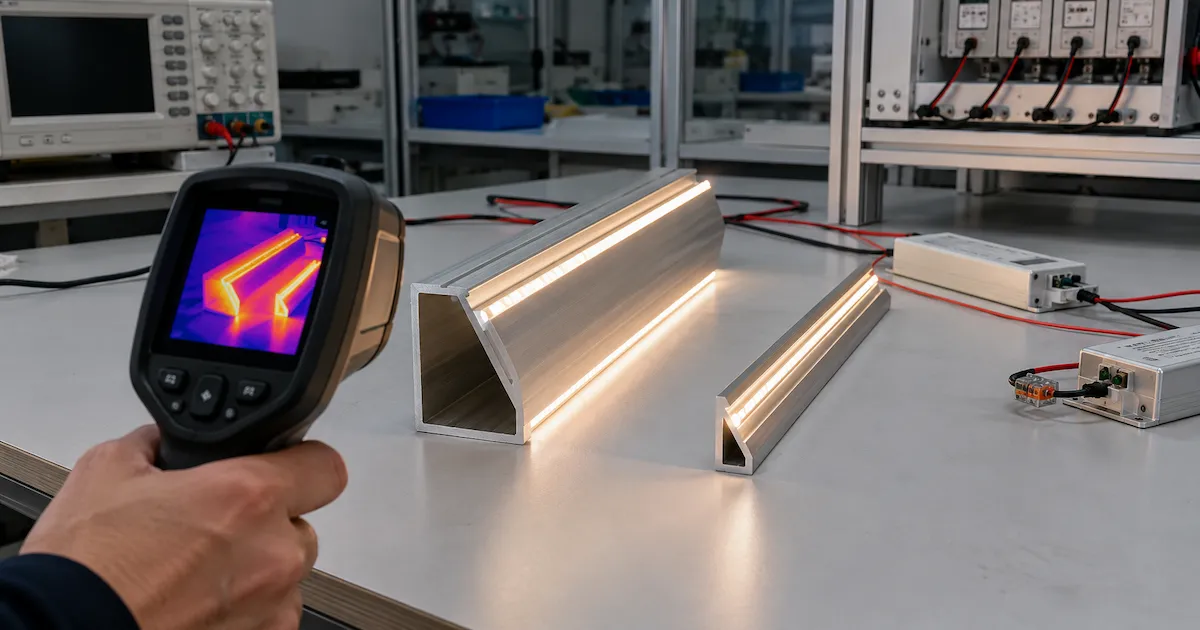
When we tested this against a standard 12V strip at 14.4 W/m, the strip mounted on aluminum ran cooler than the same strip placed directly on painted MDF. The exact temperature gap changes by profile shape, but the trend is consistent. MDF, PVC, and foam tape trap heat. Aluminum moves it away.
A lower operating temperature protects lumen maintenance. Many LED chips lose output faster when junction temperature rises. Adhesive backing also softens under heat. That is why high-power strips that look fine on day one may peel or dim after several months in a closed display shelf.
Pro Tip from VST Technical Team: “For LED strips above 10 W/m, treat the profile as part of the thermal design, not as a decorative accessory. If the profile is too small, the strip will still suffer.”
| Strip Power Range | Suggested Profile Approach | Risk If Ignored |
|---|---|---|
| 4–8 W/m | Plastic or small aluminum may work | Minor heat risk in open air |
| 9–14 W/m | Aluminum corner profile recommended | Adhesive failure, early lumen loss |
| 15–20 W/m | Larger aluminum profile with good airflow | High temperature, client complaints |
| 20 W/m+ | Thermal calculation and sample testing | Short life span, safety concern |
5. Does aluminum make corner lighting look better?
Yes, but not only because aluminum looks premium. The profile geometry controls the LED angle, diffuser distance, and shadow behavior. A 45-degree corner profile can soften harsh lines and direct light across the work area.
In kitchens, a corner profile under upper cabinets pushes light toward the backsplash and countertop. In retail shelves, it spreads light across displayed products and helps reduce discomfort glare instead of shining directly into the customer’s eyes. In hotel wardrobes, it hides the strip and gives a clean architectural line.
The diffuser still matters, and a proper LED strip diffuser choice can reduce glare and visible dots because a shallow profile with a clear cover may show LED points. A deeper profile with opal PC cover can reduce dotting, especially with 120 LED/m strips or COB strips. For dot-free results, match LED density, diffuser opacity, and profile depth.
But there’s a catch: too much diffusion reduces output. A milky cover may cut visible light by 20% to 40%, depending on material and thickness. If a project needs a measured lux target, test the strip and cover as a system.
| Lighting Goal | Profile Feature to Check | Practical Recommendation |
|---|---|---|
| Dot-free line | Diffuser distance and LED density | Use COB or high-density strip |
| Higher brightness | Clear or semi-clear cover | Accept more visible dots |
| Low glare | Opal diffuser and 45-degree angle | Good for hotels and homes |
| Shelf lighting | Narrow, angled body | Aim light toward products |
| Cove lighting | Wider beam and good cover fit | Avoid shadow gaps |
6. What aluminum grade and finish should buyers specify?
Most LED strip corner profiles use 6063 aluminum alloy because it extrudes well, has good surface quality, and performs reliably for architectural lighting accessories. The common temper is T5, which gives enough hardness for handling, cutting, and cover retention.
Surface finish affects appearance and corrosion resistance. A silver anodized aluminum finish is common for general use because it gives the profile a clean appearance and better surface protection. Black anodized is popular in dark ceilings, display shelves, and modern furniture. White powder coating blends into painted interiors, but coating thickness must not block diffuser fit.
From our manufacturing floor perspective, small tolerance drift can create big field trouble. If the diffuser slot is too tight, installers waste time forcing covers into place. If it is too loose, covers fall out after vibration or thermal cycling. For volume orders, check sample fit with the actual diffuser, end caps, clips, and LED strip width.
For outdoor or humid spaces, ask for finish details. Standard indoor anodizing may not be enough for coastal air, pool rooms, or car wash projects. The profile may need stronger surface treatment, better sealing, or a different lighting system.
| Specification Item | Common Choice | What to Confirm |
|---|---|---|
| Alloy | 6063 | Consistent extrusion and clean surface |
| Temper | T5 | Suitable hardness for profile handling |
| Finish | Silver, black, white | Match project appearance and cover fit |
| Length | 2 m, 2.5 m, 3 m | Match carton, freight, and cutting plan |
| Diffuser | PC opal, clear, frosted | UV resistance, transmission, snap fit |
7. Is aluminum always the best choice for every corner profile project?
No. Aluminum is the best default for many LED strip corner profiles, but some projects can use another material. The decision should follow power, location, design shape, compliance needs, and budget.
Common Myth: Aluminum profiles are only decorative, so any cheap channel is fine. Reality: The profile affects heat, service life, glare, mechanical safety, and installation time. A decorative mindset can cause technical failures.
For a low-power decorative strip inside a temporary exhibition stand, plastic might be acceptable. For a curved signage letter, silicone may fit better. For a vandal-risk public area, a reinforced metal housing may be needed. Yet for fixed cabinets, stair corners, retail shelves, hotel coves, and furniture lighting, aluminum usually gives the strongest balance.
The bottom-line reason is simple. A slightly cheaper material can cost more if it causes callbacks. One failed hotel corridor can require night work, replacement strips, new covers, labor claims, and reputation damage. Material choice is not only a purchase line; it is a risk control point.
Use aluminum when the project includes:
- LED strips above 10 W/m
- Long operating hours
- Enclosed spaces with limited airflow
- Visible architectural finish requirements
- Commercial warranty expectations
8. What installation details affect aluminum profile performance?
Even a good aluminum profile can fail if installing LED strip channels is done with poor surface preparation, wrong clip spacing, or bad cable exit planning. Surface preparation, strip placement, cable exit, clip spacing, and profile alignment all affect the result.
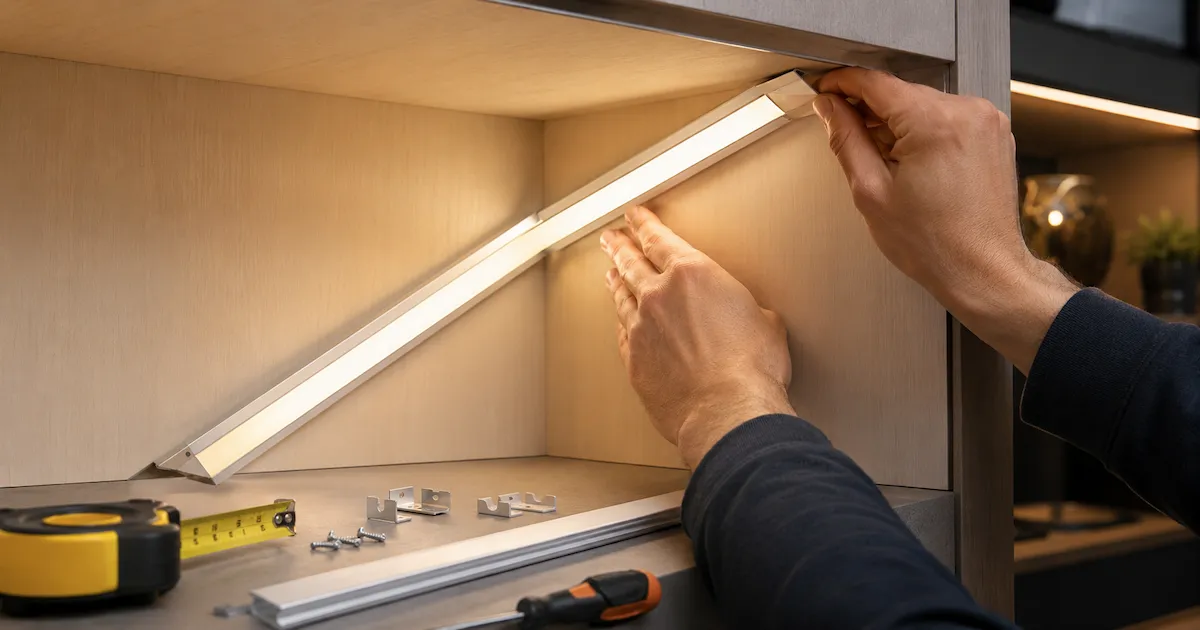
The adhesive on LED strips bonds best to clean, dry, smooth surfaces. Dust, oil, sawdust, and powder coating residue reduce bond strength. In warm cabinets, weak bonding becomes worse. Many installers add thermal tape or silicone adhesive for long runs, but the product must be compatible with heat transfer and future service.
We often see installers struggle with cable exits at corners. If the wire bends too sharply, solder pads can crack. If the end cap has no proper hole, teams cut it roughly on site. That slows the work and looks poor. Pre-drilled end caps or pre-soldered leads can save time on repeat projects.
Clip spacing also matters. Too few clips can let profiles twist or vibrate. In furniture, screws must not split the board. In drywall coves, alignment must be checked before the diffuser goes in.
| Installation Checklist | Field Target | Failure If Missed |
|---|---|---|
| Clean mounting surface | No dust, oil, paint flakes | Strip peeling or profile movement |
| Test diffuser fit | Snap in and remove smoothly | Broken covers or loose covers |
| Plan cable exit | No sharp wire bending | Cracked solder joints |
| Use enough clips/screws | Straight profile line | Sagging or rattling |
| Test before closing | Full run lit and stable | Rework after furniture assembly |
9. How should aluminum corner profiles be specified for procurement?
When choosing aluminium LED profile manufacturers, procurement teams should not buy corner profiles by photo alone. A profile may look right online but fail in strip width, diffuser fit, finish, carton strength, or clip design.
Start with the LED strip width. Common strips are 8 mm, 10 mm, and 12 mm, while RGBW or high-output strips may be wider. The inner channel must allow the strip and solder pads to sit flat. If the strip touches the diffuser or side wall, heat and assembly problems can follow.
Next, define the length and packaging. A 3 m profile reduces joints but increases freight and handling risk. A 2 m profile is easier for courier shipment and smaller workshops. For container orders, long cartons need strong end protection because bent profile ends cause waste.
Ask for drawings. A proper drawing should show outer size, inner width, diffuser type, wall thickness, angle, clip method, and end cap style. For repeat projects, keep an approved sample. Photos alone are not enough for stable supply.
| Procurement Parameter | Recommended Requirement | Reason |
|---|---|---|
| Inner width | Strip width + assembly clearance | Prevents buckling and solder stress |
| Wall thickness | Match wattage and rigidity needs | Supports heat spreading and straightness |
| Diffuser material | PC for impact resistance | Better durability than brittle covers |
| Accessory set | Clips, screws, end caps | Avoid site delays |
| Drawing approval | 2D profile drawing with tolerances | Reduces wrong shipments |
10. How can you test if an aluminum profile is suitable before bulk order?
A sample test can prevent expensive mistakes. You do not need a large lab for every check, but you should test fit, heat, light, finish, packaging, and installation time.
Start with a real assembly. Install the actual LED strip into the profile, add the diffuser, mount it in the same orientation as the project, and run it for several hours. Measure surface temperature at the hottest point. If the profile will be inside a cabinet, test it inside a closed cabinet, not on an open desk.
In our lab tests using integrating spheres, we compare light output before and after adding the diffuser because transmission loss can change lux levels. For project work, a handheld lux meter can still give useful field data if you measure at a fixed distance.
Then test handling. Cut the profile with the tool your installers will use. Check burrs, cover fit after cutting, end cap fit, and whether the finish scratches too easily. A profile that is hard to cut may raise labor cost across hundreds of meters.
| Test Item | Simple Method | Pass Standard |
|---|---|---|
| Strip fit | Install full strip sample | Flat PCB, no forced bending |
| Heat test | Run 4–8 hours | Stable temperature, no adhesive lift |
| Diffuser loss | Compare lux with/without cover | Matches project lux target |
| Cut quality | Cut with site tool | Clean edge, cover still fits |
| Packaging check | Inspect carton and end protection | No bent ends after transport |
Conclusion
Aluminum is usually the best material for LED strip corner profiles because it supports heat control, straight installation, better appearance, and longer service life. Plastic, steel, and silicone still have valid uses, but aluminum is the safer default for commercial corner lighting with real warranty pressure. Check wattage, alloy, finish, diffuser, tolerances, and installation method before bulk order. If you are unsure about heat or voltage drop for a project, send our engineering team your drawings and strip data. We’ll calculate it manually.
FAQ
Q1: Is aluminum always required for LED strip corner profiles?
No. Low-power decorative strips in open-air, short-run projects may work with plastic. For commercial projects, long operating hours, or strips above 10 W/m, aluminum is usually the safer choice because it spreads heat and improves mechanical stability.
Q2: What aluminum alloy is commonly used for LED strip profiles?
6063 aluminum alloy is widely used because it extrudes cleanly, has good surface quality, and supports anodized or powder-coated finishes. T5 temper is common for reliable handling and profile shape stability.
Q3: Can aluminum profiles stop LED strips from overheating?
They reduce heat risk, but they cannot fix an overloaded design. Strip wattage, airflow, ambient temperature, profile size, and contact quality all matter. For high-power strips, test the full system before bulk installation.
Q4: Which diffuser is best for aluminum corner profiles?
Opal PC diffusers reduce glare and LED dots, while clear covers give higher light output. For dot-free lines, pair a deeper profile with COB or high-density LED strip. Always test brightness loss before approval.
Q5: What should I check before ordering aluminum corner profiles in bulk?
Check inner width, wall thickness, finish, diffuser fit, end caps, clips, packaging, and 2D drawings with tolerances. Build one real sample assembly and run a heat and light test before confirming mass production.
