
Curved wall lighting looks clean only when the profile follows the surface without twisting, hotspots, loose tape, or thermal stress. Many projects fail because buyers specify a normal rigid profile, then force it onto a radius it was never made to handle. That leads to callbacks, uneven lines, adhesive failure, and margin loss. The practical solution is to select the profile by bending direction, LED strip type, wattage, diffuser quality, and mounting conditions. From our manufacturing floor perspective, the best profile is not always the most expensive one. It is the one that fits the site geometry, power design, and installer workflow. Early coordination between design, procurement, and installation teams prevents most rework.
1. What makes a flexible LED profile suitable for curved walls?
Understanding what flexible LED profiles are and how they transform lighting design helps buyers select a channel that bends cleanly in the required direction while protecting the LED strip and controlling heat. However, not every flexible LED profile bends in the same direction or supports the same minimum radius, diffuser type, and strip width.
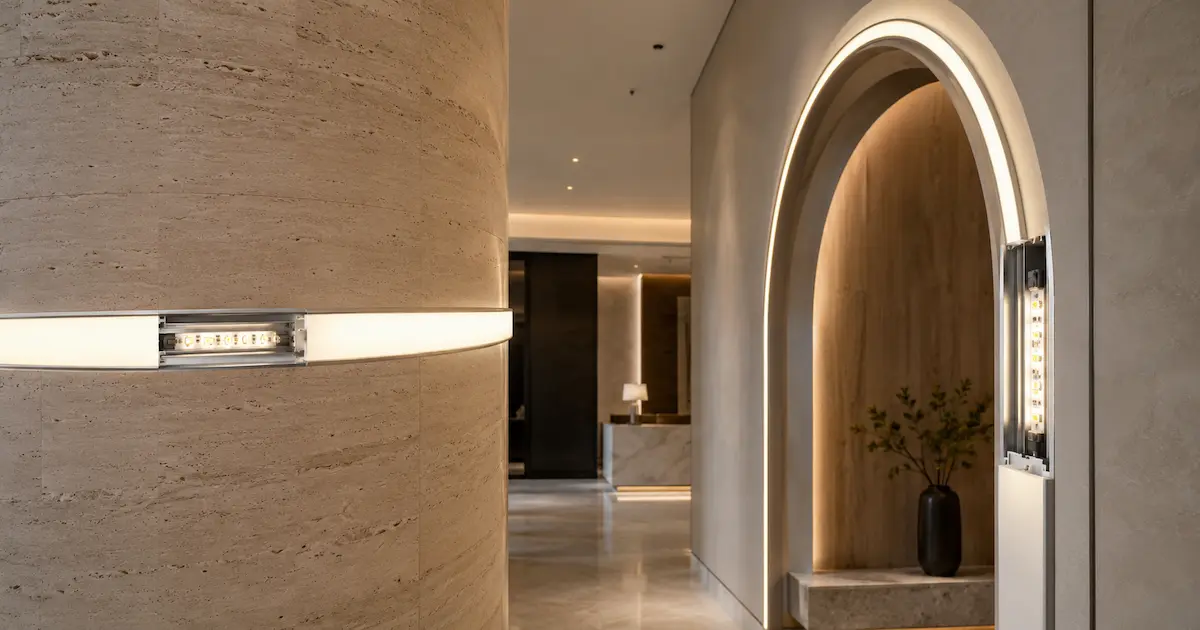
Some profiles bend horizontally for sweeping wall curves. Others bend vertically for arches and ceiling-to-wall coves. A profile that works around a round column may fail badly on a wave-shaped hotel corridor because the twisting force is different.
We often see installers struggle with three site issues:
- ● The wall radius is tighter than the profile’s minimum bending radius
- ● The LED strip is too wide for the internal channel
- ● The diffuser pops out after repeated bending
For commercial work, the profile must also support repeatable installation. A distributor may sell hundreds of meters into one project, so inconsistent bending or color shade changes can become a real reputation problem.
| Suitability Factor | What to Check | Why It Matters on Site |
|---|---|---|
| Bending direction | Horizontal, vertical, or 3D bend | Prevents twisting and diffuser gaps |
| Minimum radius | Often 150 mm to 500 mm | Avoids deformation and strip damage |
| Inner width | 8 mm, 10 mm, 12 mm, 15 mm | Matches strip PCB width |
| Heat path | Aluminum body or thermal silicone | Protects LED lifespan |
| Diffuser grip | Snap-in, co-extruded, or frosted lens | Reduces callbacks |
A brief test protocol—bending a 300 mm sample, fitting the diffuser, and running a 24-hour thermal check—can save time and warranty claims later.
2. Which side-bending aluminum profile works best for round columns?
Side-bending aluminum LED profiles are usually the best choice for round columns, curved retail walls, and circular reception counters. They bend left to right along the wall plane, so the light line stays flat against the surface.
A good side-bending aluminum channel uses segmented cuts or a flexible extrusion shape. Comparing which flexible LED profiles offer the best heat management is especially important for 10 W/m to 18 W/m strips, because an aluminum body normally transfers heat more effectively than an all-silicone design. In our lab tests using integrating spheres, we have seen that stable strip temperature helps maintain lumen output and color consistency after aging tests.
Typical usage scenarios include:
- ● A luxury hotel lobby with curved stone columns
- ● A shopping mall corridor with rounded feature walls
- ● A branded retail display with circular wall accents
One field example: a contractor used a rigid U-channel on a 450 mm radius column and cut relief slots manually. The line looked acceptable during mock-up, but after three weeks the diffuser started lifting at each cut. A purpose-made side-bending profile would have saved rework.
| Side-Bending Profile Type | Best Use | Typical Radius | Strip Width | Main Limitation |
|---|---|---|---|---|
| Slotted aluminum channel | Columns, curved walls | 300–500 mm | 8–12 mm | Visible stiffness on tight bends |
| Flexible aluminum with PC cover | Retail light lines | 250–400 mm | 8–10 mm | Cover must be seated carefully |
| Slim side-bend channel | Furniture and displays | 150–300 mm | 5–8 mm | Lower heat capacity |
When selecting, consider the finish and mounting method—anodized or powder-coated channels behave differently on-site and can influence adhesion and appearance over time.
3. When should you choose vertical-bending profiles for arches?
A correctly specified bendable LED profile is suitable for arches, curved ceiling coves, domed niches, and wall features where the channel must bend vertically without twisting. If side-bending profiles follow a plan-view curve, vertical-bending profiles follow an elevation-view curve.
Many drawings show a beautiful arch, but the bill of materials only says “LED aluminum profile.” That vague note can cause procurement errors. If the profile bends in the wrong direction, installers may force it and create a wavy, unsafe line.
Vertical-bending channels are often used in:
- ● Mosque arch lighting and cultural building interiors
- ● Restaurant entry arches with warm white COB strips
- ● Museum niches where glare control matters
In our production checks, we measure cover fit after bending because the diffuser is the weak point. If the cover loses grip on an arch, gravity makes the issue worse.
For arches, specify these points in your request:
- ● Inner channel width
- ● Required bending direction
- ● Minimum and maximum radius
- ● Mounting method: clips, screws, adhesive, or recessed slot
- ● LED strip wattage per meter
Pro Tip from the VST Technical Team: “For arch projects, ask for a 300 mm sample bent to your actual radius before placing a batch order. A flat sample tells you almost nothing about diffuser behavior under stress.”
Also plan for access points or removable sections for maintenance, since vertical bends can hide solder joints and connectors behind the diffuser.
4. Are silicone neon flex profiles better for seamless curves?
Silicone neon flex profiles can be better for seamless curves when the project needs a continuous dot-free light line with higher moisture resistance. They are widely used for curved wall outlines, signage, facade edges, spa interiors, and backlit decorative grooves.

A silicone LED profile can bend more smoothly than many aluminum channels, making it suitable for decorative outlines, signage, spa interiors, and continuous curved features. Buyers should compare which flexible LED profiles provide the best diffusers for soft light, especially when using COB or high-density SMD strips to create a seamless, dot-free curved line. However, they do not dissipate heat like aluminum. That means power density must be controlled.
Common Myth: Higher wattage always means better brightness.
Reality: Brightness depends on lumen efficiency, diffuser loss, strip density, drive current, and thermal control. A 12 W/m COB strip in a suitable silicone neon profile may look cleaner than a 20 W/m strip running hot inside a tight sleeve.
Here is a practical comparison.
| Silicone Neon Flex vs Aluminum Flexible Profile | Silicone Neon Flex | Flexible Aluminum Profile |
|---|---|---|
| Light appearance | Very smooth, dot-free | Smooth if diffuser depth is enough |
| Heat dissipation | Medium to low | Better |
| Outdoor suitability | Good with IP65/IP67 versions | Needs sealed accessories |
| Shape options | Top bend, side bend, 3D bend | Mainly side or vertical bend |
| Service access | Harder to repair | Easier to replace strip |
| Best project type | Decorative curves and signs | Architectural linear lighting |
When we tested this against a standard 12V strip in a shallow plastic sleeve, the silicone neon sample gave a cleaner line, but the aluminum-backed sample kept a lower operating temperature. That difference affects warranty risk. For outdoor or continuous installations, check UV resistance of silicone and the long-term flexibility rating—some silicones stiffen slightly over years in direct sun.
5. How do COB LED strips change profile selection?
Understanding whether flexible LED profiles are compatible with high-density COB LEDs is important because COB strips produce a more continuous light surface with less visible dotting, even inside relatively shallow channels. For curved wall lighting, this helps when the designer wants a clean line but the profile depth is limited.
COB strips are popular for hospitality, furniture, premium retail, and curved residential-style commercial areas. A 10 mm wide COB strip can fit many flexible LED profiles for curved wall lighting, but you still need to check current load and heat.
In our lab tests using integrating spheres, COB strips often show smoother visual output through milky diffusers. Yet their dense phosphor layer can trap heat if mounted in low-grade plastic channels. That is why we prefer aluminum-backed profiles for medium to high wattage COB applications.
Three practical examples:
- ● A hotel corridor curve using 3000K COB with 90+ CRI
- ● A cosmetics store curved wall using 4000K dot-free shelf accents
- ● A showroom arch with dimmable 24V COB for scene control
| COB Strip Parameter | Recommended Profile Choice | Field Note |
|---|---|---|
| 5–8 W/m | Silicone or slim aluminum | Good for soft accent lines |
| 10–14 W/m | Flexible aluminum with diffuser | Better thermal balance |
| 15–20 W/m | Wider aluminum channel | Check temperature rise |
| 24V input | Preferred for longer runs | Lower current than 12V |
| High CRI 90+ | Use good diffuser material | Keeps color quality visible |
If your buyer wants a premium look, COB is often worth the cost. If the project is price-driven, high-density SMD with a deep diffuser may work. Buyers should review LED basics, including lumen maintenance, thermal performance, and color quality, alongside LM-80/L70 data and supplier aging reports when specifying COB strips for long-term installations.
6. What IP rating should curved wall lighting profiles have?
The required IP ratings depend on the installation area and indicate how effectively the lighting enclosure resists the intrusion of solid objects and liquids. Dry indoor curved walls can use IP20 profiles. Damp areas, spas, bathrooms, facade recesses, and exterior wall curves need IP65, IP67, or a sealed neon flex system.
Let’s be real: many failures are not caused by the LED strip itself. They are caused by water entering a joint, connector, or cut end. Curves make this risk higher because bending can stress seals and end caps.
For indoor commercial walls, an open aluminum profile with a diffuser is easy to service. For outdoor curved wall lighting, silicone neon flex with molded end caps is usually safer. Recessed outdoor channels can also work, but only if drainage and cable exits are planned.
| IP Rating | Suitable Area | Profile Recommendation | Risk if Wrong |
|---|---|---|---|
| IP20 | Dry interior walls | Aluminum flexible profile | Dust only, no water defense |
| IP44 | Covered indoor damp zones | Profile with covered strip | Not for direct water spray |
| IP65 | Exterior covered curves | Sealed neon flex or sealed channel | End cap quality matters |
| IP67 | Wet facade grooves | Fully sealed silicone neon | Harder maintenance |
| IP68 | Special immersion cases | Custom sealed system | Needs project testing |
We once saw a project fail because IP65 strip was installed inside an unsealed metal groove where water collected. The strip label looked correct, but the system design was wrong. Always rate the full system, not just the strip. Also specify cable gland types and potting compound where needed to maintain ratings through bends and junctions.
7. How do voltage and driver choices affect long curved runs?
Voltage and driver choices affect brightness uniformity, cable size, dimming performance, and installation cost. For long curved wall lighting, 24V is usually more practical than 12V because it carries lower current at the same wattage.
Voltage drop becomes visible as dimmer light at the far end of the run. On curved walls, this is easy for clients to spot because the light line is continuous. A small brightness change across 15 meters can look like a defect.
When we tested this against a standard 12V strip over a long run, the 12V sample showed faster voltage drop under the same power load. The 24V version maintained a more consistent output, especially with power injection at planned points.
| 12V vs 24V for Curved Wall Lighting | 12V LED Strip | 24V LED Strip |
|---|---|---|
| Best run length | Short features | Medium to longer lines |
| Current load | Higher | Lower |
| Voltage drop risk | Higher | Lower |
| Cutting interval | Often shorter | Often longer |
| Driver selection | Wide availability | Wide availability |
| Best use | Small displays, short arcs | Hotel corridors, long curves |
Driver selection matters too. Use constant-voltage drivers with enough headroom, suitable dimming protocol, and safe installation spacing. For 0-10V, DALI, Triac, or PWM control, test the strip and driver together before site delivery. This protects your bottom line because dimming complaints are expensive to troubleshoot after handover. Also document expected run lengths, fuse protection, and cable sizes in the handover pack. The following professional installer guide explains the key considerations for specifying, connecting, testing, and installing LED strip lighting before integrating it into a curved architectural profile.
8. What diffuser and lens options create the cleanest light line?
The cleanest light line comes from matching LED density, diffuser opacity, profile depth, viewing angle, and the LED’s color and spectrum characteristics. A curved wall often places the light at eye level, so glare and hotspots become more visible than in ceiling coves.
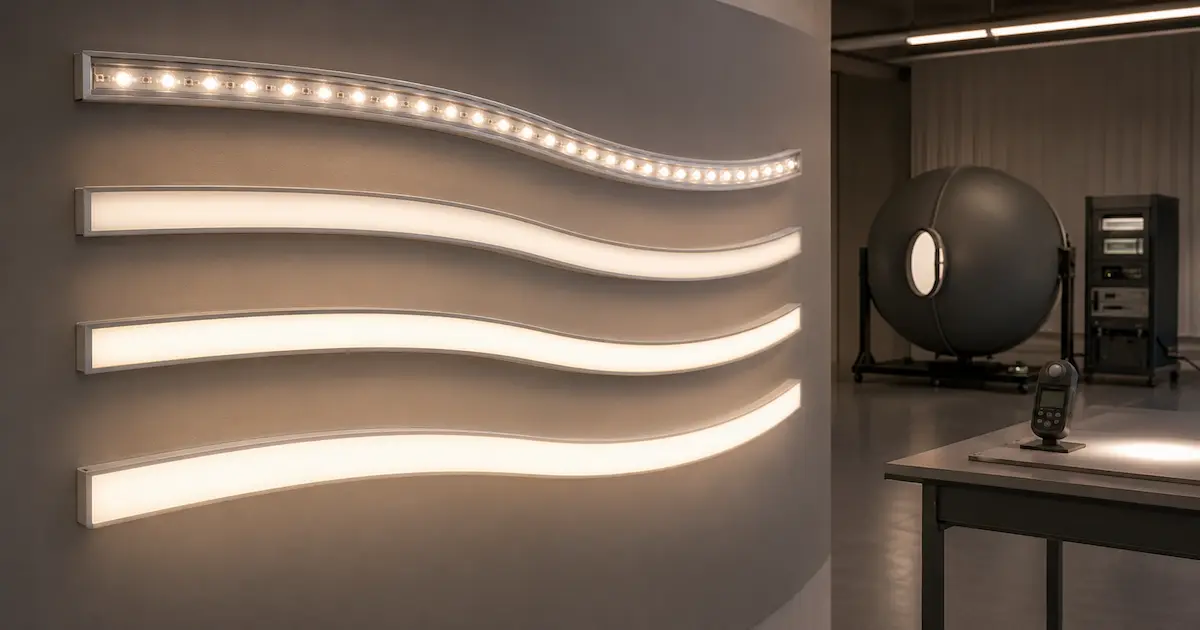
Frosted PC diffusers are common because they balance light transmission and dot hiding. Opal diffusers hide dots better but reduce lumen output. Clear covers give higher output but usually show LED points, unless the strip is COB or hidden from direct view.
Here’s the practical rule: the shallower the profile, the denser the LED strip should be.
| Diffuser Type | Light Effect | Transmission | Best Match | Trade-Off |
|---|---|---|---|---|
| Clear PC | Sharp, high output | 85–95% | Hidden indirect lighting | Shows dots |
| Frosted PC | Balanced line | 70–85% | General curved walls | Mild dotting possible |
| Opal PC | Soft line | 55–75% | Eye-level features | Lower output |
| Silicone lens | Seamless neon effect | 45–70% | Decorative curves | More heat retention |
| Black diffuser | Dark-trim look | Lower | Premium interiors | Needs higher lumen strip |
From our manufacturing floor perspective, diffuser batch consistency is often ignored. A slight milky shade difference between batches can stand out on a long curved wall. We explain this specific check because ignoring it leads to visible mismatch in hotel corridors, mall walls, and branded retail spaces. Always record diffuser batch numbers on pack labels so that replacements match the installed runs.
9. How should installers mount profiles on curved walls?
Installers should mount flexible LED profiles using a method that matches wall material, radius, service needs, and cable route. Adhesive alone may work for light silicone profiles on smooth surfaces, but mechanical clips or screws are safer for commercial work.
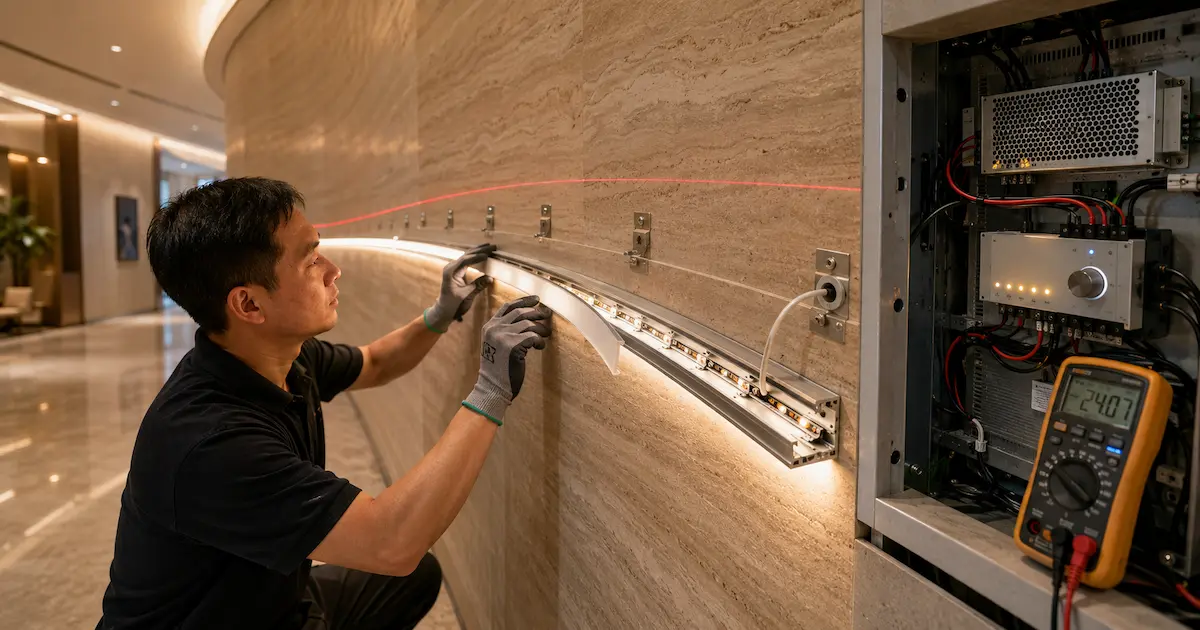
We often see installers struggle with uneven plaster, painted surfaces, and stone cladding. The profile may be flexible, but the wall may not be accurate. That is why a dry-fit stage is so valuable.
Recommended workflow:
- ● Mark the curve using a laser or flexible template
- ● Test-bend the profile before fixing
- ● Pre-drill or prepare clips at consistent spacing
- ● Feed cables without sharp bends
- ● Test polarity and dimming before closing the diffuser
| Installation Checklist | Pass Criteria | Common Fix |
|---|---|---|
| Radius verified | Profile bends without twist | Use larger radius or different bend type |
| Surface cleaned | No dust, oil, or loose paint | Clean and prime surface |
| Clips aligned | Light line stays straight | Re-mark with template |
| Cable exit planned | No pressure on solder joint | Add relief hole or longer lead |
| Driver tested | No flicker at dim level | Match driver and controller |
| Diffuser seated | No gaps on curve | Warm cover slightly and re-seat |
For contractors, installation speed affects profit. Custom pre-soldered leads, labeled sections, and factory-cut lengths can save hours on a project. They also reduce soldering mistakes on curved, hard-to-access walls. Include a simple as-built drawing with cable runs and driver locations for faster maintenance later.
10. Which flexible LED profile is best for your project type?
The best curved LED profile depends on the project geometry, bending direction, strip wattage, environmental conditions, and maintenance requirements—not on a single product name. A round column, wet facade, recessed arch, and retail display all need different choices.
Use this selection table as a quick guide.
| Project Type | Recommended Profile | LED Strip Match | Key Buying Note |
|---|---|---|---|
| Round indoor column | Side-bending aluminum | 24V SMD or COB, 8–12 W/m | Confirm radius and cover grip |
| Interior arch | Vertical-bending aluminum | COB, 3000K or 4000K | Request bent sample |
| Outdoor curved facade | Silicone neon flex IP67 | Sealed 24V neon strip | Check end caps and drainage |
| Retail wall display | Slim flexible aluminum | High-density SMD or COB | Prioritize clean diffuser |
| Spa or damp room | Sealed silicone profile | Low to medium wattage | Rate full system, not strip only |
| Luxury hotel corridor | Aluminum profile with opal cover | 24V COB, CRI 90+ | Control binning and diffuser batch |
A procurement manager should also ask about packaging. Flexible profiles can deform if packed badly. Long lengths need proper reels, cartons, or protective inserts. A technical director may care more about thermal data, LM-80 LED packages, and driver compatibility.
The real answer is to match profile mechanics with electrical design. If you send drawings showing radius, length, mounting surface, and expected brightness, the supplier can recommend a safer option with fewer assumptions. Consider scheduling a mock-up run on-site to confirm visual appearance before bulk ordering.
Conclusion
Flexible LED profiles for curved wall lighting need more than a nice catalog photo. You need the right bend direction, heat path, diffuser, IP rating, voltage plan, and mounting method. Side-bending aluminum suits columns. Vertical-bending profiles suit arches. Silicone neon flex suits seamless wet or decorative curves. If you are unsure about voltage drop, bending radius, or strip wattage for your project, send our engineering team your drawings. We’ll calculate it manually and suggest a practical profile setup.
Takeaway: small early tests and clear specification notes prevent costly rework at handover and keep client satisfaction high.
FAQ
Q1: What is a flexible LED profile for curved wall lighting?
A flexible LED profile is a bendable channel that holds LED strip lights and helps create a clean light line on curved walls, columns, arches, or rounded features. It can be made from aluminum, silicone, or a hybrid structure.
Q2: How does a side-bending LED profile work?
A side-bending profile bends left and right along the wall plane. It is commonly used around round columns, curved corridors, and circular decorative walls where the light line must follow the horizontal curve.
Q3: Is silicone neon flex better than aluminum profile?
Silicone neon flex is better for seamless, waterproof, decorative curves. Aluminum flexible profile is better for heat dissipation, service access, and architectural applications using higher wattage strips.
Q4: Should I use 12V or 24V LED strips for curved wall lighting?
For long curved runs, 24V is usually preferred because it reduces current and helps control voltage drop. 12V can work well for short arcs, furniture, and compact display lighting.
Q5: What details should I provide before ordering flexible LED profiles?
Provide the bending radius, profile direction, project length, LED strip wattage, color temperature, IP rating, mounting surface, dimming method, and whether you need pre-cut lengths or pre-soldered leads.
