
Battery powered LED strip lights usually last in two different ways: the LED chips themselves can often operate for 25,000 to 50,000 hours, while the battery runtime per charge or per battery set may last only a few hours to several days depending on battery type, strip wattage, brightness level, and usage pattern.
If you want a practical answer, most battery LED strip systems run anywhere from 6 to 40 hours before batteries need replacement or recharging, but the strip hardware can remain usable for years.
If you are comparing products for a project, this is where confusion starts. Many buyers see a long LED lifespan claim and assume the whole system will keep working for months without attention. It will not. Battery runtime, heat, driver quality, and switching frequency all affect actual service life.
That gap can lead to wrong product selection, callbacks, margin loss, and unhappy end users. In our lab tests using integrating spheres and thermal checks, we often see battery packs fail long before the LEDs do. This article explains the real lifespan, what changes it, and how to estimate runtime with confidence.
1. What does “Last” really mean for battery powered LED strip lights?
There are two lifespan questions you need to separate. One is LED strip service life. The other is battery runtime. If those get mixed together, product expectations become unrealistic.
LED strip service life refers to how long the LEDs, resistors, PCB, solder joints, and control components remain functional before light output drops too far or failures begin. For decent quality strips, this may be 25,000 to 50,000 hours. In low-cost products, it can be far less.
Battery runtime is much shorter. It means how long the strip stays lit on one battery set or one full charge. That could be 4 hours in a bright display shelf, 12 hours in a wardrobe light, or 30 hours in low-output accent use.

We often see installers struggle with this distinction in retail and furniture projects.
A client asks, “Will this last a year?” The correct response is, “The strip may last years, but the battery will not.”
| Term | What it means | Typical range |
|---|---|---|
| LED service life | Operating life before major lumen drop or failure | 25,000–50,000 hours |
| Battery runtime | Time per charge or battery set | 6–40 hours |
| Battery cycle life | Number of recharge cycles before capacity fades | 300–1000 cycles |
| System life | Combined real-world usable life | 1–5 years depending on design |
2. How long can batteries power LED strip lights in real use?
Actual runtime depends on battery chemistry, voltage, strip wattage, and dimming level. Here’s the deal. A small AA battery pack powering a 5V decorative strip behaves very differently from a lithium pack powering a 12V motion-activated strip.
For example, three AA alkaline batteries may run a low-power strip for 8 to 15 hours. Rechargeable NiMH batteries may offer slightly lower voltage but more stable output. A lithium-ion battery pack can run longer and support brighter strips more efficiently.
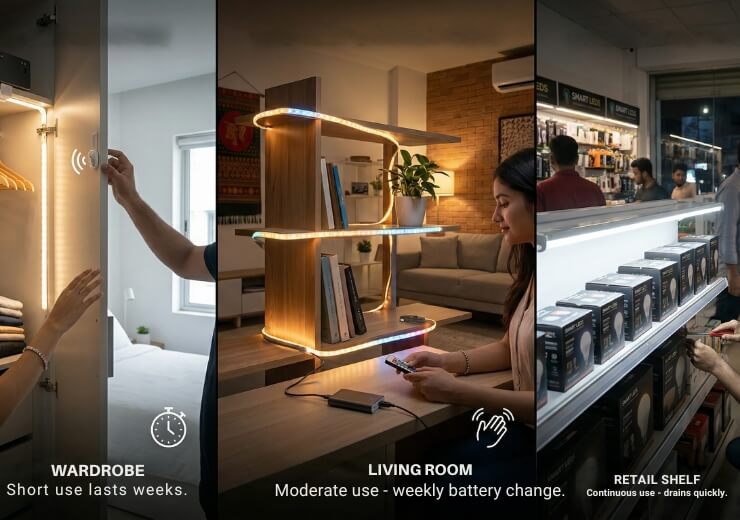
Field example one: a battery closet light using 4xAA cells and a motion sensor may last several weeks because it turns on only for short periods. Field example two: a trade show display running continuously at full brightness may drain in one day. Field example three: a restaurant menu board with evening-only operation may get several nights per charge.
When we tested this against a standard 12V strip, runtime dropped quickly once brightness exceeded 70% on a small battery pack. That matters because buyers often select strips by visual brightness and forget energy demand.
| Battery setup | Common strip type | Typical runtime |
|---|---|---|
| 3xAA alkaline | 5V mini strip | 6–12 hours |
| 4xAA alkaline | 5V/6V low-power strip | 8–15 hours |
| 4xAA NiMH | Low-power sensor strip | 6–12 hours |
| USB power bank 10,000mAh | 5V strip | 10–30 hours |
| 12V lithium pack | 12V strip | 8–25 hours |
3. Which factors have the biggest impact on runtime and lifespan?
Several variables control both runtime and long-term durability. Power draw is the obvious one. A 4.8W/m strip will last much longer on battery than a 14.4W/m strip. But there’s a catch. Heat, switching quality, and battery discharge characteristics matter too.
Brightness setting changes current consumption immediately. So does strip length. A one-meter strip on a battery pack may perform well, while a three-meter version of the same model can become impractical.
Ambient temperature also changes outcomes. In cold storage areas, battery capacity drops. In hot cabinets or enclosed signage, LED strip heat rises and accelerates material aging. From our manufacturing floor perspective, adhesive aging and solder stress are often overlooked in battery applications because users focus only on runtime.
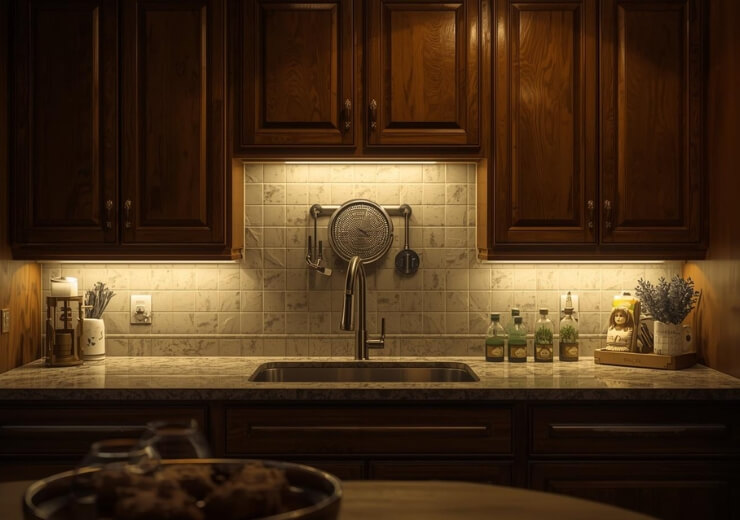
Three practical examples stand out. Under-cabinet lights in kitchens suffer from heat and grease. Temporary exhibition strips suffer from frequent switching and transport damage. Shelf lighting in retail often suffers from low-cost battery holders with weak contact springs.
| Factor | Effect on runtime | Effect on lifespan |
|---|---|---|
| Strip wattage | High impact | Medium impact |
| Battery capacity | High impact | Low impact |
| Heat buildup | Medium impact | High impact |
| Duty cycle | High impact | High impact |
| Dimming | High impact | Medium impact |
| Battery holder quality | Medium impact | Medium impact |
4. How do battery type and voltage change performance?
Battery chemistry matters more than many buyers expect. Alkaline, NiMH, lithium primary, and lithium-ion rechargeable cells all behave differently under load. This is where it gets interesting. Two packs with the same nominal voltage may give very different usable runtime.
Alkaline batteries are cheap and easy to source. They work for short-term decorative use, seasonal displays, and low-drain motion lights. NiMH rechargeables reduce replacement cost over time, which helps maintenance budgets. Lithium primary batteries perform better in low temperatures and keep voltage more stable. Lithium-ion packs usually offer the best balance for repeated use.
Common Myth: higher battery voltage always means longer life. Reality: voltage must match the strip design, while capacity in watt-hours and current handling determine runtime. Too much voltage can damage the strip. Too little can cause dim output or unstable control.
In our lab tests using integrating spheres, we found that stable voltage delivery keeps lumen output more consistent over a discharge cycle. That is why battery chemistry affects not only runtime but also visible quality.
| Battery type | Pros | Limits | Best use |
|---|---|---|---|
| Alkaline | Low upfront cost | Voltage drops under load | Temporary use |
| NiMH | Rechargeable, lower operating cost | Lower nominal voltage | Frequent short-cycle use |
| Lithium primary | Good cold performance | Higher cost | Harsh environments |
| Lithium-ion | Rechargeable, high energy density | Needs protection circuit | Regular daily use |

5. How does strip quality affect long-term durability?
Not all LED strips age at the same speed. Chip binning, PCB copper weight, resistor quality, solder consistency, and adhesive grade all change the result. Cheap strips may light up on day one, yet fail early from heat stress or weak joints.
We once saw a display case project fail because the strip looked bright in a sample test but used a thin PCB and unstable resistors. After repeated battery cycling, sections began to flicker. In a hotel furniture application, poor adhesive caused the strip to detach, bend, and crack solder pads. In a portable exhibition unit, weak soldering at wire connection points caused intermittent failure after transport.
Our Chief Engineer notes that heat dissipation is often ignored in enclosed battery lighting assemblies. That is a direct cost issue. If the strip runs hot, lumen depreciation speeds up, adhesive softens, and maintenance intervals shorten.
This matters to your bottom line because a battery lighting project is often selected for ease of installation. If product quality is weak, you lose that labor advantage through callbacks.
| Quality element | Low-grade outcome | Better-grade outcome |
|---|---|---|
| LED chip binning | Inconsistent brightness | Stable output |
| PCB copper | More voltage drop and heat | Better current handling |
| Solder quality | Early intermittent faults | Better mechanical stability |
| Adhesive backing | Peeling and movement | Secure installation |
| Resistors and ICs | Flicker or drift | Reliable control |
6. How do usage patterns change how long battery LED strips last?
Usage pattern can matter more than the battery label. Continuous operation drains cells quickly and creates more heat. Sensor-based or timer-based use can multiply practical service time.
Take three common examples. A wardrobe strip that runs for two minutes at a time can last weeks on one charge cycle. A holiday decoration lit six hours every evening may need weekly battery service. A product display running all day at full output may be a poor fit for battery power from the start.
Frequent switching also has an effect. Quality strips handle on-off cycles well, but low-cost controllers and battery boxes often fail at switches, connectors, or infrared sensors. We often see installers struggle with motion sensor placement, where false triggers waste energy and shorten battery runtime.
Ready for the good part? Smart operating logic helps a lot. Dimming, timeout shutoff, occupancy sensing, and schedule control can reduce power demand without hurting the lighting task.
| Usage pattern | Runtime effect | Typical recommendation |
|---|---|---|
| Continuous full brightness | Fast drain | Use larger battery or mains power |
| Timed use | Moderate drain | Good for cabinets and displays |
| Motion-activated | Low average drain | Best for wardrobes and stairs |
| Dimmed ambient use | Lower drain | Good for accent lighting |
| Intermittent transport/display use | Variable | Use rugged connectors |
7. What are the warning signs that a battery LED strip is nearing failure?
Battery powered strips rarely fail without some warning. Dimming is the most common sign. Flicker is another. Color shift, uneven sections, and delayed startup also point to trouble.
You need to separate battery depletion from strip damage. If brightness drops evenly, the battery is often the cause. If one segment is dark while others remain lit, suspect a strip fault, solder crack, or connector issue. If the controller resets or the sensor misfires, voltage instability may be the issue.
We saw three useful field patterns. In museum display lighting, fading output near closing time pointed to undersized battery packs. In furniture lighting, corner bending caused one segment to fail while the rest worked. In portable retail stands, oxidation on battery terminals caused intermittent flicker.
A simple maintenance check can prevent replacement of the wrong part.
| Symptom | Likely cause | Quick action |
|---|---|---|
| Uniform dimming | Battery depletion | Replace or recharge battery |
| Flicker | Loose contact or low voltage | Check terminals and pack output |
| One dark section | Strip segment damage | Replace damaged strip section |
| Color change | Overheating or chip aging | Inspect heat and strip quality |
| Delayed turn-on | Weak battery or controller issue | Test voltage and controller |
8. How can you calculate expected runtime before buying?
A simple runtime estimate saves a lot of trouble. Start with strip wattage, total strip length, battery voltage, and battery capacity. Then convert battery capacity into watt-hours and divide by strip power.
For example, a 5V strip drawing 5 watts powered by a 10,000mAh power bank gives about 50Wh in theory. Real usable energy is lower because of conversion loss, battery protection limits, and discharge behavior. Practical runtime may be closer to 8 to 9 hours rather than the theoretical 10.
Here is a quick method:
- Total strip power = watts per meter × strip length
- Battery energy = voltage × amp-hours
- Estimated runtime = battery watt-hours ÷ strip watts
- Apply 70% to 85% efficiency for real-world result

We explain this because ignoring the calculation leads to underpowered installations, visible dimming, and maintenance complaints. In our lab tests using integrating spheres, we compare initial output and output at reduced battery voltage to estimate useful runtime rather than just “time until off.”
| Example setup | Battery energy | Strip load | Estimated practical runtime |
|---|---|---|---|
| 5V 10,000mAh bank + 5W strip | 50Wh | 5W | 8–9 hours |
| 12V 2Ah pack + 9.6W strip | 24Wh | 9.6W | 1.8–2.1 hours |
| 4xAA alkaline + 2W strip | about 12Wh | 2W | 4–5 hours |
| 4xAA NiMH + 2W strip | about 9.6Wh | 2W | 3–4 hours |
9. What installation and maintenance steps help extend life?
Good installation can add a lot of usable life. Poor installation can waste even a good strip. Keep bending gentle. Avoid sharp corners. Use proper connectors or soldering. Keep batteries accessible for service. Mount the strip on a clean, stable surface.
Heat control matters. Even low-wattage strips benefit from aluminum backing or at least a surface that does not trap heat. In enclosed wood furniture, this small step can slow lumen decay and adhesive failure. For portable displays, strain relief on wire exits prevents repeated cable pull damage.
Three examples make the point. A stair project improved runtime after dimming and motion sensing were added. A retail shelf system stopped flickering after gold-plated connectors replaced loose push clips. A cabinet project gained longer strip life once the installer moved the battery box away from a warm transformer cavity.
Here’s a practical checklist.
| Installation checkpoint | Why it matters | Best practice |
|---|---|---|
| Surface cleaning | Better adhesive grip | Remove dust and oil |
| Bend radius | Prevent PCB cracks | Avoid tight corners |
| Heat path | Lower thermal stress | Use aluminum profile if possible |
| Connector quality | Stable current flow | Use secure, tested connectors |
| Battery access | Easier maintenance | Leave service clearance |
| Sensor setup | Avoid false triggers | Adjust sensitivity and timing |
10. When should you choose battery power, and when should you avoid it?
Battery powered LED strip lights are useful, but they are not right for every job. They work well where wiring is difficult, usage is short, and maintenance access is easy. Think cabinets, wardrobes, drawers, temporary displays, exhibition stands, and low-duty decorative applications.
They are a poor choice for long continuous operation, high brightness task lighting, or hard-to-access installations. For example, under-shelf lighting in a busy store may consume too much energy for practical battery service. A long corridor accent strip may suffer from repeated battery replacement labor. Outdoor projects add moisture and temperature stress, which complicates battery reliability further.
From our manufacturing floor perspective, the best battery projects are designed around realistic duty cycle. The worst ones try to force battery power into applications that really need a driver and mains supply.
This choice affects operating cost, installer time, and customer satisfaction.
| Application | Battery power suitability | Reason |
|---|---|---|
| Wardrobes and drawers | High | Short duty cycle |
| Temporary displays | High | Easy maintenance access |
| Furniture accent light | Medium to high | Works well if dimmed |
| Retail all-day shelf light | Low | Heavy battery drain |
| Outdoor facade accent | Low | Environment and access issues |
| Continuous task lighting | Low | Better on wired power |
Conclusion
Battery Powered LED strip lights can last years as hardware, but their battery runtime usually lasts hours or days, not months. The real answer depends on wattage, battery chemistry, duty cycle, heat, and strip quality.
If you calculate runtime early and match the product to the application, you avoid service problems and protect project margins. If you are unsure about battery sizing, runtime estimates, or strip selection for a specific installation, contact a technical lighting team with your layout and operating hours for a manual review.
FAQ
Q1: How Long Do Battery-Powered LED Strip Lights Last on a Single Set of Batteries?
Most run between 6 and 40 hours, depending on strip power, battery type, brightness setting, and whether the light is used continuously or with a sensor.
Q2: Do LED strip lights or batteries usually fail first?
In most cases, the batteries reach the end of usable runtime long before the LED strip reaches the end of its service life.
Q3: Are rechargeable batteries better for LED strip lights?
They are often better for repeated use because they reduce replacement cost, though runtime depends on voltage, capacity, and the strip load.
Q4: Can battery powered LED strip lights be used for all-day lighting?
Usually no. Continuous all-day lighting drains batteries quickly and often makes wired power the more practical option.
Q5: How can I make battery powered LED strip lights last longer?
Use lower wattage strips, dim the output, add motion sensing or timers, improve heat management, and choose a battery pack sized for the real load.
