
LED profiles face harsh environmental challenges in many lighting applications, from bathroom accents to outdoor facades. In such settings, selecting a LED profile waterproof design is essential, as water exposure poses significant risks to electrical components potentially causing short circuits, corrosion, and premature system failure. For lighting professionals, understanding waterproof capabilities becomes crucial when specifying products for moisture-prone environments.
The waterproof characteristics of LED profiles vary dramatically depending on design, materials, and manufacturing quality. Here’s what you really need to know: Most LED profiles aren’t inherently waterproof but can achieve various degrees of water resistance through proper design and installation techniques.
This comprehensive analysis explores waterproofing technologies, IP ratings, installation best practices, and maintenance requirements that determine whether an LED profile truly offers reliable protection against moisture infiltration.
1. What Determines if an LED Profile is Waterproof?

LED profiles aren’t universally waterproof by default. Their water resistance capabilities depend on several critical factors working together as an integrated system. Let’s break this down into practical terms.
IP Rating System
The International Protection (IP) rating provides a standardized measurement of protection against solid objects and liquids. The rating consists of two digits: the first indicates protection against solid particles, while the second indicates protection against liquids. For instance, an IP67-rated LED profile offers complete protection against dust (6) and can withstand temporary immersion in water up to 1 meter deep (7).
Housing Materials
The profile’s primary construction material significantly impacts its waterproof capabilities. Aluminum remains the most common material due to its excellent heat dissipation properties, but its water resistance depends on surface treatments. Anodized aluminum provides enhanced protection against corrosion compared to raw aluminum. Premium profiles often use marine-grade aluminum with special coatings that withstand saltwater environments.
Sealing Technology
The critical weakness in any LED profile system often lies in the seams and connections. This might surprise you: Even with high-quality components, poor sealing can compromise the entire system. Manufacturers use various sealing methods, including silicone gaskets, rubber seals, and specialized waterproof adhesives to create barriers against moisture ingress.
| IP Rating | Protection Level | Suitable Applications |
| IP20 | No water protection, dust protection only | Indoor dry environments only |
| IP44 | Protected against solid objects >1mm and splashing water | Bathrooms (non-shower areas), covered outdoor spaces |
| IP65 | Dust-tight and protected against water jets | Outdoor installations, kitchens, bathrooms |
| IP67 | Dust-tight and temporary immersion protection | Pool surrounds, ground-level landscaping |
| IP68 | Dust-tight and continuous immersion protection | Underwater applications, fountains |
2. How Do Manufacturers Achieve Waterproofing in LED Profiles?

Achieving true waterproof status for LED profiles involves multiple manufacturing techniques working in concert. These techniques vary in complexity, effectiveness, and cost. But here’s the reality: No single approach guarantees complete waterproofing; rather, it’s the combination of methods that creates reliable moisture protection.
Extrusion Design Features
Advanced aluminum profiles feature purposeful design elements that channel water away from vulnerable areas. These may include drainage channels, moisture barriers, and specialized edge designs that prevent water from seeping into seams. The extrusion process must maintain precise tolerances to ensure components fit together properly without leaving gaps where water could enter.
Specialized Diffuser Attachments
The diffuser component, which covers the LED strip, plays a crucial role in waterproofing. Snap-fit diffusers with silicone or rubber gaskets create compression seals when properly installed. Some manufacturers produce co-extruded diffusers with integrated soft-edge sealing lips that conform to surface irregularities, creating more reliable moisture barriers.
End Cap Construction
End caps represent common failure points for waterproofing. Manufacturers address this vulnerability through injection-molded end caps with integrated gaskets or by using waterproof adhesives specifically formulated for aluminum-to-plastic bonding. Some premium systems use threaded end caps with O-ring seals, similar to those in marine applications.
The technical reality is this: Waterproof LED profiles require considerable engineering attention at every junction and seam. Cable entry points typically incorporate compression fittings, glands, or specialized grommets to maintain water resistance while allowing necessary electrical connections.
3. What Are the Different Waterproof Ratings for LED Profiles?

Understanding IP ratings goes beyond memorizing numbers; it’s about matching the appropriate protection level to specific application requirements. Let’s get specific about what these ratings mean for real-world applications.
Interpreting the IP Code System
The IP (Ingress Protection) code consists of the letters “IP” followed by two digits and sometimes an optional letter. The first digit indicates protection against solid objects on a scale from 0 (no protection) to 6 (dust-tight). The second digit indicates protection against liquids on a scale from 0 (no protection) to 8 (continuous immersion under pressure).
Common IP Ratings for LED Profiles
Most indoor LED profiles carry IP20 ratings, offering no specific water protection. For bathroom applications, minimum IP44 protection prevents splashing water from causing damage. Outdoor installations typically require IP65 or higher, depending on exposure levels. For ground installations or areas with standing water, IP67 becomes necessary. Submersible applications demand IP68 ratings with specified depth and time limitations.
Testing Methodologies
IP ratings aren’t arbitrary designations; they’re determined through standardized testing procedures. What you might not realize: These tests involve specific water volume, pressure, and exposure time requirements. For example, achieving an IP65 rating requires withstanding water jets from a 6.3mm nozzle at 12.5 liters per minute from a distance of 3 meters for at least 3 minutes from multiple directions.
| Environmental Condition | Recommended Minimum IP Rating | Key Protection Features |
| Indoor dry environments | IP20 | Basic finger protection, no water resistance needed |
| Kitchen/Bathroom (non-shower) | IP44 | Protected against water splashes from all directions |
| Shower areas | IP65 | Protected against low-pressure water jets |
| Outdoor covered areas | IP65 | Dust-tight and protected against water jets |
| Outdoor exposed areas | IP67 | Can withstand temporary immersion (rain pooling) |
| Pool surrounds/Water features | IP68 | Continuous immersion protection at specified depth |
4. How Does LED Strip Waterproofing Differ from Profile Waterproofing?

LED strips and profiles represent two distinct components of a lighting system, each with different waterproofing considerations. This distinction matters because waterproofing failure in either component can compromise the entire system.
LED Strip Waterproofing Methods
LED strips typically achieve water resistance through conformal coatings, potting compounds, or silicone tube encasement. Basic strips feature a thin polyurethane or silicone coating (IP33-IP44), while more robust protection comes from complete silicone encapsulation (IP65) or specialized silicone tubes with sealed ends (IP67-IP68). These methods directly protect the electronic components from moisture contact.
Profile as Secondary Protection
The aluminum profile serves as a secondary protection layer, creating a protected environment for the LED strip inside. Even with waterproof LED strips, the profile must still prevent water ingress to avoid corrosion of connectors, power supply damage, and potential electrical hazards. For truly waterproof installations, both components must meet appropriate protection standards.
System Integration Challenges
Here’s where installation expertise becomes crucial: The system waterproofing chain is only as strong as its weakest link. Cable entry points, power supply connections, and joining sections between profile segments all present vulnerability points. Professional installations require careful attention to these transition areas, often utilizing specialized connectors, junction boxes, and sealing techniques.
While some manufacturers claim their LED strip and profile combinations achieve IP67 or IP68 ratings, these specifications often apply to laboratory conditions rather than field installations. Practical waterproofing depends significantly on installation quality, appropriate component selection, and regular maintenance.
5. What Installation Techniques Ensure Waterproof Performance?

Even properly rated waterproof LED profiles can fail if installation techniques don’t maintain system integrity. The truth is, installation procedures often determine actual waterproof performance more than product specifications alone.
Surface Preparation
Proper installation begins with thorough surface preparation. Mounting surfaces must be clean, dry, and free of dust or oils that might prevent adhesive bonding. For outdoor installations, surfaces should be treated for moisture resistance first. Uneven surfaces require special attention, as gaps between the profile and mounting surface can allow water infiltration. Some installers apply a thin bead of clear silicone along the mounting edge before attachment.
Proper Sealing Techniques
Professional installers use specific sealing techniques at all junction points. End caps require appropriate waterproof adhesives, typically polyurethane or silicone-based products specifically formulated for aluminum-to-plastic bonds. Cable entry points need waterproof grommets or compression fittings. For maximum protection, some installers apply additional silicone sealant at all seams after assembly.
Corner and Joint Solutions
This is particularly important: Corner joints and linear connections between profile sections present major vulnerability points. Manufacturers offer specialized corner connectors with integrated sealing features, but these must be perfectly aligned and secured with appropriate adhesives. Custom-cut corner miters require special attention, with many professionals applying waterproof tape underneath the joint before securing with screws and sealing externally with clear silicone.
| Installation Component | Common Waterproofing Failure Point | Professional Solution |
| End caps | Poor adhesion, cracking from thermal expansion | Use waterproof adhesive specifically designed for aluminum-plastic bonds |
| Cable entry points | Water tracking along cables | Implement drip loops, cable glands with appropriate IP rating |
| Linear connections | Gaps between profile sections | Use specialized connectors with gaskets or seal with silicone |
| Corner joints | Imprecise cuts creating gaps | Use prefabricated corner connectors or apply waterproof tape under miter joints |
| Mounting surface interface | Water infiltration between profile and surface | Apply silicone bead along mounting edges before installation |
6. What Materials Are Used in Waterproof LED Profiles?
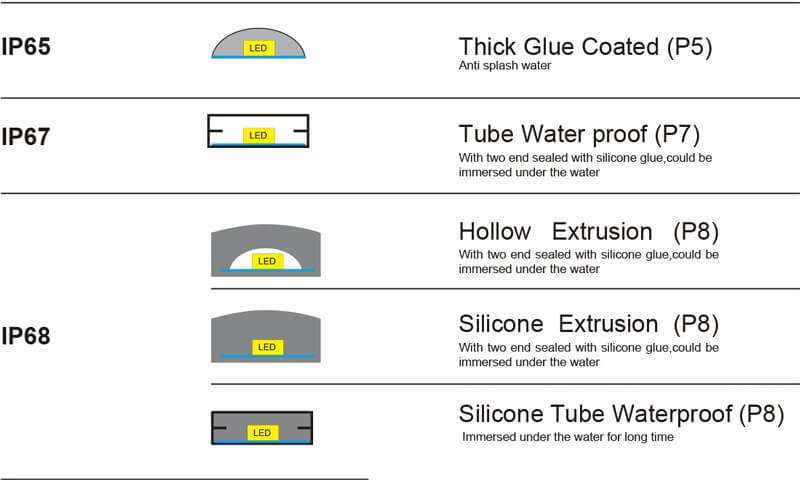
Material selection significantly impacts the waterproof capabilities and longevity of LED profiles in moisture-prone environments. You might be surprised to learn how much material science goes into truly waterproof profile systems.
Aluminum Alloy Variations
Not all aluminum profiles offer equal water resistance. Standard architectural aluminum (6063-T5) provides basic corrosion resistance, but marine-grade alloys (5052 or 6061) offer superior performance in wet environments. The extrusion quality matters significantly; precision manufacturing minimizes gaps and ensures consistent fitting between components. Premium profiles often feature anodized finishes (15-25 microns thick) that enhance corrosion resistance while allowing for color customization.
Diffuser Materials
Diffuser materials must balance light transmission with water resistance and durability. Polymethyl methacrylate (PMMA) offers excellent optical properties but may become brittle over time. Polycarbonate provides superior impact resistance and better weathering characteristics for outdoor applications. Some manufacturers use co-extrusion technology to create diffusers with rigid bodies and flexible sealing edges.
Sealing Components
Gaskets, O-rings, and seals define the waterproof integrity of the system. The technical details here matter: EPDM rubber provides excellent weather resistance but may degrade under UV exposure. Silicone gaskets offer superior temperature range performance (-50°C to +250°C) and UV stability, making them ideal for outdoor installations. TPE (thermoplastic elastomer) seals provide good compression recovery and moderate cost for less demanding applications.
For specialized applications like seaside installations, some manufacturers offer premium profiles with enhanced material specifications: marine-grade aluminum, stainless steel mounting hardware, UV-stabilized silicone gaskets, and specialized protective coatings to withstand saltwater exposure. These high-performance systems typically carry higher costs but provide significantly longer service life in challenging environments.
7. How Do Environmental Factors Affect Waterproof LED Profiles?

Waterproof LED profiles face diverse environmental challenges beyond simple water exposure. Here’s the thing: These environmental factors interact in complex ways, often amplifying each other’s effects on system integrity.
Temperature Fluctuations
Thermal cycling causes expansion and contraction of different materials at varying rates. This mechanical stress can compromise seals over time, particularly at joints between dissimilar materials. Profiles installed outdoors in climates with extreme temperature variations require specialized design features: expansion joints, flexible sealing compounds, and components rated for appropriate temperature ranges.
UV Radiation Effects
Ultraviolet radiation degrades many polymers used in LED profile systems. Diffusers may become yellowed or brittle, while gaskets and seals may crack or lose elasticity. Quality waterproof profiles incorporate UV stabilizers in all polymer components and may feature additional protective coatings. Installation orientation can also impact UV exposure; horizontally mounted profiles typically face accelerated degradation compared to vertical installations.
Chemical Exposure Considerations
What many professionals overlook is the impact of chemical exposures on waterproof integrity. Chlorinated pool environments, saltwater proximity, cleaning chemicals, and even pollutants in rainwater can deteriorate seals and corrode aluminum. For specialized environments, specific material compatibility must be verified; standard waterproof profiles often fail prematurely when exposed to harsh chemicals.
Humidity cycles present another significant challenge, particularly for installations that experience frequent transitions between wet and dry conditions. Condensation can form inside improperly sealed profiles during temperature changes, leading to internal corrosion even without direct water exposure. Proper ventilation or completely sealed systems with desiccant packages represent two different approaches to addressing this issue.
8. What Maintenance Ensures Long-Term Waterproof Performance?

Even the highest quality waterproof LED profiles require proper maintenance to preserve their moisture resistance over time. Let’s be honest: Neglected maintenance represents the primary reason for premature waterproofing failure in otherwise well-designed systems.
Regular Inspection Protocol
Establish systematic inspection schedules based on installation environment. Indoor installations of LED profiles in humidity-controlled environments may need only annual inspections, while outdoor systems in harsh conditions benefit from quarterly checks. Visual inspections should focus on seal integrity, looking for cracking, separation, or discoloration. Physical inspection involves gentle pressure testing of gaskets and seals to verify flexibility and compression recovery.
Cleaning Procedures
Proper cleaning maintains both aesthetic appeal and waterproof integrity. Use pH-neutral cleaners without abrasives or solvents that might damage seals. For outdoor installations, low-pressure washing removes debris that could trap moisture against seals. After cleaning, allow profiles to dry completely before nightfall to prevent moisture trapping. Some professionals apply specialty silicone protectants to gaskets and seals annually to maintain flexibility.
Remedial Maintenance
This step makes all the difference: Address small issues before they become system failures. Replace cracked or damaged diffusers promptly. Reapply appropriate sealant to compromised joints. For systems showing signs of water ingress, complete disassembly, drying, and reassembly with new sealing components may be necessary. Document all maintenance activities to establish patterns and predict replacement needs.
| Maintenance Activity | Indoor Frequency | Outdoor Frequency | Harsh Environment Frequency |
| Visual inspection | Annually | Quarterly | Monthly |
| Cleaning | Every 6 months | Quarterly | Monthly |
| Seal conditioning | Not typically required | Annually | Every 6 months |
| Sealant inspection | Annually | Every 6 months | Quarterly |
| Full component check | Every 3 years | Annually | Every 6 months |
9. How Do You Troubleshoot Water Infiltration in LED Profiles?

When water infiltration occurs despite waterproof specifications, systematic troubleshooting identifies the failure point and informs appropriate remediation. The challenge is water can enter at one point but manifest damage in a completely different location.
Identifying Entry Points
Water infiltration investigation begins with careful observation. Look for water droplets, mineral deposits, or corrosion patterns inside the profile. These indicators often reveal water travel paths rather than entry points. Perform controlled water testing using low pressure spray and food coloring to trace infiltration pathways. For persistent issues, thermal imaging during drying cycles can reveal moisture retention areas not visible to the naked eye.
Common Failure Points
Several areas consistently present waterproofing challenges in LED profile systems. End caps frequently fail due to inadequate adhesive application or material incompatibility. Cable entry points allow water tracking along conductors when not properly sealed with appropriate glands or drip loops. Linear connectors between profile sections fail when expansion/contraction cycles break seal integrity. Corner joints present special vulnerability due to their complex geometry and multiple material transitions.
Remediation Approaches
Here’s what professionals know: Complete disassembly and proper reassembly often proves more effective than spot repairs. Remove LED strip and thoroughly dry all components before reassembly. Replace compromised seals and gaskets rather than attempting to supplement existing ones. For chronic failure points, consider design modifications such as adding drip shields, changing orientation, or implementing redundant sealing measures.
For critical applications, some professionals implement water detection systems using specialized moisture-sensing tapes inside the profile connected to monitoring systems. These early warning systems allow intervention before water damage becomes extensive or creates electrical hazards.
10. What Are the Latest Innovations in Waterproof LED Profile Technology?

The waterproof LED profile market continues to evolve with innovative solutions addressing historical limitations. The exciting news is these advancements are making truly reliable waterproof installations more accessible and cost-effective.
Integrated Sealing Systems
Traditional waterproof profiles rely on multiple discrete sealing components, creating numerous potential failure points. Newer designs feature integrated sealing systems with co-extruded gaskets permanently bonded to aluminum profiles. This approach eliminates assembly variables and provides more consistent performance. Some advanced systems incorporate pre-applied adhesive sealants that activate during assembly, ensuring complete coverage at critical junctions.
Advanced Materials Development
Material science advancements deliver significant improvements in waterproof performance. Hydrophobic nano-coatings applied to aluminum surfaces enhance corrosion resistance without affecting thermal properties. New composite polymers for diffusers provide better UV stability while maintaining excellent light transmission. Specialized silicone formulations offer improved bonding to multiple substrates along with enhanced flexibility retention over time.
Smart Monitoring Capabilities
This changes the game completely: Integration of smart monitoring systems into waterproof LED installations provides real-time performance data. Humidity sensors inside profiles detect moisture infiltration before visible damage occurs. Temperature monitoring prevents condensation issues by triggering heating elements or ventilation systems. These smart features connect to building management systems, allowing preventative maintenance rather than emergency repairs.
| Innovation Category | Traditional Approach | New Technology | Key Benefit |
| Sealing Method | Separate gaskets and adhesives | Co-extruded integrated sealing systems | Reduced assembly variables, more consistent performance |
| Material Protection | Anodizing and paint | Hydrophobic nano-coatings | Superior corrosion resistance without affecting thermal properties |
| Connection Technology | Mechanical joints with separate seals | Welded/seamless connections | Elimination of potential failure points |
| Monitoring System | Visual inspection only | Integrated moisture/temperature sensors | Early detection of waterproofing failure |
| Installation Method | Field assembly of components | Pre-assembled modular systems | Quality-controlled waterproof integrity |
Conclusion
LED profiles can achieve reliable waterproof performance when properly designed, manufactured, installed, and maintained. The key factors determining waterproof capabilities include appropriate IP rating selection, quality materials, proper installation techniques of LED profiles, and regular maintenance protocols tailored to the specific installation environment.
For lighting professionals, understanding the comprehensive nature of waterproofing goes beyond product specifications to encompass the entire system lifecycle. Successful waterproof installations require attention to all potential vulnerability points and consideration of long-term environmental impacts on system integrity.
When specifying waterproof LED profile systems, balance the protection level with actual application requirements to optimize both performance and cost. Over-specification wastes resources, while under-specification risks premature failure and potential safety hazards. Work with reputable manufacturers who provide detailed technical specifications and installation guidelines specific to their products.
By applying the principles outlined in this analysis, lighting professionals can confidently implement LED profile systems that maintain their waterproof integrity throughout their service life, even in challenging environments.
FAQ
Q1: Can standard LED profiles be made waterproof after installation?
Standard LED profiles designed without waterproof features can rarely achieve reliable water resistance through post-installation modifications. While applying silicone sealant to joints and penetrations may provide limited protection against occasional splashes (approximating IP44 rating), this approach cannot deliver consistent protection for wet environments. The fundamental design elements—channeled water pathways, specialized gaskets, and properly engineered seals—cannot be effectively retrofitted. For truly waterproof applications, always select profiles specifically designed with integrated waterproofing features that carry appropriate IP ratings for the installation environment.
Q2: How long do waterproof seals typically last in outdoor LED profiles?
Waterproof seal longevity in outdoor LED profiles varies significantly based on environmental conditions, material quality, and maintenance practices. In moderate climates with regular maintenance, quality silicone gaskets typically maintain effective sealing for 5-7 years before showing degradation. EPDM rubber seals generally last 3-5 years before requiring replacement. Installations in harsh environments (coastal regions, extreme temperature variations, high UV exposure) may see seal degradation within 2-3 years. Premium systems using advanced materials with UV stabilizers and proper protective overhangs can extend seal life to 8-10 years. Regular inspection and proactive replacement of deteriorating seals before failure occurs represents best practice for maintaining system integrity.
Q3: What’s the difference between water-resistant and waterproof LED profiles?
The distinction between water-resistant and waterproof LED profiles involves significant technical differences in design, materials, and performance capabilities. Water-resistant profiles (typically IP44-IP54) offer protection against splashing water from limited directions and are suitable for humidity-prone indoor environments like bathrooms or kitchens. They feature basic protection measures like splash guards or simple gaskets. Waterproof profiles (IP65 and higher) provide comprehensive protection against water jets, temporary immersion, or continuous submersion depending on their specific rating. They incorporate sophisticated sealing systems, specialized gasketing at all joints, and precisely engineered water diversion features. This distinction matters critically during specification, as water-resistant profiles will fail in genuinely wet environments.
Q4: Can waterproof LED profiles be cut to custom lengths while maintaining their waterproof integrity?
Custom-cutting waterproof LED profiles requires specific techniques to maintain waterproof integrity. While the aluminum channel itself can be cut with appropriate tools (miter saw with non-ferrous blade or precision track saw), the newly created end requires proper sealing to restore waterproof protection. Professional installers use specialized end caps with appropriate gaskets and waterproof adhesives designed for aluminum-polymer bonds. The cut must be perfectly square and deburred to ensure proper cap fitting. For highest reliability in wet environments, factory pre-cut profiles with sealed ends offer superior performance compared to field modifications. If field cutting is unavoidable, some manufacturers provide special sealing kits specifically designed for their profile systems.
Q5: How do waterproof LED profiles affect heat management of the LED strips?
Waterproof LED profiles create complex thermal management challenges due to their sealed construction. While standard profiles allow some passive airflow around LED strips, waterproof versions create enclosed environments that can trap heat. This requires careful consideration of several factors: heat sink capacity of the aluminum profile (profile mass and surface area), thermal transfer efficiency (thermal tape quality), power density of the LED strip, and ambient temperature of the installation environment. High-quality waterproof profiles address this through oversized aluminum cross-sections, superior thermal interface materials, and sometimes active cooling strategies for high-output applications. Operating LED strips at reduced current in waterproof profiles extends system longevity by reducing thermal stress on seals and electronic components.
