
The solution is not to buy the brightest strip on the data sheet. You need a matched system. Strip, profile, cable, power supply, controller, and installation method must work as one package. In our lab tests using integrating spheres, aging racks, and thermal imaging cameras, we see how small specification changes affect output, color, and lifetime. This article gives you a practical specification path for commercial dome ceiling lighting.
1. What Makes Ceiling Dome Lighting Different From Straight Cove Lighting?
A ceiling dome changes how light behaves. In a straight cove, the strip usually throws light along a flat ceiling or wall. In a dome, light reflects across a curved surface, so any hot spot, color shift, or spacing error becomes more visible.

We often see installers struggle with circular layouts because the strip must bend around a radius while keeping equal distance from the dome surface. A small wave in the strip path can create a bright patch. A joint placed in the wrong place can leave a shadow. In a luxury hotel lobby, this can look like poor workmanship even when the strip itself is good.
For led strip lights for ceiling dome projects, you need to check:
- Dome diameter and radius
- LED strip bending direction
- Distance from strip to reflective surface
- Finish color and reflectance of the ceiling
- Access space for driver servicing
- Fire and safety rules for the building
| Ceiling Dome Factor | Field Risk | Better Specification Choice |
|---|---|---|
| Small radius curve | Strip lifting or cracked PCB | Side-bend strip or segmented layout |
| Glossy surface | Visible dotting and glare | COB strip or diffuser profile |
| Long circular run | Voltage drop | 24V or 48V strip with power injection |
| No maintenance hatch | Hard driver replacement | Remote driver cabinet |
| Warm interior design | Color conflict | 2700K or 3000K with 3-step binning |
Here’s the deal: dome lighting is a system job, not only a strip order. Spend time on the template and radius drawings to reduce rework and to allow the supplier to pre-cut, pre-solder, or pre-bend components where possible. Before reviewing the electrical and product specifications, this expert lighting-design overview explains how placement, indirect illumination, surface reflection, and layered light influence the final appearance of an interior space.
2. Which Voltage Is Best for LED Strip Lights for Ceiling Dome?
Voltage affects run length, cable size, driver cost, and installation time. Most dome projects use 24V systems because they balance safety, component availability, and reduced voltage drop, while an experienced 24V LED strip manufacturer can advise on run length, cable size, feed points, and driver loading. For very long commercial rings, 48V may be a better choice if local rules and driver availability allow it.

When we tested this against a standard 12V strip, the 12V sample showed visible brightness loss after a few meters under higher load. That matters in a dome because the eye compares the full circle at once. If one side is dimmer, the client will see it.
Use 12V only for short decorative rings, small furniture domes, or retrofit spaces where the run is short. Use 24V for most hotels, villas, retail ceilings, restaurants, and reception areas. Use 48V for long runs where fewer feed points reduce labor.
| Voltage Option | Best Use | Typical Run Control | Main Risk |
|---|---|---|---|
| 12V LED strip | Short dome accents under 5m | Many feed points | Fast voltage drop |
| 24V LED strip | Most ceiling dome projects | Feed every 5–10m depending wattage | Needs correct driver sizing |
| 48V LED strip | Large commercial circular domes | Longer runs with fewer feeds | Driver and approval matching |
For procurement teams, fewer feed points can save installation hours. However, the chosen voltage must match local compliance needs, dimming gear, and maintenance practice. Also consider the availability of compatible dimming drivers and emergency lighting integration at the chosen system voltage.
3. How Do You Choose Brightness, Wattage, and LED Density?
Understanding LED basics helps explain why higher wattage does not automatically produce better brightness, because useful output also depends on luminous efficacy, optical loss, heat management, and system design. Reality: brightness depends on lumen efficiency, LED density, optical loss, ceiling reflectance, and heat control. A 14.4W/m strip with poor efficiency can deliver less useful light than a 9.6W/m strip with higher lumen output and a proper profile.
For led strip lights for ceiling dome use, start with the lighting effect. Is the dome the main light source, or is it only ambient decoration? A restaurant may need soft indirect light. A shopping mall atrium may need a stronger luminous ring. A private villa may care more about smoothness than raw output.
In our lab tests using integrating spheres, we compare lumen per meter, CCT, CRI, and power draw before recommending strips for larger orders. Field data usually falls into these ranges:
| Application | Suggested Power | LED Density | Light Goal |
|---|---|---|---|
| Decorative dome accent | 4.8–9.6W/m | 60–120 LEDs/m | Soft glow |
| Hotel or villa dome | 9.6–14.4W/m | 120–240 LEDs/m or COB | Smooth ambient light |
| Retail or lobby dome | 14.4–20W/m | COB or high density SMD | Strong indirect wash |
| Large public ceiling | 18–24W/m | High output strip | High lumen package |
The cost risk is simple. Overspecification wastes driver budget and raises heat. Underspecification creates client complaints. The right wattage protects both appearance and margin. Always validate choices with a mock-up and measure lux distribution to ensure the ring meets the designer’s intent.
4. Which Color Temperature and CRI Should You Specify?
Color temperature determines the atmosphere of the dome, while the colour rendering of white LED light sources affects how naturally surrounding wood, fabrics, stone, artwork, skin tones, and retail finishes appear. For hospitality spaces, 2700K to 3000K is common. For offices and modern retail, 3500K to 4000K works well. For medical, technical, or airport areas, 4000K to 5000K may fit the design brief.
The larger the dome, the more visible color inconsistency becomes. We explain this binning detail because ignoring it leads to visible color mismatch in hotel corridors, banquet halls, and premium retail ceilings. Specify 3-step MacAdam binning when visual consistency matters. For budget projects, 5-step may pass, but it carries more risk.
From our manufacturing floor perspective, batch control matters as much as the LED chip brand. If a contractor orders half the project now and the rest two months later, the supplier should keep binning records.
| Space Type | Suggested CCT | Suggested CRI | Notes |
|---|---|---|---|
| Hotel lobby dome | 2700K–3000K | CRI 90+ | Warm, premium feeling |
| Restaurant dome | 2700K–3000K | CRI 90+ | Good for skin tones and wood |
| Retail dome | 3000K–4000K | CRI 90+ | Product color accuracy |
| Office reception | 3500K–4000K | CRI 80–90 | Clean and balanced |
| Public transit ceiling | 4000K–5000K | CRI 80+ | Brighter visual impression |
Pro Tip from VST Technical Team: “For dome ceilings, do not approve samples under only workshop light. Test them against the real ceiling paint or final material board.” Also observe the fixture under expected operating temperatures, as CCT and perceived tint can shift slightly under different thermal loads.
5. Should You Use SMD, COB, or Neon Flex for a Dome Ceiling?
The LED type changes the visual result. SMD strips are cost-efficient and widely used. COB strips create a continuous light line with fewer visible dots, and a qualified COB LED strip light manufacturer can help match chip density, wattage, PCB width, bending limits, and thermal requirements to the dome design. LED neon flex gives a protected, diffused body and can follow some curved shapes well.

For led strip lights for ceiling dome projects, the viewing angle and installation depth decide the best choice. If the strip is hidden deep inside a cove and only reflected light is visible, high-density SMD may be enough. If the strip line can be seen from below, COB or neon flex reduces dotting. If the dome has a tight circular groove, a side-bend neon flex may fit better than a flat PCB.
A field example: a retail client once rejected a dome mock-up because the SMD dots reflected on a glossy gold ceiling. The fix was not more wattage. The team changed to COB with a milky diffuser and reduced output slightly. The visual improvement outweighed the small increase in material cost.
| Strip Type | Strength | Limitation | Good Ceiling Dome Use |
|---|---|---|---|
| SMD 2835 strip | Good cost and efficiency | Dots may show | Hidden indirect coves |
| High-density SMD | Better smoothness | More heat at high wattage | Medium-depth dome channels |
| COB strip | Dot-free line | Needs good heat path | Premium visible grooves |
| LED neon flex | Diffused and protected | Larger body, lower bending limits | Decorative circular outlines |
Choose based on what the viewer sees, not only the price per meter. Also verify the diffuser material for UV stability and long-term yellowing, especially in sunlit atriums.
6. Why Are Aluminum Profiles and Heat Dissipation So Critical?
Heat is one of the main reasons dome installations fail early, so the correct solution to LED strip heat issues should be planned before choosing the strip wattage, channel size, diffuser, and cavity design. A dome ceiling often traps warm air. If the strip is stuck directly onto gypsum, wood, or painted plaster, heat cannot move away from the PCB. Adhesive weakens, LEDs discolor, and lumen output drops faster.
Well-specified aluminium profiles for indirect lighting spread heat, maintain a clean circular mounting line, support the diffuser, and simplify future strip replacement. They also hold diffusers, reduce dotting, and make replacement easier. For commercial projects, treat the channel as part of the complete lighting system, and work with experienced LED aluminium profile manufacturers to match the thermal mass, diffuser depth, mounting style, and curved-ceiling geometry.
Our Chief Engineer notes that heat dissipation is often ignored in decorative ceilings because the light is hidden. That hidden space can be hotter than the room below, especially near HVAC ducts or skylights.
| Profile Choice | Heat Control | Visual Result | Suitable Use |
|---|---|---|---|
| Bare strip on painted surface | Poor | Risk of waves and shadows | Temporary mock-ups only |
| Standard aluminum channel | Good | Cleaner line | Most dome coves |
| Deep profile with diffuser | Better dot control | Soft output | Visible dome grooves |
| Recessed curved profile | Good if fitted correctly | Architectural finish | Premium ceilings |
| Custom pre-cut arc segments | Strong consistency | Faster installation | Repeated hotel rooms or chains |
The bottom-line impact is clear. Good thermal design reduces replacements, protects warranty cost, and keeps the project looking stable after handover. Where possible, specify profiles with thermal contact to the strip’s copper runs and avoid deep, sealed cavities unless active thermal paths are included.
7. How Should Drivers, Dimming, and Controls Be Planned?
Driver planning can make or break a dome ceiling. A beautiful strip layout will still fail if the power supply is undersized, inaccessible, noisy, or incompatible with the dimmer. Always complete an accurate LED profile drivers calculation and include suitable capacity headroom instead of operating the power supply continuously at its maximum rating. A common practice is to load the driver to around 80% of rated capacity, depending on model, ambient temperature, and approval rules.
For dimming, match the driver and controller to the site system, and consider DALI lighting control where addressable zones, repeatable dimming, centralized management, and scene programming are required. Small private projects may use PWM controllers. Hotels often need 0–10V, DALI, TRIAC, DMX, or smart control integration. Large decorative domes may need zoning so the lighting team can tune brightness around the circle.
We often see installers struggle with mixed dimming protocols. A TRIAC wall dimmer paired with the wrong constant voltage driver can create flicker, buzzing, or poor low-end dimming.
| Control Method | Best Fit | Strength | Risk to Check |
|---|---|---|---|
| On/off driver | Simple decorative dome | Low cost | No scene control |
| TRIAC dimming | Residential and small commercial | Familiar wiring | Compatibility varies |
| 0–10V | Office and commercial | Stable dimming | Needs control cable |
| DALI | Hotels and projects | Addressable control | Commissioning skill needed |
| DMX | Dynamic decorative domes | Fine scene control | Higher setup cost |
Specify driver location early. Maintenance access is not a detail. It is a cost control point. Review the available flicker basics and request relevant flicker and EMC performance data when the dome will be used in photography, broadcasting, video production, or other camera-sensitive environments.
8. How Do You Prevent Voltage Drop in Circular Dome Runs?
Voltage drop is common in circular LED strip layouts because the run length can become longer than expected. A 4-meter diameter dome has a circumference of about 12.6 meters. If the strip runs in two rings, the total length can exceed 25 meters before the contractor notices the load.
For led strip lights for ceiling dome systems, feed power from more than one point when needed. Use thicker cable for longer distances. Split large rings into zones. Avoid pushing full current through one narrow PCB path.
In our lab simulations, a 24V strip at higher wattage can show visible end-of-run loss if powered only from one side over long lengths. Power injection at both ends or at center points brings the brightness back into balance.
| Symptom | Likely Cause | Field Fix | Design Prevention |
|---|---|---|---|
| One side of dome is dim | Voltage drop | Add feed point | Calculate run length before ordering |
| Strip end changes color | Low voltage at far end | Use thicker cable | Use 24V or 48V for longer runs |
| Driver gets hot | Overload | Split load | Keep driver load near 80% |
| Flicker at full output | Cable loss or weak driver | Shorten cable or upgrade driver | Test full load before closing ceiling |
| Uneven ring brightness | Single-side feeding | Feed both ends | Zone the circular layout |
Many voltage drop problems are cheaper to solve on paper than on site. Include a simple wiring diagram with feed point locations on the installation drawings to avoid guesswork during installation.
9. What Installation Details Reduce Callbacks?
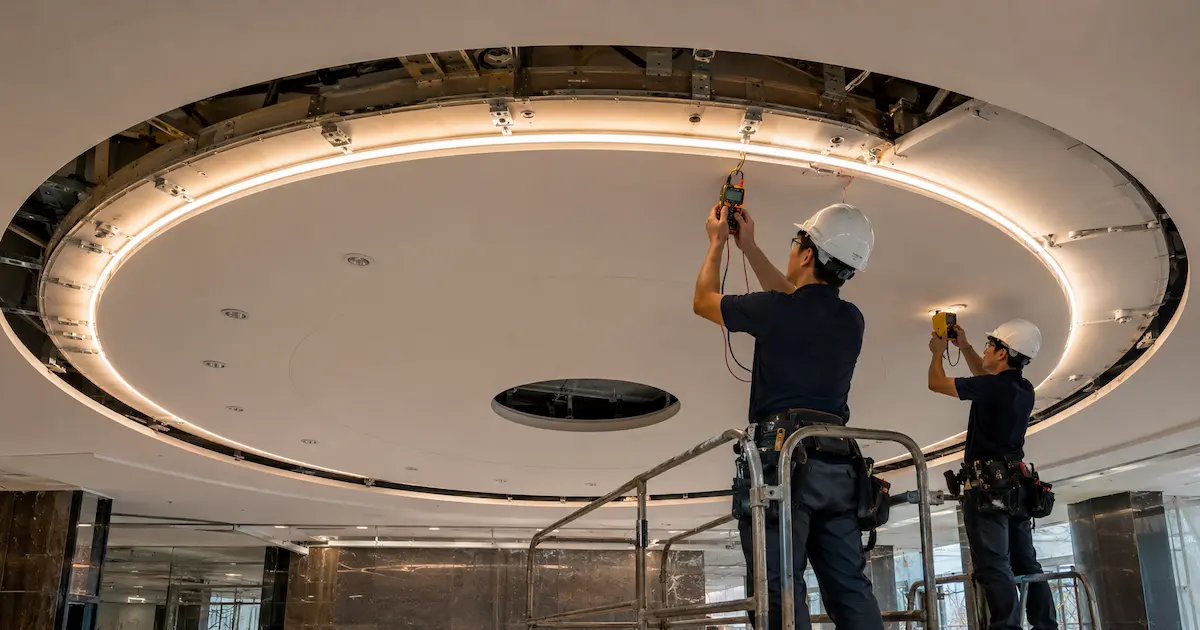
Good installation protects the specification. Even high-grade strips fail when the surface is dusty, the solder joints are stressed, or the cable route is poorly planned. Before mounting, review how to install aluminium profiles for indirect lighting, clean every channel, check polarity, dry-fit the full circular ring, and test each segment before closing the ceiling.
For dome ceilings, avoid sharp bends. Standard LED strip bends only along its allowed direction. Twisting the PCB around a circular groove can crack solder pads. If the design requires a side curve, use side-bend strip, short segments, or neon flex made for that bending direction.
From our manufacturing floor perspective, pre-soldered leads and pre-cut lengths can reduce field errors. On repeated hotel rooms or retail chain projects, custom kits save time and keep every ceiling consistent.
| Installation Step | Why It Matters | Field Check |
|---|---|---|
| Confirm dome radius | Prevents strip stress | Compare drawing with site measurement |
| Dry-fit profile segments | Avoids gaps and waves | Mark joint locations before fixing |
| Test polarity and voltage | Prevents dead sections | Use multimeter before final cover |
| Power up before closing ceiling | Finds defects early | Run for 30–60 minutes |
| Record driver locations | Speeds service | Add labels to ceiling plan |
A practical case: one contractor reduced callbacks by ordering strips with factory-soldered tails and matching connectors. Less soldering above head height means fewer weak joints. Also consider using strain-relief clamps and cable management to reduce pull forces on solder joints during installation.
10. How Should You Source LED Strip Lights for Ceiling Dome Projects?
Sourcing should focus on repeatable data, not only catalog photos. Ask for electrical data, lumen data, binning tolerance, CRI report, test conditions, PCB width, copper weight, IP rating, driver match, and approval documents such as CE, RoHS, UL, or CB where required.
For led strip lights for ceiling dome orders, samples should match the final production plan. If the sample uses one LED bin and the mass order uses another, the mock-up approval loses value. Ask the supplier to state CCT tolerance, lumen tolerance, and lead time honestly.
A dependable commercial LED lighting manufacturer should explain product limits clearly, including minimum bend radius, maximum run length, driver compatibility, thermal restrictions, and acceptable dimming systems. For example, not every strip can bend around a tight dome radius. Not every dimmer works with every driver. Not every high-watt strip can survive in a sealed cove. Clear limits prevent liability later.
Use this sourcing checklist:
- Request full spec sheet and test report
- Confirm CCT binning and CRI target
- Ask for thermal data with profile recommendation
- Match drivers and dimming protocol
- Request production photos for large orders
- Keep spare material from the same batch
Welcome to contact our technical support team if your project needs voltage drop calculation, sample matching, or custom pre-soldered leads.
Conclusion
LED strip lights for ceiling dome projects succeed when the strip, profile, driver, controls, and installation method are specified together. Focus on voltage drop, heat, binning, dimming compatibility, and service access. These choices protect safety, appearance, and margin. If you are unsure about the voltage drop calculation for your specific project, send our engineering team your drawings. We’ll calculate the load and feed points manually.
When planning procurement, include a short commissioning checklist and hold a pre-installation meeting with the electrician and supplier to align feed points and driver locations. That simple step cuts onsite decision time and reduces rework.
FAQ
Q1: What are led strip lights for ceiling dome applications?
They are flexible linear LED systems used inside curved, recessed, or layered dome ceilings. They usually create indirect ambient light, decorative rings, or soft architectural highlights. The full system includes LED strip, aluminum profile, diffuser, power supply, controller, wiring, and mounting accessories.
Q2: Is 12V or 24V better for a ceiling dome?
For most ceiling dome projects, 24V is better because it reduces voltage drop compared with 12V and allows longer runs with fewer power feed points. 12V can work for short decorative sections. Large commercial domes may use 48V if drivers and approvals fit the project.
Q3: How do I avoid visible dots in a dome ceiling?
Use COB strips, high-density SMD strips, or aluminum profiles with milky diffusers. Increase the distance between the strip and reflective surface when possible. Glossy dome finishes show dots more easily, so test samples on the actual ceiling material.
Q4: Do LED strips need aluminum profiles in ceiling domes?
Yes, for professional projects they are strongly recommended. Aluminum profiles help move heat away from the strip, keep the mounting line straight, hold diffusers, and make service work cleaner. Bare strip on plaster or wood raises failure risk.
Q5: How many power supplies are needed for a circular dome ceiling?
It depends on total wattage, voltage, driver capacity, cable distance, and zoning plan. Calculate total meters multiplied by watts per meter, then keep driver loading around 80% where suitable. Large rings often need several feed points or separate zones.
