
LED strip lights for lobby lighting are flexible linear LED systems used for coves, reception desks, wall slots, stair edges, ceiling details, and backlit surfaces. The best results come from matching voltage, wattage, color temperature, CRI, driver type, aluminum profile, and control method to the lobby’s layout and operating hours.
Lobby lighting looks simple on drawings, but field conditions can punish weak specifications. A slight color shift across a ceiling cove can make a hotel entrance look cheap. A driver with poor dimming can create flicker in a corporate reception area. Overloaded strips can fail early and lead to expensive callbacks.
The solution is not just buying brighter strips. You need a system: LED tape, heat sink, power supply, wiring plan, dimmer, diffuser, and testing standard. In our lab tests using integrating spheres, thermal cameras, and aging racks, we see how small specification choices affect real projects. This guide gives you a practical way to select and specify lobby LED strip lighting with fewer risks.
1. What Roles Do LED Strip Lights Play in Lobby Lighting?
LED strips work best in lobbies when they support the architecture rather than fight it. They create soft lines, guide movement, frame reception zones, and add depth to materials such as stone, wood, glass, and metal. Strip lighting should not carry the whole lobby alone unless the design has been calculated for that purpose.
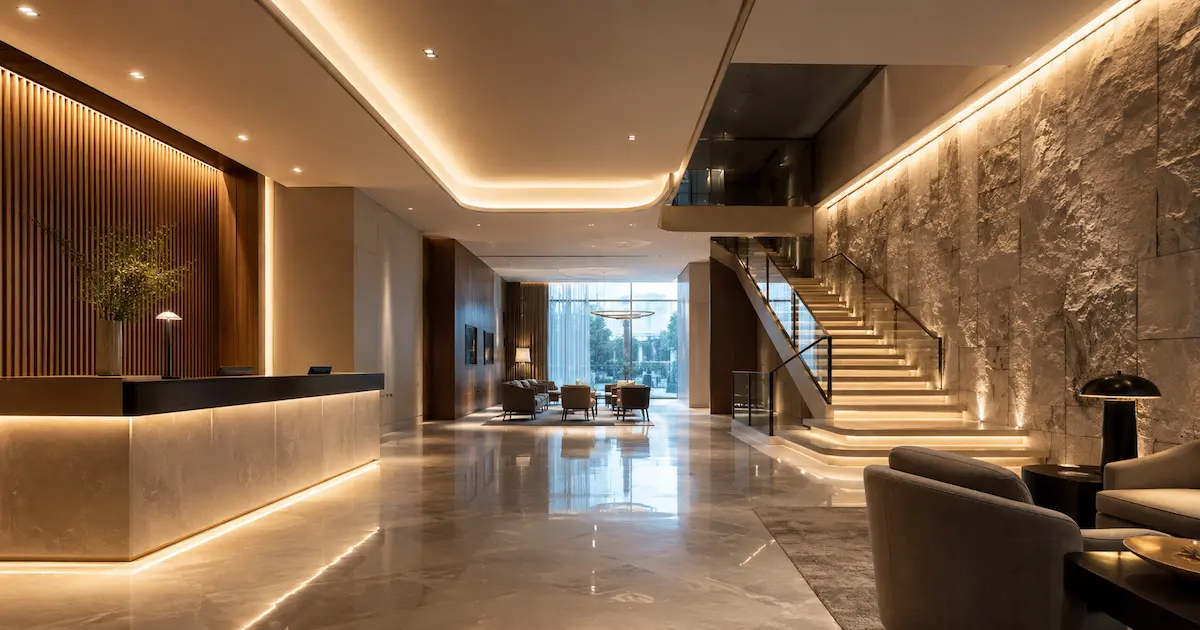
Good lobby applications include:
- Ceiling coves for indirect ambient light
- Reception desk under-counter or back-panel lighting
- Wall grazing for textured panels
- Stair and ramp guidance lines
- Signage backlighting and logo lighting
- Display shelves in waiting areas
| Lobby Area | Typical LED Strip Use | Preferred Effect | Key Risk |
|---|---|---|---|
| Ceiling cove | Indirect light | Soft ambient glow | Visible dark gaps |
| Reception desk | Front or rear glow | Brand focus | Glare to visitors |
| Feature wall | Grazing or washing | Texture depth | Uneven beam pattern |
| Stair edge | Marker lighting | Safety guidance | Mechanical damage |
| Signage | Backlight | Clear logo visibility | Hot spots |
2. How Do You Choose the Right Color Temperature for a Lobby?
Color temperature sets the emotional tone. Warm white (2700K–3000K) suits hotels and hospitality spaces. Neutral white (3500K–4000K) fits office lobbies and public buildings.
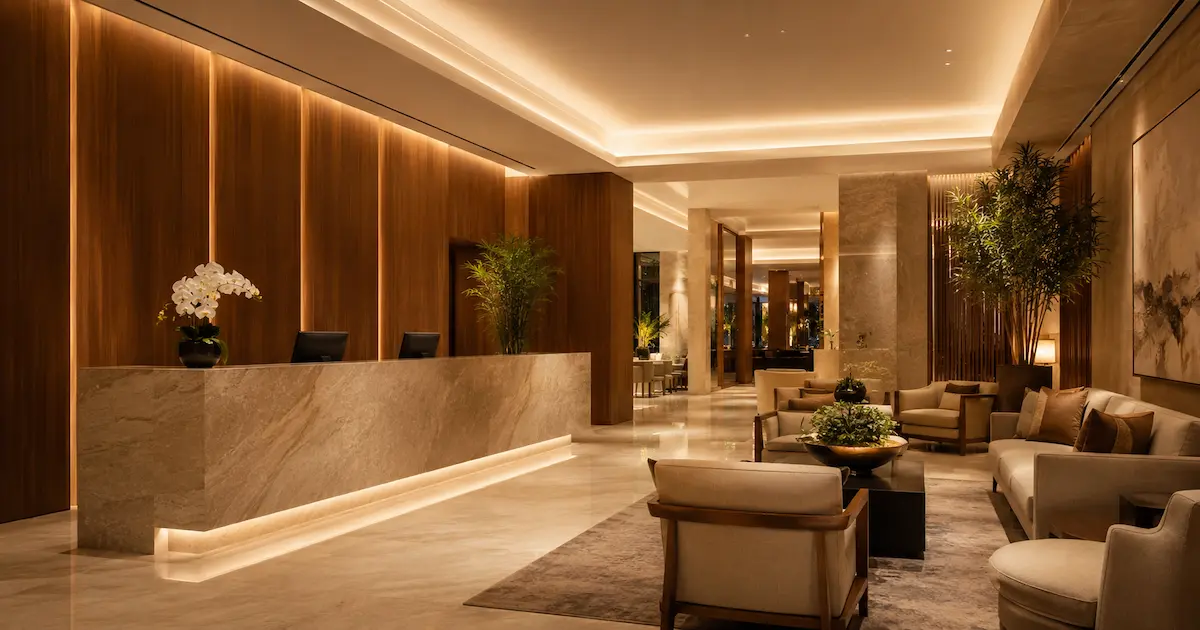
Consistency is critical—specify LED binning (3-step MacAdam) to avoid visible shifts across reflective surfaces like marble or metal. The U.S. Department of Energy’s LED basics explain how color appearance, color rendering, efficiency, and operating conditions affect the visual quality of LED lighting.
| Lobby Type | Suggested CCT | Typical CRI | Design Reason |
|---|---|---|---|
| Hotel entrance | 2700K–3000K | CRI 90+ | Warm and premium feel |
| Office reception | 3500K–4000K | CRI 80–90+ | Clean and efficient look |
| Retail lobby | 3000K–4000K | CRI 90+ | Better material and product color |
| Clinic lobby | 4000K | CRI 90+ | Clear, calm, and hygienic tone |
| Apartment lobby | 3000K | CRI 80–90+ | Comfortable daily use |
3. What Brightness and Wattage Should You Specify?
Brightness depends on lumen output, LED efficiency, diffuser loss, installation height, and reflectance. Typical lobby strip powers:
| Application | Suggested Power | Approx. Light Level Goal | Notes |
|---|---|---|---|
| Decorative ceiling line | 4.8–9.6W/m | Low accent | Use with diffuser for dot-free effect |
| Standard cove light | 9.6–14.4W/m | Medium ambient | Good balance for many lobbies |
| High ceiling indirect light | 14.4–24W/m | Strong ambient | Needs heat dissipation check |
| Reception desk glow | 9.6–18W/m | Brand feature | Avoid direct eye exposure |
| Wall grazing | 12–24W/m | Texture highlight | Beam angle and spacing matter |
Test actual lumen per meter and thermal behavior before procurement. Overspecified wattage raises energy, heat, and failure risk; underspecification causes complaints.
4. Should You Use 12V, 24V, or 48V LED Strips in Lobby Projects?
Voltage affects run length, voltage drop, cable size, and driver layout. For small details 12V can work. For most commercial coves, sourcing a properly tested system from an experienced 24V LED strip manufacturer is practical because 24V reduces current and supports longer runs more effectively than 12V. For very long runs, 48V reduces current but needs compatible components.
| Item | 12V LED Strip | 24V LED Strip | 48V LED Strip |
|---|---|---|---|
| Best use | Short details | Commercial coves | Long architectural runs |
| Voltage drop | Higher risk | Lower risk | Lowest among the three |
| Cut length | Shorter segments | Medium segments | Longer segments often |
| Driver selection | Very common | Very common | More project-based |
| Wiring current | Higher | Lower | Much lower |
| Typical lobby fit | Desk, signage | Cove, wall slot, desk | Long perimeter ceiling |
Always plan feed points and cable resistance—feed long runs from both ends or split into shorter circuits.
5. How Do LED Profiles and Diffusers Affect the Finished Lobby Look?
Aluminum profiles and diffusers determine heat management and visual quality. For ceiling coves and wall slots, installers should understand how to install aluminium profiles for indirect lighting so the strip remains straight, properly cooled, and visually uniform.

A deep recessed LED profile with an opal diffuser can produce a smoother, more integrated light line in visible ceiling slots, while shallow channels may still reveal individual LED points. Test the strip and profile as one system to confirm appearance and temperature.
| Profile Type | Best Lobby Use | Visual Result | Watch Point |
|---|---|---|---|
| Shallow surface profile | Hidden coves | Basic protection | Dots may appear |
| Deep recessed profile | Visible slots | Smooth line | Needs installation depth |
| Corner profile | Stair or display edge | Angled output | Check glare angle |
| Bendable profile | Curved walls | Continuous curve | Radius limits apply |
| Waterproof profile | Doorway or humid zone | Protected line | Heat must be checked |
6. What CRI, LED Density, and Chip Type Work Best?
Choose CRI and density to match finishes and viewing distance. For premium lobbies, CRI 90+ is recommended. Use higher LED density between 120 and 180 LEDs/m for visible channels, while understanding what a COB LED strip is can help explain why COB technology produces a smoother light line with fewer visible dots. Match chip type to thermal and optical design. For premium visible channels, a reliable COB LED strip light manufacturer should provide consistent phosphor quality, verified color binning, lumen data, and thermal test results.
| Strip Type | Best Use | Strength | Limitation |
|---|---|---|---|
| SMD 2835 | White coves | Good efficiency | Dots visible in shallow channels |
| SMD 5050 RGB | Color effects | Strong color output | More heat at higher power |
| COB white | Visible linear details | Smooth light line | Needs quality phosphor control |
| RGBW | Mood scenes | White plus color | More complex control wiring |
| Tunable white | Day-to-evening scenes | Flexible ambience | Requires proper controller setup |
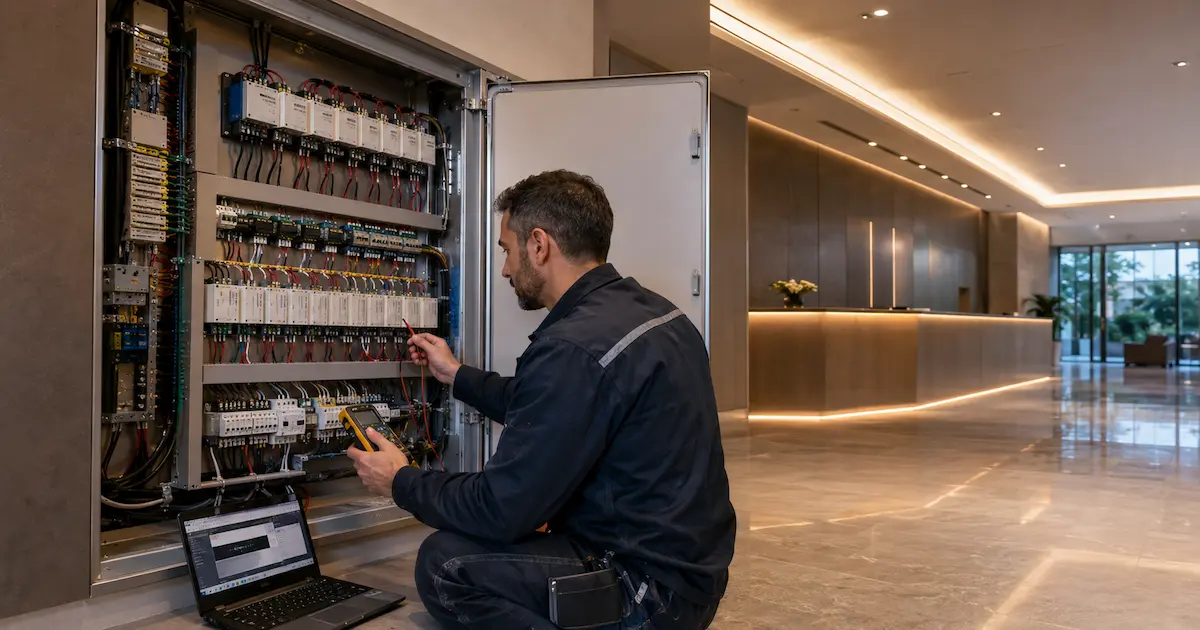
Select certified drivers with headroom and compatible dimming. DALI suits hotels and offices; DMX fits RGBW features; 0–10V and TRIAC remain common. Complete an LED profile driver calculation before procurement and aim to load each driver at about 80% of its rated capacity to provide sufficient headroom and extend service life.
| Control Method | Best Lobby Use | Strength | Risk if Misapplied |
|---|---|---|---|
| Non-dim | Utility or fixed scenes | Simple wiring | No mood adjustment |
| TRIAC | Small decorative zones | Familiar | Flicker risk |
| 0–10V | Office lobbies | Stable dimming | Control cable needed |
| DALI | Hotels and offices | Scene control | Commissioning skill needed |
| DMX | RGB/RGBW features | Accurate color scenes | More setup time |
Decide the control system before procurement to avoid mismatches and commissioning issues.
8. What Installation Details Prevent Callbacks?
Proper installation prevents many failures: prepare clean surfaces, use mechanical fixing in commercial areas, avoid sharp bends, strain-relieve solder joints, and label circuits. Run burn-in tests before closing ceilings.
| Checklist Item | Correct Practice | Failure Prevented |
|---|---|---|
| Surface preparation | Clean with alcohol, dry fully | Adhesive release |
| Heat path | Mount in aluminum profile | LED lumen decay |
| Run length | Follow voltage drop plan | Dim ends |
| Cable sizing | Match current and distance | Heat and power loss |
| Driver access | Install in serviceable location | Costly ceiling access |
| Circuit labels | Mark zone and driver | Slow maintenance |
| Batch control | Keep same CCT bin | Color mismatch |
9. What IP Rating and Protection Level Does a Lobby Need?
Most indoor lobby strips can be IP20 inside profiles. Use IP65 for areas near entrances, beverage counters, or planters. The IEC’s IP ratings guidance explains how the two-digit IP code classifies enclosure protection against solid objects, dust, and water exposure.
| IP Rating | Protection Level | Best Lobby Area | Key Caution |
|---|---|---|---|
| IP20 | Dry indoor use | Ceiling coves, wall slots | No moisture protection |
| IP44 | Light splash resistance | Semi-protected details | Confirm construction type |
| IP65 | Dust and water spray | Near entrances or planters | Check heat rise |
| IP67 | Temporary immersion | Wet threshold areas | Harder to service |
| IP68 | Continuous wet use | Rare for lobby interiors | Project-specific only |
10. How Do You Buy or Specify LED Strip Lights for Lobby Lighting?
Specify measurable items: voltage, watts/m, lumen/m, CCT, CRI, binning, IP rating, PCB width, LED density, driver type, dimming method, profile model, connector style, and certification needs. A qualified LED strip light manufacturer should be able to confirm these specifications with photometric reports, thermal testing data, wiring diagrams, and consistent production-batch records. Request integrating sphere reports, IES files, aging photos, and wiring diagrams. For long runs, ask for voltage drop calculations and pre-soldered leads to save site labor.
| Specification Item | Recommended Detail | Why It Matters |
|---|---|---|
| Voltage | 24V for most commercial coves | Reduces voltage drop |
| CCT | 3000K, 3500K, or 4000K with bin | Prevents mixed color |
| CRI | CRI 90+ for premium zones | Better material rendering |
| Driver | Certified, 80% loading target | Longer service life |
| Profile | Aluminum with diffuser | Heat and smooth output |
| Testing | Aging and photometric data | Reduces sourcing risk |
| Packaging | Zone labels and cut lengths | Faster site installation |
Conclusion: Spec Lobby LED Strips With Data, Not Guesswork
Match CCT, CRI, voltage, wattage, profile, driver, dimming, and IP rating to the actual lobby conditions. Test samples in the intended profile, include driver headroom, and plan feed points to avoid voltage drop. If you need help with voltage drop, dimming compatibility, or profile temperature, send your layout to our engineering team for a manual review.
FAQ
Q1: What are LED strip lights for lobby lighting?
Flexible linear LED systems used for indirect light, accent lines, signage backlighting, reception desk glow, stair guidance, and wall features. They work with drivers, profiles, diffusers, and controls.
Q2: How does voltage affect lobby LED strip installation?
Voltage affects current and voltage drop. 24V strips usually perform better than 12V for long coves; very long runs may use 48V or multi-point feeds.
Q3: What color temperature is best for a hotel lobby?
2700K–3000K for a warm premium feel; 3500K–4000K for cleaner commercial lobbies. Always specify binning to avoid visible differences.
Q4: Do lobby LED strips need aluminum profiles?
Yes—profiles improve heat dissipation, protect the strip, hold diffusers, and create a cleaner appearance.
Q5: Why do LED strips flicker after installation?
Flicker usually comes from incompatible dimmers, low-quality drivers, overloaded supplies, voltage drop, or poor wiring, so installers should know how to fix LED strip lights flickering before the lobby lighting system is handed over. Test the full system before handover.
