
If you source strip lighting for shelves, joinery, signage, retail, or architectural details, you already know the problem. Standard strips can show visible light dots, uneven output, and ugly shadow lines under shallow profiles. That leads to client complaints, rework, and wasted installation hours. The solution is often a COB 10mm LED light strip, which combines a compact board width with a uniform light surface. In our lab tests using integrating spheres, we see that COB designs can produce a much smoother visual effect than lower-density SMD options in the same application. This matters because lighting quality is not just about lumens. It affects finish quality, perceived product value, and installer reputation. In this article, I’ll explain what a COB 10mm LED light strip is, how it works, where it fits, what specifications matter, and what to check before you specify or buy it.
1. What does COB mean in a 10mm LED strip?
COB stands for Chip on Board. In this design, many LED chips are mounted directly onto the strip’s circuit board and then coated with phosphor and encapsulation material. The result is simple but very useful: instead of seeing separate bright points, you see one smooth lighting line.
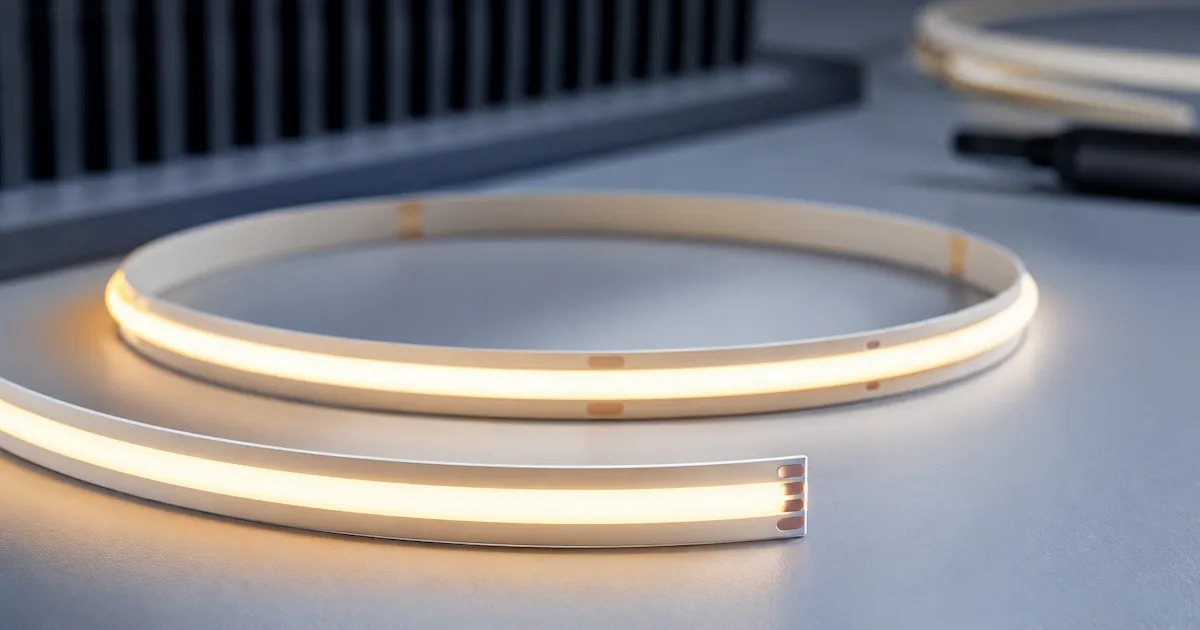
The 10mm part refers to the PCB width. That width is common because it balances flexibility, copper space, thermal path, and compatibility with many aluminum profiles. We often see installers struggle with narrow cabinets or slim profiles where 8mm boards are possible but less forgiving, while wider boards may not fit standard channels.
Three common examples make this easy to picture:
- • Under-cabinet task lighting where hotspots would reflect on polished stone
- • Retail shelf lighting where products need even front-edge illumination
- • Cove lighting in shallow channels where dotting becomes very visible
From our manufacturing floor perspective, the board width also affects solder pad area, current handling, and assembly stability. In addition, the encapsulation layer used on COB strips affects light diffusion, UV resistance, and long-term yellowing. Different manufacturers use differing silicones or resins; higher-grade compounds reduce color shift and maintain clarity in high-UV or high-temperature conditions.
| Term | Meaning | Why it matters |
|---|---|---|
| COB | Chip on Board LED packaging | Creates smooth, dot-free light |
| 10mm | PCB width | Fits many standard profiles |
| Flexible strip | Bendable linear lighting product | Speeds up installation |
| Phosphor coating | Light-converting surface layer | Helps form continuous light |
2. How is a COB strip different from a standard SMD strip?
The main difference is the light surface. A standard SMD strip uses packaged LEDs placed at intervals along the PCB. Even high-density SMD strips can still show points of light, especially in shallow aluminum channels. COB strips place many chips closely together, then cover them to create a more uniform line.
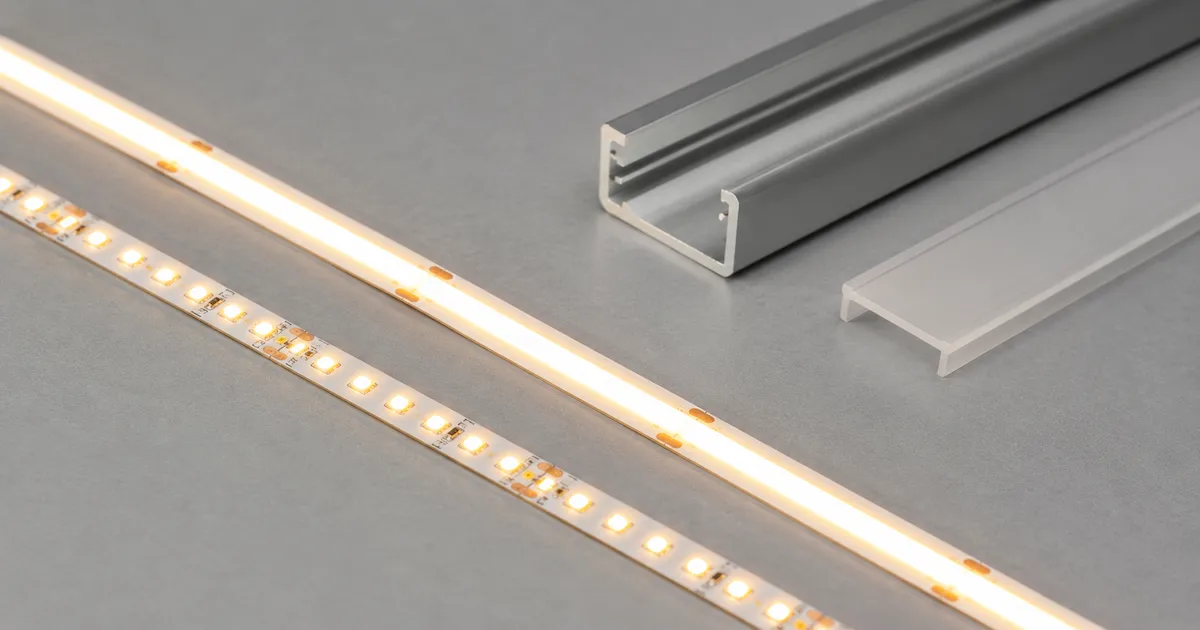
Here’s the deal. That visual difference changes the whole project result. In hotel millwork, premium display cases, and furniture lighting, a dotted line can make a finished installation look cheap. A smooth line usually looks cleaner and more professional.
When we tested this against a standard 12V strip, the COB version reduced visible spotting dramatically at the same profile depth. We once saw a showroom project fail approval because the designer used a low-density SMD strip under a frosted cover only 8mm deep. After replacement with COB, the visual issue was gone.
Common Myth: COB always means brighter. Reality: not always. Some COB strips prioritize visual uniformity over peak lumen output. You must compare lumens per meter, wattage, efficacy, and thermal conditions.
| Feature | COB strip | Standard SMD strip |
|---|---|---|
| Light appearance | Smooth continuous line | Visible dots possible |
| Visual comfort | Better in shallow profiles | Depends on LED pitch and diffuser |
| Premium finish effect | Strong | Moderate to strong |
| Maintenance perception | Clean and refined | Can look more technical |
| Best use case | Decorative and close-view linear light | General linear lighting |
3. Why is the 10mm width significant?
A 10mm PCB width is more than a dimension on a datasheet. It affects fit, heat handling, copper layout, and connection reliability. Many common LED profiles, corner channels, recessed extrusions, and surface-mounted housings are designed around strip widths near 10mm.
So what happens if the width is wrong? You get installation delays. A strip that is too wide will not sit flat. A strip that is too narrow may shift, lift, or leave adhesive gaps inside the profile. That sounds minor, but in volume installations it creates alignment issues and callbacks.
In our lab tests using integrating spheres and thermal imaging cameras, we also see that PCB width influences thermal spread. A 10mm board usually gives more room for copper than ultra-narrow boards, which can help with current distribution and temperature control.
Typical field examples include:
- Joinery lighting in wardrobes using slim recessed channels
- Mirror backlighting where profile space is limited but smooth output is needed
- Signage edge lighting where reliable solder pads matter during assembly
| Width factor | Impact on project | Practical note |
|---|---|---|
| Profile fit | Affects channel compatibility | 10mm fits many standard extrusions |
| Copper area | Affects current path | Better than many narrower boards |
| Solder pad space | Affects wire connection ease | Helpful for installers |
| Adhesive contact | Affects mounting stability | Better seating inside profile |
4. How does a COB 10mm LED light strip work electrically?
Most COB 10mm LED strips run on constant-voltage systems, usually 12V or 24V DC. The chips are arranged in repeating circuit sections with resistors or current-balancing design, so installers must know where to cut COB LED strip sections before powering them from one or both ends depending on run length.
What’s the real story? Electrical design matters because the smooth light surface can distract buyers from the basics: voltage drop, current load, wire sizing, and driver matching. A strip can look perfect on a sample reel and still underperform in a 15-meter field run.
We often see installers struggle with long runs powered from one side only. The far end dims, color shifts slightly warmer, and the customer thinks the strip quality is poor. In many cases, the real issue is incorrect power injection.
A few working examples:
- • A 3m COB LED strip for short furniture runs where cut length flexibility matters
- • 24V strips for longer architectural lines with reduced voltage drop
- • Tunable white or dimmable systems where the driver and controller must match strip current
When planning power, a practical rule is to calculate expected current draw and then add a 20–30% safety margin to the driver capacity to avoid thermal stress and early failure. Also consider wiring gauge: thicker conductors for longer runs reduce voltage drop and prevent color shifts. For a COB LED strip 30m project or other multi-run installations, plan power injection points every few meters or at both ends to maintain uniform output.
| Electrical item | Typical option | Why it matters |
|---|---|---|
| Input voltage | 12V or 24V DC | Impacts run length and voltage drop |
| Power | 8W to 15W/m common | Affects brightness and heat |
| Cut points | Vary by design | Impacts installation flexibility |
| Dimming | Pulse-width modulation with compatible controller | Impacts stability and flicker behavior |
5. What key specifications should you check before buying?
A COB 10mm strip should never be selected on width alone, and buyers should also understand how to cut COB LED strip sections correctly before installation.
You need to review the full specification set. That includes voltage, wattage per meter, lumens per meter, color temperature, CRI, PCB copper weight, IP rating, cut length, binning consistency, and warranty terms.
But there’s a catch. Two strips can look similar in photos and still perform very differently in the field. One may use better phosphor, tighter color control, and thicker copper. The other may run hotter and lose output faster.
In our lab tests using integrating spheres, we check actual lumen output and compare it to claimed data. We also use aging racks to monitor stability over time. That matters because inflated specifications create margin erosion later through returns and replacements.
Three specification mistakes we see often:
- • Choosing color temperature without checking batch consistency
- • Buying by wattage only, ignoring lumens per watt
- • Ignoring the color rendering index in retail, hospitality, and display applications
If longevity is important, ask for L70 or L90 projections (years at specific ambient temperature) and the test conditions used to generate them. Also clarify whether the quoted lumen values are initial lumens or measured after burn-in—manufacturers differ in how they present these numbers.
| Spec | Typical range | Why you should care |
|---|---|---|
| CCT | 2700K to 6500K | Sets mood and application fit |
| CRI | 80, 90, 95+ | Affects color rendering quality |
| Luminous output | 600 to 1400 lm/m | Impacts lighting level |
| PCB copper | 2oz or more preferred in some cases | Helps heat and current handling |
| IP rating | IP20, IP65, IP67 | Determines environment suitability |
6. Where is a COB 10mm LED strip typically used?
A 4m COB LED strip is widely used in medium-length areas where people can directly see the light source or where the profile depth is shallow. That includes cabinetry, shelving, display edges, hospitality joinery, handrails, mirror lighting, and architectural details.
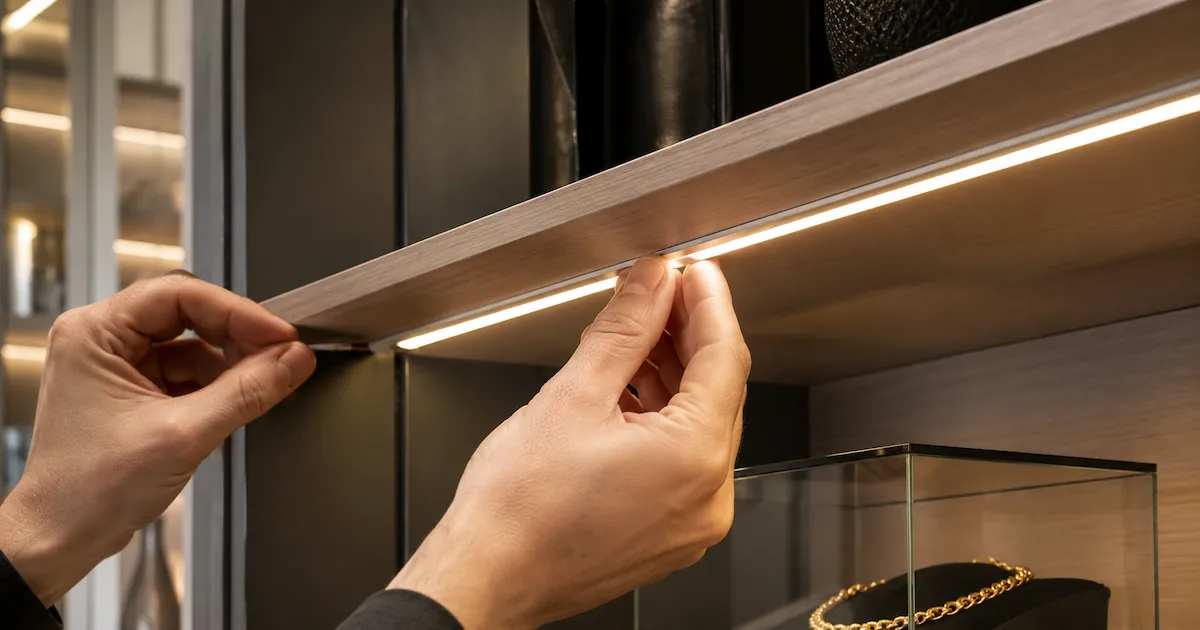
Why does this matter to your bottom line? Because the wrong strip in a visible application causes immediate quality complaints. A customer may not know what COB means, but they will notice light dots, patchy diffusion, or inconsistent color.
We once saw a luxury retail display use standard low-density strip behind a thin diffuser. The products looked uneven, shadows were harsh, and the acrylic showed dotting. After changing to COB, the shelf face became clean and the product presentation improved.
Useful scenarios include:
- • Jewelry counters where high CRI and smooth light improve visual merchandising
- • Hotel headboards where close-view comfort is needed
- • Stair nosing and handrail channels where profile depth is limited
| Application | Why COB 10mm works | Watch point |
|---|---|---|
| Retail shelves | Smooth close-view light | Need good CRI |
| Furniture lighting | Fits slim channels | Check heat in enclosed space |
| Cove lighting | Reduces dotting | Confirm run length |
| Mirror lighting | Soft line effect | Match CCT to room design |
| Signage details | Clean edge illumination | Verify adhesive strength |
7. What are the main advantages and limitations?
The main advantages are visual uniformity, premium appearance, flexible installation, and good performance in shallow profiles. For many projects, that alone justifies the switch from older SMD designs. The strip can also reduce the need for deeper diffusers, which gives designers more freedom.
Still, no product is perfect. Some COB strips are less efficient than well-designed SMD strips. Some run warmer at higher power densities. Some low-cost versions have weak adhesive or poor phosphor stability.
From our manufacturing floor perspective, the best approach is to match the strip to the job rather than assume COB solves everything. For accent lighting, display lighting, and direct-view linear light, COB is often the right answer. For high-output indirect lighting in deep channels, SMD may still be competitive.
Our Chief Engineer notes that heat dissipation is often ignored in woodwork and enclosed aluminum-free installations. That is where lumen depreciation accelerates.
Consider total cost of ownership: higher-quality COB strips may cost more upfront but reduce callbacks, replacements, and complaints—often justifying the premium. Low-cost strips can appear competitive on price but increase labor and warranty costs over time.
| Factor | Advantage | Limitation |
|---|---|---|
| Visual effect | Dot-free appearance | May cost more than basic SMD |
| Profile compatibility | Works in shallow channels | Still needs correct mounting |
| Perceived quality | Very strong | Depends on consistent binning |
| Efficiency | Good in many models | Not always highest available |
| Installation | Clean finish | Long runs still need proper feeding |
8. How do voltage, IP rating, and color options affect selection?
These three choices shape project success more than many buyers expect. Voltage affects maximum practical run length. IP rating affects environmental resistance. Color options affect the visual result and the end user’s satisfaction.
Let’s be real. A wrong IP choice causes failures. A wrong CCT makes materials look off. A wrong voltage increases brightness drop on long runs. None of these issues show clearly on a simple sample board.
In outdoor soffits, we usually recommend checking not only the IP rating but also connector sealing, silicone quality, and UV exposure conditions. For kitchen furniture, IP20 may be enough in dry areas, while vanity or splash-prone areas may need added protection.
The mandatory comparison below helps simplify selection.
| Option | Best for | Trade-off |
|---|---|---|
| 12V | Short runs, tighter cut points | Higher voltage drop |
| 24V | Longer runs, steadier output | Slightly larger cut sections |
| IP20 | Dry indoor use | No water protection |
| IP65 | Splash-prone indoor areas | More surface coating |
| IP67 | Outdoor or wet exposure | Thicker construction |
| 2700K-3000K | Warm hospitality feel | Lower visual crispness |
| 4000K | Neutral commercial use | Less warmth |
| 6000K-6500K | Bright task use | Can feel harsh |
9. What installation mistakes cause failures or poor lighting results?
A good strip can still fail if installed badly. The most common mistakes are poor surface cleaning, incorrect driver sizing, long one-end feeds, weak soldering, no heat sink, and bending beyond the strip’s limit.
This is where it gets interesting. Many failures blamed on the strip are actually system failures. We often see installers struggle with adhesive lift because the aluminum profile had oil residue, or with flicker because the dimmer was incompatible with the driver.
We once saw three field failures in one month caused by the same issue: 24V strip loaded on an undersized power supply with no reserve margin. The strip was fine. The driver overheated and shut down.
Use this checklist before handover.
| Checkpoint | Common problem | Practical fix |
|---|---|---|
| Mounting surface | Dust or oil weakens tape | Clean with alcohol and dry fully |
| Driver sizing | No power reserve | Add 20% to 30% headroom |
| Run length | End dimming | Use power injection |
| Heat dissipation | Overheating in wood channel | Use aluminum profile |
| Bending | PCB crack near corner | Respect minimum bend radius |
| Connections | Loose solder or clip | Test continuity before closing |
In addition to the checklist above, keep a small spare reel and connectors on site for rapid replacement during commissioning. Test each run for continuity, color temperature, and flicker at the installed length before final assembly. If dimming, cycle the dimmer through its full range to check for stability and audible noise.
10. How should you evaluate suppliers and product quality?
If you are buying COB LED strip 100m reels or other COB 10mm strips in volume, product appearance is only part of the decision. You should review test data, certification scope, batch consistency, reel labeling, packing method, adhesive brand, solder quality, and communication speed on technical questions.
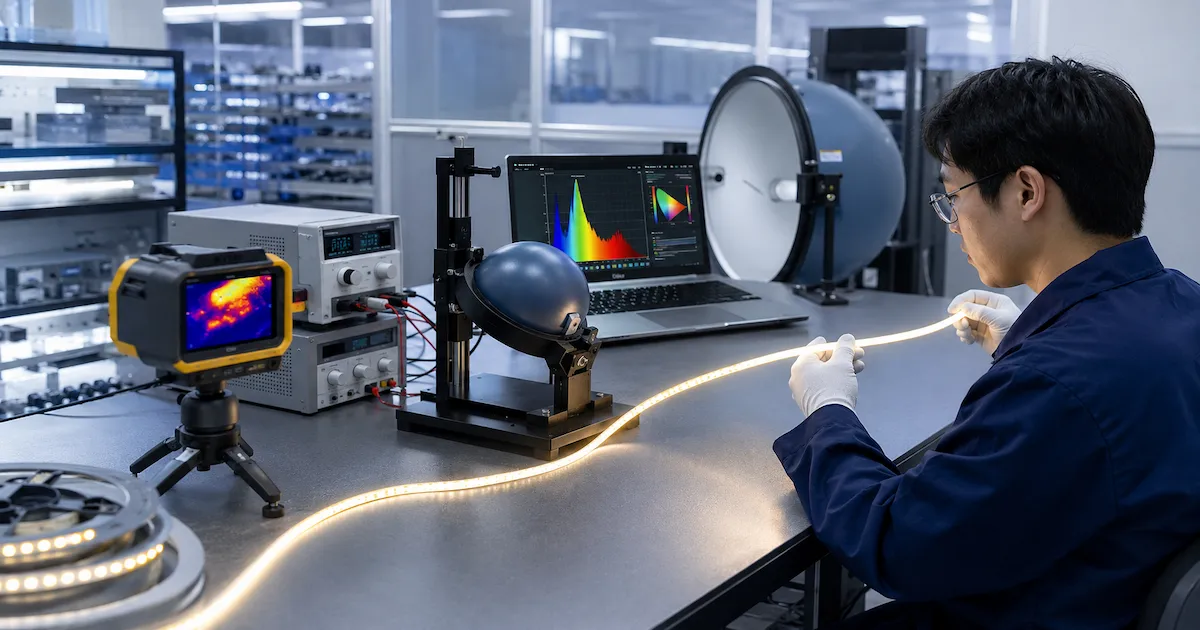
Why does this matter? Because a strip that looks good in one sample reel can become a liability if later batches shift in color, adhesive strength, or PCB quality. That can damage your project margin and your reputation.
In our lab tests using integrating spheres, thermal imaging cameras, and aging racks, we focus on three things: output truth, temperature behavior, and consistency over time. If a supplier cannot explain those basics clearly, that is a warning sign.
A practical supplier review should include:
- • Verified lumen and wattage test data
- • Clear tolerance on CCT and CRI
- • Run-length recommendations with wiring guidance
- • IP construction details, not just an IP code
- • Production transparency for custom or repeat orders
| Evaluation point | What to ask | Risk if ignored |
|---|---|---|
| Color consistency | What binning control is used? | Visible mismatch across batches |
| Thermal behavior | What is the operating temp test result? | Early lumen decay |
| Adhesive | Which tape brand is used? | Strip lifting after install |
| Certification | Which exact models are covered? | Compliance issues |
| Lead time honesty | What is real production timing? | Project delays |
Also ask about burn-in procedures, sample testing on representative lengths (not just short sections), and warranty claim processes. A responsive supplier will offer technical drawings, recommended drivers, and installation notes specific to their product rather than generic advice.
FAQ
Q1: What is a COB 10mm LED light strip?
A COB 10mm LED light strip is a flexible strip with a 10mm-wide PCB that uses Chip on Board technology to create a smooth, nearly dot-free light line.
Q2: How does a COB strip work?
It mounts many LED chips directly on the circuit board and covers them with a phosphor layer, producing a continuous light surface powered by a 12V or 24V constant-voltage system.
Q3: Is COB better than SMD for all projects?
No. COB is often better for shallow profiles and close-view lighting, while some SMD strips may suit high-output or lower-cost applications better.
Q4: What should I check before buying a COB 10mm strip?
Check voltage, wattage, lumens per meter, CRI, color temperature, IP rating, PCB quality, cut length, thermal performance, and batch consistency.
Q5: Where are COB 10mm LED strips commonly used?
They are common in furniture, retail shelving, hotel joinery, mirrors, cove lighting, display cases, and other places where smooth linear light matters.
Conclusion
A COB 10mm LED light strip is a practical choice when you need smooth linear light, a compact board width, and a cleaner finish than many standard strip options can give. The right decision depends on real specs, real installation conditions, and real quality control, not just catalog photos. If you are unsure about run length, driver matching, or profile compatibility, send your drawing or application details to a technical team for review before ordering.
Minor maintenance notes: wipe exposed diffusers periodically with a damp, lint-free cloth and avoid abrasive cleaners. For IP65/67 strips, check silicone seals annually for any signs of degradation in harsh environments. Keep records of batch numbers and installation dates to simplify any warranty claims or future replacements.
