
You can get quality LED extrusion at a good price from specialized LED profile manufacturers, factory-direct China suppliers, trained lighting distributors, or OEM partners with verified aluminum grade, diffuser quality, surface finish, and thermal test data. The best choice depends on your volume, project specs, certification needs, and lead time.
1. What Does Quality LED Extrusion Really Mean?
Quality LED extrusion means the aluminum profile protects the LED strip, manages heat, holds its shape, diffuses light properly, and fits accessories without field modification; buyers also need to understand how to use LED extrusions correctly in real projects. A low price is only useful if the profile performs after installation.
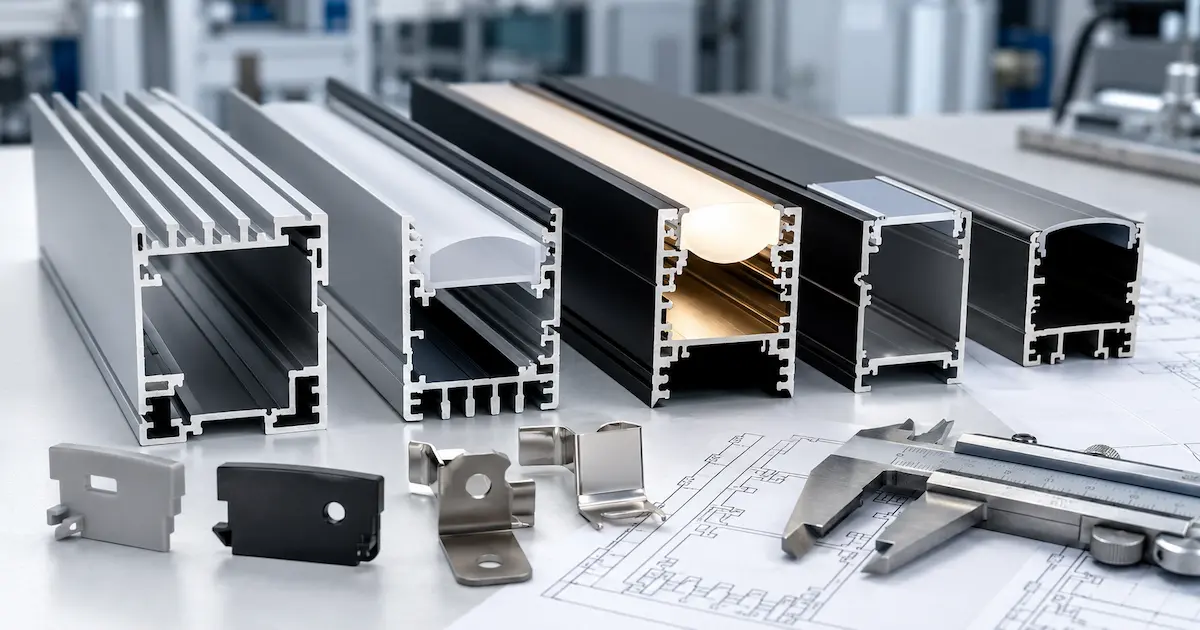
Here’s the deal: many quotations look similar. The difference hides in the aluminum wall thickness, alloy type, anodizing layer, diffuser material, and straightness tolerance, which is one reason buyers often ask why aluminium is best for extrusion in LED profile production. To better understand why extrusion quality, die control, and profile shape matter when buying LED channels, this video gives a clear visual explanation of how aluminum extrusions are made.
For example, a 2-meter recessed profile for a hotel corridor needs stable dimensions because a 1 mm bend can make the diffuser pop out. A cabinet lighting profile may need a tight frosted cover to avoid dust lines, while outdoor or visible profiles may need better anodizing quality for corrosion resistance and surface consistency. An outdoor facade profile needs a better sealing plan and stronger clips.
In our lab tests using integrating spheres, we measure LED strip output before and after placing it inside different diffusers. Some low-cost covers reduce light by 35% or create visible dots, so selecting the right LED channel diffuser is important for clean output and client approval. Better PMMA or PC diffusers usually give a cleaner line with controlled loss.
| Quality Factor | What to Check | Why It Affects Cost |
|---|---|---|
| Aluminum alloy | 6063 or equivalent | Better forming and heat flow |
| Wall thickness | 1.0–1.5 mm common range | Thin walls bend during shipping |
| Diffuser material | PC or PMMA | Affects UV resistance and light loss |
| Anodizing finish | Uniform color, no stains | Reduces corrosion claims |
| Accessory fit | End caps, clips, suspension kits | Saves installer labor |
2. Where Are the Best Places to Buy LED Extrusion?
You can buy LED extrusion from local electrical wholesalers, lighting distributors, online platforms, direct factories, and OEM lighting manufacturers, but a proper where to buy aluminium profile for LED strips sourcing guide helps compare each channel more safely. Each channel serves a different need.
Local wholesalers are useful when you need stock fast. Contractors often buy from them for small jobs, maintenance work, or urgent replacements. The downside is price. You may also get limited sizes and basic accessories.
Lighting distributors are better for repeat supply. They can stock popular profiles and provide local support. However, their catalog may not cover custom lengths, black anodizing, deeper channels, or special mounting brackets.
Factory-direct sourcing is often the best route for quality LED extrusion at a good price if your order volume is steady. You can request exact drawings, custom packaging, private labels, pre-cut lengths, and matching LED strip assemblies. But there’s a catch: not every factory is technical. Some trade companies only resell from unknown extrusion workshops.
| Buying Channel | Best For | Main Risk | Price Level |
|---|---|---|---|
| Local wholesaler | Urgent small orders | Limited choice | High |
| Lighting distributor | Repeat regional supply | Less customization | Medium-high |
| Online marketplace | Price checks and samples | Mixed quality | Low-medium |
| Direct factory | Project and OEM orders | Supplier vetting needed | Low-medium |
| Full lighting manufacturer | Complete strip plus profile kits | Need clear specs | Medium |
3. How Do I Compare Price Without Buying Weak Profiles?
Do not compare LED extrusion prices only by meter. Compare total installed cost. A profile that is 8% cheaper can cost more if it bends, scratches, delays installation, or needs replacement parts.
Ask each supplier for the same profile drawing, wall thickness, diffuser material, finish, packing method, MOQ, and lead time. Without the same baseline, price comparison becomes misleading. For instance, one supplier may quote a 1.0 mm wall while another quotes 1.3 mm. Both may call it the same model, but the stronger one has more aluminum content.
We often see installers struggle with diffusers that are too tight or too loose. A loose cover rattles in retail shelves. A tight cover cracks during long runs. In a supermarket shelf project, that small mismatch can slow a team by hours per aisle.
Use this quick cost view before purchase:
| Cost Item | Cheap Profile Risk | Quality Profile Benefit |
|---|---|---|
| Unit price | Looks attractive | May be slightly higher |
| Installation labor | More cutting and refitting | Faster assembly |
| Shipping damage | More bent lengths | Better packing and wall strength |
| Client approval | Risk of visible defects | Cleaner finish |
| Warranty claims | Higher callback rate | Lower service cost |
A fair price should protect your margin, not just reduce the purchase order number.
4. Which Technical Specs Should I Request Before Ordering?
Before ordering, request profile drawings, alloy grade, wall thickness, anodizing details, diffuser transmission data, accessory list, packing standard, and sample approval process. These documents reduce guesswork.
For commercial lighting, a simple PDF catalog is not enough. Ask for CAD drawings if the profile must fit furniture, signage, ceiling slots, or retail shelving. Product companies that add lighting to displays often need a profile width tolerance within a narrow range. Even a small deviation can block assembly.
When we tested this against a standard 12V strip inside a shallow profile, heat rose faster than expected because the LED strip had poor contact with the aluminum base. A deeper or wider profile lowered the surface temperature and helped protect lumen maintenance. That matters because heat shortens LED strip life and can increase warranty risk.
| Spec Request | Suggested Detail | Buyer Benefit |
|---|---|---|
| Drawing | 2D/3D file with tolerances | Confirms fit before tooling |
| Alloy | 6063-T5 common choice | Better extrusion stability |
| Finish | Silver, black, white, custom | Matches project design |
| Diffuser | Clear, frosted, opal | Controls glare and dot visibility |
| Length | 1 m, 2 m, 3 m, custom cut | Reduces site cutting |
| Packing | Inner sleeve, carton, pallet | Cuts transit damage |
5. Is Factory-Direct China Sourcing a Good Option?
Factory-direct sourcing from China can be a strong option when you need quality LED extrusion at a good price, especially for repeat orders, private labels, or project-based lengths. China has mature aluminum extrusion capacity and strong LED supply chains.
Still, you need a disciplined buying process. Ask whether the supplier owns extrusion tooling, assembles LED strips, or only trades finished profiles.
A profile-only workshop may offer good aluminum, but a complete aluminum profile for LED strip lighting solution should also support LED strip fit, power feed design, and thermal testing. A lighting manufacturer can often match the strip, profile, diffuser, end caps, driver, and wiring plan in one package.
From our manufacturing floor perspective, the best outcomes happen when buyers share the installation scenario, not only the part number. A hotel cove light, a stair handrail, and a freezer display case may all use LED profiles, but the heat, moisture, access, and diffuser needs differ.
Good signs from a factory-direct supplier include:
- Clear drawings and real production photos
- Sample approval before mass order
- Honest lead time, not vague promises
- Thermal and aging test ability
- Stable packaging method for long profiles
- CE, the RoHS Directive, UL, or CB support where applicable
6. How Can I Check Supplier Reliability Before Payment?
Supplier reliability shows in communication, documents, sample quality, and production control. A good supplier answers technical questions clearly and admits limits when a design is not suitable.
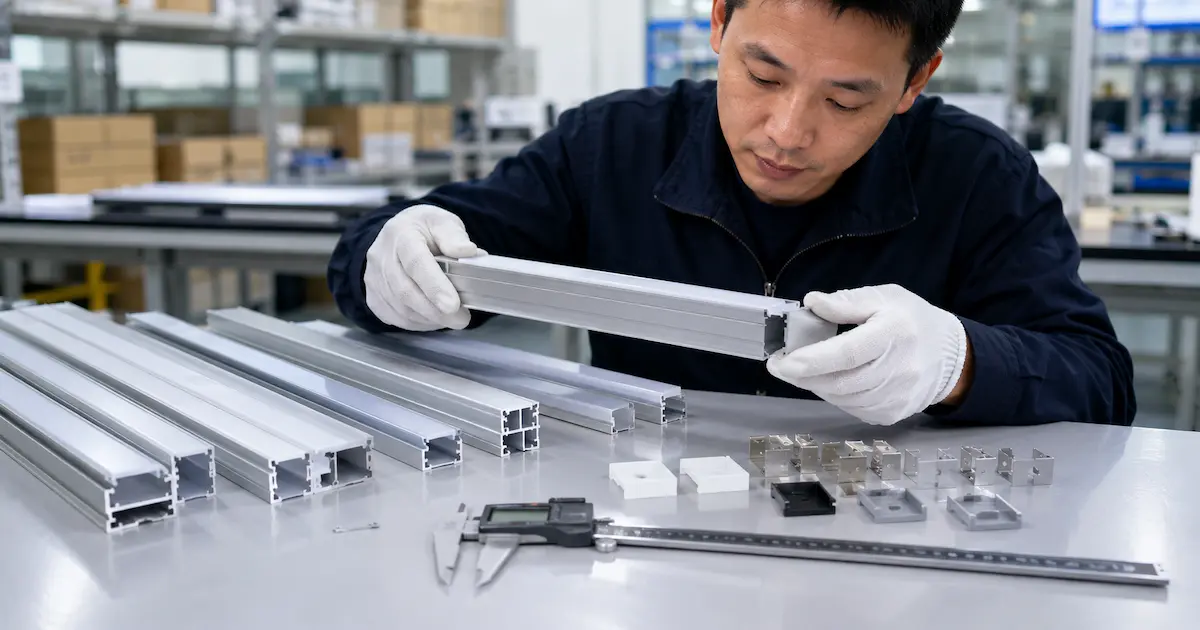
Start with a sample order. Check straightness, scratches, diffuser fit, end cap alignment, clip grip, and LED strip contact. Then request photos or video of packing, carton drop protection, and bundle labeling. Long aluminum profiles are easy to damage if packed poorly. One bent carton can cause a full project delay.
Ask for batch control. If you order black anodized profiles across several months, color variation can be visible under showroom lighting. We once saw a retail display project face rejection because the left and right shelf profiles came from different finishing batches.
| Reliability Check | Good Response | Warning Sign |
|---|---|---|
| Technical questions | Specific and fast | Only says “no problem” |
| Samples | Match drawing and quote | Different from catalog |
| Certifications | Valid files by model | Generic logo files |
| Lead time | Clear days and capacity | Changes after deposit |
| Photos | Real production images | Stock photos only |
| After-sales | Clear claim process | No written policy |
A supplier who documents the process lowers your commercial risk.
7. What Profile Type Should I Choose for My Project?
Choose the profile based on mounting method, LED strip width, heat load, diffuser need, and access for service. The cheapest profile type is rarely the best for every job.
Surface-mounted profiles are common for cabinets, shelves, and quick retrofits. Recessed profiles give a cleaner look in ceilings, walls, and furniture. Corner profiles work well under cabinets or inside display cases. Suspended linear profiles suit offices, showrooms, and architectural spaces.
Common Myth: Higher wattage always means better brightness.
Reality: It depends on lumen efficiency, diffuser loss, profile depth, and heat dissipation. A 14.4 W/m LED strip in a poor shallow profile may run hot and lose output faster. A 10 W/m strip with high efficiency in a suitable aluminum channel can provide better long-term results.
| Profile Type | Best Use | Key Buying Point |
|---|---|---|
| Surface profile | Cabinets, shelves, retrofits | Easy mounting and service |
| Recessed profile | Ceilings, walls, furniture | Flange size and cut-out accuracy |
| Corner profile | Under cabinet, display cases | Beam angle and clip strength |
| Suspended profile | Offices, showrooms | Suspension kit and rigidity |
| Waterproof profile | Facades, wet areas | Sealing design and cable exit |
Pro Tip from VST Technical Team: “Heat dissipation is often ignored in profile selection, so buyers should understand what to know about heat sink aluminium profiles before approving profiles for high-wattage LED strips. If the strip exceeds 12 W/m, check the aluminum mass and contact area before approving the profile.”
8. Should I Buy LED Extrusion With LED Strip as a Kit?
Buying LED extrusion with LED strip as a kit can reduce installation time and compatibility risk. It is useful for OEM products, display shelves, furniture lighting, and project contractors who want repeatable results.
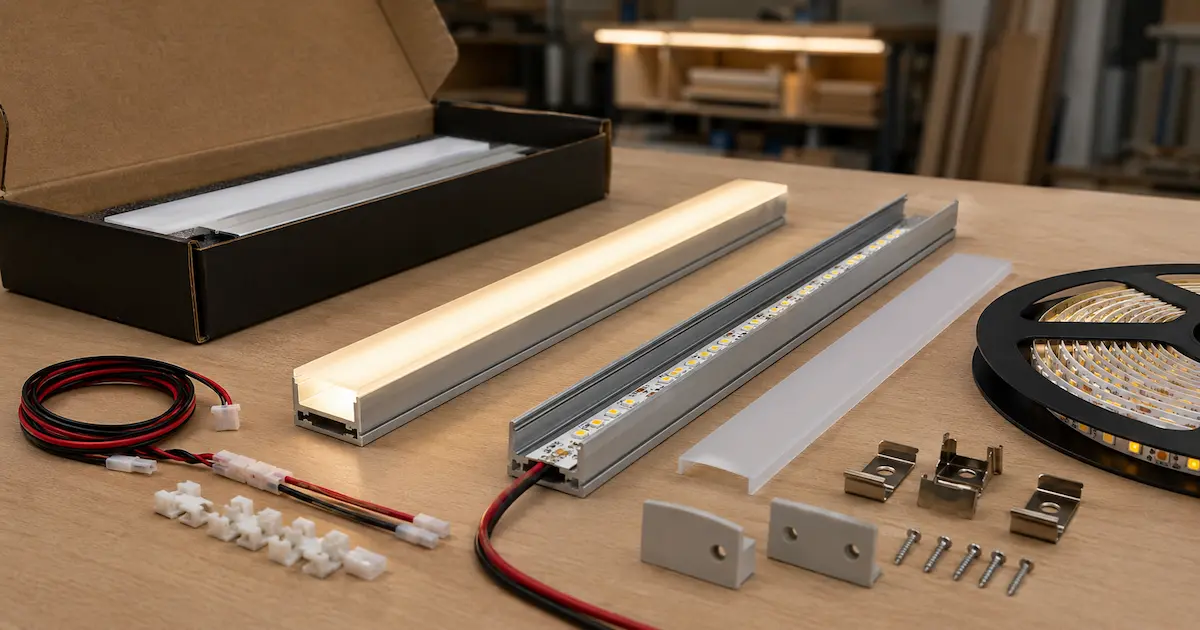
A kit can include pre-cut extrusion, LED strip, soldered leads, diffuser, end caps, clips, labels, and packaging by room or project zone. This matters in real work. If an installer spends two extra hours soldering and cutting on each site, your low material price disappears.
We often see installers struggle with field soldering in narrow shelves, especially when the power cable exit is not planned. Factory-prepared leads reduce failures caused by cold solder joints, wrong polarity, or exposed copper pads. In a furniture production line, this can improve assembly speed and reduce rework.
| Purchase Format | Benefits | Best Fit |
|---|---|---|
| Profile only | Flexible strip choice | Electrical wholesalers |
| Profile plus diffuser | Lower accessory mismatch | Distributors |
| Full kit | Faster installation | Contractors and OEM projects |
| Custom cut kit | Less waste | Furniture and displays |
| Pre-wired kit | Lower soldering errors | Job sites with tight labor |
For many buyers, a kit is not a luxury. It is a labor-control tool.
9. What Is the Best Way to Control Shipping Cost and Damage?
LED extrusion is long, light, and easy to bend. Shipping cost and damage control can decide whether your purchase is truly a good deal.
For small samples, courier shipping is fine. For volume orders, sea freight often gives better cost per meter, but packing must be strong. Ask for inner plastic sleeves, end protection, tight bundles, thick cartons, and pallets for long lengths. For 3-meter profiles, palletized packing and basic commercial packaging standards are usually safer than loose cartons.
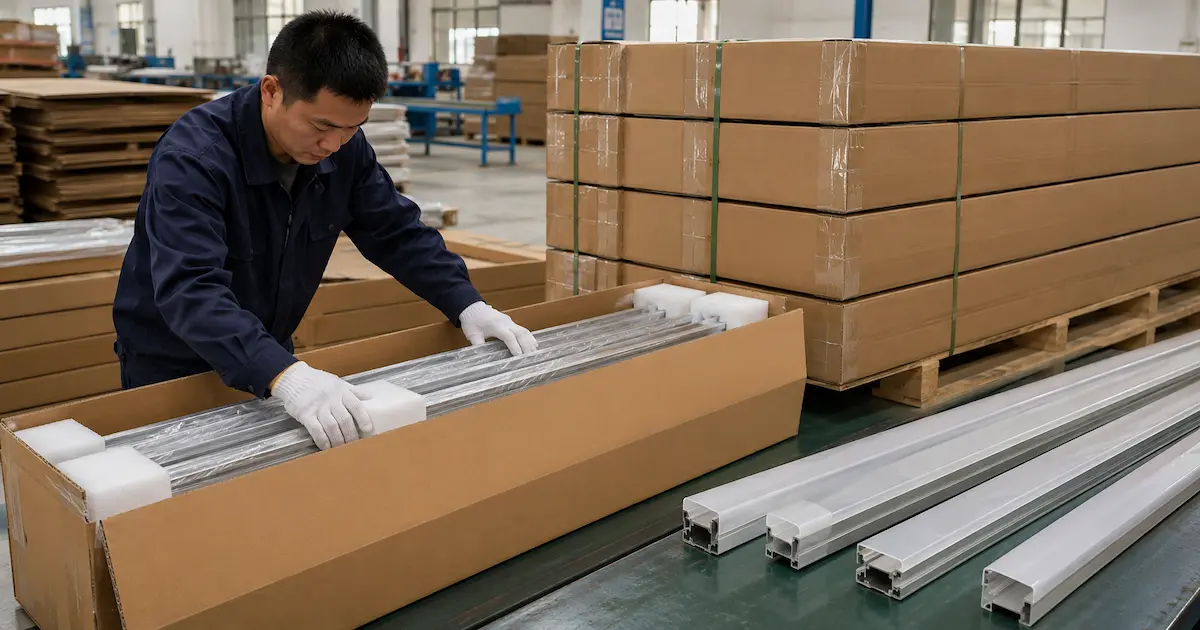
What’s the real story? Many “cheap” quotes hide weak packing. A profile damaged in transit cannot be fixed on site without visible marks. If your project schedule is tight, replacement shipping can cost more than the original savings.
| Shipping Choice | Best Quantity | Risk Level | Notes |
|---|---|---|---|
| Express courier | Samples, urgent small orders | Medium | Fast but costly for long goods |
| Air freight | Urgent project stock | Medium | Length limits may apply |
| Sea LCL | Medium orders | Medium-high | Needs strong cartons and pallets |
| Sea FCL | Large orders | Low-medium | Best control over loading |
| Local stock | Fast regional supply | Low | Higher unit price |
Ask suppliers to send packing photos before shipment. It is a simple step that prevents expensive disputes.
10. What Buying Checklist Helps Me Get Quality LED Extrusion at a Good Price?
A buying checklist turns sourcing from guesswork into a controlled process. Use it before sample approval and again before mass production.
Start with application details: indoor or outdoor, dry or damp, visible or hidden, strip wattage, run length, input voltage, driver location, and service access. Then confirm the profile drawing, diffuser choice, accessory fit, finish, cutting method, cable exit, and packing.
In a luxury hotel lobby, color consistency and clean diffuser lines protect the contractor’s reputation. For outdoor facade lighting, sealing and cable strain relief reduce water-related claims. For supermarket shelves, pre-cut and pre-wired profiles save labor during night installation windows.
| Checklist Item | Pass Standard | Action if Failed |
|---|---|---|
| Drawing approved | Matches project dimension | Revise before sample order |
| Diffuser fit | Slides or clips smoothly | Change cover or tolerance |
| LED strip contact | Flat on aluminum base | Use better tape or wider channel |
| Heat test | Surface temp within target | Lower wattage or larger profile |
| Finish match | Same batch appearance | Request batch control |
| Packing | No movement inside carton | Add sleeves, foam, or pallet |
| Labeling | Model and length clear | Add project zone labels |
Use this table with your supplier. It helps both sides avoid assumptions.
Final Notes
Quality LED extrusion at a good price comes from matching specs, supplier capability, and project reality. Check the aluminum, diffuser, finish, packing, and LED strip compatibility before you chase the lowest meter price. A reliable LED profile manufacturer should help you reduce labor, protect your margin, and avoid callbacks. If you are unsure about profile depth, voltage drop, or thermal load for your project, send your drawings to our engineering team. We’ll review them manually and give practical feedback.
Conclusion
Choosing quality LED extrusion at a fair price means prioritizing the full installed cost: material specs, fit, thermal performance, packing, and supplier reliability. Buy samples, run a short thermal and fit test, and confirm accessory packs before committing to mass production to protect schedule and margin.
FAQ
Q1: What is quality LED extrusion?
Quality LED extrusion is an aluminum profile designed to hold LED strip, improve heat transfer, protect the strip, and create a clean light line. Good quality depends on alloy, wall thickness, finish, diffuser performance, and accessory fit.
Q2: Where can I get quality LED extrusion at a good price?
You can source it from specialized manufacturers, factory-direct China suppliers, lighting distributors, or wholesalers. For repeat orders or custom needs, factory-direct sourcing usually gives stronger price control and more technical flexibility.
Q3: Is thicker aluminum always better for LED profiles?
Not always. Thicker aluminum can improve strength and heat dissipation, but profile shape and LED contact area also matter. The right choice depends on strip wattage, mounting method, run time, and project environment.
Q4: Should I buy LED extrusion and LED strip separately?
You can, but a matched kit often saves labor and reduces compatibility issues. Pre-cut and pre-wired kits work well for contractors, furniture makers, display shelf producers, and repeat project installations.
Q5: How do I avoid damage during LED extrusion shipping?
Ask for strong cartons, inner sleeves, end protection, tight bundles, and pallets for long profiles. Request packing photos before shipment and confirm whether the supplier has experience shipping 2-meter or 3-meter aluminum profiles.
