
Architectural aluminium profiles are extruded aluminium channels, trims, frames, and housings used in buildings and lighting systems to add structure, protection, heat dissipation, and a clean finish. In LED lighting, they are widely used to hold LED strips, control glare, improve thermal performance, and make installation more precise.
If you specify LED strip lighting for ceilings, cabinets, walls, stairs, or retail shelving, you already know the risk. A bare LED strip may look acceptable on day one, but poor heat control, visible dots, weak mounting, and uneven finishing often lead to callbacks, client complaints, and margin loss.
The good news is simple. The right architectural aluminium profile solves many of these issues at once. In our lab tests using integrating spheres, we often see more stable light output and better long-term consistency when LED strips are installed inside well-matched aluminium channels with proper diffusers and thermal paths.

This article explains what architectural aluminium profiles are, how they work, where they fit, and what you should check before choosing one.
1. What is an architectural aluminium profile in LED lighting?
In LED lighting, an architectural aluminium profile is a shaped aluminium extrusion designed to house and support LED strips or linear light components within a built environment. It is not just a decorative channel. It is a functional part of the lighting system.
A typical profile includes several elements:
- Aluminium body for structure and heat transfer
- Diffuser or cover for light softening
- End caps for finishing
- Mounting clips or recessed flanges for installation
- Optional accessories such as joiners, corner pieces, and suspension kits
We often see installers struggle with projects where LED strips are installed directly onto wood, gypsum board, or painted metal without a proper channel. The result is usually the same: poor alignment, visible LED hotspots, and reduced service life.
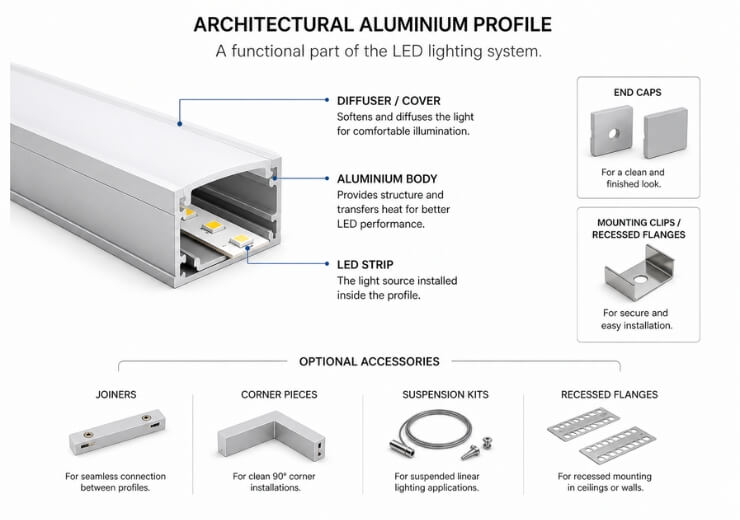
Here is a quick breakdown of the profile’s job:
| Component | Main function | Why it matters |
|---|---|---|
| Aluminium channel | Holds strip and transfers heat | Helps stability and lifespan |
| Diffuser | Softens and spreads light | Reduces dotting and glare |
| End caps | Protect ends | Improves appearance and dust control |
| Mounting system | Secures profile | Speeds installation and improves consistency |
So, the profile is both a mechanical and optical tool. That is why it matters in architectural work. In addition to the visible benefits, properly chosen profiles simplify electrical routing and driver placement, which reduces installation time and improves long-term serviceability.
2. Why are architectural aluminium profiles used instead of bare LED strips?
Bare LED strips are fast to install, but they can create hidden problems. This is where it gets interesting. Many failures blamed on LED strip quality are actually profile-related or installation-related.
The main reasons professionals use architectural aluminium profiles are:
- Better heat dissipation
- Cleaner and straighter installation
- Lower glare
- Better light diffusion
- Mechanical protection against dust and impact
- Easier integration into furniture, walls, ceilings, and millwork
In our lab tests using integrating spheres, heat build-up has a direct effect on lumen maintenance. From our manufacturing floor perspective, strips mounted in a suitable aluminium profile usually perform more consistently than strips installed on low-conductivity surfaces.
For example, under-cabinet lighting in kitchens, shelf lighting in retail stores, and cove lighting in hotels all benefit from profile-based installation.
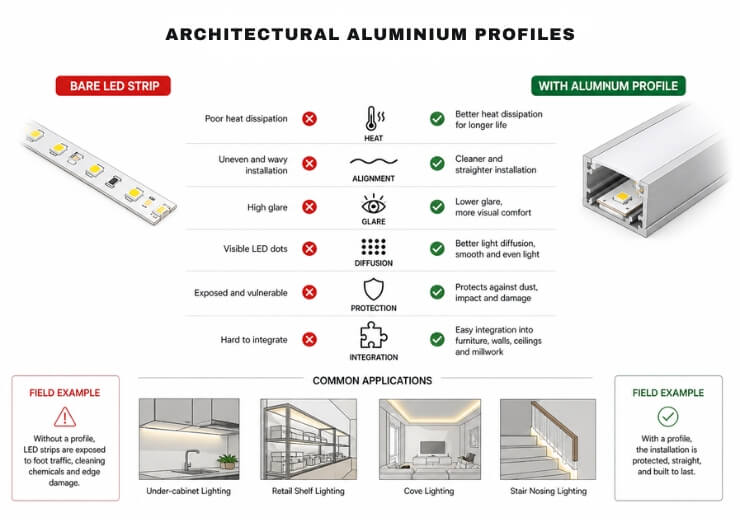
A field example is stair nosing lights. Without a profile, the strip is exposed to foot traffic, cleaning chemicals, and edge damage. Another is a recessed drywall line. Without a proper extrusion, achieving a straight, shadow-controlled finish is difficult.
| Installation method | Pros | Risks |
|---|---|---|
| Bare LED strip | Lower initial cost | Heat, glare, shorter life, weak finish |
| Aluminium profile with diffuser | Better finish and protection | Slightly higher material cost |
That extra material cost often prevents much larger service costs later. Consider too that correct profiling reduces labor by preventing rework, which frequently outweighs the incremental material expense on larger projects.
3. What are the main types of architectural aluminium profiles?
Architectural aluminium profiles come in many shapes because lighting layouts vary. A cabinet channel is not the same as a recessed ceiling line, and neither works like a corner profile for display shelving.
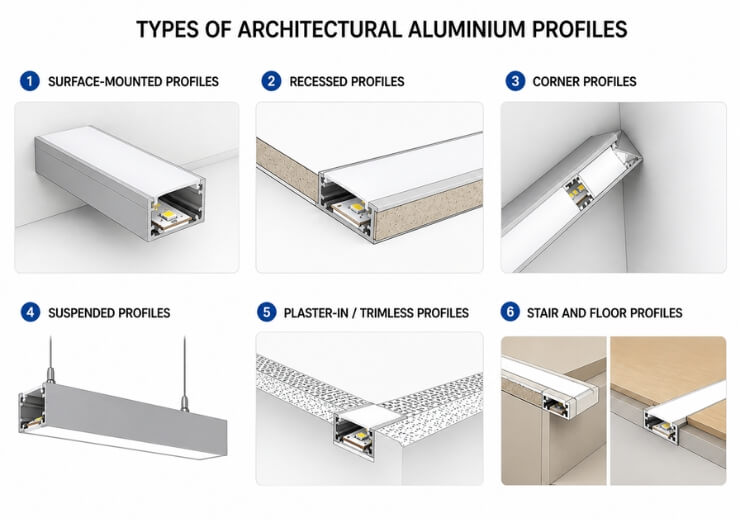
The main profile types include:
- Surface-mounted profiles: Used on ceilings, walls, shelves, and cabinets where recessing is not practical. They are often selected for retrofit projects and areas where future access is likely.
- Recessed profiles: Installed flush into drywall, wood, tile, or furniture panels for a seamless finish. Recessed solutions require accurate cutouts and coordination with other trades.
- Corner profiles: Placed at 45-degree angles in corners, often under cabinets or inside display cases. They direct light where it’s needed while keeping the strip out of direct view.
- Suspended profiles: Hung with wires or rods for office, commercial, and decorative linear lighting. These allow long, continuous runs and can include integrated wiring channels.
- Plaster-in or trimless profiles: Designed to disappear into the architectural surface for minimalist lines of light. These are popular in high-end hospitality and residential projects.
- Stair and floor profiles: Built for stronger mechanical protection in traffic areas. They are typically more robust, sometimes with thicker walls and specially designed covers.
| Profile type | Typical application | Main benefit |
|---|---|---|
| Surface-mounted | Cabinets, shelves, retrofit jobs | Easy installation |
| Recessed | Drywall, joinery, ceilings | Flush appearance |
| Corner | Under cabinets, showcases | Directional light angle |
| Suspended | Offices, retail, reception areas | Strong linear visual effect |
| Plaster-in | Premium interiors | Minimal visible trim |
| Stair/floor | Steps, pathways | Higher protection |
Ready for the good part?
Choosing the right type early can save redesign time and installation conflict later. Also consider compatibility with LED strip dimensions and driver placement when selecting a profile type.
4. How do these profiles improve LED strip performance?
Many buyers think of the profile as an accessory. That is a mistake. The profile can directly affect performance in four ways: thermal management, optical control, mechanical support, and maintenance access.
Thermally, aluminium helps move heat away from the LED strip PCB. When we tested this against a standard 12V strip mounted on a low-conductivity surface, the strip in the aluminium channel ran cooler and stayed more stable over time. That matters because excessive junction temperature shortens LED life and can shift color.
Optically, a diffuser turns a harsh dotted line into a smoother visual line. In hotel corridors, reception desks, and wardrobe lighting, this affects the perceived quality of the whole project.
Mechanically, the profile keeps the strip straight. It also reduces the chance of adhesive failure. We once saw a retail shelf project fail because the strip adhesive released after repeated heating cycles on coated wood.
Maintenance-wise, a serviceable profile with removable cover makes strip replacement easier. Profiles that allow snap-in diffusers and tool-free removal speed up maintenance and lower lifecycle costs.
| Performance factor | Without profile | With profile |
|---|---|---|
| Heat handling | Limited | Better thermal path |
| Light appearance | Visible dots | Softer output |
| Mechanical support | Adhesive only | More secure mounting |
| Maintenance | Harder to replace | Easier service access |
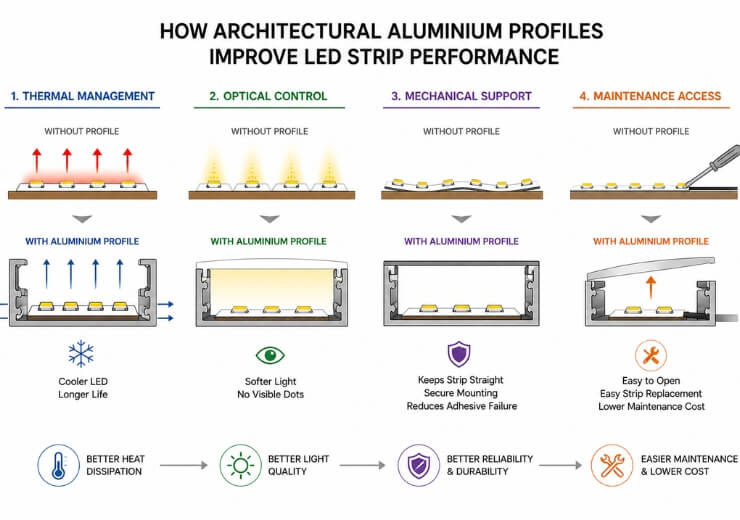
That is not cosmetic. It affects service life and project quality. In addition, well-designed profiles can be used to mask wiring, allow inline connectors, and accommodate sensors or emergency lighting components without visible clutter.
5. What materials and finishes are common in architectural aluminium profiles?
Most architectural lighting profiles use extruded aluminium, often in grades selected for formability, surface quality, and acceptable thermal performance. The base metal matters, but so does the finish.
Common finishes include:
- Anodized silver
- Matte white powder coating
- Matte black powder coating
- Custom painted finishes
- Brushed or specialty finishes for matching interior hardware
Diffusers are usually made from polycarbonate or PMMA. Frosted covers reduce glare and improve visual comfort. Clear covers keep maximum output but show LED points more easily. Opal covers sit in the middle.
From our manufacturing floor perspective, finish quality affects both appearance and handling. Scratches, uneven coating, or poor cut quality become obvious in premium hospitality and retail projects. We often see specifiers focus only on profile dimensions while ignoring diffuser transmission and surface treatment.
| Element | Common options | Selection note |
|---|---|---|
| Body material | Extruded aluminium | Good heat transfer and rigidity |
| Surface finish | Anodized, white, black | Match project style and durability needs |
| Diffuser | Clear, frosted, opal | Balance output and dot concealment |
| End caps | Plastic or metal | Affect finish detail and protection |
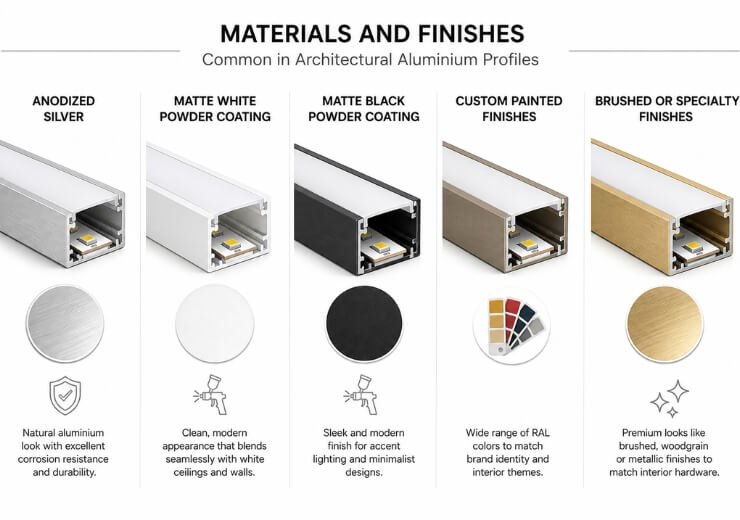
A profile is judged by how it looks after installation, not just by its drawing. Also consider UV stability and yellowing resistance of diffusers for installations exposed to sunlight or high temperatures.
6. What should you check when selecting a profile for a project?
This is where mistakes usually happen. A profile that fits the LED strip width is not automatically the right profile.
You should check at least these points:
- Internal width and depth
- LED strip wattage and heat load
- Diffuser type and light transmission
- Mounting method
- IP requirement
- Line-of-light effect
- Ceiling, wall, furniture, or floor application
- Service access after installation
- Accessory availability and cut-length tolerance
Common Myth: any aluminium channel will cool an LED strip properly.
Reality: profile mass, contact area, ventilation, strip wattage, and installation surface all matter. A very shallow decorative channel may not manage heat well for a high-power strip.
Our Chief Engineer notes that heat dissipation is often ignored in short tender documents, even though it directly affects lumen maintenance and warranty risk. When specifying, ask for thermal simulations or real-world test reports for high-wattage runs.
| Selection factor | Why you should care | Typical risk if ignored |
|---|---|---|
| Strip wattage | Affects heat | Premature aging |
| Diffuser depth | Affects dot visibility | Poor visual result |
| Mounting style | Affects labor | Rework on site |
| IP rating | Affects durability | Water or dust ingress |
| Accessory fit | Affects finish | Gaps and poor alignment |
We explain this because ignoring one small fit detail can create expensive installation delays. Also check how profiles join over long runs to avoid light breaks or thermal expansion issues.
7. How do recessed, surface, and corner profiles compare?
The best profile style depends on both design intent and installation constraints. There is no single best option.
A recessed profile works well when you need a flush architectural line. It is common in gypsum ceilings, wall niches, and premium joinery. The trade-off is more planning, tighter cutout tolerances, and earlier coordination with builders.
A surface profile is faster to install and ideal for retrofit projects, cabinet lighting, and utility areas. It is more visible, but installation is simpler and replacement is easier.
A corner profile throws light diagonally, which is useful under cabinets, inside closets, and in display cases where direct front-facing glare is a problem.
Here is the mandatory comparison table:
| Feature | Recessed profile | Surface profile | Corner profile |
|---|---|---|---|
| Visual effect | Flush and integrated | Visible but neat | Angled and functional |
| Installation effort | Higher | Lower | Moderate |
| Best use | Ceilings, walls, joinery | Retrofit, cabinets, shelves | Corners, task lighting, displays |
| Service access | Moderate | Easy | Easy to moderate |
| Typical risk | Cutout errors | More visible hardware | Beam direction mismatch |
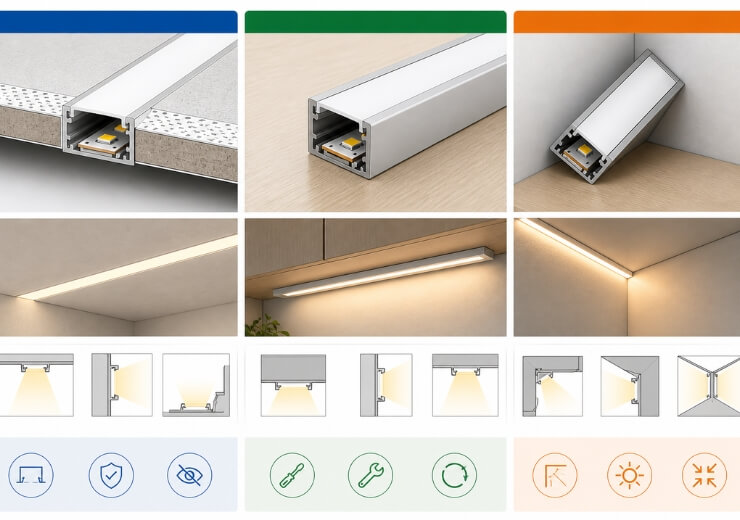
What’s the real story?
Good profile selection is less about fashion and more about fit, access, and lighting effect. Consider also acoustic and fire-rated requirements when integrating profiles into ceilings or bulkheads, as these can influence mounting details.
8. How do installers and specifiers avoid common failures?
Most field failures are predictable. We often see installers struggle with three recurring issues: poor heat transfer, diffuser mismatch, and weak mounting preparation.
Case one is a hotel cove where high-output strips were packed into a small shallow channel. The light looked fine during handover, but heat caused output drop over time.
Case two is a furniture project where the wrong diffuser left visible LED dots, and the client rejected the visual finish. Case three is an outdoor canopy where end caps and seals were not matched to the IP requirement.
A simple checklist helps:
| Checkpoint | What to verify | Failure avoided |
|---|---|---|
| Strip width and power | Fits channel and heat capacity | Overheating |
| Surface preparation | Clean, flat mounting base | Adhesive or clip failure |
| Diffuser choice | Dotting vs output balance | Poor visual comfort |
| End caps and seals | Correct accessories installed | Dust or moisture ingress |
| Driver access | Safe maintenance route | Difficult servicing |
Pro Tip from the VST Technical Team: test one assembled sample at real operating temperature before full project rollout. That small step often catches fit, glare, and thermal issues before they affect hundreds of meters.
Additionally, provide installers with clear installation drawings, torque and adhesive specifications, and a list of approved accessories. Site training and a documented snagging checklist reduce the chance of on-site errors. Keep record of component batch numbers and diffuser samples to trace any future issues.
9. Where are architectural aluminium profiles most commonly used?
These profiles appear in more places than many buyers expect. They are common in commercial, hospitality, residential, retail, and industrial support lighting.
Typical applications include:
- Under-cabinet task lighting
- Cove and cornice lighting
- Recessed ceiling lines
- Stair nosing and step lighting
- Wardrobe and closet illumination
- Retail shelf and display case lighting
- Reception desks and feature walls
- Mirror and vanity lighting
- Office suspended linear systems
In a luxury hotel lobby, a plaster-in profile can create a clean shadow gap effect. In supermarket shelving, corner profiles improve product visibility without exposing the strip. In workshop benches, surface profiles protect strips from direct handling.
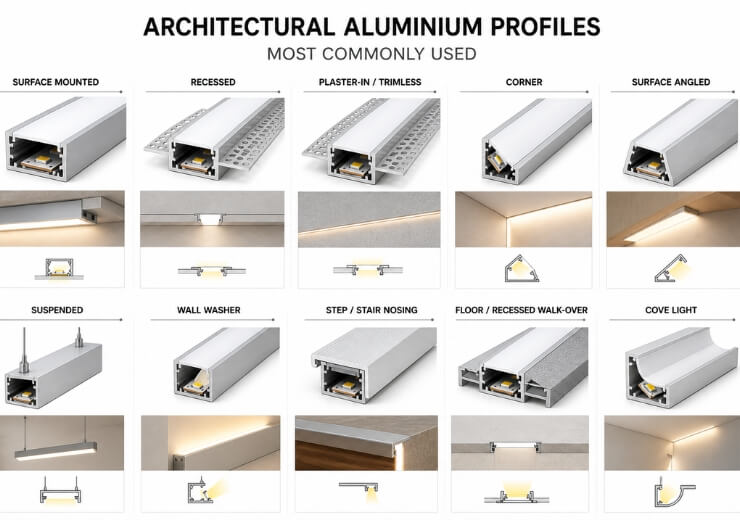
In our lab tests using integrating spheres, we also compare diffuser transmission because a profile used for accent lighting may prioritize softness, while a task-light profile may prioritize output.
| Application area | Common profile style | Main priority |
|---|---|---|
| Hotel cove | Recessed or plaster-in | Seamless line of light |
| Retail shelf | Surface or corner | Product visibility |
| Cabinet task light | Surface or corner | Glare control |
| Office linear light | Suspended | Uniformity and scale |
| Stair lighting | Stair profile | Safety and protection |
The application drives the specification, not the other way around. Also consider cleaning and maintenance cycles for high-touch environments; choosing a profile with replaceable diffusers or anti-scratch treatments can reduce long-term refurbishment costs.
10. What buying and specification details matter most?
If you are sourcing architectural aluminium profiles, the drawing alone is not enough. You need to review commercial and technical details together.
Check these buying points:
- Extrusion tolerance and straightness
- Standard lengths and cut service
- Accessory completeness
- Finish consistency across batches
- Diffuser fit and transmission consistency
- Packaging protection for long profiles
- Certification needs for the whole lighting system
- Lead time and project phasing
- Customization options for width, flange, color, or pre-cut lengths
From our manufacturing floor perspective, long profiles can be damaged more by poor packaging than by production defects. We once saw a shipment where the profile body was fine, but diffuser scratches made the product unusable for a premium project. Another common issue is inconsistent end-cap fit from mixed tooling sources.
So, ask for samples, section drawings, diffuser data, and accessory lists before approval.
| Buying detail | Why it matters | Good practice |
|---|---|---|
| Straightness | Affects visual line | Check long sample |
| Finish consistency | Affects appearance | Approve master sample |
| Accessory matching | Affects assembly | Verify full kit |
| Packaging | Prevents transit damage | Use protected bundling |
| Custom cut option | Saves site labor | Confirm tolerance in advance |
A small review upfront can prevent large site problems later. Also confirm warranties and liability for bespoke colors or finishes, and request clear return policies for damaged diffusers or extrusions.
Conclusion
Architectural aluminium profiles are far more than simple channels. In LED lighting, they manage heat, improve visual comfort, protect the strip, and create a cleaner architectural finish. The right choice depends on application, wattage, mounting method, diffuser effect, and long-term service needs.
If you are unsure about profile size, heat load, or diffuser selection for a specific project, send your drawings to our engineering team and we will help review the fit before installation starts.
FAQ
Q1: What are architectural aluminium profiles used for in LED lighting?
They are used to house LED strips, improve heat dissipation, soften light with diffusers, protect the strip, and create a cleaner installation finish in architectural spaces. They also help channel wiring and support modular assembly.
Q2: Do aluminium profiles make LED strips last longer?
They can help. A suitable aluminium profile improves heat transfer, and lower operating temperature usually supports better lumen maintenance and longer service life. Correct mechanical fixation also prevents adhesive failures that can lead to damage.
Q3: Which diffuser is better: clear, frosted, or opal?
It depends on the goal. Clear gives higher output, frosted reduces glare and visible dots, and opal offers a balanced result for many indoor architectural projects. Consider the viewing distance and application when choosing; close-proximity accent lighting often benefits from frosted or opal options.
Q4: Are recessed profiles better than surface-mounted profiles?
Not always. Recessed profiles give a flush premium look, while surface-mounted profiles are easier to install and maintain. The better option depends on the project conditions. Also factor in repair access and the potential need to upgrade strips in future.
Q5: What is the most common mistake when choosing an aluminium profile?
Many buyers choose only by strip width and ignore heat load, diffuser depth, accessories, and installation method. That can lead to poor light effect and service problems. The best practice is to test a sample assembly under expected operating conditions before wide deployment.
