
Strip lights come in single colors like warm white, natural white, cool white, red, green, blue, amber, and pink. They also come in multi-color formats such as RGB, RGBW, RGB+CCT, and tunable white. The right choice depends on application, control method, color consistency, and installation conditions.
If you specify the wrong strip color type, the problem is not just visual. It can cause client rejection, rework, dimming issues, poor product presentation, and margin loss. We often see installers struggle with projects where the buyer asked for “white LED strips” without defining color temperature, CRI, or binning tolerance. The result is predictable: mismatched tones across shelves, corridors, or furniture lines.
This article explains what colors do strip lights come in, how each option works, and how to choose the right one for commercial, retail, architectural, and OEM use. In our lab tests using integrating spheres, thermal cameras, and aging racks, color choice is never just about appearance. It affects output, efficiency, driver matching, and long-term consistency.
1. What are the main color categories of strip lights?
The simplest answer is that strip lights are sold in three broad color groups: single color, white spectrum, and color-changing. That sounds straightforward, but here’s the deal: each group has different technical and commercial implications.

Single-color strips include red, green, blue, yellow, amber, pink, and sometimes specialty tones such as UV or horticulture spectra. These are common in signage, indicator lighting, decorative cove lines, and machine status displays. White spectrum strips include warm white, neutral white, natural white, daylight, and cool white. These dominate retail shelves, joinery, hospitality, and under-cabinet projects.
Color-changing strips include RGB, RGBW, RGB+CCT, and RGBIC LED strip options with addressable pixel control. These are common in bars, façade accents, event spaces, gaming products, and programmable installations. In one hotel case, a spec changed from 3000K static white to RGBW for banquet flexibility. That improved scene control, but it also changed driver count, controller selection, and commissioning time.
From our manufacturing floor perspective, many sourcing mistakes happen because buyers ask for “multi-color strip” without clarifying whether they need static color mixing or true white rendering. Clarifying whether white quality or saturated color is the priority early in the specification prevents costly rework.
| Strip Light Category | Typical Colors | Common Use | Key Selection Point |
|---|---|---|---|
| Single Color | Red, green, blue, amber, pink | Signs, accent lines, indicators | Wavelength and brightness |
| White Spectrum | 2700K to 6500K | Retail, hospitality, furniture | CCT, CRI, consistency |
| Color-Changing | RGB, RGBW, RGB+CCT | Mood lighting, scene control | Controller and channel count |
| Pixel Addressable | Individually controlled LEDs | Media effects, dynamic displays | IC type and programming |
2. Which white colors are available in LED strip lights?
White is not one color. That is where many projects go wrong. Most white strip lights are defined by correlated color temperature, usually from 2400K to 6500K. Lower Kelvin values look warmer and more yellow. Higher Kelvin values look cooler and more blue.
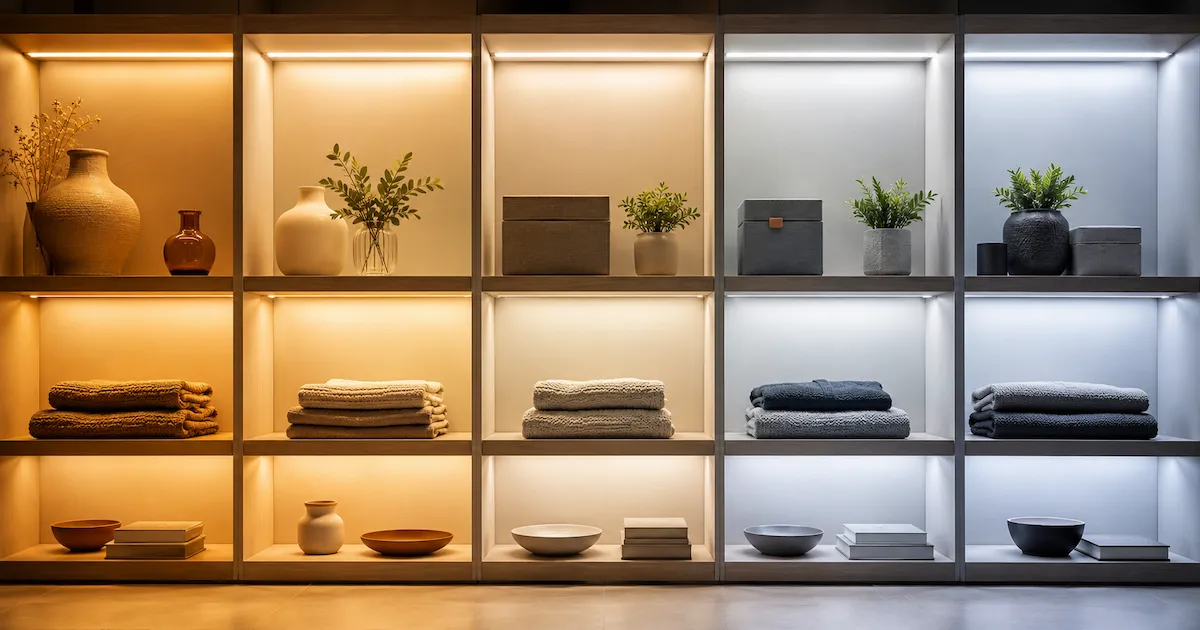
Common options include 2700K, 3000K, 3500K, 4000K, 5000K, and 6500K. In restaurants and hotels, 2700K to 3000K is common because it feels relaxed and premium. In offices and utility spaces, 4000K is a practical middle point. In task lighting, display cases, and workshops, 5000K to 6500K may be specified for a cleaner visual impression.
But there’s a catch. Two 3000K strips from different suppliers may not look the same if binning is loose. We explain this because ignoring it leads to visible color mismatch in hotel corridors and millwork installations. In our lab tests using integrating spheres, we often compare sample batches for CCT drift before mass production.
A second factor is CRI, especially when buyers need reliable color rendering of light sources for retail displays, food counters, fashion, and wood finishes. A 3000K strip at CRI 80 and one at CRI 95 will render surfaces differently. In butcher counters, fashion retail, and wood cabinets, that matters to sales. Higher CRI samples should be reviewed under intended merchandising conditions, and spectral power distribution should be checked if precise color rendition is essential.
| White Color Option | Typical Kelvin | Visual Effect | Common Applications |
|---|---|---|---|
| Extra Warm White | 2400K–2700K | Soft, yellow, intimate | Hotels, lounges, heritage spaces |
| Warm White | 3000K | Comfortable, premium | Homes, restaurants, furniture |
| Neutral White | 3500K–4000K | Balanced, clean | Offices, retail, corridors |
| Cool White | 5000K | Crisp, bright | Displays, task lighting |
| Daylight White | 6500K | Blue-white, sharp | Workshops, utility, some signage |
3. What single-color strip lights are commonly offered?
Outside white, the most common static strip light colors are red, green, blue, yellow, amber, and pink. These are not all equal in performance, so comparing the brightest and darkest LED strip light colour options helps buyers avoid weak accent lines or overpowering decorative effects.. Red often works well for signage and low-glare night applications. Amber is popular in hospitality details because it feels warmer and often avoids the harsh look of yellow. Blue is widely used in decorative edges, refrigeration highlights, and brand accents. Green shows up in displays, gardens, and indicator systems.
We once saw a retail chain choose yellow strips for shelf trims, only to reject the result because the tone looked too green under the lens cover. The fix was switching to amber. Small difference on paper, big difference on site. That is why sample confirmation matters.
Single-color strips can also be wavelength-specific. For example, red may be offered around 620 to 630nm, and green may sit in different ranges depending on chip selection. For brand-sensitive work, this matters. When work requires strict brand color matching, demand spectral data or a measured sample under the final diffuser to avoid surprises.
Pro Tip from the VST technical team: always test colored strips with the actual diffuser, profile, and viewing distance. Lens material can shift perceived color and brightness more than buyers expect.
| Static Color | Typical Visual Character | Frequent Uses | Watch Point |
|---|---|---|---|
| Red | Strong, attention-grabbing | Signs, safety marks, night accent | Can overpower nearby finishes |
| Green | Fresh, visible | Displays, indicators, landscape details | Shade varies by chip range |
| Blue | Cool, vivid | Branding, décor, refrigeration | Can appear harsh at high brightness |
| Amber | Warm, elegant | Hospitality, step lights, vintage style | Better than yellow in many interiors |
| Yellow | Bright, playful | Signage, novelty applications | May shift under covers |
| Pink | Soft, decorative | Cosmetics, themed displays | Often lower demand and less standardized |
4. How do RGB, RGBW, and RGB+CCT strip lights differ?
Many buyers ask what colors do strip lights come in and assume RGB covers everything. It does not. RGB COB LED strip products mix red, green, and blue to create many colors, but pure white on standard RGB is usually weak or unnatural compared with dedicated white chips.

An RGBW COB LED strip adds a white diode, which means better white scenes, cleaner pastel tones, and less compromise in hospitality or retail settings.. RGB+CCT adds two white channels, usually warm white and cool white, so you can tune white color temperature while still having color-changing scenes.
This is where it gets interesting. The more channels you add, the better the flexibility, but the more complex the system becomes. You need the right controller, more output channels, careful power planning, and proper programming—especially for outdoor or water-feature projects such as programming RGB LED lights for swimming pools. We often see installers struggle with RGB+CCT jobs where the controller selected only supports RGBW. The strip works, but not fully.
In a luxury bar, RGB may be enough. In a hotel suite, RGBW is often the better balance. In a showroom that needs both mood scenes and accurate daytime white, RGB+CCT is usually the strongest option. Also consider how colors mix at high brightness; many controllers adjust PWM or use constant current approaches that alter color balance slightly at lower intensities.
| Type | Channels | White Quality | Best For | System Complexity |
|---|---|---|---|---|
| RGB | 3 | Limited white mixing | Decorative color scenes | Moderate |
| RGBW | 4 | Better dedicated white | Hospitality, retail, mixed use | Medium to high |
| RGB+CCT | 5 | Tunable warm/cool white | Premium projects, showrooms | High |
| Pixel RGB | Per LED/group | Dynamic effects only | Media façades, events | Very high |
5. What is tunable white, and why does it matter?
Tunable white strips let you adjust white color temperature, usually between warm and cool ranges such as 2700K to 6500K. This is not a gimmick. It solves real application issues.
In office renovation work, a client may want cooler white during active hours and warmer white in lounge zones. In a jewelry showcase, cooler light may sharpen sparkle, while a warmer scene may be preferred in evening mode. In residential furniture, users often want one strip to cover task use and ambient use.
From our manufacturing floor perspective, tunable white requires balanced current control across two white channels. If the controller or driver is unstable, visible stepping or uneven blending can appear. In our lab tests using integrating spheres, the combined output at mixed CCT points is checked because nominal lumen data at just warm or cool endpoints does not tell the full story.
Common Myth: higher wattage always means better brightness. Reality: tunable white strips may have lower output at certain mixed settings than at full warm or full cool, because power is shared across channels. Buyers who ignore this often under-light a display or worktop. Make sure to request mixed-state lumen numbers or request spectral charts at midpoints if accurate photometry is required.
Why does this matter? Because underestimating real-world output creates site complaints and costly retrofits.
6. Are there specialty strip light colors beyond standard options?
Yes. Standard catalog colors cover most jobs, but specialty strips serve narrow technical roles. These include amber-true wavelength, UV, pink grow-light blends, red-blue horticulture, high-CRI museum whites, dim-to-warm strips, and even side-emitting versions that affect perceived color line quality.
Dim-to-warm is popular in hospitality and premium residential work. As you dim the strip, the color shifts warmer, similar to incandescent lamps. We once saw this used in a wine display wall where standard 3000K dimming looked flat, but dim-to-warm created a richer mood.
UV strips are used for curing, effects, anti-counterfeit checks, and some display concepts. These require extra care for safety and material compatibility. Horticulture strips are another category. The goal there is not visual comfort but spectral response for plant growth.
Ready for the good part? Specialty colors often need more sample validation than standard white. Diffusers, mounting surfaces, and camera sensors can all alter the perceived effect. For technical or scientific uses, ask for full spectral power distribution (SPD) and consider a short pilot run to confirm performance under site conditions.
| Specialty Strip Type | Color Characteristic | Typical Use | Technical Caution |
|---|---|---|---|
| Dim-to-Warm | Warmer as dimmed | Restaurants, lounges, homes | Requires compatible dimming setup |
| UV | Ultraviolet output | Effects, curing, verification | Safety and exposure control |
| Horticulture | Red/blue/full spectrum | Plant growth systems | Spectrum target matters more than appearance |
| High-CRI White | Better color rendering | Museum, retail, premium display | Lower efficacy than standard CRI |
| Side-Emitting | Edge glow appearance | Curves, signs, slim profiles | Bending direction must match design |
7. How do diffuser covers, profiles, and voltage affect perceived color?
Strip color on the reel is not always the color you see after installation. Opal diffusers can soften point glare, but they can also reduce brightness and slightly change the visual tone. Clear covers preserve output better, but they show LED dotting unless pitch is tight or COB technology is used.
Voltage also changes performance over run length. When we tested this against a standard 12V strip, the 24V version held more stable brightness and color on longer runs. That is why long shelving, cove lighting, and corridor details often move to 24V. Otherwise, the far end may look dimmer or warmer due to voltage drop.
We often see installers struggle with shallow aluminum channels that do not dissipate heat well. Heat shifts LED characteristics over time. In one furniture program, enclosed wooden grooves caused the strip to age faster and appear different from open-shelf strips in the same showroom.
This is why profiles and thermal paths matter to your bottom line. If color changes after a few months, your customer does not blame the profile. They blame the whole installation. Planning adequate ventilation, using wider PCBs where needed, and choosing strips with appropriate thermal ratings will reduce complaints and extend life.
| Factor | Effect on Color Appearance | Practical Impact |
|---|---|---|
| Opal diffuser | Softer but slightly muted tone | Better visual comfort, lower output |
| Clear cover | Sharper and brighter | More visible LED dots |
| Poor heat dissipation | Color shift over time | More returns and shorter life |
| 12V over long run | More voltage drop | Uneven brightness and color |
| 24V over long run | Better consistency | Fewer feed points |
8. Which strip light color options fit different applications?
The right answer depends on the scene, the surface, and the business goal. For hotel coves, 2700K to 3000K often creates the premium tone guests expect. For supermarket shelves, 4000K or special food lighting may present products more honestly. For cosmetics counters, high-CRI neutral white is usually safer than standard cool white because skin tones look more natural.
For bars and clubs, RGB or RGBW gives programmable scenes. For office joinery, neutral white or tunable white is often easier to maintain professionally than saturated colors. For outdoor architectural accents and other types of outdoor lighting fixtures, RGBW can work well, but only if the IP rating, controller placement, and voltage drop plan are correct.
We explain this because choosing color by taste alone is risky. In one project, a showroom selected 6500K for wooden shelves. The result looked sterile, and product warmth was lost. Another project used 2700K in a pharmacy display and the space felt too dim. Matching color to application is not subjective guesswork. It is a practical specification task.
| Application | Recommended Strip Color | Why It Works |
|---|---|---|
| Hotel cove lighting | 2700K–3000K | Warm, comfortable guest experience |
| Office shelves | 3500K–4000K | Clean, balanced presentation |
| Retail fashion | 3000K high CRI or 3500K high CRI | Better fabric and skin tone rendering |
| Bar and lounge | RGBW | Scene flexibility with usable white |
| Display cabinets | 4000K–5000K high CRI | Crisp visibility without harsh color distortion |
| Outdoor accent | RGBW or amber | Visual impact with scene control |
9. What specifications should you check before ordering by color?
Color selection alone is not enough. For common SMD options such as 2835 LED strips, you should also verify CCT, CRI, binning, lumen output, power per meter, voltage, PCB width, IP rating, control protocol, and maximum run length. If one of these is missed, the selected color may not perform as expected.
Here’s the real story. A 3000K strip for a recessed profile may fail simply because the PCB is too wide. An RGBW strip may be right visually but unusable with the existing controller. A beautiful 95 CRI strip may create thermal issues if the profile is undersized.
In our lab tests using integrating spheres, nominal color claims are checked against actual output and electrical load. We once saw a buyer compare two “same color” samples, but one consumed 14.4W/m and the other 9.6W/m. The brightness gap was large enough to change diffuser choice and power supply count.
Pro Tip from the VST technical team: ask for a sample label that clearly shows batch code, CCT or color type, CRI, voltage, wattage, and IP level. That keeps approval records clean and reduces disputes later. Also request photometric files (IES/LDT) when the project requires precise illuminance calculations.
| Spec Item | Why It Matters | Typical Risk if Ignored |
|---|---|---|
| CCT / Color Type | Defines light appearance | Wrong mood or brand mismatch |
| CRI | Affects object rendering | Poor product presentation |
| Binning | Controls consistency | Batch mismatch |
| Voltage | Affects run length | Visible end dimming |
| Wattage per meter | Drives brightness and heat | Under-lighting or overheating |
| IP Rating | Matches environment | Premature failure |
| Controller Compatibility | Needed for color control | Partial or failed operation |
10. How can you avoid color mismatch and installation problems?
To choose a better quality LED strip light, start with approved samples, then lock the specification. That means the exact color type, CCT range, CRI, PCB version, diffuser type, voltage, and driver or controller setup. If any of those change during purchasing, the installed result can change too.
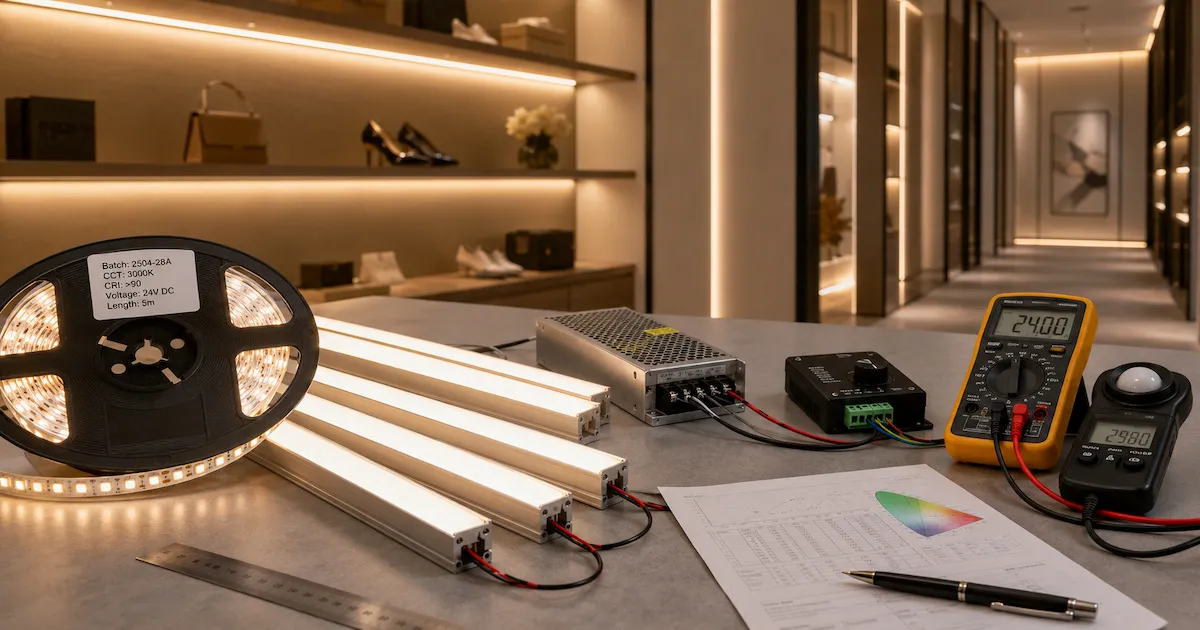
We often see installers struggle with mixed-batch jobs where additional reels are ordered weeks later without batch control. In long corridors or chain-store rollouts, that can create visible section-to-section differences. A second problem is on-site cutting and reconnecting without proper polarity and channel marking, especially on RGBW and tunable white strips.
A practical checklist helps. So does a pilot installation. In one retail rollout, a 2-meter mock-up caught a diffuser shift before 400 locations went into production. That saved rework, freight, and field labor.
| Common Issue | Likely Cause | Practical Fix |
|---|---|---|
| Color mismatch between reels | Different bin or batch | Approve and lock batch codes |
| Weak white on RGB strip | No dedicated white channel | Use RGBW instead |
| Uneven color on long runs | Voltage drop | Move to 24V or add feed points |
| Tone changed after install | Diffuser or cover effect | Test with final profile assembly |
| Color drift over time | Excess heat | Use aluminum profile and proper load |
| Controller not working fully | Wrong channel support | Match strip type to controller spec |
Conclusion
Strip lights come in a wide range of options: fixed single colors, a full white spectrum, tunable white, RGB/RGBW/RGB+CCT, and addressable pixels. The best choice depends on the application’s visual goal, control system, and installation details such as voltage, profiles, and diffusers. Define the exact CCT or color, confirm CRI and binning, plan for voltage drop and heat, and test with the final profile before bulk orders. Lock batches and controller compatibility to avoid mismatch and rework.
To reinforce the practical steps: start with a written specification, approve a labeled sample, run a short pilot installation using final materials, obtain photometric data where needed, and confirm controller compatibility before placing large orders. These steps reduce field issues and protect margins on multi-site rollouts.
FAQ
Q1: What colors do strip lights come in?
Strip lights come in warm white, neutral white, cool white, red, green, blue, amber, yellow, pink, RGB, RGBW, RGB+CCT, tunable white, and some specialty spectra like UV or horticulture.
Q2: How does RGB differ from RGBW?
RGB uses red, green, and blue chips to mix colors. RGBW adds a dedicated white chip, which gives better white light quality and cleaner pastel colors.
Q3: What is the best white color for commercial interiors?
It depends on the project. 3000K suits hospitality and warm retail spaces, while 3500K to 4000K is common for offices, shelves, and general commercial use.
Q4: Can diffuser covers change the way strip light color looks?
Yes. Opal covers can soften glare and slightly mute the tone, while clear covers keep brightness higher but may show LED dotting.
Q5: How do I avoid color mismatch on large strip light orders?
Approve samples with batch identification, lock CCT or color type, confirm binning tolerance, and avoid mixing late replenishment stock without checking consistency.
