
Corner profiles in modern architectural lighting hold LED strips at 45-degree or angle-specific positions, protect the strip, manage heat, hide wiring, and create cleaner light lines in corners, coves, cabinets, stairs, wall joints, and display systems.
Many contractors can install LED strips quickly, but raw strips in corners often create glare, visible dots, poor heat control, and uneven lines. Those issues cause callbacks, client complaints, and margin loss. A corner aluminum profile solves this by giving the strip a stable mechanical housing, a better beam angle, and a finished architectural appearance. From our manufacturing-floor perspective, corner profiles are not small accessories. They are project-risk reducers — we test profile heat behavior, diffuser output, and strip fit because one small mismatch can show up across hundreds of meters in a hotel, retail chain, or office fit-out.
1. What Are Corner Profiles in Architectural LED Lighting?
LED strip corner profiles are aluminum channels designed to mount LED strips where two surfaces meet. Typical positions include wall-to-ceiling corners, cabinet inside corners, stair edges, display shelves, and recessed furniture grooves. Most models use a 45-degree LED mounting surface so the light projects diagonally rather than straight down.

The LED aluminum profile keeps the strip flat, protects solder joints, supports the diffuser, and gives installers a repeatable mounting method.
Common parts include:
- Aluminum extrusion body
- Opal, frosted, clear, or semi-clear diffuser
- End caps with or without cable holes
- Mounting clips or screws
- LED strip, driver, dimmer, and control wiring
| Corner profile component | Main function | Project benefit |
|---|---|---|
| Aluminum body | Holds LED strip and transfers heat | Longer LED life and cleaner mounting |
| Diffuser cover | Softens LED points and controls glare | Better visual comfort |
| End caps | Close open ends and manage cable exit | Finished look and safer wiring |
| Mounting clips | Fix profile without messy adhesive only | Faster maintenance |
| 45-degree strip seat | Aims light across two planes | More balanced corner illumination |
2. Why Do Corners Need a Dedicated Lighting Profile?
Corners combine shadow, glare, limited space, and awkward wiring. A bare strip in a corner often sends light in the wrong direction and exposes LED dots. That creates visible defects and service issues.
A dedicated corner profile provides a screw-fixed or clip-fixed base, a defined angle, and a protected cavity. For large projects, a few failed corners cause disproportionate labor and access costs.
| Corner problem | Result without profile | Result with corner profile |
|---|---|---|
| LED dots visible | Cheap appearance, glare complaints | Diffused, controlled light line |
| Weak adhesive | Strip falls or waves | Mechanical fixing with clips or screws |
| Poor angle | Dark zones near the joint | Diagonal beam covers both surfaces |
| Exposed solder joints | Higher damage risk | Protected inside aluminum housing |
| Hard cleaning | Strip gets pulled or scratched | Diffuser shields LED surface |
3. How Do Corner Profiles Shape Beam Angle and Visual Comfort?
Most angled corner LED profiles use a 45-degree orientation because it spreads light across adjacent surfaces. However, profile depth, LED density, and diffuser type determine dot visibility and perceived brightness.
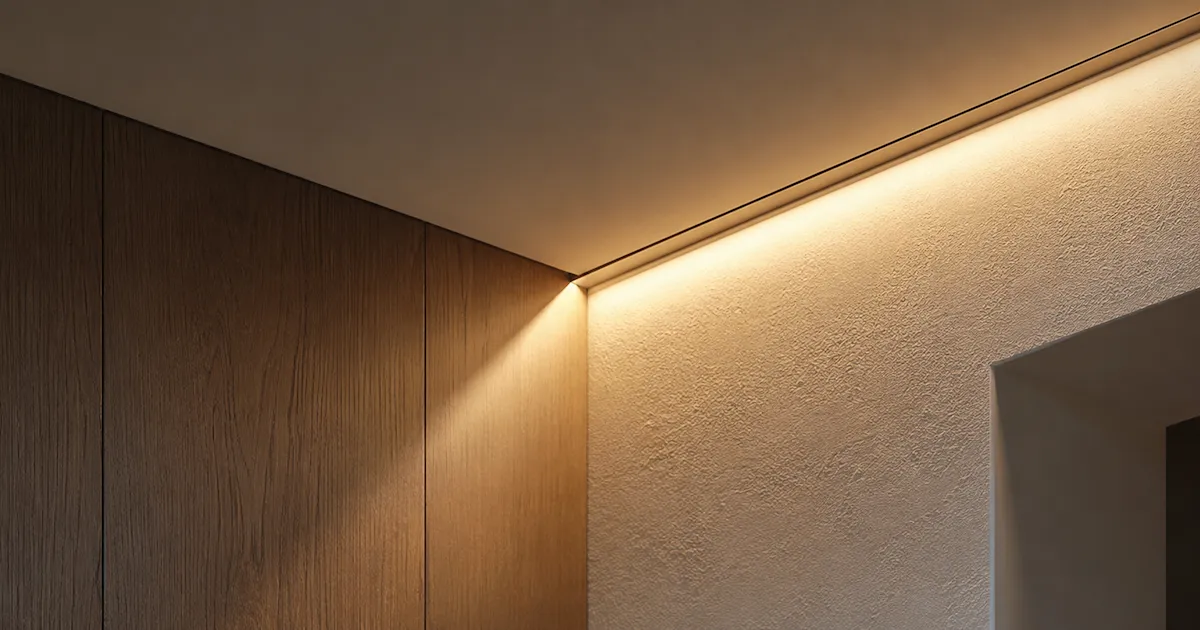
A milky diffuser can reduce lumen output by 15%–35% depending on material and thickness, but it often improves perceived quality by removing glare.
To better understand how LED strip choice, brightness, efficiency, and power planning affect the final corner profile result, this neutral educational video gives a helpful overview before selecting the full lighting system.
| Diffuser type | Typical light loss | Dot control | Best use case |
|---|---|---|---|
| Clear PC | 5%–10% | Low | Hidden technical areas |
| Frosted PC | 10%–20% | Medium | Shelves, cabinets, work zones |
| Opal PC | 20%–35% | High | Hotels, premium retail |
| Black diffuser | 30%–45% | Medium–high | Dark interiors, decorative lines |
4. Which Materials and Specifications Matter Most?
For aluminum profiles, small specification differences change field performance. Check aluminum grade, surface treatment, wall thickness, diffuser material, and internal width.
6063 aluminum is common for its extrusion quality and heat handling. Wall thickness around 0.8–1.5 mm balances rigidity and cost. Confirm inner width (8/10/12 mm typical), diffuser type, and finish before ordering.
| Specification | Practical range | Why it affects the project |
|---|---|---|
| Aluminum grade | 6063 common | Better extrusion shape and finish |
| Wall thickness | 0.8–1.5 mm | Rigidity and heat path |
| Strip cavity width | 8–12 mm typical | Prevents strip bending or poor fit |
| Diffuser material | PC or PMMA | Impact strength and optical output |
| Surface finish | Anodized or coated | Corrosion resistance and design match |
5. Corner Profiles vs Flat Profiles: Which Should You Specify?
Flat profiles suit under-shelf lines, ceiling slots, and direct linear mounting. Corner profiles are for junctions where two planes meet and the beam needs a diagonal direction.
Tilted flat profiles can look inconsistent; a corner profile gives a fixed angle and cleaner alignment.
| Corner profile vs flat profile | Corner profile | Flat profile |
|---|---|---|
| Mounting position | Inside corners and angled joints | Flat surfaces and slots |
| Beam direction | Usually 45 degrees | Straight outward |
| Visual effect | Soft wash across two planes | Linear direct line |
| Installation repeatability | High in corners | High on flat surfaces |
| Best project fit | Cabinets, coves, stairs, displays | Shelves, ceilings, panels, signage |
6. How Do Corner Profiles Help Heat Dissipation and LED Lifetime?
A corner profile with better heat dissipation for LEDs draws heat from the strip PCB and spreads it across a larger metal surface. Slim decorative channels suit low-wattage strips; deeper profiles are required for higher wattages and COB applications.
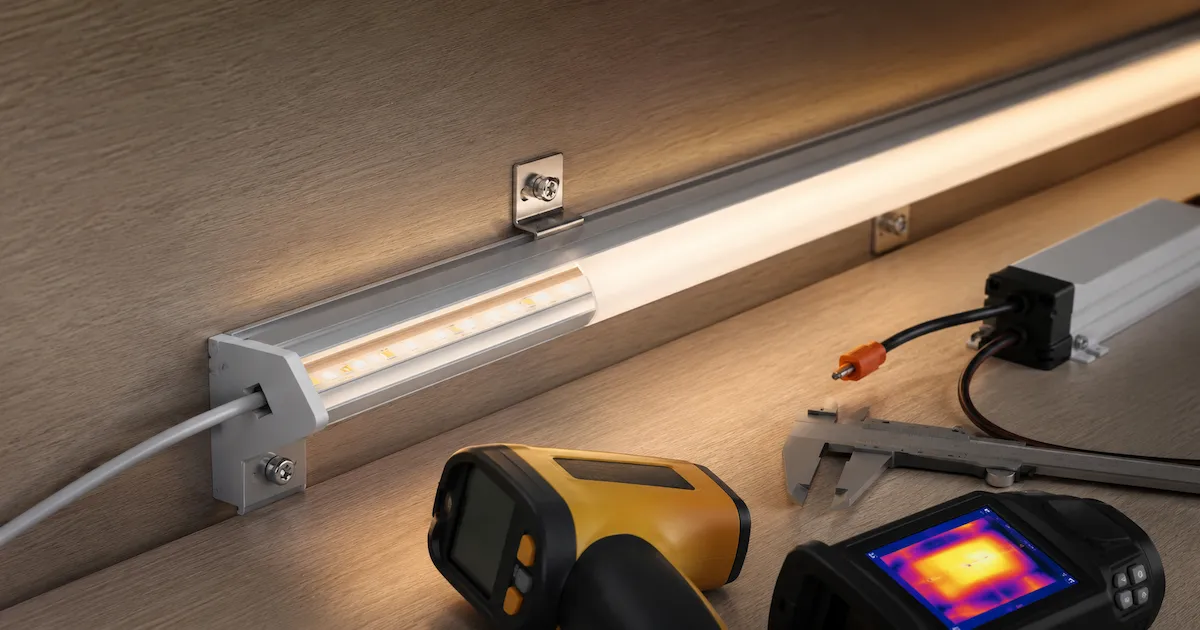
| LED strip power | Suggested profile type | Heat risk level | Typical application |
|---|---|---|---|
| 4.8 W/m | Slim corner profile | Low | Decorative cabinet glow |
| 9.6 W/m | Standard aluminum corner profile | Medium-low | Shelves and wardrobes |
| 14.4 W/m | Deeper profile with good mass | Medium | Retail and cove lighting |
| 19.2 W/m+ | Heavy profile and thermal review | Higher | Bright task or commercial lines |
7. What Installation Details Prevent Callbacks?
| Installation checklist item | What to verify | Common failure if ignored |
|---|---|---|
| Profile straightness | No twist before fixing | Wavy light line |
| Cut quality | Smooth ends, no burrs | Diffuser cracks or gaps |
| Strip adhesion | Full contact with aluminum | Hot spots and early failure |
| Cable exit | End cap hole fits cable | Pinched wires |
| Voltage drop | Measure at far end | Dim end sections |
| Driver load | 20% spare capacity preferred | Driver overheating |
| Test run | 2–4 hours before handover | Hidden wiring fault missed |
8. Where Are Corner Profiles Used in Real Projects?
They appear in hotel lobbies, retail shelving, offices, wardrobes, stair edges, and furniture. For outdoor use, pair the best corner profiles for outdoor LED strip installations with IP-rated strips and sealing strategies.
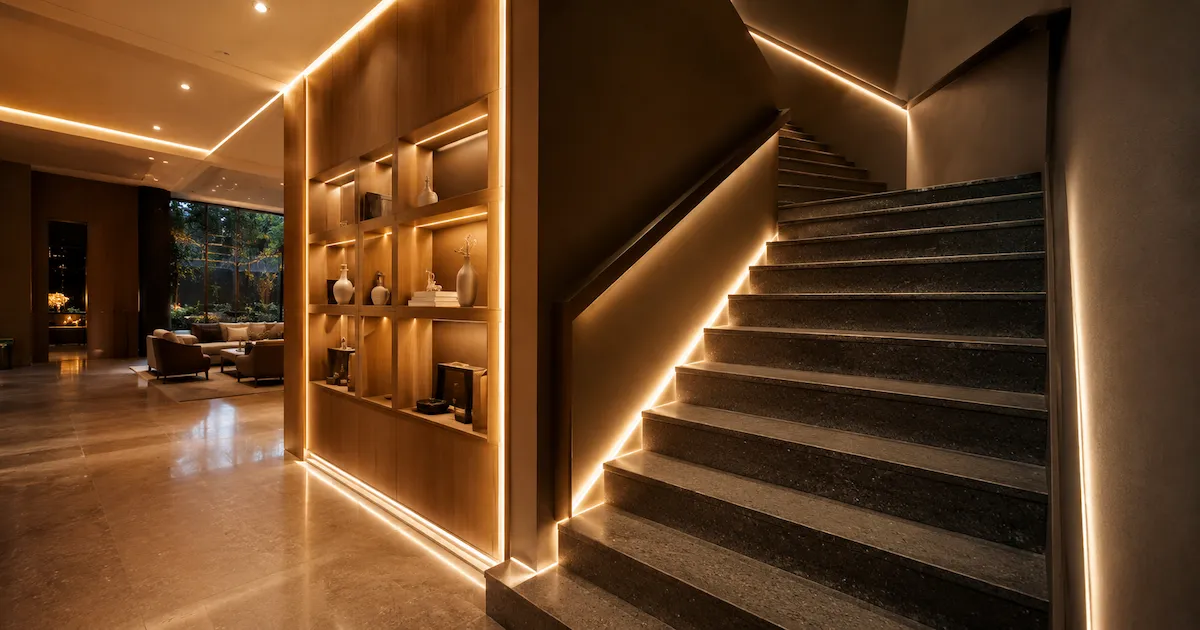
| Application | Preferred profile feature | Design target |
|---|---|---|
| Hotel corridors | Opal diffuser, anodized body | Soft glare control |
| Retail shelves | 45-degree beam, easy cable exit | Product-focused light |
| Wardrobes | Slim body, warm CCT strip | Hidden comfort light |
| Stair edges | Strong diffuser, secure clips | Safety and guidance |
| Outdoor facade corners | Coated aluminum, sealed strip plan | Weather resistance |
9. How Should Buyers Check Quality Before Bulk Orders?
Request cross-section drawings, test samples with the actual strip, and material data for diffuser and finish. Confirm inner width, end cap fit, clip spacing, and packaging strength.
| Quality checkpoint | Acceptable sign | Warning sign |
|---|---|---|
| Diffuser fit | Snaps in without stress | Too loose or too tight |
| Anodizing | Even color along length | Streaks, spots, shade changes |
| Straightness | No visible bow in 2 m length | Curved profile body |
| Strip fit | PCB sits flat | Edges curl or lift |
| Packaging | Protected ends and covers | Scratches after transport |
10. How Do Corner Profiles Affect Cost, Compliance, and Project ROI?
Profiles add material cost but often reduce total project cost by lowering labor, rework, and maintenance. Include profile, diffuser, end caps, clips, cutting labor, wiring labor, driver layout, packaging, and waste allowance in budget.
| Cost factor | Low-risk choice | Business impact |
|---|---|---|
| Profile tolerance | Stable extrusion tooling | Faster installation |
| Diffuser quality | UV-resistant PC where needed | Less yellowing |
| Pre-cut service | Factory-cut to drawing | Lower site labor |
| Pre-soldered leads | Labeled input/output cables | Fewer wiring errors |
| Packaging | Strong cartons and film | Fewer transit scratches |
| Documentation | Clear drawings and test data | Easier client approval |
Conclusion
Corner profiles give LED strips a reliable angle, improved heat management, mechanical protection, and a professional finish. They reduce callbacks and protect margin when specified as part of the complete lighting system: profile dimensions, diffuser, strip selection, driver rating, wiring plan, and mounting method. Insist on samples and test data for visible projects and consider factory services (pre-cutting, pre-drilling, pre-soldering) to save site labor and ensure consistency.
FAQ
Q1: What is a corner profile for LED strip lighting?
A corner profile is an aluminum channel made for installing LED strips in corners or angled joints. It holds the strip, supports heat transfer, protects wiring, and gives the lighting a cleaner architectural finish.
Q2: How does a corner profile improve light distribution?
Most corner profiles position the LED strip at around 45 degrees. This directs light across two nearby surfaces, which reduces dark corners and creates a softer wash than a raw strip stuck flat to one side.
Q3: Can corner profiles reduce LED strip overheating?
Yes, if the strip sits flat against the aluminum base. The profile spreads heat away from the PCB. For high-wattage strips, use a heavier profile and test surface temperature before approval.
Q4: Are corner profiles suitable for outdoor architectural lighting?
They can be used outdoors with proper IP-rated strips, sealed accessories, corrosion-resistant finishes, and drainage-aware mounting.
Q5: What should I check before ordering corner profiles in bulk?
Check inner width, diffuser fit, aluminum straightness, surface finish, end caps, mounting clips, packaging, and compatibility with your LED strip and connector plan.
