
Use an aluminium profile when an LED strip needs heat control, a clean mounting channel, better diffusion, physical protection, or a finished architectural look. It is especially useful for medium and high-wattage strips, visible installations, furniture lighting, cabinets, hotels, retail shelves, and outdoor-rated channels.
1. What does an aluminium profile actually do for LED strip lighting?
An aluminium profile, also called an LED channel or extrusion, holds the LED strip, and the benefits of aluminium channel for LED strip lighting include stable mounting, better heat transfer, and diffuser support when a softer or dot-free line is required.
Adhesive tape alone may be fine for some low-power hidden lighting, but it is not a full mounting system for commercial work. In lab tests, diffusers can reduce raw lumen output by 8%–35% depending on material and opacity; the smoother visual result often outweighs small lumen losses.
Common use cases:
- Retail shelves where clean lines affect product presentation
- Furniture lighting where installers need tidy routing
- Hotel rooms where visible LED dots can cause rejection
- Stair lighting where profile edges protect the strip from impact
| Aluminium Profile Function | What It Solves | Business Impact |
|---|---|---|
| Heat dissipation | Slower lumen decay | Fewer warranty claims |
| Diffuser support | LED dots and glare | Better client acceptance |
| Mechanical housing | Peeling strips and impact | Lower callback risk |
| Clean mounting | Uneven lines | Faster approval |
| Accessory system | End caps, clips | Faster installation workflow |
Beyond these immediate benefits, profiles standardise installation details across projects. They provide predictable mounting points for clips, pre-drilled holes for wiring exits, and finished edges that match trim and furniture. For designers, profiles make it easier to specify focal distances, aiming angles, and uniformity in lighting plans. For maintenance teams, a profile simplifies replacement because the strip is seated in a known channel rather than glued to varying substrates.
2. When does heat make an aluminium profile necessary?
Heat is a main reason to use a profile because many LED strip heat issues start when heat remains trapped behind the PCB. If heat remains trapped, junction temperature rises, accelerating lumen depreciation, color shift, adhesive failure, and solder fatigue.
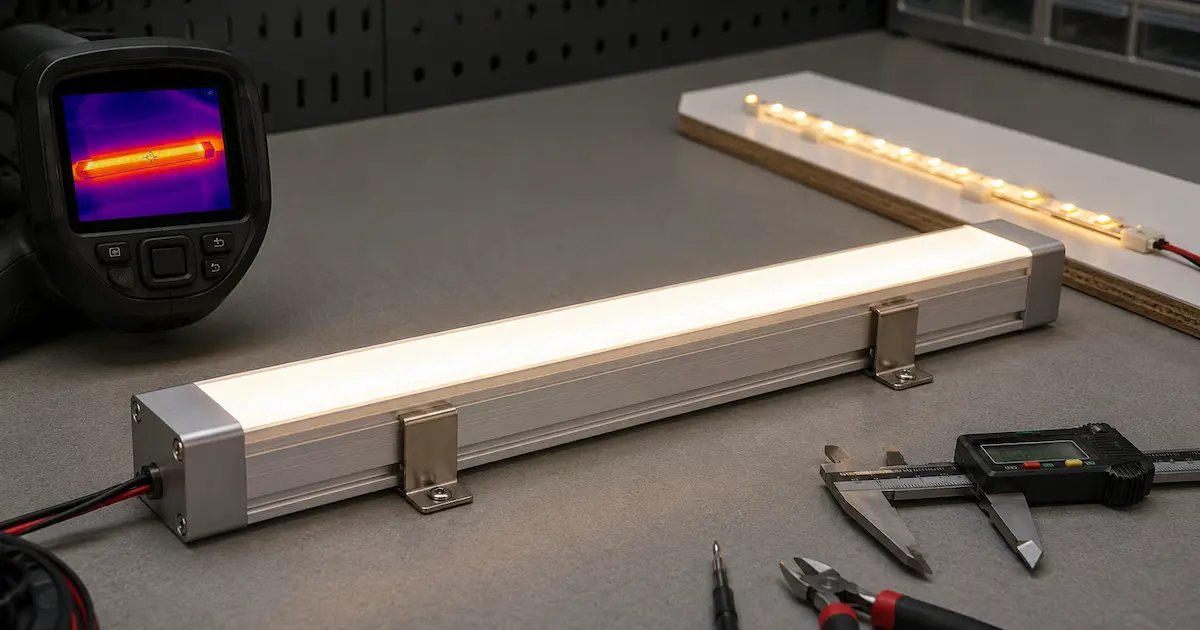
High-density strips on poor thermal substrates (painted MDF, plastic) are typical problem cases. For ongoing runs, profiles are recommended at lower power thresholds because real operating conditions (enclosed cabinets, long hours) increase thermal stress.
| LED Strip Power | Profile Recommendation | Reason |
|---|---|---|
| Under 4.8W/m | Often optional | Low heat if ventilated |
| 7.2–9.6W/m | Recommended | Better adhesion and heat path |
| 12–14.4W/m | Strongly recommended | Controls PCB temperature |
| 18–24W/m | Required | Heat risk too high without metal channel |
| Above 24W/m | Heavy profile/custom sink | Slim channels insufficient |
A practical rule: consider not only wattage per meter but also duty cycle. A 9.6W/m strip running 12–16 hours per day inside a closed cove will accumulate much more thermal stress than the same strip used an hour a day on a ventilated shelf. Also account for ambient temperature — installations in warm environments or near other heat sources need larger or more thermally capable profiles.
Technical tips: choose profiles with larger contact area to the PCB (flat base or adhesive backer designed for thermal transfer), and prefer anodised aluminium, which improves emissivity. For very high power strips, consider profiles with fins or mounting to a larger heat sink or a secondary heat spreader.
3. When do you need better diffusion and fewer LED dots?
Use a profile with a diffuser when strips are visible or reflected on glossy surfaces, especially when the project needs perfect light diffusion with aluminium channels. Dot visibility depends on LED density, distance to diffuser, diffuser opacity, and viewing angle. A deeper channel with COB or high-density strip often produces the smoothest line.
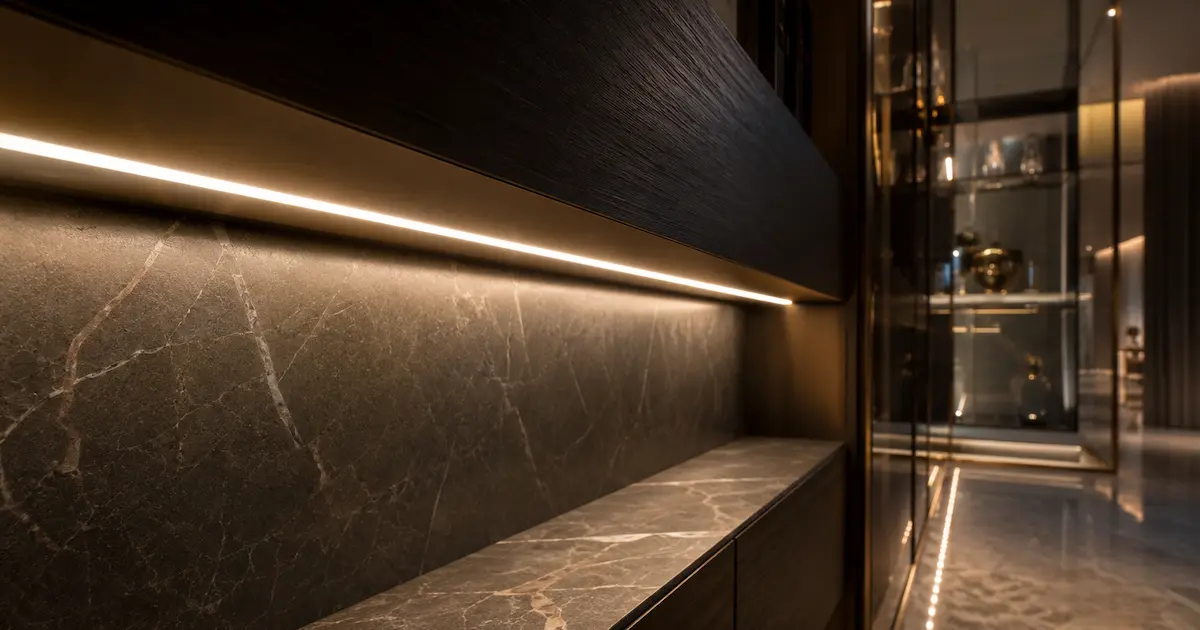
| Diffuser Type | Light Appearance | Approx. Light Loss | Best Use |
|---|---|---|---|
| Clear PC | Bright, points visible | 3%–8% | Hidden locations, max output |
| Frosted PC | Softer, some dots | 10%–18% | Cabinets, shelves |
| Opal PC | Smoothest line | 20%–35% | Visible linear lighting |
| Black diffuser | Contrasty, lower output | 35%–55% | Premium dark interiors |
Pro tip: always test the exact strip, diffuser, viewing distance, and angle before bulk ordering.
Additional considerations include the strip pitch and beam angle. For accent lines where sharp visual definition is required, a narrow channel with a clear diffuser can preserve crispness while still protecting the strip. For architectural cove lighting where the line should appear continuous from multiple vantage points, opal diffusers and deeper channels are preferable because lighting quality depends on visual comfort, uniformity, glare control, and the final visible effect. Also consider anti-glare coatings or micro-textured diffusers for critical hospitality or retail projects.
COB (chip-on-board) strips are often the best choice for dot-free effect because they inherently present a linear source; paired with a shallow profile, COB can deliver a smooth line while preserving overall compactness. Always include a mock-up in the client approval process.
4. When should profiles be used for mechanical protection?
Use profiles wherever strips may be touched, cleaned, or impacted. Bare PCBs are fragile—solders, copper pads, and LEDs suffer from contact and abrasion. Profiles and diffusers protect strips from cleaning routines, product handling, and shipping vibration.
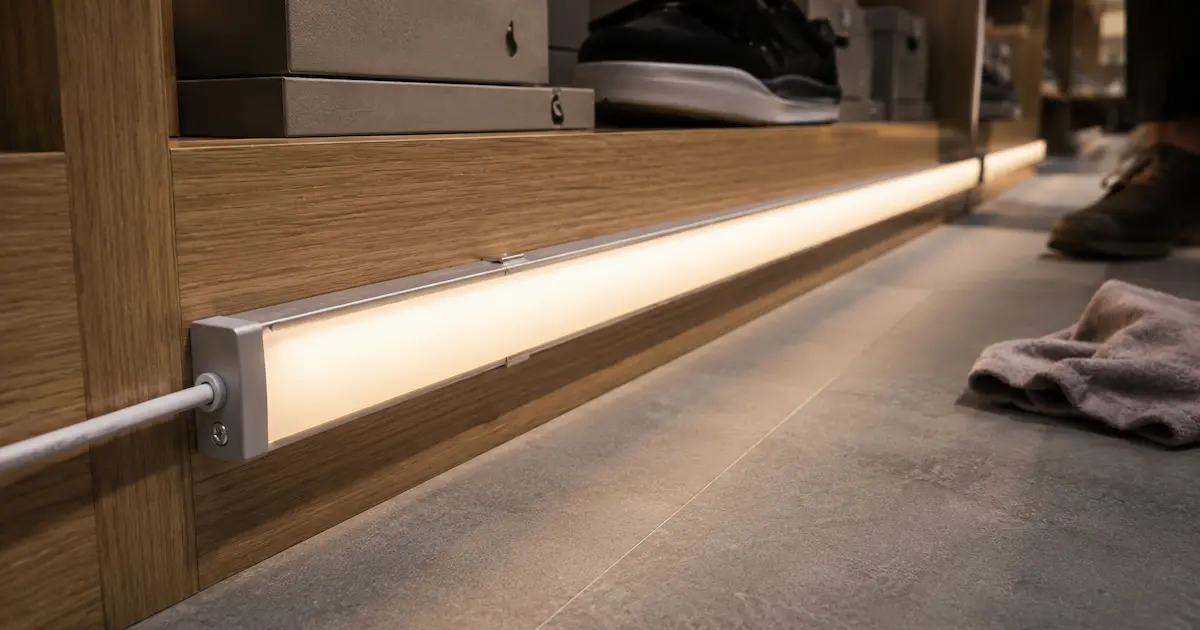
Scenarios that benefit from protection:
- Retail shelving where stock movement risks abrasion
- Furniture panels that undergo shipping and assembly
- Stair or plinth lighting exposed to foot traffic or equipment
| Site Condition | Bare Strip Risk | Profile Benefit |
|---|---|---|
| Dusty shelves | Adhesive failure | Keeps strip cleaner |
| Frequent cleaning | Solder/LED damage | Diffuser blocks contact |
| Public access | Accidental hits | Physical shielding |
| Vibration | Peeling adhesive | Mechanical fixing |
Note: profiles add mechanical protection but do not replace appropriate IP-rated strips and sealed connectors where water is involved.
Installation advice: use proper mounting clips and screws rather than relying solely on tape. End caps with cable exit seals prevent snagging during installation. For furniture or products that will be transported, specify shock-absorbing packing and consider flexible profiles or corner profiles that protect edges during handling.
5. When do outdoor or wet locations require aluminium profiles?
Outdoor and wet locations need careful planning, and a waterproof LED profile should be considered when rain, washdown, condensation, or humidity may affect the strip system. While IP-rated strips resist moisture, waterproof coatings can impede heat transfer. Profiles that provide mass and ventilation, sealed end caps, drainage, and proper cable routing are essential for long life.
| Rating/System | Protection Level | Typical Application | Watch Point |
|---|---|---|---|
| IP20 + indoor profile | Dry indoor | Cabinets, wardrobes | No water contact |
| IP65 + open profile | Splash resistance | Bathrooms, sheltered signs | Seal cable exits |
| IP67 + sealed profile | Strong moisture defense | Facades, damp zones | Heat buildup risk |
| IP68 systems | Submersion-capable | Pools, fountains | Special resin and cables |
Always specify both strip IP ratings and profile approach; sealed strips in closed profiles may overheat. Practical guidance: for exterior facades, choose anodised or powder-coated profiles to resist corrosion. Include drainage or breathable glands where condensation is likely. When sealing profiles to achieve IP67, plan thermal testing to ensure junction temperatures remain within spec. For submersible fixtures, use systems rated for continuous immersion and special cable glands and potting compounds; treat these as engineered fixtures rather than off-the-shelf strip assemblies.
6. Which aluminium profile type fits your application?
Select the profile based on mounting surface, viewing needs, and service access. A surface LED profile is quick for retrofit work, while recessed channels are flush, corner profiles direct light, deep profiles improve diffusion, and suspended profiles act as linear fixtures.
| Profile Type | Mounting | Advantage | Typical Use |
|---|---|---|---|
| Surface | Screws/clips | Fast retrofit | Shelves, cabinets |
| Recessed | Groove/milling | Flush finish | Furniture, millwork |
| Corner | 45° mount | Aim light | Cabinets, displays |
| Deep | Surface/recessed | Dot-free line | Corridors, offices |
| Suspended | Hanging kit | Architectural | Showrooms, offices |
Pick the profile before finalizing cabinet or trim drawings to avoid costly changes.
Selection tips: for retrofit jobs where demolition is limited, surface profiles with low visual depth and snap-in diffusers speed work and reduce dust. For high-end joinery, using a recessed LED profile during CNC routing yields a clean, invisible fixture. Engineer cable exits and service access early — some recessed profiles can be difficult to access for strip replacement, so include removable diffusers or access panels where maintenance is expected.
7. How do voltage, wattage, and strip type affect profile selection?
Voltage impacts wiring and voltage drop but not the profile’s heat-sinking role. 24V systems reduce current and voltage-drop risk for longer runs; 12V suits short sections. Profile choice should reflect wattage per meter and operating hours.
| Parameter | 12V Strip | 24V Strip |
|---|---|---|
| Best run length | Shorter | Longer |
| Voltage drop risk | Higher | Lower |
| Current for same wattage | Higher | Lower |
| Typical use | Small cabinets | Long shelves, coves |
High-density SMD or COB strips influence diffuser depth and channel mass needs. Always match strip wattage and density to profile thermal capacity.
Additional advice: consider driver placement and ventilation. Drivers generate heat too and should not be buried in poorly ventilated enclosures near strips. If dimming is required, check compatibility (triac, 0–10V, DALI, DMX) and plan driver access within the profile or nearby housing. For long runs, stage power injection points and use properly sized conductors to avoid excessive voltage drop that can exaggerate thermal and brightness issues at the far end.
8. When is an aluminium profile not needed?
A profile may be unnecessary for low-power, hidden, short, or temporary installations where the substrate already provides good heat transfer (e.g., metal frames) and there is minimal physical contact or cleaning.
Skip profiles only if all these apply:
- Power typically under 4.8–7.2W/m
- Strip is hidden from view
- Surface is clean, flat, and thermally friendly
- Runtime is limited
- No physical contact risk
If conditions change, add a profile to protect margin and schedule.
Examples: short accent pieces behind opaque trims, temporary stage lighting for events, or prototype mock-ups may be safely installed without profiles. However, for any installation intended to last in commercial environments, the modest material and labour cost of a profile usually pays back in reduced callbacks and longer, predictable performance.
9. What should distributors and contractors specify before ordering?
When working with aluminium LED profile manufacturers, a clear specification prevents site improvisation. Define strip PCB width, wattage per meter, voltage, length tolerance, mounting method, diffuser type, finish, end cap orientation, IP rating, and packaging. For OEMs, pre-cut lengths and pre-drilled holes save labor.
| Specification Item | Why It Matters | Example |
|---|---|---|
| Inner width | Prevents forced fitting | 10.5mm for 10mm strip |
| Profile depth | Controls dots | 12mm for smoother line |
| Finish | Matches design | Black anodized |
| Length tolerance | Modular assembly | ±1mm |
| Cable exit | Avoids onsite drilling | Side-exit end cap |
Request a sample with the actual strip inside the profile for sign-off.
Procurement tips: include part numbers for clips, screws, end caps, and compliance requirements such as the RoHS Directive when the aluminium profile system is used in regulated electrical projects. Specify whether diffusers are supplied assembled or loose. If the installer will pre-wire strips, specify driver mounting clips and maximum driver dimensions. Label profile lengths and ends to match installation drawings to reduce onsite errors.
10. How can testing and installation checks reduce callbacks?
Testing and checks catch issues early. Use thermal imaging and 30–60 minute run tests in production. On site, after confirming how to install aluminium channel for LED strip lighting, verify strip fit, mounting alignment, diffuser seating, cable exits, driver load, voltage at the far end, heat behavior, and dimming stability.
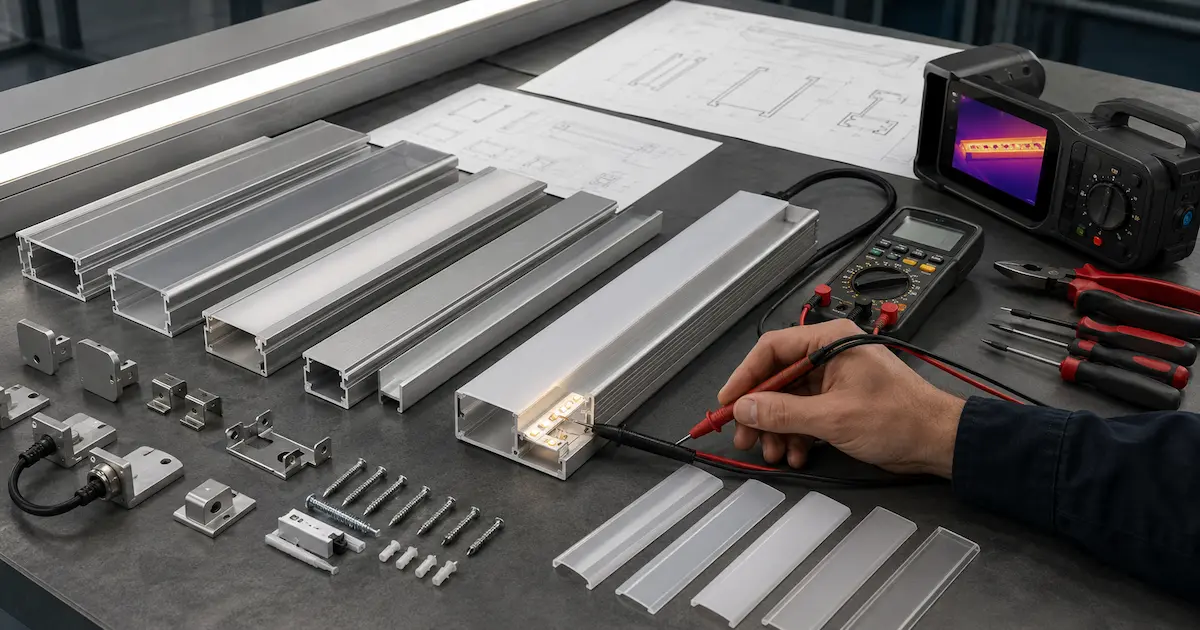
| Checkpoint | Inspect For | Prevents |
|---|---|---|
| Strip fit | PCB sits flat | Hot spots, adhesion failure |
| Profile mounting | Clips aligned | Wavy lines |
| Diffuser seating | No gaps | Dust ingress, poor look |
| Cable exit | No sharp bends | Broken joints |
| Voltage at far end | Under-load measurement | Brightness drop |
| Heat test | 30–60 min run | Overheating after handover |
A short pre-handover checklist saves hours of rework.
Field checklist: include a signed sign-off for mock-ups before bulk installation. Capture thermal images and measure voltages under load. If dimming, test across the full control range and for compatibility with sensors or building control systems. Keep a spare diffuser and a short strip length in the job kit to troubleshoot on site quickly.
Sections Overview
This article covers when aluminium profiles are needed: functions and benefits (1), thermal reasons (2), diffusion and dot control (3), mechanical protection (4), outdoor considerations (5), profile types (6), electrical interactions (7), cases where profiles are optional (8), specification checklist (9), and testing to reduce callbacks (10).
Conclusion
Use an aluminium profile whenever heat control, visual quality, mechanical protection, or serviceability matters. Treat the profile, diffuser, strip, driver, and wiring as a single system. Specify early, test a physical sample, and prefer mechanical fixing for critical installations to reduce failures and protect margins.
FAQ
Q1: What is an aluminium profile for LED strip lights?
An aluminium profile is a metal channel that holds LED strip lights, with a diffuser, end caps, and clips. It improves heat dissipation, diffusion, alignment, and protection.
Q2: How do I know if my LED strip needs an aluminium profile?
Check wattage, runtime, visibility, mounting substrate, and contact risk. If above ~9.6W/m, visible, on wood/plastic, or running long hours, use a profile.
Q3: Does an aluminium profile make LED strips brighter?
No. Diffusers often reduce measured lumens. The profile helps the strip run cooler, which supports stable output over time and a smoother visual result.
Q4: Can I use aluminium profiles outdoors?
Yes, but pair the profile with IP-rated strips, sealed exits, drainage, and corrosion-resistant finishes. Sealed profiles can trap heat, so plan thermal paths.
Q5: What profile depth gives the best dot-free effect?
Deeper profiles with opal diffusers reduce dots best. High-density SMD or COB strips can achieve smoother lines in shallower profiles; always test a sample before bulk ordering.
