
1. Why do jewelry showcases need specialized LED strip lighting?
Jewelry is hard to light because it reflects everything. A diamond, gold ring, or watch face will show glare, dark bands, and color shift faster than a matte retail product. That is why led strip lights for jewelry showcase use must be selected with tighter rules than shelf lighting or general cabinet lighting.
A basic strip can create three problems. It may make white diamonds look slightly yellow. It may create dot reflections on polished glass. It may heat the case and shorten LED life. In a luxury hotel lobby display, this can turn a premium product into something that looks cheap. In a mall kiosk, it can lead to buyer hesitation. In a watch counter, glare can hide dial detail.
Here’s the deal: brightness alone does not sell jewelry, so practical jewelry display lighting techniques should balance sparkle, color accuracy, glare control, and customer comfort. Accurate color, clean sparkle, and visual comfort do.
| Jewelry Display Goal | Lighting Requirement | Business Risk If Ignored |
|---|---|---|
| Diamond fire | High intensity with controlled angle | Stones look flat |
| Gold warmth | CCT around 3000K-3500K | Gold looks pale or greenish |
| Silver and platinum clarity | 4000K-5000K with high CRI | Metal looks dull |
| Premium viewing comfort | Diffused strip in aluminum profile | Glare and customer discomfort |
| Long daily operation | Thermal control | Early failures and callbacks |
2. What CRI and color temperature work best for jewelry?
CRI measures how naturally a light source shows colors, while the CIE’s technical guidance on colour rendering of white LED light sources provides broader context for evaluating the colour quality of solid-state lighting. For jewelry, CRI 90 is a practical minimum. CRI 95 is better for high-end counters. R9 also matters because red rendering affects rubies, rose gold, warm diamonds, and skin tone when customers try rings.
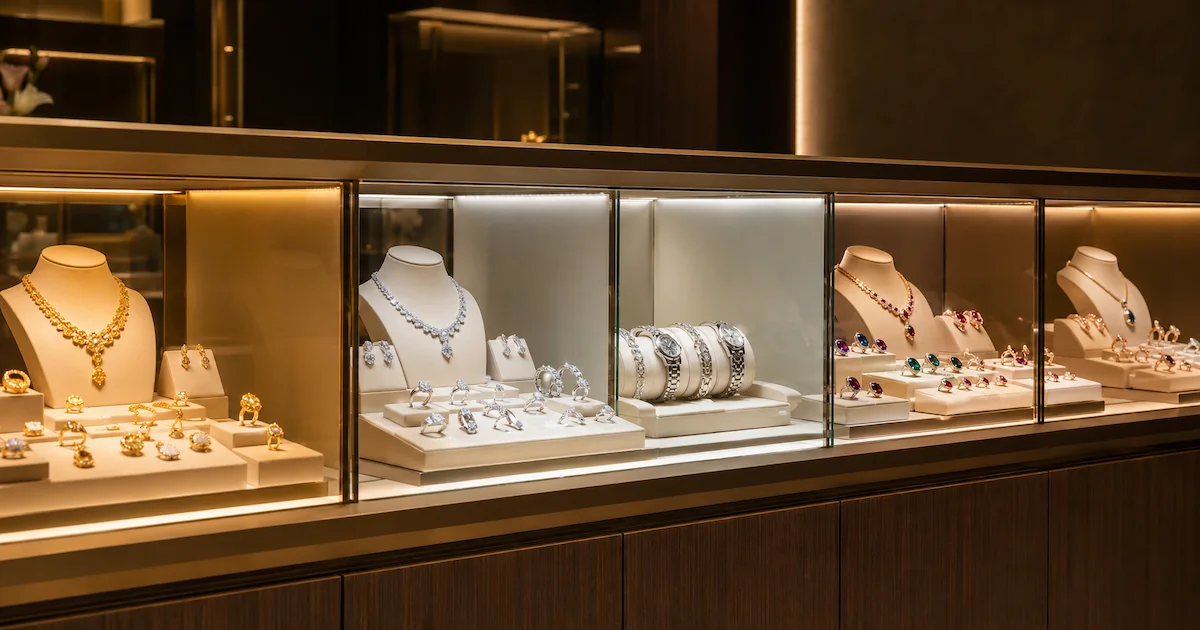
Color temperature depends on the product mix. Warm white supports yellow gold and vintage jewelry. Neutral white works well for mixed counters. Cool white can add sparkle to diamonds, but it may make gold look less rich. We often see installers struggle with mixed CCT strips across the same showcase, especially when they purchase small batches from different suppliers.
A field example: one chain store used 6000K strips for all counters. Diamonds looked sharp, but yellow gold lost warmth. After switching gold cases to 3500K and diamond cases to 5000K, the store reduced complaints about “cold-looking” products.
| Jewelry Type | Suggested CCT | Suggested CRI | Notes |
|---|---|---|---|
| Yellow gold | 3000K-3500K | 90-95 | Adds warmth and richness |
| Diamonds | 4500K-5500K | 90-95 | Supports sparkle and clarity |
| Silver/platinum | 4000K-5000K | 90-95 | Keeps metal clean and crisp |
| Gemstones | 3500K-4500K | 95 preferred | Better color discrimination |
| Mixed showcase | 4000K | 90-95 | Balanced choice for most stores |
The following conservation-focused webinar explains how professionals evaluate LED light quality when illuminating valuable objects and sensitive display materials.
3. How much brightness is right for a jewelry showcase?
Lux at the product surface matters more than strip lumens per meter because professional photometry evaluates visible light in relation to human visual response and the amount of light reaching the illuminated surface. Many buyers compare lumen output only, then find that the showcase looks uneven after installation. Glass height, profile position, beam angle, and diffusion all change the final result.
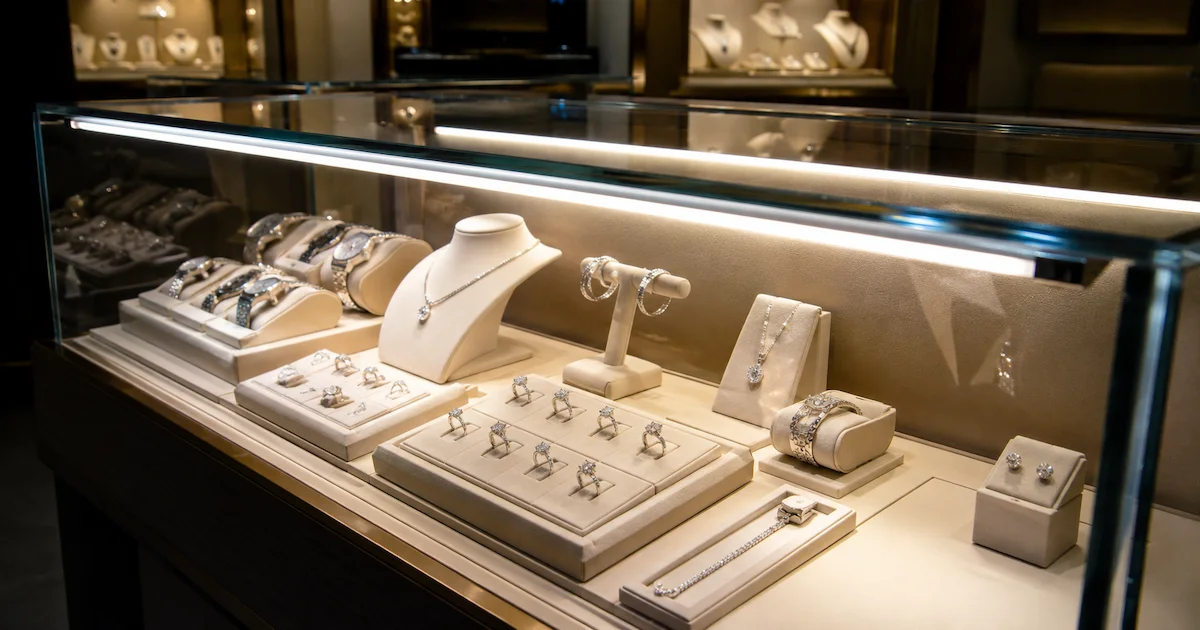
For most jewelry counters, a target range of 1,500 to 3,000 lux at the jewelry surface works well. High-end diamond displays may use higher accent levels, but glare control becomes harder. For small glass cases, a 10-15W/m strip with high efficiency can perform better than a cheap 20W/m strip that overheats.
Common Myth: Higher power rating always means better brightness.
Reality: Light output depends on LED efficiency, PCB quality, binning, profile design, and driver stability. A poor strip can consume more power and still deliver lower usable lux.
In our lab tests using integrating spheres, two 14.4W/m strips from different sources showed a lumen gap of more than 20%. That gap directly affects store appearance and tender acceptance.
| Display Size | Typical Strip Power | Target Lux at Product | Suggested Setup |
|---|---|---|---|
| Small ring tray | 8-12W/m | 1,500-2,000 lux | Side strip plus diffuser |
| Standard glass counter | 10-15W/m | 2,000-3,000 lux | Top front and rear lines |
| Diamond showcase | 15-20W/m | 3,000 lux or more | Narrow beam profile with dimming |
| Watch display | 10-14W/m | 1,500-2,500 lux | Soft linear light, low glare |
4. Should you use 12V or 24V LED strips in showcases?
For led strip lights for jewelry showcase projects, 24V is usually the safer commercial choice. It reduces current, lowers voltage drop, and supports longer runs with more stable brightness. 12V can still work in small cases, but it needs shorter runs and more careful wiring.
When we tested this against a standard 12V strip, the 24V version kept better brightness uniformity over a 5-meter run. The 12V strip showed visible dimming near the far end when powered from one side. In a retail counter with glass reflections, that small drop becomes easy to see.
Use 12V for compact OEM displays, battery-backed demo units, or very short runs. Use 24V for chain stores, long counters, and multi-case projects. If the run exceeds 5 meters, feed power from both ends or split the circuit.
| Feature | 12V LED Strip | 24V LED Strip |
|---|---|---|
| Best use | Small showcases | Commercial counters and long runs |
| Voltage drop | Higher risk | Lower risk |
| Current load | Higher | Lower |
| Wiring heat | More concern | Easier to manage |
| Driver selection | Very common | Common for professional projects |
| Installation margin | Lower | Better |
5. Which LED strip type works best: SMD, COB, or side-emitting?
SMD strips are widely used because they offer strong output, flexible cost control, and many CCT options. Understanding COB strip construction helps explain why these strips create a continuous light line and work well in shallow showcases where individual LED dots can reflect on glass. Side-emitting strips can help when space is tight and light must graze across a tray.
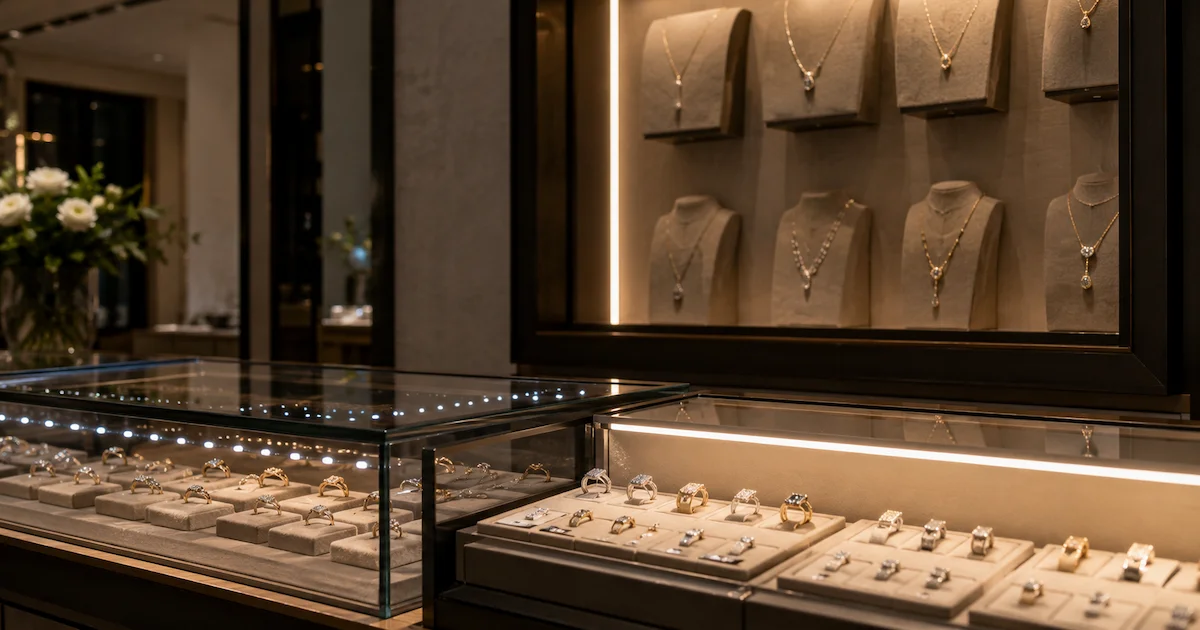
For jewelry, reflection control often matters as much as output. In one boutique project, a standard SMD 2835 strip caused dotted reflections on the inside glass panel. The contractor changed to a smooth-output COB LED strip inside a slim opal profile and solved the reflection problem without changing the case structure. In another project, side-emitting strips lit a necklace wall without exposing the light source to customers.
From our manufacturing floor perspective, COB strips need tighter process control because phosphor coating uniformity affects color consistency. SMD strips are easier to customize with PCB width, LED count, and cut length.
| Strip Type | Strength | Limitation | Best Showcase Use |
|---|---|---|---|
| SMD 2835/2216 | High output, many options | Can show LED dots | Counters with diffuser profiles |
| COB | Smooth line, low dotting | Thermal design still needed | Glass shelves, shallow cases |
| Side-emitting | Thin edge lighting | Lower output range | Slim trays and accent edges |
| High-density SMD | Better uniformity | Higher cost | Premium counters with profiles |
6. How do aluminum profiles and diffusers affect performance?
An aluminum profile for LED strip lighting is not only decorative; it also supports heat transfer, protects the PCB, conceals wiring, and helps shape the beam inside the showcase. They move heat away from the LED strip, protect the PCB, hide wiring, and shape the light. A diffuser softens dotting but also reduces output, so designers should understand how to achieve controlled light diffusion with aluminum channels before calculating final lux at the jewelry tray. The optical material and thickness of an LED channel diffuser affect both visible dot reduction and transmitted light, with many opal covers reducing output by 15% to 35%.
This is where it gets practical. If your design needs 2,500 lux at the tray, you must account for diffuser loss during calculation. Otherwise, the installed case may look underlit, and the project manager may request rework.
Our Chief Engineer notes: “Heat dissipation is often ignored in jewelry cases because the strip feels small. But inside a sealed glass counter, temperature rises fast during 10 to 12 hours of daily use.”
Use recessed profiles when you need a clean built-in finish, while a compact mini LED profile can suit narrow jewelry trays and showcases with very limited mounting space. Use 45-degree corner profiles when lighting from the front top edge. Use deep profiles when dot-free lighting is needed with SMD strips.
| Profile Choice | Main Benefit | Watch Point |
|---|---|---|
| Slim surface profile | Easy retrofit | Less heat mass |
| Recessed profile | Clean built-in look | Needs precise slot cutting |
| 45-degree corner profile | Better product angle | Can glare if exposed |
| Deep profile with opal cover | Smooth light line | Lower lumen output |
| Black profile | Blends into dark cases | May absorb more heat |
7. What driver and dimming setup should you specify?
A good strip can still fail visually if the driver is weak. For led strip lights for jewelry showcase systems, use constant-voltage LED drivers with enough power reserve. A common rule is to load the driver at 75% to 85% of its rated power, while accurate LED driver capacity calculations should also account for total strip wattage, cable loss, dimming equipment, and operating temperature. For example, a 60W driver should feed about 45W to 50W of strip load for stable long-term use.
Dimming matters because jewelry stores change scenes. Daytime window lighting, evening mall lighting, and VIP viewing rooms need different brightness levels. PWM dimming is common, but low-quality dimmers may cause camera flicker or visible stepping, so buyers should review independent flicker research when specifying drivers for showcases that are frequently photographed or recorded. For higher-grade projects, 0-10V, DALI, or DMX control may be used, depending on the store system.
We once saw a project fail acceptance because the display looked fine to the eye, but social media videos showed flicker bands. The driver and dimmer were replaced with a higher-frequency PWM unit, and the issue disappeared.
| Control Method | Best Use | Risk to Check |
|---|---|---|
| On/off driver | Simple counters | No scene control |
| PWM dimming | Most strip projects | Flicker frequency varies |
| 0-10V | Retail control panels | Compatibility with dimmer |
| DALI | Larger store systems | Programming needed |
| DMX | Dynamic premium displays | More wiring and setup |
8. How should installers plan wiring, cutting, and connectors?
Installation details decide whether the lighting looks professional after six months. Plan cable routes before fixing the profile. Keep solder joints accessible where possible. Avoid tight bends near resistors or solder pads. Use correct wire gauge for the current, and don’t rely on weak clip connectors in high-value retail counters unless they are tested for the load and environment.
We often see installers struggle with voltage drop because they add extra strip length during site work but keep the same driver and feed point. The far end becomes dimmer, and the customer sees a color shift. Power injection solves many of these cases.
Pre-soldered leads can save time on repeated showcase builds. For OEM display makers, custom cut lengths reduce site labor and reduce waste. A chain store rollout with 80 counters can save many hours if strips arrive cut, soldered, labeled, and matched to drawings.
| Installation Step | Recommended Practice | Common Failure |
|---|---|---|
| Measure run length | Add circuit plan before ordering | Wrong cut length |
| Cut strip | Cut only at marked pads | Damaged circuit |
| Solder leads | Use strain relief | Broken joint |
| Feed power | Feed both ends for long runs | Dim far end |
| Test before sealing | Run 30-60 minutes | Hidden fault after handover |
| Label wires | Mark driver and circuit | Slow service later |
9. What safety and certification details matter for commercial projects?
Retail jewelry showcases run for long hours near valuable products and customers. Safety cannot be treated as a checkbox, and commercial showcase installers should follow appropriate electrical safety practices to reduce the risks of shock, fire, damaged wiring, and unsuitable equipment. Use certified drivers, flame-retardant cable where required, proper insulation, and correct IP rating if cleaning spray or humidity is present.
For indoor glass counters, IP20 strips inside profiles may be fine if the case is dry and protected. For counters cleaned often with liquid spray, IP65 silicone coating can help. However, silicone coating holds more heat, so lower power density or better aluminum housing may be needed. IP67 tube strips are usually bulky for fine jewelry cases unless the design has enough space.
CE and RoHS are common for Europe. UL or ETL-related requirements may apply in North America. CB reports can support cross-market checks. The real safety gain comes from matching strip, driver, wire, profile, and installation method.
| Requirement | What to Check | Why It Matters |
|---|---|---|
| Driver certification | CE, UL, ETL, CB options | Reduces liability risk |
| Strip material | PCB copper, adhesive, coating | Affects heat and life |
| IP rating | IP20, IP65, IP67 | Matches cleaning and humidity |
| Wire size | Current capacity | Prevents overheating |
| Thermal path | Aluminum contact | Protects LEDs and adhesive |
10. How do you test samples before placing bulk orders?
Never approve led strip lights for jewelry showcase supply only from a photo or datasheet. Test samples inside a real or mock-up showcase. Check the jewelry under glass, from customer eye level, and through a phone camera. What looks fine on a bench may show glare inside the cabinet.
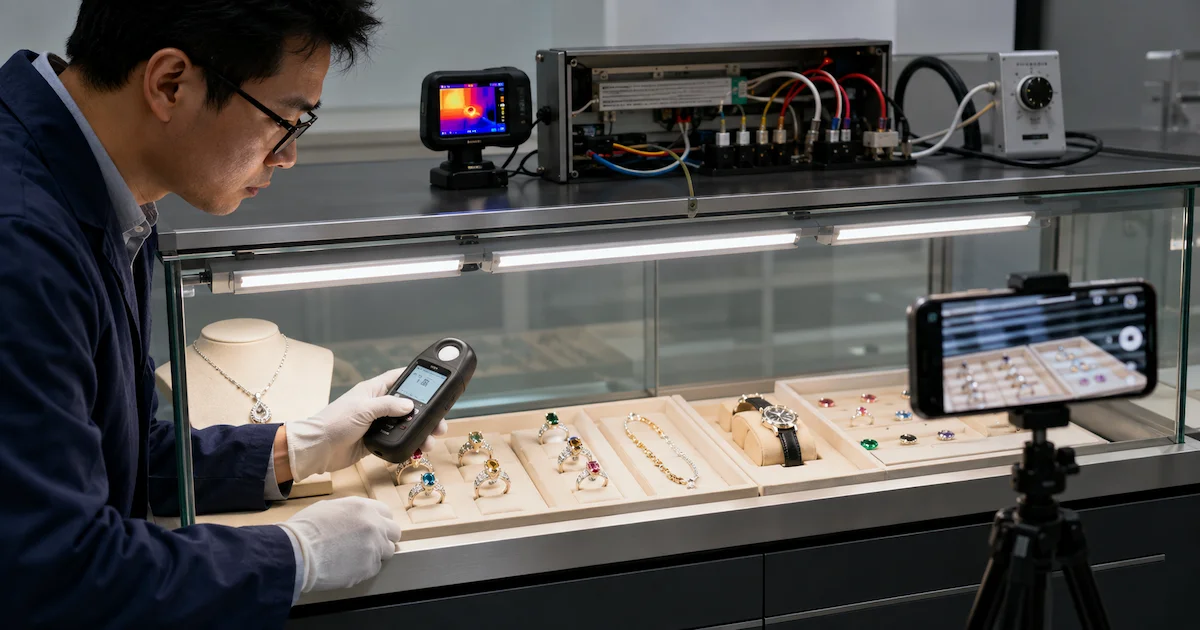
Use a simple sample approval process. Measure CCT and lux if tools are available. Run the strip for at least 24 hours in the profile. Check adhesive behavior, diffuser color, and driver noise. Compare at least two production samples from different reels if the project requires batch consistency.
In our lab tests using integrating spheres, we record initial output, CRI, CCT, and power draw. On aging racks, we run strips under load to observe early failures. This does not replace field testing, but it gives buyers a stronger base before store installation.
| Test Item | Acceptable Check | Warning Sign |
|---|---|---|
| CCT match | Same case looks uniform | One section appears yellow/blue |
| CRI/R9 | Meets project spec | Gem colors look weak |
| Heat | Profile stays within safe range | Adhesive softens |
| Flicker | No bands on phone video | Rolling stripes appear |
| Driver noise | Silent in counter | Buzzing under dimming |
| Diffusion | No visible dot reflections | Dots on glass or metal |
Final Thoughts
LED strip lights for jewelry showcase projects should be specified as a complete lighting system, not a loose strip purchase. CRI, CCT, lux level, voltage, profiles, drivers, dimming, wiring, and certification all affect the final counter appearance and service cost. The main message is simple: test under real showcase conditions before bulk supply. If you are unsure about voltage drop, CCT choice, or profile layout, send our engineering team your drawings. We’ll calculate it manually and give practical feedback.
Conclusion
To achieve consistent, premium results in jewelry showcases, treat lighting as an engineered system: pick high-CRI LEDs, specify CCT for the product mix, plan thermal paths with aluminum profiles, and confirm driver and dimmer compatibility. Always approve samples in a mock-up with the actual glass and diffusers, and insist on batch-controlled production and labelled wiring for repeat rollouts. These steps reduce rework, protect valuable inventory, and ensure customer confidence in store presentation.
FAQ
Q1: What are led strip lights for jewelry showcase projects?
They are linear LED lighting products selected for jewelry counters, glass cases, display trays, and premium retail cabinets. They usually require high CRI, stable CCT, controlled glare, low heat, and clean diffusion so gemstones and metals look accurate.
Q2: Is 3000K or 4000K better for jewelry showcases?
3000K to 3500K works well for yellow gold and warm luxury scenes. 4000K is a balanced option for mixed jewelry. Diamonds and silver often benefit from 4500K to 5500K, provided glare is controlled.
Q3: Do COB LED strips remove all dot reflections?
COB strips reduce dotting a lot, but glass angle, profile depth, diffuser type, and viewer position still matter. Test COB inside the actual showcase before bulk approval.
Q4: How can I reduce voltage drop in long showcase lighting runs?
Use 24V strips, shorter circuit sections, correct wire gauge, and power feeds from both ends when needed. Avoid running long strip lengths from one weak feed point.
Q5: What should I check before ordering bulk LED strips for jewelry displays?
Check CRI, R9, CCT tolerance, lux at product level, driver compatibility, dimming flicker, profile heat performance, certification needs, sample aging, and batch color consistency.
