
LED tape channels for outdoor sculpture lighting are aluminum, silicone, stainless, or recessed mounting systems that protect LED strips, manage heat, shape light output, and make installation cleaner. The best options include deep aluminum channels with diffusers, bendable silicone neon channels, recessed floor channels, grazing channels, and marine-grade stainless mounting profiles.
Outdoor sculpture projects often fail for simple reasons: water ingress, glare, color shift, weak adhesion, voltage drop, and channels that cannot handle thermal load. Those failures create callbacks, client disputes, margin erosion, and safety risks in public spaces. The solution is to select the channel based on the sculpture material, viewing distance, IP rating, beam effect, power density, and service access. From our manufacturing floor perspective, channel selection is never just a visual choice. It is a performance decision that affects warranty cost and site reliability.
1. Which LED tape channels work best for outdoor sculptures?
The best LED tape channels for outdoor sculpture lighting depend on whether you need a soft line, grazing effect, hidden glow, or rugged public-area protection. For most projects, the top choices are deep aluminum channels with opal diffusers, bendable silicone channels, recessed linear channels, and stainless fixing channels for harsh outdoor sites.
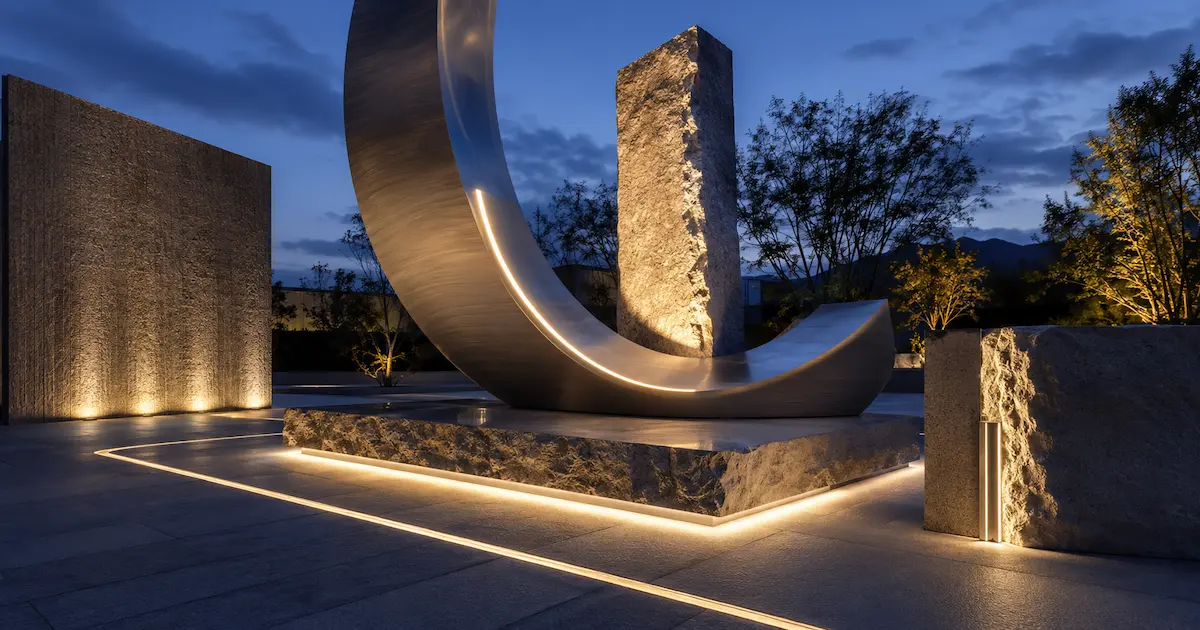
Here’s the deal: sculpture lighting usually has more movement, shadow, and irregular geometry than façade lighting. A straight profile may look clean on paper but fail on a curved bronze figure or a stone installation with uneven surfaces.
| Channel type | Best use case | Main strength | Watch point |
|---|---|---|---|
| Deep aluminum channel | Straight edges, plinths, frames | Better diffusion and heat control | Needs drainage planning |
| Bendable silicone neon channel | Curves, organic shapes | Seamless lit line | Lower heat transfer than aluminum |
| Recessed floor channel | Walkways around sculpture | Impact resistance and clean finish | Must avoid standing water |
| Grazing channel | Stone, concrete, textured metal | Strong shadow detail | Beam angle must be tested onsite |
| Stainless mounting channel | Coastal or vandal-prone sites | Corrosion and mechanical strength | Higher cost and harder cutting |
In a museum garden, we would often use deep aluminum channels hidden under the sculpture base, following many of the same planning principles used for LED strip lights for art installations. In a public plaza, recessed channels with tempered covers are safer. For a curved stainless artwork, flexible neon-style channels often give the cleanest line.
Practical add-on: always mock up a segment in situ—cuttings, planned drain locations, and the finished finish can differ from CAD. A one-meter physical sample mounted in the intended position and sealed as the final product will show realistic glare, color, and shadow before committing hundreds of meters.
2. How do aluminum channels affect heat, lifetime, and light quality?
A properly sized aluminum profile for LED strip lighting pulls heat away from the PCB and helps keep LED junction temperature under control in outdoor sculpture installations. Heat matters because every extra degree accelerates lumen decay, adhesive failure, and color drift, so installers should address the common solutions for LED strip heat issues before finalizing channel size and wattage. That directly affects your warranty risk.
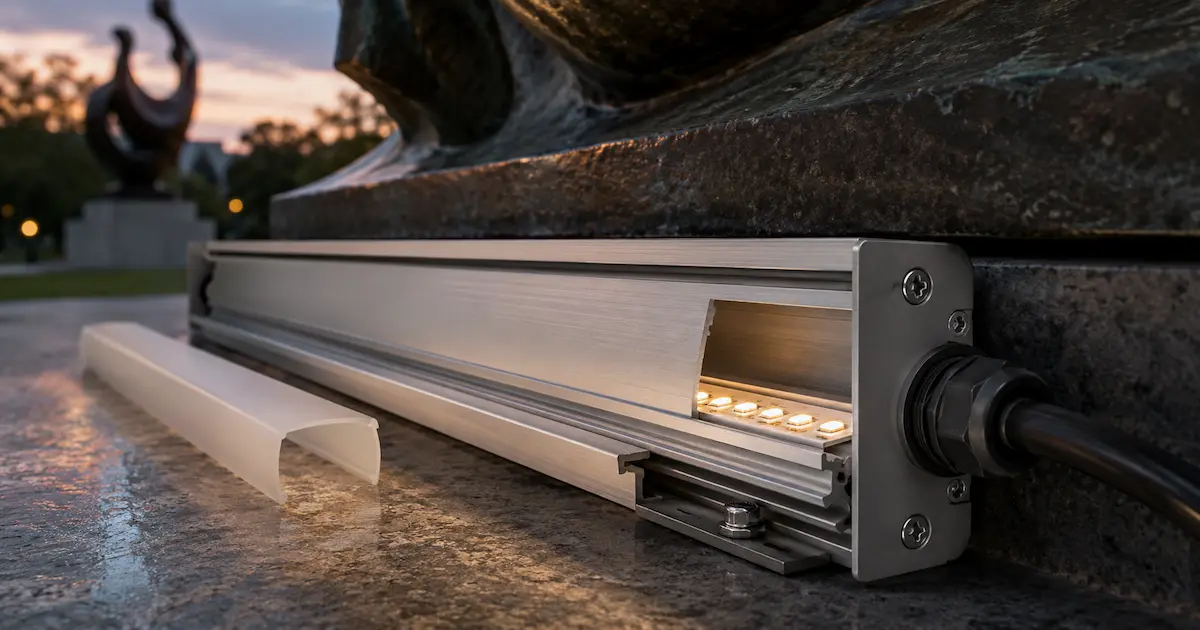
In our lab tests using integrating spheres, we compare LED tape output before and after thermal aging because effective thermal management of white LEDs is essential for maintaining light output, color stability, and long-term reliability. A 14.4W/m strip mounted in a proper aluminum profile can run much cooler than the same strip stuck directly onto painted steel or stone. The difference can be enough to change service life from a stable multi-year installation to an early callback.
Common Myth: Higher wattage always means better brightness.
Reality: Brightness depends on lumen efficiency, channel diffusion, thermal transfer, optics, and surface reflectance. A 10W/m high-efficiency strip in a good aluminum channel may outperform a 19.2W/m strip trapped in a sealed, heat-soaked cavity.
| Material | Thermal behavior | Outdoor suitability | Typical use |
|---|---|---|---|
| Anodized aluminum | Strong heat transfer | Good with sealed ends | Base lines, hidden coves |
| Powder-coated aluminum | Good, coating reduces transfer slightly | Good if coating is UV rated | Visible architectural channels |
| Raw aluminum | Good but may oxidize | Needs treatment outdoors | Budget internal cavities |
| Stainless steel | Lower heat transfer than aluminum | Very good in coastal sites | Mounting rails, guards |
Pro Tip from VST Technical Team: “If the LED tape is above 12W/m, don’t treat the channel as a trim piece. Treat it as part of the thermal system.”
Additional detail: consider thermal adhesive pads or thermally conductive silicone where direct metal contact is limited. Also plan for maximum ambient temperatures in direct sun—surface temperatures can soar, so outdoor-rated thermal calculations should use site-specific maximums, not room-temperature lab numbers.
3. Are silicone neon channels better for curved sculpture lines?
A flexible silicone LED profile is often the best choice for curved sculpture lighting because it bends smoothly and creates a continuous, dot-free line. They suit public art, abstract metal forms, letters, rings, arches, and installations where a rigid aluminum profile would need too many cuts.

But there’s a catch. Silicone does not dissipate heat like aluminum. That means the internal LED tape, PCB width, copper weight, and power density need tight control. For long runs, we prefer 24V or 48V systems, lower watt density, and factory-made injection-molded end caps. Hand-filled sealant can work, but only if the technician controls curing, strain relief, and cable entry.
We often see installers struggle with twisted silicone channels on curved art pieces. The light line looks fine during testing, then waves or pulls loose after thermal cycling. For a city park sculpture, that becomes a public complaint. For a hotel entry sculpture, it becomes a brand issue.
| Silicone type | Bend direction | Best sculpture shape | Risk to check |
|---|---|---|---|
| Top-bend neon | Vertical curves | Arches, waves, letters | Minimum bend radius |
| Side-bend neon | Horizontal curves | Rings, outlines, curved bases | Uneven brightness if twisted |
| 3D flexible neon | Complex curves | Free-form artwork | Higher cost, tighter planning |
| Mini neon | Fine detail | Small sculptures, signage accents | Lower brightness, small cables |
For precise work, ask for a sample bend test before mass production. It can save hours onsite.
Installation tip: assess the expected thermal cycling range and include expansion loops or flexible mounting points. Silicone channels can shift slightly with temperature swings; planned relief eliminates stress on the seal and cables.
4. What IP rating should channels have for rain, snow, and washdown?
Outdoor sculpture lighting needs a realistic IP rating based on the internationally recognized degrees of protection provided by enclosures, not just an unsupported label on a datasheet. IP65 can handle dust and water jets from limited angles. IP67 can handle temporary immersion. IP68 is made for longer immersion under defined conditions. However, IP rating alone does not solve condensation, cable wicking, or drainage.
What’s the real story? Many failures happen because water enters through cut ends, connector joints, screw holes, or driver boxes rather than through the LED tape body. A perfect strip in a poorly sealed housing can still fail, which is why contractors should understand how to specify waterproof LED channels for exposed installations rather than relying only on the strip’s stated IP rating.
| Rating | Protection level | Suitable locations | Field warning |
|---|---|---|---|
| IP65 | Dust tight, water jet resistant | Covered outdoor sculptures, under caps | Not for puddles |
| IP67 | Dust tight, temporary immersion | Exposed bases, splash zones | Seal all cuts carefully |
| IP68 | Long immersion under stated depth/time | Fountains, water features | Confirm depth, chemistry, cable type |
| IK08-IK10 cover | Impact resistance | Public plazas, walkable zones | Check cover glare and slip risk |
In a snowy climate, freeze-thaw cycles can open tiny gaps. In coastal areas, salt mist attacks screws and low-grade aluminum. In a fountain sculpture, chlorine or mineral content can shorten seal life. We recommend matching IP rating with mechanical sealing, cable glands, stainless screws, and a drainage route. This protects the project budget more than selecting the highest IP number blindly.
Maintenance note: schedule periodic inspection intervals—at six months for the first year, then annually. Check seals, re-torque fasteners, inspect cable glands, and verify no buried moisture. A small maintenance plan written into the handover reduces long-term cost and extends warranty coverage.
5. How should beam angle and diffuser type be selected?
Beam angle and the selected LED channel diffuser define how the sculpture is perceived, including its brightness, visual softness, dot visibility, glare, and shadow detail. Designers should also evaluate discomfort glare in outdoor environments, considering the source luminance, apparent size, viewing position, and surrounding background brightness. A wide opal diffuser softens edges and reduces glare. Clear covers raise output but reveal LED dots. Milky covers hide dots but reduce lumen output.
In our lab tests using integrating spheres, we often see 15% to 35% light loss through opal diffusers, depending on material and thickness. That loss is not bad if the project needs visual comfort. It only becomes a problem when nobody accounts for it during lumen planning.
| Optical choice | Light effect | Light loss range | Best location |
|---|---|---|---|
| Clear cover | High output, visible dots | 5%–12% | Hidden channels, grazing |
| Frosted cover | Balanced output | 12%–22% | Mid-distance viewing |
| Opal cover | Dot-free soft line | 20%–35% | Close viewing, luxury spaces |
| Asymmetric lens | Directed wash | 10%–25% | One-sided sculpture faces |
| Narrow lens | Strong grazing | 8%–18% | Stone, concrete, carved metal |
For a carved stone sculpture, a grazing channel placed 50–150 mm from the surface can reveal depth. For polished stainless steel, wide diffused light avoids harsh mirror glare. For bronze artwork, warm CCT around 2700K–3000K often feels more natural, while cool white can make it look flat.
Designer tip: use visual targets to agree on final CCT and diffuser before procurement. Lighting renders can mislead; a physical mock-up with the chosen diffuser and final CCT under night conditions gives far better alignment with client expectations.
6. Which voltage and power setup reduces voltage drop on long outdoor runs?n
Voltage drop in low-voltage cabling is one of the most common causes of uneven sculpture lighting because cable resistance reduces the voltage available to fixtures located farther from the power source. Long outlines, circular bases, and hidden cable routes often require more cable length than the drawing shows. If the far end looks dim or warmer, the client may reject the effect even if the product is technically working.
When we tested this against a standard 12V strip, a 10-meter run showed visible drop faster than a 24V version at the same watt density. For large outdoor sculptures, 24V is usually the practical baseline. For long public art runs, 48V constant voltage systems can reduce current and cable loss, provided local rules and driver options fit the project.
| System | Current level | Best run length | Pros | Cons |
|---|---|---|---|---|
| 12V vs 24V | 12V draws about double current at same watts | Short details under 5 m | Easy sourcing, many accessories | More voltage drop |
| 24V vs 48V | 24V draws double current versus 48V | Medium runs 5–15 m | Good balance, wide driver range | Needs feed planning |
| 48V vs 12V | 48V has far lower current | Long outlines 15 m+ | Lower cable loss | Requires correct safety review |
Use parallel feeds, thicker cable, and center feeding for rings or loops. Place drivers near the load when possible, but keep them serviceable. A hidden driver sealed inside a sculpture may look neat, but it can turn a simple service call into a full dismantling job.
Technical advice: calculate conductor size with the actual load and allowable voltage drop (typically 3–5%). Online voltage-drop calculators help, but always cross-check with the driver’s minimum voltage and recommended operating range. For pixel installations, account for data integrity under low-voltage conditions. The following independent installation tutorial demonstrates practical methods for extending, waterproofing, testing, and power-injecting outdoor LED runs to reduce connection failures and uneven brightness.
7. What mounting methods prevent channel movement and water traps?
Mounting is where many outdoor sculpture projects either become reliable or start failing quietly. Adhesive tape alone is rarely enough for outdoor channels, and comparing suitable aluminium channels for outdoor LED lighting can help contractors choose profiles designed for clips, sealed fasteners, drainage, and changing temperatures. Temperature swings, dust, humidity, and substrate movement weaken the bond. Mechanical fixing is safer, especially for public installations.
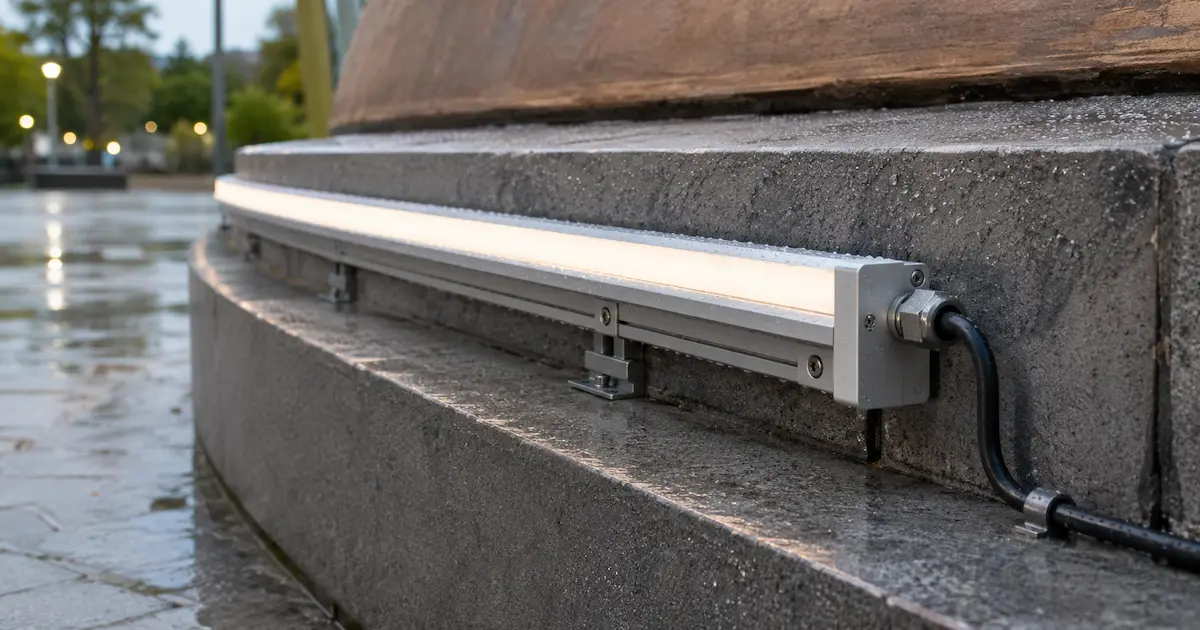
We often see installers struggle with irregular stone, cast metal, and powder-coated bases. Screws may not sit flat. Clips can twist. Drain holes may face the wrong direction after onsite adjustment. Small details create big trouble later.
Recommended mounting methods include:
- ● Stainless clips for straight aluminum channels
- ● Countersunk screws with sealing washers for exposed bases
- ● Flexible brackets for curved silicone neon
- ● Structural adhesive only as a support method, not the only hold
- ● Drainage gaps at low points
- ● Cable strain relief at every entry point
| Mounting issue | Likely result | Better practice |
|---|---|---|
| No drain path | Water pooling, seal stress | Add weep holes and slope |
| Adhesive-only fixing | Channel detachment | Use clips or screws |
| Mixed metals | Corrosion staining | Use compatible fasteners |
| Tight cable bend | Broken conductors | Add strain relief loop |
| No service access | High labor cost | Plan removable covers |
Onsite guidance: create a simple drilling template or jig for repetitive fixings and mark low points for drainage before final sealing. This reduces human error and ensures consistent placement when working on uneven substrates.
8. How do control channels handle RGBW, DMX, and dimming?
Outdoor sculpture lighting often needs more than static white. RGBW, tunable white, pixel tape, DMX control, and 0–10V dimming can shape the artwork for events, seasons, or city branding. The channel must leave enough space for LED tape width, wiring, and heat. A tight profile that fits single-color tape may not fit RGBW or pixel tape.
Here is where it gets interesting. Control design affects maintenance. If every sculpture segment has a custom controller hidden in a sealed box, troubleshooting becomes slow. If zones are planned clearly, a technician can isolate a failed run quickly.
| Control type | Best use | Channel impact | Site concern |
|---|---|---|---|
| Single-color dimming | Warm white sculpture glow | Narrow channels possible | Driver compatibility |
| Tunable white | Day/night color adjustment | More conductors | CCT calibration |
| RGBW | Color scenes | Wider tape and more heat | Waterproof connectors |
| DMX pixel | Dynamic effects | Data cable route needed | Signal distance and addressing |
| 0–10V/DALI | Building integration | Driver-side planning | Control cabinet access |
For a hotel courtyard sculpture, RGBW may support events without changing hardware. For a civic monument, warm white plus dimming may be more respectful. For interactive art, pixel control needs strong documentation, because future repairs depend on channel mapping and address records.
Control protection: specify surge protection, fusing, and grounding, especially for coastal or exposed sites. Also document addressing maps and store copies with the client; without this, pixel installations become costly to reprogram after a failure.
9. What failures should contractors check before handover?
A solid handover check prevents painful callbacks. Outdoor sculpture lighting should be tested after installation, after wetting, and after night viewing. Daytime electrical tests are not enough because glare, dotting, and color mismatch only show in real viewing conditions.
From our manufacturing floor perspective, factory testing and field testing must meet in the middle. We can age LED tape, inspect solder joints, run thermal imaging, and verify CCT bins. The contractor still needs to confirm cable routes, sealing, grounding, and drainage onsite.
| Failure mode | Quick symptom | Likely cause | Fix before handover |
|---|---|---|---|
| Dim far end | Brightness fades along run | Voltage drop | Add feed point or thicker cable |
| Water inside channel | Fogging or flicker | Poor end seal, no drain | Reseal and add drainage |
| Color mismatch | Different white tones | Mixed bins or heat shift | Use same bin, test samples |
| Hot channel | Cover warps, lumen decay | High watt density | Lower power or change profile |
| Random flicker | Unstable output | Driver overload, bad joint | Check load, joints, driver margin |
| Loose profile | Channel moves | Weak adhesive | Add mechanical fixing |
Commissioning checklist: include soak test (spray/wet), thermal imaging run at max rated power, night-time visual sign-off with client, and labelled as-built wiring diagrams. These small steps drastically cut the chance of post-handover disputes.
10. How should buyers specify LED tape channels for outdoor sculpture projects?
Good specifications reduce risk before production starts. A vague request for an outdoor LED strip channel leaves too much room for error unless the buyer also defines the profile material, dimensions, sealing method, diffuser, mounting system, and cable exits. A better request lists sculpture material, channel type, IP rating, voltage, CCT, CRI, wattage, diffuser, cable length, connector method, mounting method, driver location, control protocol, and packaging needs.
For procurement teams, this is about predictable quality and fewer surprises. For installers, it saves time. For designers, it protects the intended visual effect.
Use this short specification checklist:
- ● Sculpture material: bronze, stainless, stone, concrete, glass, resin
- ● Environment: rain, snow, coastal salt, fountain spray, UV exposure
- ● Viewing distance: close touch, 1–3 m, 5 m+
- ● Light effect: outline, halo, grazing, washing, hidden glow
- ● Electrical plan: voltage, power per meter, feed points, driver margin
- ● Control: static, dimming, RGBW, DMX pixel
- ● Service plan: removable cover, spare parts, labeling
| Specification item | Recommended detail | Why it affects cost |
|---|---|---|
| IP rating | IP65/IP67/IP68 with seal method | Impacts labor and warranty |
| Channel drawing | Cross-section with dimensions | Prevents fit errors |
| Cable exit | Side, rear, end, custom length | Saves site soldering time |
| CCT/CRI/bin | 2700K–4000K, CRI 80/90, bin code | Reduces visual mismatch |
| Packaging | Cut lengths, labels, zone marks | Speeds installation |
Procurement tip: request samples early and include acceptance tests in the purchase order. Label each cut length and provide a simple installation diagram with torque specs for fasteners and recommended sealants.
Conclusion
The right LED tape channels for outdoor sculpture lighting balance optics, sealing, heat, voltage, mounting, and service access. Aluminum profiles handle heat well. Silicone neon channels suit curves. Recessed and stainless channels protect public installations. Match the channel to the artwork, not the other way around. If you are unsure about voltage drop, channel size, or sealing detail, send our engineering team your drawings. We’ll calculate the load and review the channel plan manually.
Final practical steps: always produce a one-meter prototype, agree tolerance and drain positions with the site team, and include a brief maintenance schedule in the handover pack. These small administrative actions avoid the majority of on-site failures and preserve the artwork’s intended appearance over years.
FAQ
Q1: What are LED tape channels for outdoor sculpture lighting?
They are mounting profiles or housings that hold LED tape, protect it from weather and impact, manage heat, and shape the light effect. Common materials include aluminum, silicone, and stainless steel.
Q2: Which channel is best for curved outdoor sculptures?
Bendable silicone neon channels are usually best for curves, rings, and organic shapes. For high-power tape, check heat limits and use samples to verify bend radius and brightness.
Q3: Is IP68 always better than IP65 for sculpture lighting?
No. IP68 helps in immersion, but many outdoor sculptures only need IP65 or IP67 with proper drainage, sealing, and cable glands. The site condition should drive the choice.
Q4: Why does LED tape look dim at the end of a long sculpture run?
The usual cause is voltage drop. Use 24V or 48V tape, thicker cables, shorter segments, parallel feeds, or center feeding to keep brightness even.
Q5: Should outdoor LED tape channels use screws or adhesive?
Use mechanical fixing for most outdoor projects. Adhesive can help positioning, but screws, clips, brackets, and sealed fasteners give better long-term stability.
