
LED tape light channel lighting is ideal for yoga studio ambiance when it is specified with the right aluminum profile, diffuser, color temperature, dimmer, driver, and installation layout. It gives soft linear light, hides glare, supports calm scenes, and protects the LED strip from heat, dust, and touch damage.
1. Is LED tape light channel lighting suitable for yoga studio ambiance?
Yes — it can create quiet, low-glare illumination along ceilings, walls, mirrors, reception counters, and meditation zones. Yoga spaces need visual comfort more than aggressive brightness. A good channel system spreads light through a diffuser and creates seamless dot-free lighting instead of showing individual LED points.
Channels control glare, improve heat dissipation, and provide a clean architectural finish. A frosted diffuser may reduce output by 15–35%, depending on material and thickness. That loss is acceptable if it removes glare and visible dotting.
Typical use cases include indirect ceiling cove lighting, wall wash behind acoustic panels, mirror perimeter light, reception desk lines, and low-level path lighting.
| Yoga Studio Area | Recommended Lighting Effect | Common Channel Position | Main Risk if Poorly Designed |
|---|---|---|---|
| Main practice room | Soft indirect glow | Ceiling cove or upper wall | Glare during floor poses |
| Meditation room | Low warm ambience | Recessed wall niche | Over-bright light breaks calm mood |
| Mirror zone | Even face and body light | Vertical side channels | Reflections show LED dots |
| Reception | Clean linear accent | Under counter or back wall | Uneven color across long runs |
| Corridor | Safe low-level guide | Skirting or handrail | Driver flicker causes discomfort |
2. What ambiance does a yoga studio really need from LED channels?
Yoga studio lighting must support focus, movement, relaxation, and safety. It should not feel like retail lighting. Many projects fail because the lighting plan copies a gym or salon design, using too much brightness and cool white light.
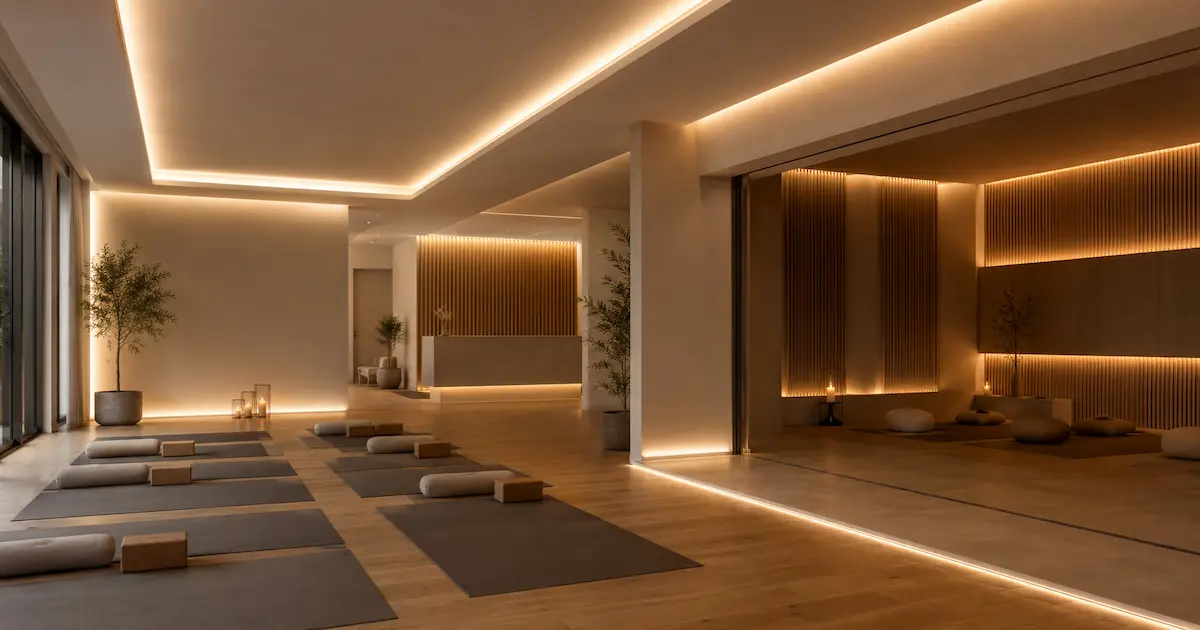
A studio typically needs layered light: brighter scenes for cleaning, balanced scenes for active classes, and low warm scenes for restorative practice. Separate circuits for general light, accent light, and task light are recommended. The following video provides a helpful overview of how layered lighting, color temperature, placement, and dimming work together to create a comfortable and visually balanced interior.
| Scene Type | Suggested CCT | Approx. Lux Range | Suggested Placement | Notes |
|---|---|---|---|---|
| Morning yoga | 3000K–3500K | 200–300 lux | Ceiling cove plus wall lines | Clear but still soft |
| Evening flow | 2700K–3000K | 120–220 lux | Indirect perimeter | Warm and calm |
| Meditation | 2200K–2700K | 30–80 lux | Hidden channels | Very low glare |
| Cleaning | 3500K–4000K | 300–500 lux | Separate general circuit | Not for class mood |
| Reception | 3000K | 150–250 lux | Counter and logo wall | Brand-friendly tone |
3. Which LED tape specifications matter most for yoga studios?
The key LED basics for yoga studio specifications include color temperature (CCT), CRI, LED density, wattage per meter, voltage, dimming compatibility, and binning tolerance. Don’t start with wattage alone — start with desired effect and mounting distance.
Recommendations: 2700K–3000K for warm areas, 3000K–3500K for posture visibility, CRI 90+ for accurate skin tones and finishes. For long coves, 24V reduces voltage drop.
| Specification | Recommended Range | Why It Matters | Risk if Ignored |
|---|---|---|---|
| CCT | 2700K–3500K | Controls mood and comfort | Room feels cold or dull |
| CRI | 90+ | Natural skin and material color | Premium finishes look poor |
| Voltage | 24V preferred | Better for longer runs | Visible dimming at strip ends |
| LED density | 120–240 LEDs/m or COB | Reduces dotting | Dotted reflection in mirrors |
| Power | 7–14.4W/m typical | Balances output and heat | Heat shortens lifespan |
| Binning | 3-step SDCM preferred | Batch color consistency | Mixed color on long walls |
4. Should yoga studios use 12V or 24V LED tape channels?
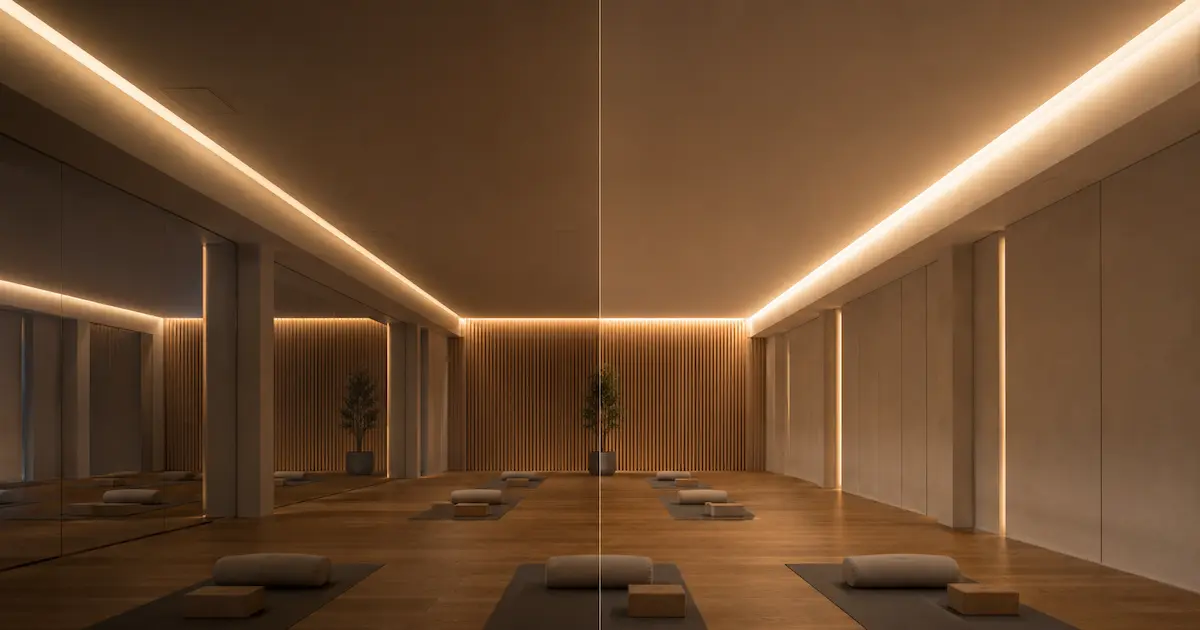
For most studios, a 24V LED strip is the better choice for maintaining consistent brightness across long coves and perimeter installations. It handles longer runs with less voltage drop, keeping brightness consistent along coves and perimeter channels. 12V is fine for short details or furniture features but requires more feed points for long runs.
| Feature | 12V LED Tape | 24V LED Tape | Best Choice for Yoga Studio |
|---|---|---|---|
| Long run stability | Lower | Higher | 24V |
| Cutting intervals | Shorter | Often longer | Depends on layout |
| Driver current | Higher | Lower | 24V for cable efficiency |
| Ceiling cove runs | More feed points needed | Fewer feed points | 24V |
| Voltage drop risk | Higher | Lower | 24V |
Pro tip: For coves over 5 meters, feed from both ends or use parallel feed wiring.
5. Which aluminum channel and diffuser design works best?
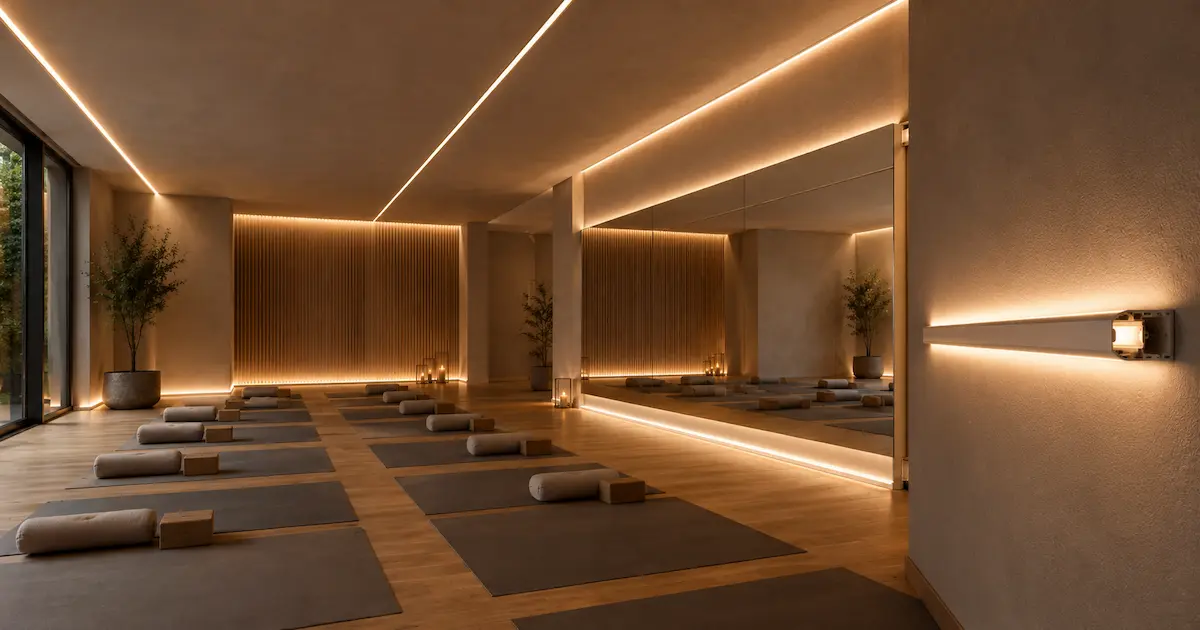
The channel is a heat sink, mounting base, glare-control part, and protection layer. For yoga studios, choose profiles based on installation: surface, recessed, corner, or deep dot-free profiles. An opal or frosted LED channel diffuser usually provides the softest and most comfortable light for yoga and meditation spaces.
| Channel Type | Best Use | Diffuser Choice | Notes |
|---|---|---|---|
| Surface-mounted profile | Walls, mirrors, shelves | Frosted or opal | Easy service access |
| Recessed profile | Clean ceiling or wall lines | Opal | Requires accurate slot work |
| Corner profile | Room edges, mirror sides | Frosted | Good directional control |
| Deep dot-free profile | Direct visible lines | Opal | Better for premium studios |
| Bendable profile | Curved walls or logo features | Frosted | Check minimum bend radius |
A good channel can upgrade a mid-power strip visually; a poor channel can make a high-end strip look cheap.
6. How do dimming and controls affect yoga class experience?
Dimming quality is critical. Classes transition from active sequences to stillness, so understanding flicker basics is important when specifying lights that must dim smoothly and quietly. Selecting compatible drivers and controls is essential for achieving dimmable LED strip lights with no flicker, hum, or low-level dimming problems.
Control options include TRIAC, 0–10V, DALI, DMX, PWM, and smart systems. For small studios TRIAC can be simple, while 0–10V or DALI offer better zone control for larger spaces. Test the exact driver/dimmer combination before bulk supply.
| Control Method | Best For | Pros | Watch Point |
|---|---|---|---|
| TRIAC | Small rooms | Familiar wall dimming | Must match driver type |
| 0–10V | Studio zones | Smooth commercial control | Needs control wiring |
| DALI | Multi-room projects | Scene programming | Higher setup skill |
| DMX | Color scenes or events | Fine control | More technical setup |
| PWM controller | DC-side dimming | Good for tape systems | Use quality controller |
Recommended zones: perimeter channels, instructor/focal wall, mirrors, reception, and corridors.
7. How should LED tape channels be installed for reliability?
Plan layout, calculate load, confirm driver location, and plan cable routes before cutting tape. Avoid adhesive-only mounting; use channels with clips, screws, or brackets. Power injection should be planned: for long runs feed from both ends or use parallel sections, and keep drivers serviceable.
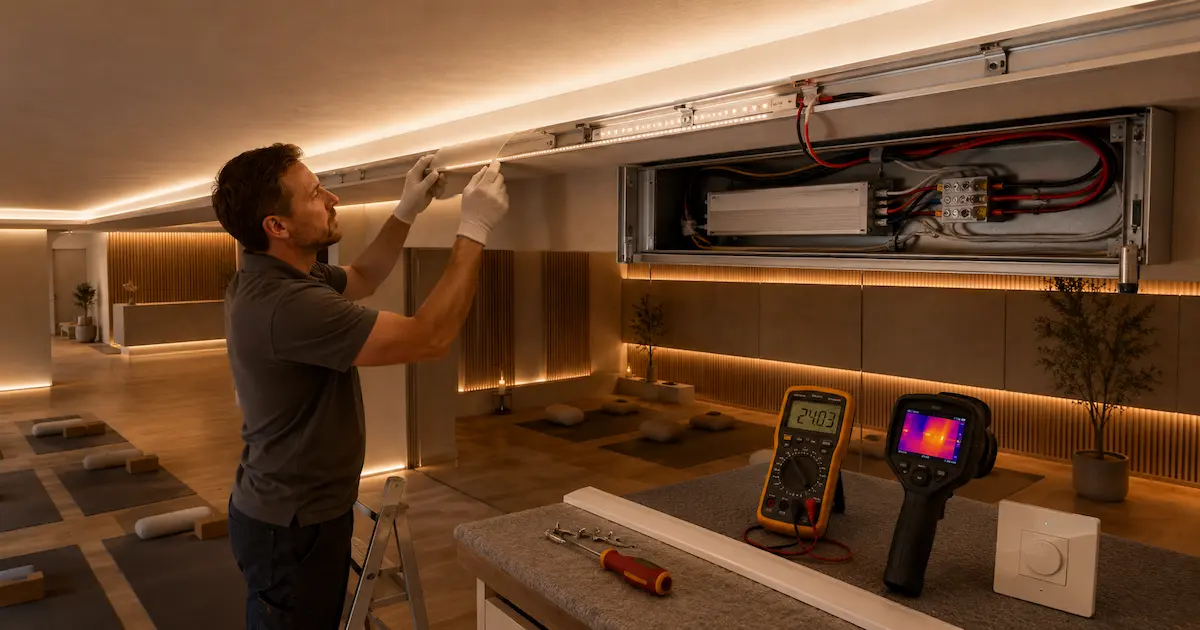
Installation checklist:
| Step | Action | Field Risk Reduced |
|---|---|---|
| Confirm layout drawing | Mark feed points and zones | Wrong cable route |
| Calculate total wattage | Add 20% driver headroom | Driver overload |
| Select channel depth | Match LED density and diffuser | Visible dots |
| Test dimming sample | Use actual driver and dimmer | Flicker callbacks |
| Prepare mounting surface | Clean, dry, flat | Adhesive failure |
| Use mechanical fixing | Clips or screws | Channel falling |
| Check voltage at far end | Measure under load | Uneven brightness |
| Run burn-in test | 2–4 hours before handover | Early fault detection |
These checks are low cost but protect reputation and reduce rework.
8. What safety, certification, and IP rating should be specified?
Specify CE/RoHS, UL/ETL for North America, and other local certifications as required. Drivers must be certified for the market. IP ratings depend on location: dry ceiling coves can use IP20 inside a profile, while changing rooms or wet-adjacent spaces may need IP44–IP65.
| Location | Suggested IP Rating | Reason | Extra Note |
|---|---|---|---|
| Dry ceiling cove | IP20 | Protected from touch and moisture | Best heat performance |
| Mirror side channel | IP20–IP44 | Touch and cleaning exposure | Use diffuser cover |
| Changing room | IP44–IP65 | Humidity and cleaning | Check local code |
| Near shower or spa zone | IP65+ | Moisture risk | Use certified driver placement |
| Floor-level guide light | IP44–IP65 | Mopping and impact | Use robust profile |
Avoid over-specifying waterproofed tape inside sealed channels without considering heat buildup.
9. What are common failure modes and how can they be prevented?
Common failures come from heat, voltage drop, poor soldering, incompatible dimming, weak mounting, and moisture Use thermal imaging to detect hot spots and follow a prevention checklist.
| Symptom | Likely Cause | Quick Test | Fix |
|---|---|---|---|
| One end is dim | Voltage drop | Measure voltage under load | Add feed point or use 24V |
| Visible dots | Low density or shallow profile | View at class angle | Use COB or deeper channel |
| Flicker when dimming | Driver/dimmer mismatch | Test with matched dimmer | Change driver or controller |
| Tape peeling | Heat or poor surface prep | Check channel temp | Use channel and clips |
| Color mismatch | Poor binning | Compare CCT samples | Specify 3-step SDCM |
| Early lumen loss | Excess heat | Thermal camera scan | Lower wattage or larger profile |
Prevention (sample approval, burn-in, and correct driver sizing) is cheaper than repair and protects margins.
10. How can you specify LED tape light channel lighting for a yoga studio project?
Start with room function, ceiling height, wall colors, mirror placement, control zones, and maintenance access. Then complete the LED profile driver calculation and select the voltage, wattage, CCT, CRI, LED density, channel type, diffuser, driver, and dimming method.
Sample specification for a 70 m² yoga room with 2.8 m ceiling:
| Item | Suggested Specification | Reason |
|---|---|---|
| LED tape | 24V, CRI 90+, 2700K/3000K | Warm, natural appearance |
| LED density | COB or 120+ LEDs/m | Smooth line effect |
| Channel | Aluminum profile with opal diffuser | Heat and glare control |
| Driver | Certified constant voltage driver | Safety and stable output |
| Dimming | 0–10V, DALI, or tested TRIAC | Scene control |
| Binning | 3-step SDCM | Consistent color |
| Driver headroom | 20% spare capacity | Lower stress and heat |
| Sample approval | 1–2 m mock-up | Confirms real visual result |
Test a real channel sample before full purchase to confirm mood and thermal performance.
Conclusion
LED tape light channel lighting is a strong choice for yoga studio ambiance when planned around comfort, heat management, dimming quality, safety, and service access. Specify appropriate CCT and CRI for mood and material rendering, prefer 24V for long runs, use anodized aluminum channels with opal or frosted diffusers, size drivers with headroom, and test a mock-up before full installation. These steps reduce callbacks, improve client satisfaction, and protect contractor margins.
FAQ
Q1: Is LED tape light channel lighting better than bare LED strip for yoga studios?
Yes. Better heat dissipation means an aluminum channel can increase the life of the LED strip while also protecting the tape, hiding wiring, reducing glare, and creating a cleaner line. Bare strip can work for hidden areas, but it often causes dotting and service problems.
Q2: What color temperature is best for yoga studio ambiance?
Most yoga studios work best with 2700K to 3000K for calm zones and 3000K to 3500K for brighter movement or posture areas. Avoid very cool white unless the room has a specific wellness concept.
Q3: Can LED tape channels be dimmed smoothly?
Yes, if the driver, dimmer, and tape load are compatible. Test the exact parts together before installation. 0–10V and DALI often work well for larger studios with scene control.
Q4: Do yoga studios need waterproof LED tape?
Not always. Dry ceiling coves can use IP20 tape inside aluminum channels. Use IP44 to IP65 in changing rooms, floor-level areas, or places exposed to cleaning moisture.
Q5: How do I avoid visible LED dots in channel lighting?
Use higher-density or COB tape with a deep LED channel and an opal diffuser to increase the mixing distance and hide visible LED dots. Always test a short mock-up at the real viewing distance before approving the full order.
