
Yes, an LED aluminium channel can increase the life of an LED strip by reducing heat buildup, protecting the PCB from physical stress, improving mounting stability, and helping the light run within safer temperature limits. The effect is strongest for high-wattage, dense, or long-running strips.
That question comes up often in commercial lighting projects because failed LED strips create callbacks, margin loss, and client complaints. The problem is rarely only the strip. Heat, poor mounting, dust, moisture, weak solder joints, and wrong driver sizing all shorten service life. An aluminum profile is not magic, but it gives the strip a better operating environment. In our lab tests using integrating spheres, thermal imaging cameras, and aging racks, we see that better heat transfer can reduce lumen decay and color shift over time. Here’s the deal: if you specify the right profile, cover, power supply, and installation method, LED strip projects become far more predictable.
1. How Does Heat Shorten LED Strip Life?
Heat is the main reason many LED strips fail earlier than expected, so understanding the causes and solutions to LED strip heat issues is essential before selecting the strip, profile, and installation method. LED chips convert power into light, but part of that power becomes heat. If the heat stays trapped in the strip, the LED junction temperature rises. That stresses phosphor, solder pads, resistors, adhesive tape, and the flexible PCB.
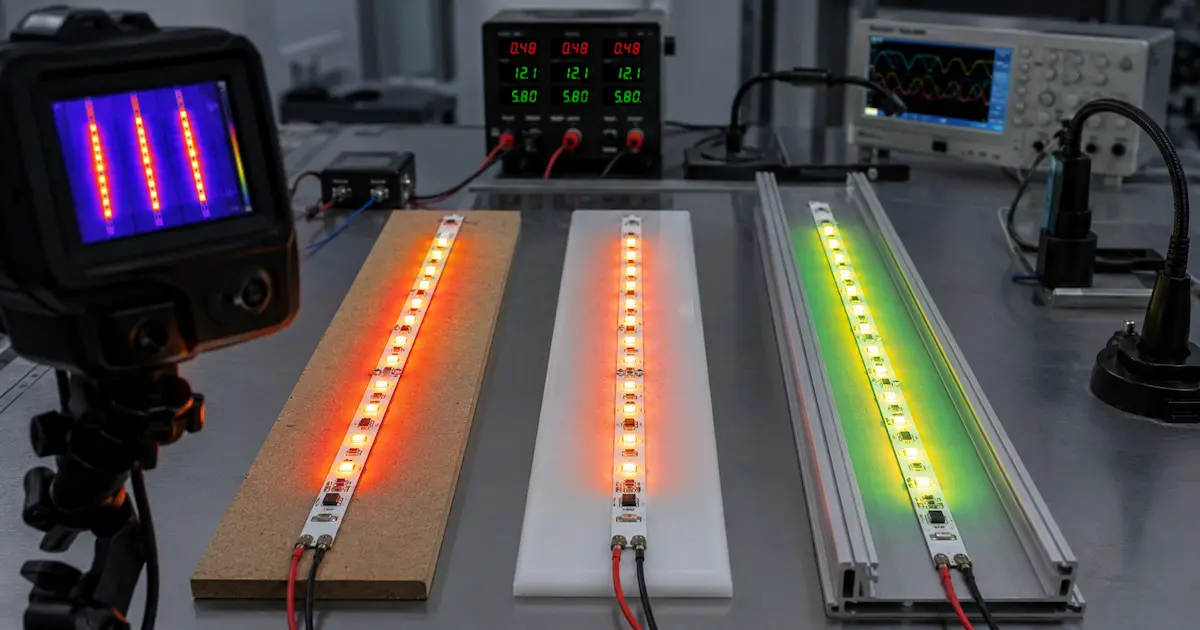
In our lab tests using integrating spheres, we often compare the same strip on wood, plastic, steel, and aluminum profiles. The aluminum profile usually gives the most stable lumen output during long burn-in periods because it spreads heat away from the narrow PCB. A 14.4 W/m strip mounted directly on painted MDF can run much hotter than the same strip inside a properly sized aluminum channel.
This matters to your bottom line because heat-related failures rarely appear on day one. They appear after six months in a hotel cove, a supermarket shelf, or an office feature wall. That means warranty claims and site visits.
| Heat Factor | What Happens | Field Risk |
|---|---|---|
| High wattage per meter | More heat per PCB area | Faster lumen drop |
| Poor mounting surface | Heat cannot spread | Adhesive failure |
| Sealed tight cavity | Heat gets trapped | Color shift and early failure |
| Long daily run time | Thermal stress repeats | Shorter service life |
2. What Does an LED Aluminum Channel Actually Do?
An aluminum profile for LED strip lighting acts as both a mechanical support and a thermal-spreading base for the LED tape. It gives the strip a flat metal base, protects it from handling damage, and supports a diffuser cover when needed. Many buyers think the channel is only for appearance. That is a common mistake.
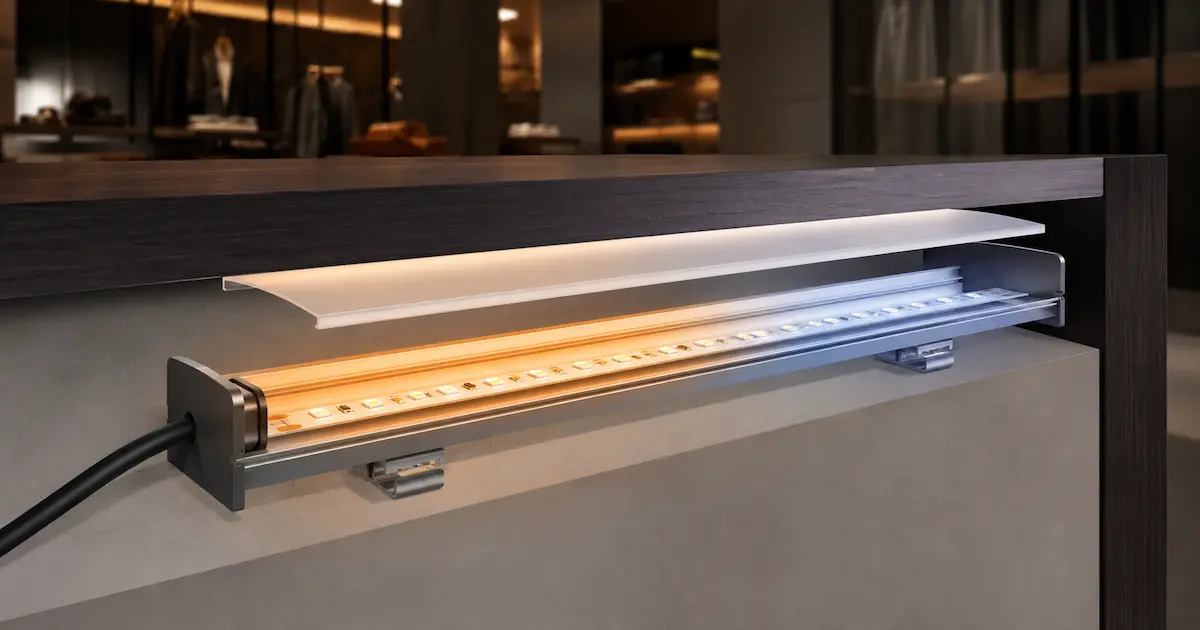
From our manufacturing floor perspective, a strip with good copper weight and quality LEDs still needs a suitable installation environment. Aluminum has much better thermal conductivity than wood, plaster, and most plastics. It acts as a heat spreader, not a full heat sink in every case. That difference matters. A slim decorative profile may help, but a deeper, heavier profile with more aluminum mass can perform better in high-output projects.
We often see installers struggle with strips that were stuck under cabinets without a clean surface. Dust, paint texture, and heat make the tape loosen. The strip sags, solder joints bend, and sections go dark.
| Channel Function | Practical Benefit | Common Project Use |
|---|---|---|
| Heat spreading | Lower PCB temperature | Cove lights, display shelves |
| Mechanical protection | Less bending and scratching | Furniture, retail fixtures |
| Diffusion | Softer light line | Hotels, offices, showrooms |
| Straight mounting | Cleaner alignment | Linear architectural lighting |
The following engineering tutorial explains the fundamentals of heatsink design, thermal resistance, and real-world temperature testing, helping clarify how aluminum mass and heat-transfer conditions affect LED-strip reliability.
3. Does Aluminum Channel Always Extend LED Strip Lifespan?
No. It usually helps, but only when the full system is designed correctly. If the strip wattage is too high, the driver is unstable, ventilation is blocked, or the profile is too small, lifespan can still be poor.
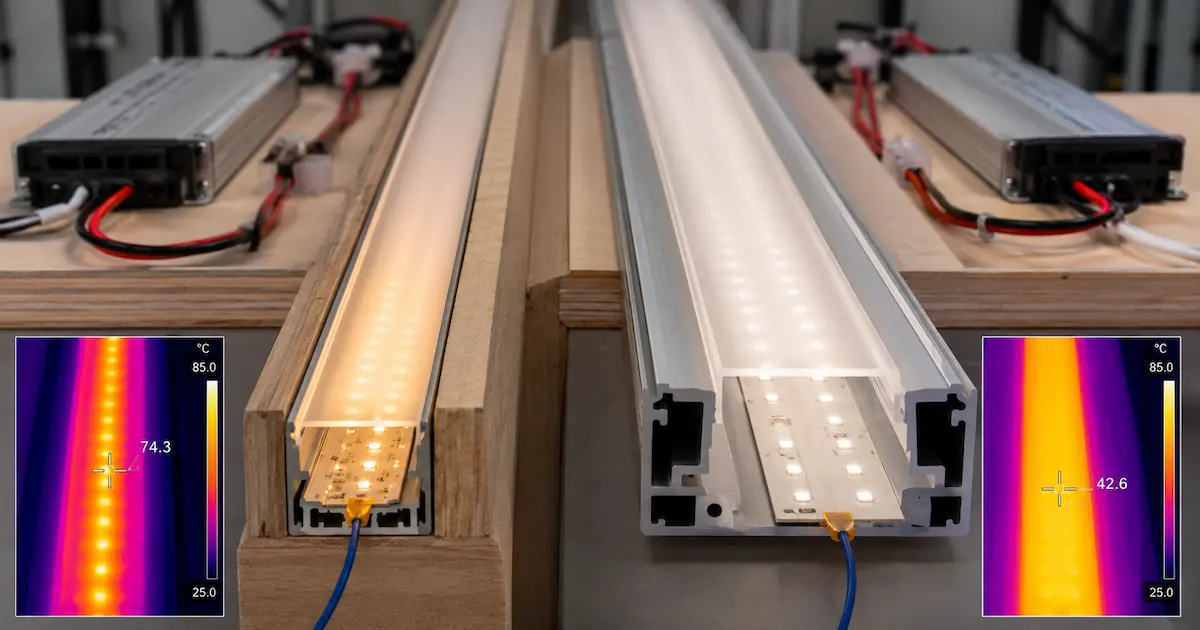
But here’s the catch: an aluminum profile cannot fix a low-grade strip with poor soldering, undersized copper, or weak LED binning. It can reduce thermal stress, yet it cannot correct bad components. In one field example, a contractor used 24 W/m strip inside a very slim recessed profile with a milky cover and no airflow, although a heavier wide LED channel would have provided more aluminum mass and a larger heat-spreading surface. The aluminum helped slightly, but the profile was too small for the heat load. After months of 12-hour daily use, the strip showed visible lumen loss.
Use aluminum channel as part of a system, not as an isolated accessory. Match strip power, profile size, driver capacity, wiring, cover type, and ambient temperature.
| Situation | Will Channel Help? | Comment |
|---|---|---|
| 4.8 W/m accent strip | Mild benefit | Heat is already low |
| 9.6–14.4 W/m strip | Strong benefit | Good match for many profiles |
| 19.2–24 W/m strip | Depends on profile | Needs larger aluminum mass |
| Closed hot cavity | Limited benefit | Ventilation still matters |
4. Which LED Strips Gain the Most from Aluminum Profiles?
High-density and high-output strips gain the most, particularly when they are installed in channels that offer the best cooling for high-power LED tapes. COB strips, 2835 high-lumen strips, and 5050 RGBW strips often generate more heat than low-power accent tape. Long operating hours also raise the value of aluminum channel.
When we tested this against a standard 12V strip running at 14.4 W/m, the strip mounted on bare laminate ran hotter than the one mounted in aluminum. The difference became more visible after hours of continuous operation. Thermal images showed heat spreading across the profile rather than concentrating around LED packages and resistors.
Think about usage. A strip used two hours per evening in a residential wardrobe has low stress. A strip used 14 hours daily in a bakery display, hotel reception, or shopping mall ceiling has a different duty cycle. For that type of project, the aluminum channel is a low-cost insurance measure.
| LED Strip Type | Typical Power | Profile Recommendation |
|---|---|---|
| Low-power 3528 accent strip | 4.8 W/m | Basic slim profile is enough |
| 2835 commercial strip | 9.6–14.4 W/m | Standard aluminum channel |
| COB strip | 10–15 W/m | Profile with good heat spread |
| RGBW 5050 strip | 18–24 W/m | Wider, heavier profile needed |
5. What Is the Right Channel Size and Material?
Channel size affects thermal performance. Width, wall thickness, surface area, and aluminum grade all matter. A thin 8 mm decorative profile cannot handle the same heat load as a 20 mm wide architectural extrusion. The strip must also sit flat inside the channel. Air gaps reduce heat transfer.
Pro Tip from the VST Technical Team: “Do not select the profile only from the front-view drawing. Check inner width, aluminum weight per meter, cover clearance, and installation cavity temperature. These details decide whether the strip runs comfortably or near its limit.”
A common rule is simple: higher wattage needs more aluminum mass and more open air, which is why choosing the right LED strip light profile requires checking wattage, profile dimensions, mounting style, and cavity ventilation together. For recessed channels, heat can be trapped inside plasterboard or wood. Surface-mounted channels often release heat better because more metal contacts open air.
| Profile Parameter | Why It Matters | Buying Check |
|---|---|---|
| Inner width | Strip must lie flat | Allow space for solder pads |
| Wall thickness | More metal spreads heat better | Compare weight per meter |
| Mounting style | Recessed can trap heat | Check cavity ventilation |
| Cover height | Avoid LED pressure | Leave space above LEDs |
| Aluminum finish | Affects durability | Anodized finish is preferred |
6. How Do Diffuser Covers Affect Heat and Lifespan?
An LED channel diffuser improves the appearance and protects the strip, but its opacity, thickness, and fit can also affect light transmission and heat retention. Clear, frosted, and opal covers behave differently. Opal covers reduce visible dots, yet they also reduce light output and may keep more heat inside the profile. That means you may need a higher-output strip, which creates more heat again. This is where design choices connect directly to lifespan.
For a luxury hotel lobby, dot-free linear light may require a deep LED channel that creates more distance between the LED chips and diffuser while providing additional aluminum mass. A COB strip or deeper profile with an opal cover can work well. For a warehouse rack label light, a clear cover may be better because efficiency matters more than a perfectly smooth line.
Do not choose the milkiest cover without checking lumen loss. A heavy opal diffuser may cut output by 30–50%. If the installer compensates by raising wattage, the thermal load rises.
| Cover Type | Light Effect | Heat Impact | Best Use |
|---|---|---|---|
| Clear cover | Highest output | Lowest trapping | Utility and cabinet lights |
| Frosted cover | Moderate diffusion | Moderate trapping | Retail shelves |
| Opal cover | Smoothest line | Higher trapping | Hotels and premium interiors |
| No cover | Best cooling | No dust protection | Hidden cove use |
7. What Common Misconception Causes Early Strip Failure?
Common Myth: Higher wattage always means better brightness and longer project value.
Reality: Brightness depends on lumen efficiency, LED quality, optics, driver stability, cover loss, and heat control. A 20 W/m strip that overheats can deliver less useful light over time than a 12 W/m strip mounted in a suitable aluminum profile.
We once saw a retail display project where the buyer selected the highest wattage strip in the catalog because the sample looked bright for ten minutes. After installation inside enclosed wood shelves, the strips ran hot for long hours. Adhesive released, light output dropped, and several shelves needed rework. A lower-wattage strip with a better profile would have protected both cost and reputation.
The real target is maintained lumen output, not initial brightness. For project specifications, ask for operating temperature data, LM-80 related LED data if available, CRI, binning tolerance, copper thickness, and recommended profile type.
| Wrong Assumption | Better View | Project Result |
|---|---|---|
| More watts means better light | More lumens per watt matters | Lower energy cost |
| Tape can stick anywhere | Surface and heat path matter | Fewer callbacks |
| Any profile works | Profile mass must match load | Longer service life |
| Cover choice is cosmetic only | Cover changes heat and output | Better specification control |
8. How Should You Install LED Strip in Aluminum Channel for Long Life?
Installation quality can decide whether the LED aluminum channel will increase the life of the LED strip. Clean the channel before sticking the tape. Dust, oil, and aluminum shavings weaken adhesion. Press the strip evenly along the copper-free areas, not directly on LED packages or resistors.
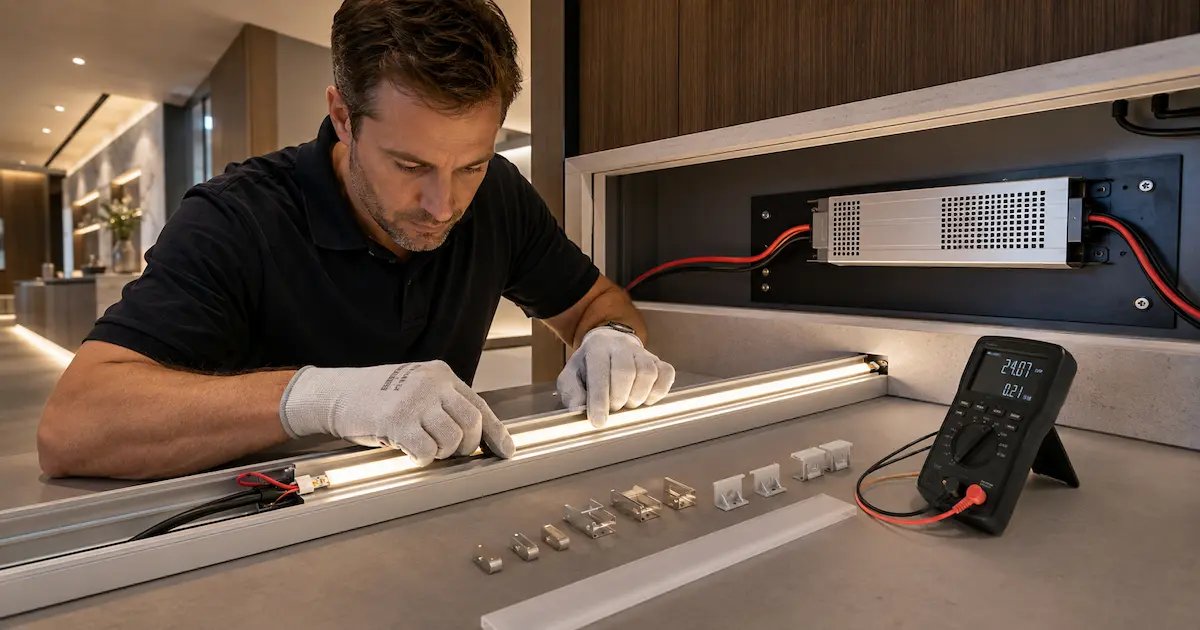
We often see installers struggle with corners. They bend strips sharply inside channels, crack solder joints, or force the PCB around tight turns. Use corner connectors, pre-soldered leads, or cut-and-solder methods where needed. Avoid pulling the strip during installation because tension stresses pads.
Driver placement also matters. A stable constant-voltage driver with enough capacity keeps voltage and current under control. For long runs, feed power from both ends or use parallel feeds to reduce voltage drop.
| Installation Checklist | Correct Practice | Failure Prevented |
|---|---|---|
| Clean aluminum base | Use alcohol wipe, let dry | Tape peeling |
| Check strip width | Fit before sticking | Edge lifting |
| Avoid sharp bends | Use soldered corners | Cracked PCB |
| Size driver correctly | Keep load around 80% rating | Driver overheating |
| Test before cover | Run 30–60 minutes | Hidden defects |
| Use end caps | Reduce dust entry | Contact contamination |
9. How Do Voltage, Current, and Drivers Affect Lifespan?
A good aluminum profile helps with heat, but electrical design still matters, including accurate LED profile driver calculations for the total strip load, operating margin, voltage, and feed arrangement. LED strips are usually constant-voltage products, such as 12V or 24V. Long runs can suffer voltage drop, which causes dimming at the far end and uneven color in RGB or tunable white systems.
A 24V strip often performs better than a 12V strip on longer runs because current is lower for the same wattage. Lower current means less loss in copper traces and cables. For contractors, that means fewer complaints about uneven brightness.
When we simulate 20-meter runs in the lab, power feed layout often matters as much as strip selection. A high-quality strip can still look poor if powered from one end only over a long distance.
| 12V Strip vs 24V Strip | 12V LED Strip | 24V LED Strip |
|---|---|---|
| Best run length | Short sections | Longer sections |
| Current for same wattage | Higher | Lower |
| Voltage drop risk | Higher | Lower |
| Cut interval | Often shorter | Often longer |
| Project use | Small cabinets, signs | Cove lights, linear runs |
10. What Specification Should Buyers Request from Suppliers?
If you want the aluminum channel to increase LED strip life, specify the strip and profile as one matched package. Ask for the recommended wattage range of the profile, strip PCB width, copper thickness, LED type, adhesive brand, cover transmission rate, and tested surface temperature.
From our manufacturing floor perspective, the best projects start with clear drawings and usage details. Tell the supplier the run length, daily operating hours, ambient temperature, mounting surface, dimming method, cover preference, and target brightness. Without those details, the supplier can only guess.
For procurement teams, this protects margin. A slightly better profile may cost more per meter, but one avoided service visit can pay for the upgrade many times over. In commercial projects, labor usually costs more than the lighting material.
| Supplier Data to Request | Why You Need It | Red Flag |
|---|---|---|
| Strip wattage per meter | Thermal load calculation | No tested data |
| PCB copper thickness | Current capacity | Thin PCB on high wattage |
| Profile weight per meter | Heat spread ability | Very light extrusion |
| Cover light transmission | Brightness planning | No percentage given |
| Aging test record | Quality consistency | No burn-in process |
| Certification files | Local compliance | Unclear documents |
Final Recommendation
An LED aluminum channel can extend LED strip service life, mainly through heat control, stable mounting, and physical protection. It works best when matched with the right strip wattage, profile mass, diffuser, driver, and wiring plan. Do not treat it as decoration only. Treat it as part of the lighting system. If you are unsure about voltage drop, profile size, or heat load for a project, send our engineering team your layout. We’ll calculate it with you manually.
Conclusion
An aluminum channel is a practical investment to increase the lifespan and reliability of LED strips when used as part of a matched system. Prioritize profiles with adequate mass and ventilation for your chosen wattage, select diffusers and drivers that do not force excessive thermal loads, and verify installation practices with sample burn-in tests. These steps minimize early failures, reduce callbacks, and protect long-term project value.
FAQ
Q1: Does LED aluminum channel increase the life of the LED strip?
Yes. In most commercial and long-running applications, it can extend service life by spreading heat away from the LED strip PCB, reducing adhesive failure, and protecting the strip from dust, contact damage, and bending stress.
Q2: Can an LED strip be installed without aluminum channel?
Yes, especially for low-power accent lighting with short operating hours. However, for high-wattage strips, visible linear lighting, retail displays, hotel coves, and cabinet lighting, aluminum channel gives better heat control and a cleaner installation.
Q3: Does a diffuser cover reduce LED strip lifespan?
A diffuser cover can trap some heat, especially opal covers. It does not automatically shorten lifespan, but you should match the cover with a suitable profile and avoid using excessive wattage just to compensate for light loss.
Q4: What aluminum channel is best for high-wattage LED strip?
Use a wider and heavier profile with good wall thickness, open heat exposure, and enough inner width for the strip. For 19.2 W/m or 24 W/m strips, avoid very slim decorative profiles unless thermal testing confirms safe operation.
Q5: Is 24V LED strip better than 12V for long runs in aluminum channel?
Often yes. A 24V strip draws lower current for the same wattage, so voltage drop is reduced. This helps maintain more even brightness across long channels, especially in coves, corridors, and commercial display systems.
