
1. What are flexible LED profiles?
Flexible LED profiles are bendable mounting housings designed to support flexible LED strip lights while helping them follow curved and irregular surfaces. Their job is to hold the strip in place, protect it from mechanical stress, manage light diffusion, and give the installation a finished appearance. Typical profiles include a strip cavity, a diffuser or light-emitting surface, and sometimes mounting clips or adhesive backing.
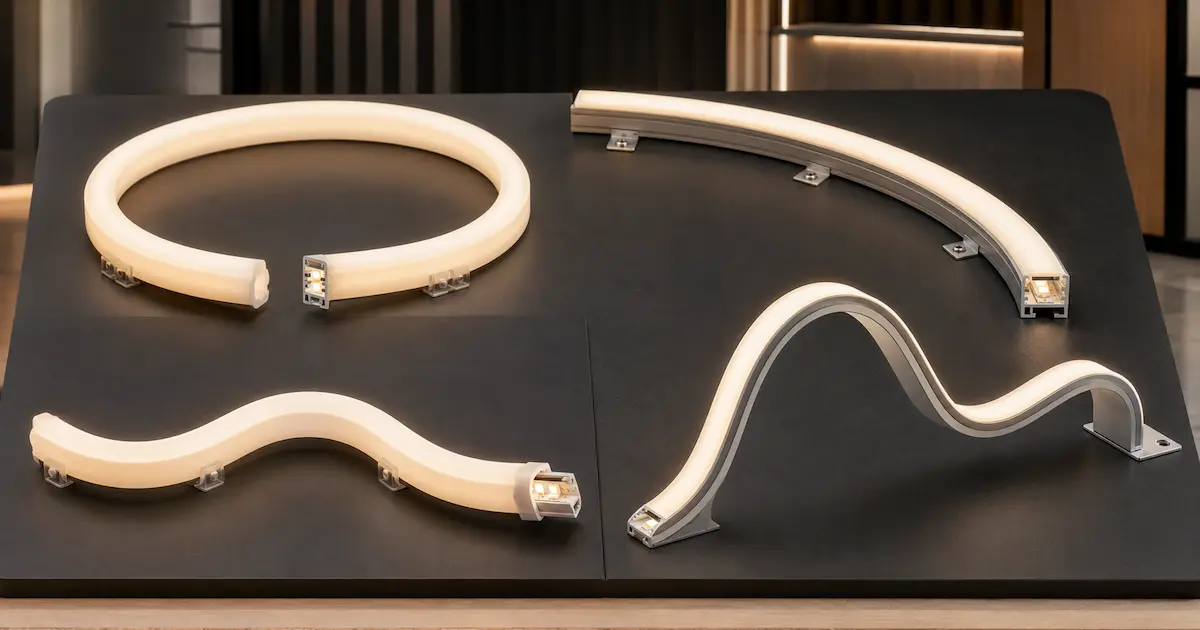
Common field examples:
- Curved cove lighting in a restaurant ceiling
- Round mirror backlighting in a hotel bathroom
- Logo signage where the light path needs tight bending
- Cabinet lighting seen up close
| Flexible LED profile type | Main material | Best use | Typical benefit |
|---|---|---|---|
| Silicone neon profile | Silicone | Signage, wet zones | Dot-free output and IP protection |
| Bendable aluminum profile | Aluminum with flexible joints | Curved ceilings, furniture | Better heat control than plastic |
| PVC flexible channel | PVC | Low-cost indoor projects | Easy cutting and fast fitting |
| Side-bending profile | Silicone or PVC | Letters, curves, logos | Tight horizontal radius |
| Top-bending profile | Silicone or PVC | Arches, columns, waves | Smooth vertical curves |
Many manufacturers also offer accessory kits: end caps, corner joints, mounting clips, and bespoke diffusers. These accessories reduce on-site adaptation work and help keep installations consistent.
2. Why do flexible LED profiles matter in modern lighting design?
A properly selected flexible LED profile allows light to follow the architecture instead of forcing the architecture to accommodate rigid fixtures. They reduce joints, failure points, and labor on curved drywall coves and complex shapes. Benefits include fewer customer complaints, lower risk of strip damage, repeatability across rollouts, and cleaner finishes for designers.
Because excess heat can affect the performance and useful life of LED lighting, a low-cost bare strip may pass a brief sample test but reveal issues after months of heat, cleaning, and movement. Flexible profiles reduce those long-term risks. They also help meet regulatory and warranty requirements by offering predictable mounting and protection conditions, which improves long-term lumen maintenance and reduces premature replacements.
3. How do flexible LED profiles work with LED strip lights?
They combine mounting, optical diffusion, and protection. Compatibility starts with strip width: common PCB widths are 5 mm, 8 mm, 10 mm, 12 mm, and 15 mm. If the profile cavity is too narrow, the strip will buckle; if too wide, it may shift, causing uneven light.
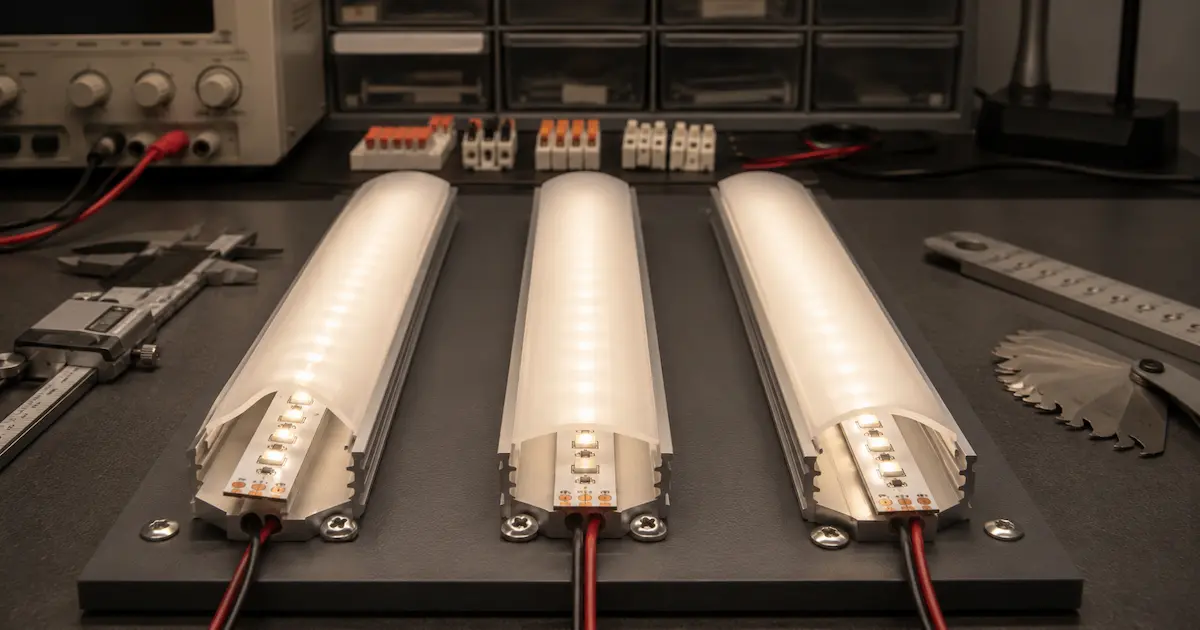
Voltage choice affects long curved runs: 24V strips exhibit less voltage drop on long runs than 12V strips, especially when power-feed points are placed appropriately. For example, a 24V 14.4 W/m strip will have roughly half the current for the same wattage compared to a 12V equivalent, reducing copper losses across a run and permitting longer uninterrupted lengths in profiles.
| Option | 12V LED strip | 24V LED strip |
|---|---|---|
| Best run length | Short sections, displays | Longer runs, coves, corridors |
| Voltage drop risk | Higher on long runs | Lower under similar load |
| Cutting interval | Shorter cut marks | Longer cut marks |
| Driver current | Higher current for same wattage | Lower current for same wattage |
| Best fit with flexible profiles | Small furniture, signage | Architectural lines, retail, hotels |
Match profile size, strip wattage, bend direction, and power plan before ordering to avoid costly on-site fixes. Also consider feed-through connectors and the type of solder pads (e.g., 2-pin, 3-pin for RGB) as these affect the ease of making joins inside a profile. The following educational video provides a helpful overview of how to select an LED strip based on voltage, power, efficiency, and installation requirements before matching it with a flexible profile.
4. What materials are used in flexible LED profiles?
Materials include silicone, PVC, TPU, and aluminum, with a bendable LED profile offering a stronger balance of curved installation capability, structural support, and heat control. Each balances flexibility, heat resistance, appearance, and service life.
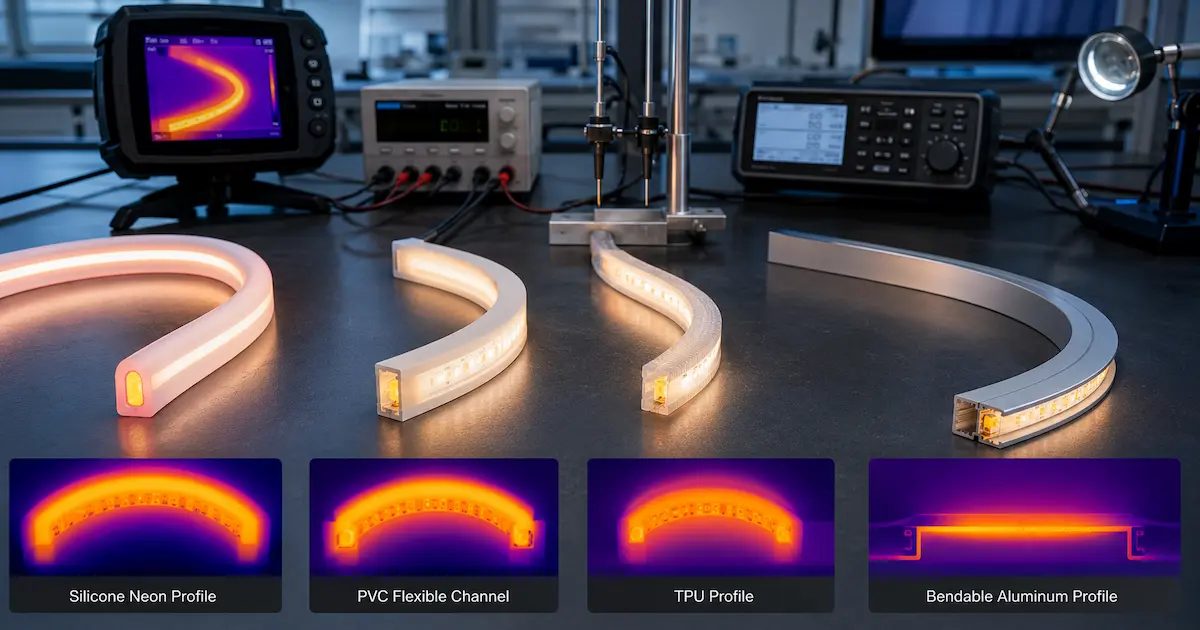
| Material | Flexibility | Heat handling | Outdoor suitability | Cost level |
|---|---|---|---|---|
| Silicone | High | Medium | Good with UV-grade material | Medium–high |
| PVC | Medium | Low–medium | Limited unless UV stabilized | Low |
| TPU | High | Medium | Project dependent | Medium |
| Bendable aluminum | Medium | High | Good with coating | Medium–high |
Pro Tip: Evaluate working temperature, strip wattage, and UV grade. Heat and sunlight affect service life more than a brief bend test. When specifying for exterior use, ask for UV-stable grades and confirm accelerated weathering test data. For higher-wattage applications, compare which flexible LED profiles offer the best heat management and correlate the material’s thermal resistance with the expected LED junction temperature.
5. How do flexible LED profiles change visual effects?
They convert point light into a cleaner line or glow by diffusing the LED chips. Key effects depend on LED density, diffuser depth, and surface color.
- Higher LED density (e.g., 120 LEDs/m or COB) reduces visible dots
- Deeper diffusers mix light better
- Opal silicone hides dots more than clear material
Remember: brightness depends on lumen efficiency, diffuser loss, thermal control, and driver quality—not only wattage. Typical diffuser transmission losses range from 5–25% depending on opacity; designers should account for this when specifying lumens required for a space. Designers should compare which flexible LED profiles provide the best diffusers for soft light, using semi-opaque materials to balance dot reduction against overall light output. Designers should also evaluate LED color and spectrum, including color-rendering performance and correlated color temperature, when the illuminated profile will be visible to occupants.
6. How do flexible LED profiles improve safety and durability?
Profiles reduce physical stress on strips, prevent adhesive failures on curved surfaces, and offer dust and moisture protection, while the specified IP Code indicates the enclosure’s tested level of protection against solid objects and water ingress. A properly sealed waterproof LED profile can provide IP65–IP68 protection when the end caps, cable entries, and joints are prepared correctly.
| IP rating | Protection level | Typical location |
|---|---|---|
| IP20 | Indoor dry areas | Shelves, coves, furniture |
| IP65 | Dust-tight, water jets | Kitchens, covered outdoor zones |
| IP67 | Temporary immersion | Wet facades, floor-adjacent zones |
| IP68 | Long immersion under set limits | Pools, fountains (confirm specs) |
Heat dissipation must be considered: bendable aluminum handles heat better than silicone or PVC and should be chosen for higher wattage applications. For water-exposed profiles, ensure cable glands and end caps are sealed with appropriate silicone sealants and that potting compounds match the thermal expansion properties of the profile to avoid stress over time.
7. Where are flexible LED profiles used most often?
Common applications:
- Curved cove ceilings and recessed lines
- Retail shelves, display racks, and showcases
- Indoor and outdoor signage
- Stair edges and handrails
- Mirror, cabinet, and furniture lighting
- Facade contours and entrance features
A curved LED profile offers greater design freedom while maintaining the repeatable installation standards required for hotel, retail, and commercial rollouts. In hospitality and retail, matching the same profile across multiple properties ensures a consistent customer experience and simplifies maintenance stocking for service teams.
8. What specifications should buyers check before ordering?
Confirm bend direction, bend radius, strip cavity size, material, IP rating, strip wattage, CCT, diffuser type, mounting method, and driver match. Also confirm binning/tolerance for long visible runs to prevent color mismatch.
| Specification | What to confirm | Why it affects the project |
|---|---|---|
| Bend direction | Side bend, top bend, or both | Prevents twisting/deformation |
| Bend radius | Minimum safe radius | Avoids cracks/light gaps |
| Strip width | 5–15 mm common | Prevents loose/squeezed strips |
| Wattage per meter | Heat load | Protects lumen life |
| CCT and binning | Same batch or tight bin | Reduces color mismatch |
| IP rating | Indoor/damp/wet/immersion | Cuts water-failure risk |
| Mounting method | Clips, channel, glue, screws | Affects labor and service access |
A technical review before purchase reduces site repairs and warranty exposure. Request sample lengths to validate visual performance, and confirm whether the supplier provides certified test data for IP, thermal resistance, and UV stability.
9. How should installers handle cutting, bending, and mounting?
Best practices:
- Clean the surface with alcohol and dry before adhesion
- Cut LED strips only at marked copper pads and resolder properly
- Respect the minimum bend radius and bend in the correct direction
- Dry-fit the profile before gluing or fastening
- Seal end caps correctly for the target IP rating
- Test each section before final closure (bench test 30–60 minutes)
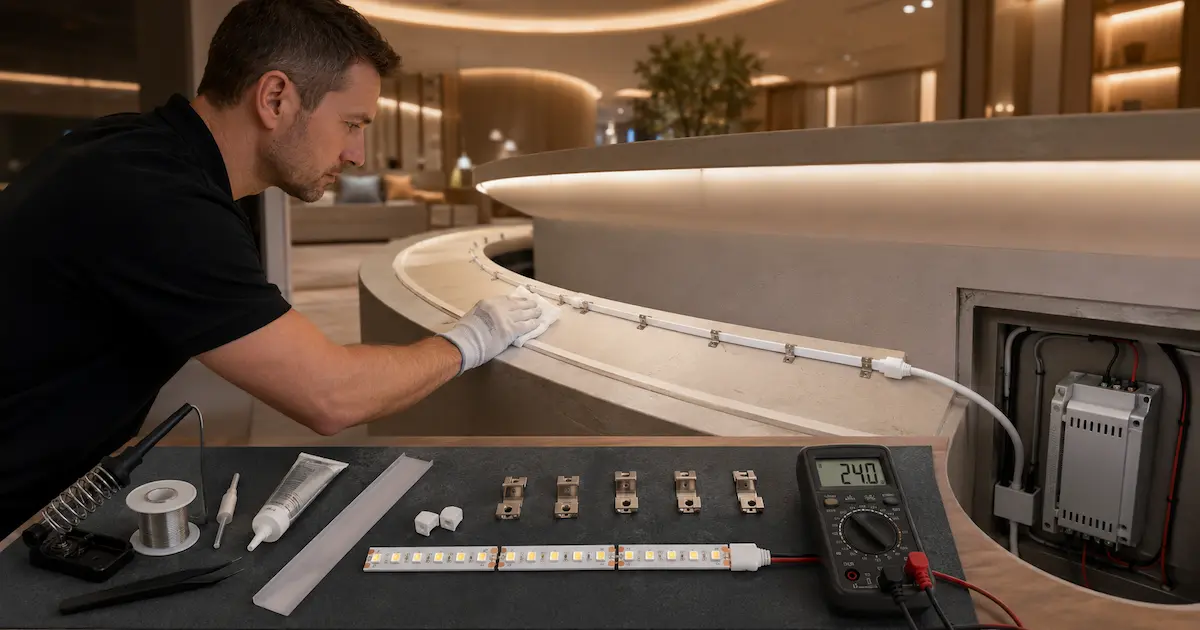
| Installation step | Good practice | Quick fix |
|---|---|---|
| Surface prep | Clean with alcohol, dry fully | Reclean and use clips |
| Cutting | Cut at copper marks | Recut and resolder |
| Bending | Follow bend direction | Reinstall with correct profile |
| Sealing | Seal end caps before exposure | Replace wet section, reseal |
| Power feed | Feed long runs from both ends if needed | Add cable feed or use 24V |
| Testing | Test before final closure | Bench test each section |
Learning the easiest way to install flexible LED profiles and completing a small pre-installation test can prevent full-day callbacks, incorrect bends, and expensive material replacement. Also consider the following practical tips: use a thin bead of neutral-cure silicone to secure end caps on wet-location profiles, avoid solvent-based adhesives that attack silicone, and mark feed points on the profile to maintain service access. Mounting clip spacing of 200–300 mm is typical for horizontal installations to prevent sag; for higher-vibration environments tighten spacing accordingly.
10. How can flexible LED profiles reduce total project cost?
Although unit cost per meter may be higher than bare strip, flexible profiles often reduce overall installed cost by saving labor, lowering rework risk, and improving client acceptance. They standardize rollouts, simplify spares, and shorten training time for installers.
Total cost factors to compare:
- Profile price per meter
- Labor minutes per meter
- Rework risk
- Driver and cable needs
- Warranty exposure
- Client acceptance rate
When you model total installed cost, include likely service calls over a five-year window and expected replacement frequency. In many projects the modest premium per meter for a flexible profile is paid back within the first year through reduced maintenance and faster install times.
11. What mistakes should you avoid with flexible LED profiles?
Common mistakes:
- Choosing material only by price without checking heat or UV resistance
- Mixing LED batches and creating color mismatch
- Underestimating voltage drop on long runs
- Using IP20 profiles in washdown or wet areas
- Stretching strips while installing, stressing solder joints
Check thermal compatibility, sealing, and power plans early to avoid expensive site work later. Avoid improvising with non-certified sealants on IP-rated profiles and always validate bends on a small sample before committing to full runs.
Final Thoughts
Flexible LED profiles let designers and contractors create clean curved light lines, protect LED strips, control diffusion, and reduce installation risk. The best outcomes come from matching material, bend direction, IP rating, strip wattage, voltage, and mounting method before production starts.
If you are unsure about bend radius, voltage drop, or profile selection for a specific project, send our engineering team your drawing. We’ll review the details and help you reduce site surprises. For project handoffs, ask for an installation checklist and sample panels to verify aesthetic and technical performance prior to final production.
FAQ
Q1: What is a flexible LED profile?
A flexible LED profile is a bendable channel or housing for LED strip lights. It helps the strip follow curves, protects the circuit, diffuses light, and gives the installation a cleaner finish.
Q2: Can flexible LED profiles be used outdoors?
Yes, with appropriate material selection, IP rating, and proper cable entry and end sealing. Silicone profiles are commonly supplied to IP65–IP68 ratings.
Q3: Do flexible LED profiles help with heat dissipation?
Bendable aluminum profiles handle heat better than silicone or PVC. Silicone profiles provide IP protection and diffusion but need thermal review for high-wattage strips.
Q4: Are flexible LED profiles better than rigid aluminum profiles?
They are better for curves, signage, columns, and irregular shapes. Rigid aluminum profiles remain preferable for long straight runs where maximum heat control and mechanical straightness are priorities.
Q5: What details should I provide before requesting a flexible LED profile quote?
Provide drawings, bend direction, bend radius, strip width, wattage per meter, voltage, IP rating, length, CCT, dimming needs, and installation environment to avoid wrong samples and site rework.
