
1. Which flexible LED profile type fits retail window displays best?
For most retail window displays, the best starting point is a flexible aluminum profile with a milky diffuser. It bends better than a rigid channel, manages heat better than bare silicone, and gives a cleaner commercial finish than exposed tape light. Curved perfume counters, fashion mannequins, jewelry niches, and cosmetics walls all benefit from this balance.

You can also use full silicone neon-style profiles where the line of light must be visible from the street. They work well for logos, arches, brand frames, and seasonal shapes. However, they usually hide heat less effectively than aluminum-backed systems, so wattage and run length need care.
Here’s the deal: the profile is not only a mounting accessory. It controls light direction, visual comfort, product color, installer speed, and long-term failure risk. The following short video provides a helpful overview of how lighting placement, direction, and visual focus affect merchandise presentation in a retail environment.
| Flexible LED profile type | Best retail use | Main strength | Watch point |
|---|---|---|---|
| Bendable aluminum profile | Curved shelves, display edges, arches | Heat control and clean finish | Needs correct bending radius |
| Silicone neon profile | Visible light lines, logos, curves | Dot-free appearance | Lower heat transfer |
| Flexible recessed profile | Built-in counters and wall niches | Flush architectural look | Requires accurate groove size |
| Flexible surface profile | Fast retrofit on glass, wood, acrylic | Easy mounting | Cable exit planning needed |
2. How much bending radius do you need for clean curves?
Bending radius decides whether a profile follows the display design or becomes a job-site problem. Tight curves look attractive in retail windows, but forcing a profile past its rated bend can deform the diffuser, crack the PCB, or pull solder joints apart. We often see installers struggle with arches around display islands because the profile was selected only by width, not bend behavior.
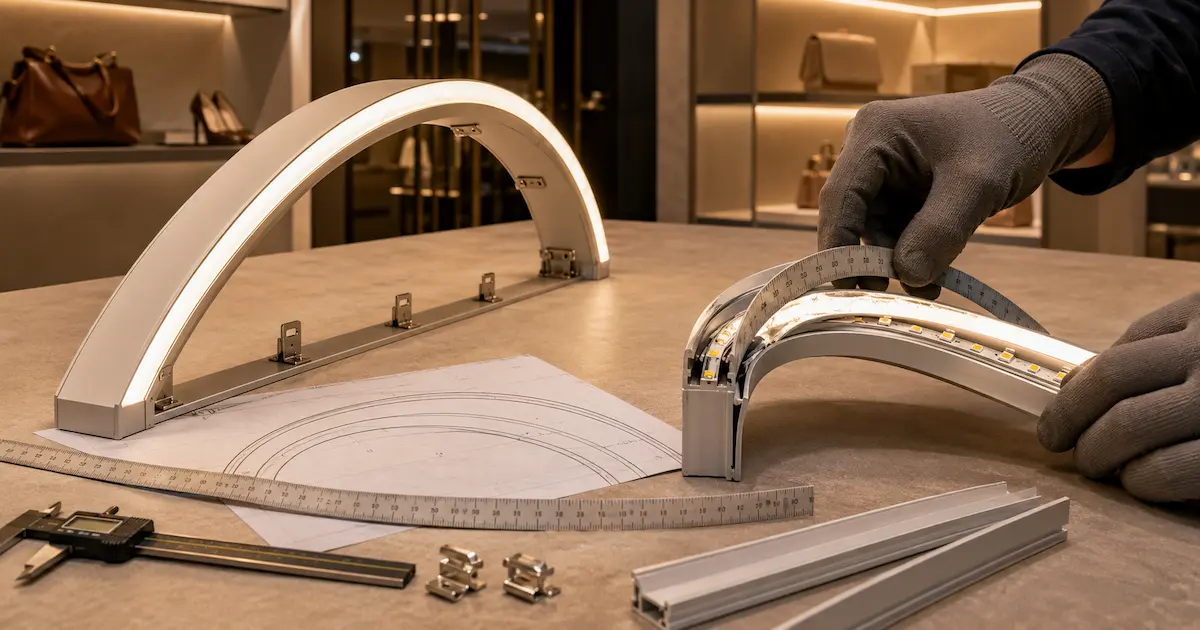
A safe rule is simple: match the minimum bend radius to the drawing before ordering samples. For soft curves around mannequins or product frames, many flexible aluminum profiles can handle moderate bending. For small circular logos or sharp decorative turns, silicone neon or side-bending LED neon may be safer.
In a shoe store field example, a contractor used a rigid micro profile on a curved wall slot. The result was uneven gaps and visible shadows. A side-bending flexible LED profile solved the geometry issue, followed the curved wall more accurately, and cut rework time.
| Application shape | Suggested profile style | Typical minimum bend radius | Practical note |
|---|---|---|---|
| Large display arch | Flexible aluminum channel | 150–300 mm | Good for premium window borders |
| Small brand logo | Silicone side-bending neon | 50–100 mm | Check cutting marks before design approval |
| Curved shelf edge | Slim flexible aluminum | 100–200 mm | Use clips at closer spacing |
| Circular product podium | Top-bending silicone neon | 80–150 mm | Test glare from street view |
3. Which LED strip works best inside flexible profiles?
The profile and LED strip must be specified together. For retail window displays, I usually recommend 24V high-density strips with CRI 90 or above. Understanding the color rendering of light sources is important because high-CRI lighting helps clothing, leather, cosmetics, jewelry, and food packaging look closer to their real color. A low-CRI strip can make red fabric look dull or skin-tone packaging look gray, which directly affects product presentation.
Using flexible LED profiles compatible with high-density COB LEDs is an excellent solution when smooth, dot-free output matters. High-density SMD strips can also work if the diffuser depth is enough. RGBW or tunable white strips are useful for seasonal campaigns, but they need better controller planning and staff-friendly scenes.
In our lab tests using integrating spheres, we compare lumen output, CCT, CRI, and color shift after aging. One common issue is that two strips may both claim 4000K, yet one measures near 3850K and another near 4200K. In a single window, that mismatch is visible.
| LED strip type | Best use in retail windows | Visual result | Technical note |
|---|---|---|---|
| COB 24V | Premium visible lines | Very smooth | Good with shallow diffusers |
| SMD 2835 high-density | Shelves and backlighting | Smooth if pitch is tight | Check diffuser depth |
| RGBW strip | Campaign displays | Color scenes plus white | Needs reliable controller |
| Tunable white strip | Day/night merchandising | Adjustable CCT | Requires 2-channel driver control |
4. Should you choose 12V or 24V systems?
For flexible LED profiles for retail window displays, 24V is usually the safer choice for longer runs. It reduces voltage drop, supports cleaner wiring, and helps keep brightness more consistent from one end to the other. 12V can still work for short signage, small cabinet highlights, or compact displays, but it becomes harder to control across long borders.
When we tested this against a standard 12V strip, the 24V version held brightness more evenly across a long retail frame. The 12V strip needed more power injection points, which raised labor time and made cable routing harder behind the decorative panel.
But there’s a catch. Voltage alone does not fix bad design. You still need correct wire gauge, driver sizing, circuit separation, and access for service.
| 12V vs 24V factor | 12V LED system | 24V LED system | Retail window recommendation |
|---|---|---|---|
| Best run length | Short runs | Medium to longer runs | 24V for most window borders |
| Voltage drop risk | Higher | Lower | 24V reduces dim end issues |
| Driver current | Higher current | Lower current | 24V eases cable sizing |
| Cut length | Often shorter | Often longer | 12V can suit tiny signs |
| Installation labor | More injection points | Fewer injection points | 24V saves time on large displays |
5. How do diffuser choices affect glare, dots, and product color?
Diffusers decide what customers actually see. Clear covers give higher output but can show dots and create glare on glass. Milky diffusers soften the line, while choosing flexible LED profiles with the best diffusers for soft light can further reduce glare and create a more premium retail-window appearance. Opal silicone gives the most even neon-like appearance, yet it may reduce lumen output more than a shallow clear cover.
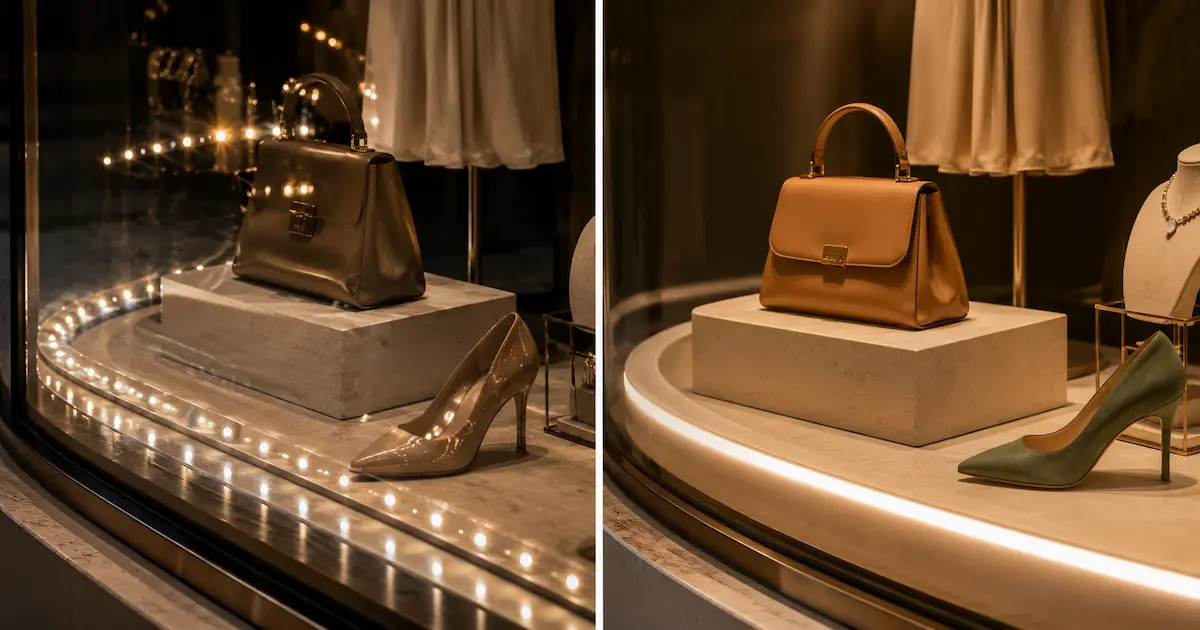
Retail glass reflects everything. A bright dotted strip near the front pane can create double reflections at night, making the display look messy from outside. In a jewelry window, glare can compete with sparkle. In fashion, a poor diffuser can cast dotted highlights on fabric and mannequins.
Common Myth: Higher wattage always means better brightness. Reality: lumen efficiency, diffuser loss, beam angle, surface reflectance, and color temperature all affect the final result. A 10W/m strip with a good diffuser and high efficiency may look better than a 14W/m strip trapped in a hot, shallow profile.
| Diffuser type | Light effect | Output loss tendency | Best use |
|---|---|---|---|
| Clear PC cover | Bright, sharper dots | Low | Hidden indirect lines |
| Frosted cover | Balanced softness | Medium | Shelves and display edges |
| Milky diffuser | Smooth, low glare | Medium to high | Front-facing retail lines |
| Opal silicone | Neon-like line | Higher | Logos and visible curves |
6. What material and finish should the profile use?
Aluminum remains the best base material for most flexible profiles because it spreads heat and gives a stable mounting surface. Anodized silver is common, but black, white, and custom powder-coated finishes can help the profile disappear inside the window design. For luxury stores, the finish matters because the profile may be visible at close range.
Silicone housings are useful for curved visual lines, but they need care around dust, cleaning chemicals, and mounting tension. Lower-grade silicone can yellow near sunlight or high heat. In retail windows with strong sun exposure, material aging becomes a real cost factor.
From our manufacturing floor perspective, we check extrusion tolerance, diffuser fit, bend consistency, and surface finish before packing. A loose diffuser can rattle during transport or slip during vertical installation. A tight diffuser may crack after repeated service.
| Material or finish | Strength | Typical risk | Good use case |
|---|---|---|---|
| Anodized aluminum | Heat transfer, clean look | Scratches if handled poorly | General retail windows |
| Powder-coated aluminum | Matches store interior | Coating thickness affects fit | Branded store fixtures |
| Silicone | Smooth curves, soft line | Yellowing on low-grade material | Logos and decorative shapes |
| PC diffuser | Impact resistance | UV aging if low quality | High-traffic store areas |
7. How do IP ratings affect retail window installations?
Many indoor retail windows do not need waterproof lighting. Yet the area may still face cleaning spray, condensation, open-door humidity, or direct sun heat. That is why the IP code should match the installation’s real exposure to dust, moisture, cleaning spray, and condensation—not just the room label.
IP20 profiles work in dry interior displays with controlled cleaning. IP65 silicone-covered strips or sealed profiles suit display zones near entry doors, flower shops, supermarkets, and windows cleaned with spray liquids. IP67 may be used for semi-outdoor glass boxes or facade-adjacent displays, but sealed products trap more heat, so wattage should be reduced or mounting should help cooling.
We once saw a project fail because a dry-rated strip was placed at the base of a window where staff cleaned glass daily. Water entered the solder joint area, and several sections flickered after two weeks. The replacement used sealed connectors and an IP65 line.
| IP rating | Protection level | Retail window use | Heat note |
|---|---|---|---|
| IP20 | Dry dust protection only | Indoor dry shelves | Best heat release |
| IP54 | Light splash protection | Protected display zones | Moderate heat release |
| IP65 | Water spray resistance | Windows with cleaning spray | Watch sealed strip temperature |
| IP67 | Temporary water exposure | Semi-outdoor display boxes | Reduce wattage if enclosed |
8. What installation details reduce callbacks?
Good flexible LED profiles for retail window displays fail less often when installers receive clear details. The biggest risks are poor cable exits, weak adhesive, too few mounting clips, sharp bend points, and drivers hidden where nobody can service them. These sound basic, but they cause many field complaints.
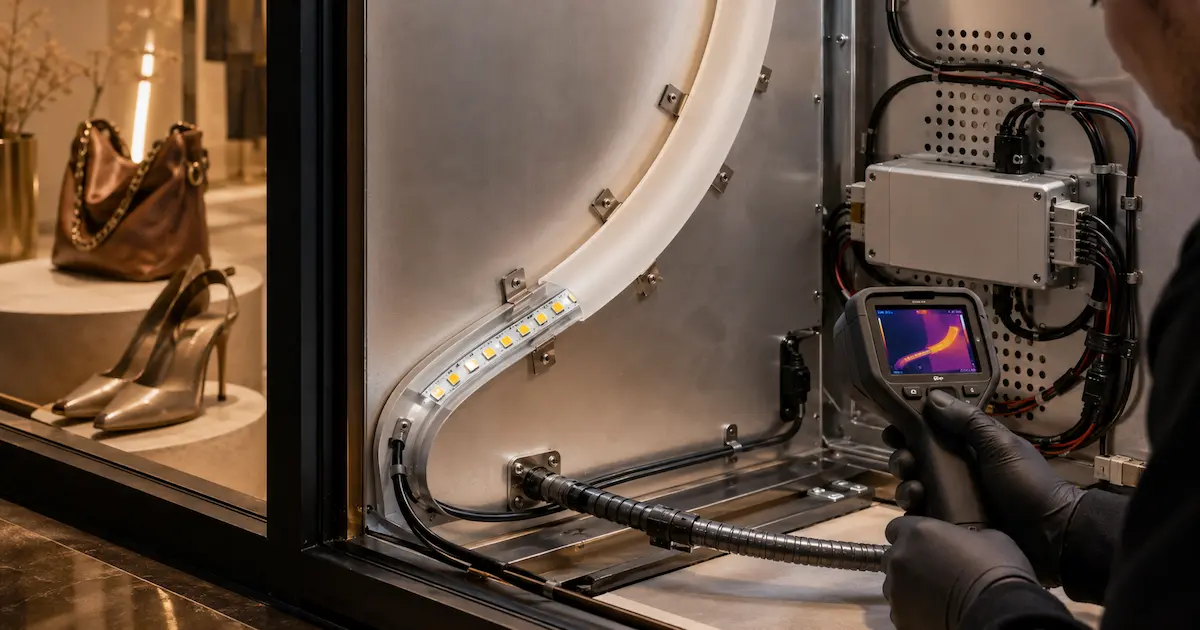
Use mechanical clips or screws whenever possible. Adhesive alone may release from painted wood, dusty aluminum, or warm acrylic. For curved profiles, place clips closer together than you would with straight channels. Plan cable exits before bending. If the cable leaves at the wrong angle, it can push the diffuser open or create a shadow at the end cap.
Pro Tip from the VST Technical Team: “Leave a service loop near the driver and mark each circuit on the drawing. Ten minutes of labeling can save an hour during maintenance.”
| Installation checklist item | Why it matters | Field fix if missed |
|---|---|---|
| Confirm bend radius before cutting | Prevents cracked diffuser and PCB stress | Replace with side-bending profile |
| Use clips at short intervals | Keeps curve stable | Add mechanical clips, not glue only |
| Pre-plan cable exit | Avoids shadows and open end caps | Rework end cap or drill relief hole |
| Separate long runs into circuits | Reduces voltage drop | Add power injection or new driver |
| Keep drivers accessible | Cuts service labor | Add access panel or remote driver box |
9. How should thermal management be handled?
Heat is the silent margin killer in retail lighting. A strip may look fine during a short test, then lose brightness or shift color after months of daily operation. Window displays can be harsh because sunlight heats glass, fixtures run long hours, and enclosed decorative panels block airflow.
Aluminum profiles help move heat away from the LED strip, but selecting flexible LED profiles with effective heat management is still essential for high-wattage or long-hour retail installations.The mounting surface also matters. A flexible aluminum profile attached to metal shelving runs cooler than the same profile stuck inside foam board. High wattage strips need deeper channels, better contact, and lower ambient temperature.
Our Chief Engineer notes that heat dissipation is often ignored in curved retail lines because the visual design gets approved before the electrical design. That can lead to early lumen loss and warranty pressure.
A practical target is to keep the LED strip solder point temperature within the supplier’s rated range during real operation. Thermal imaging cameras help verify this. If the profile feels painfully hot by hand, treat it as a warning and test properly.
10. How do you specify profiles for procurement and repeat orders?
A clear specification protects your profit. For retail chains, repeatability matters more than one perfect sample. If one store receives 3000K and the next receives 3500K, the brand image changes. If one batch bends well and the next batch has a loose diffuser, installers lose trust.
Specify the profile model, bend direction, diffuser type, finish, strip voltage, wattage per meter, CCT, CRI, LED density, IP rating, driver type, dimming method, cable length, connector type, and packaging label, and confirm that your high-density LED strip manufacturer can maintain these specifications across repeat batches. Ask for batch records and test data when color consistency matters.
We explain this binning process because ignoring it leads to visible color mismatch in window frames and product shelves. For retail rollouts, request same-bin LEDs for each project phase and keep spare sections from the same batch.
| Procurement specification | Recommended detail | Business reason |
|---|---|---|
| CCT tolerance | 3-step SDCM or agreed bin | Reduces visible mismatch |
| CRI | Ra90+ for product lighting | Better color presentation |
| Voltage | 24V for most long runs | Fewer dim-end complaints |
| Diffuser | Milky or opal for visible lines | Cleaner street view |
| Driver | Dimmable if scenes are needed | Better campaign control |
| Packaging | Project labels by circuit | Faster site sorting |
Conclusion
The best flexible LED profiles for retail window displays match the display shape, strip type, voltage, diffuser, IP rating, and heat path. A good profile makes the installation cleaner, the product colors more accurate, and the maintenance easier. A poor match causes glare, dim ends, flicker, and callbacks. If you are unsure about bend radius, voltage drop, or profile-strip compatibility for a project, send our engineering team your drawing. We’ll review the details and calculate the safe layout manually.
FAQ
Q1: What are flexible LED profiles for retail window displays?
They are bendable LED mounting channels, usually made from aluminum or silicone, used to hold LED strips in curved or shaped retail displays. They protect the strip, guide the light, improve appearance, and help with heat control.
Q2: Are flexible aluminum profiles better than silicone neon profiles?
Flexible aluminum profiles are better for heat control and fixture-style installation. Silicone neon profiles are better for visible curved light lines, logos, and decorative shapes. The best choice depends on whether performance or visual line effect has priority.
Q3: Should I use 12V or 24V LED strips in retail windows?
Use 24V for most medium and long runs because it reduces voltage drop and cable current. Use 12V only for short signs, compact display props, or designs with very short cut length needs.
Q4: How can I avoid LED dots in a flexible profile?
Use COB strips or high-density SMD strips, choose a milky or opal diffuser, and select a profile with enough diffuser depth. Always test a sample at the real viewing distance before full production.
Q5: What information should I give a supplier before ordering?
Send the drawing, bend radius, run length, voltage, wattage, CCT, CRI, dimming method, IP rating, mounting surface, cable exit direction, and required finish. Clear data reduces sample revisions and site rework.
