
1. What makes flexible LED profile lighting different from standard gallery lights?
Flexible LED profile lighting combines a bendable channel, LED strip, diffuser, end caps, and mounting accessories, so buyers should work with an experienced aluminium LED profile manufacturer that can supply drawings, bend-radius data, thermal information, diffuser options, and matched accessories. Unlike rigid track spots, it can follow arcs, curved ceilings, display plinths, archways, and custom millwork.
Here’s the deal: standard gallery lighting is excellent for adjustable accent beams. Flexible profiles are better for concealed lines, soft wall grazing, luminous edges, and architectural detail. A gallery often needs both.
We often see installers struggle with curved plaster coves where rigid aluminum channels leave gaps or require multiple cuts. Flexible profiles reduce cutting time and make the light line look continuous. In a sculpture room, they can wrap around a circular plinth. In a photography gallery, they can sit inside shallow wall slots where track heads would look too intrusive. In a luxury hotel art corridor, they can follow curved walls while keeping the ceiling clean.
| Lighting Type | Best Use in Galleries | Main Limitation | Commercial Impact |
|---|---|---|---|
| Flexible LED profile | Curves, coves, display edges, custom millwork | Needs careful strip and diffuser choice | Saves labor on non-linear layouts |
| Rigid LED profile | Straight shelves, wall washers, linear ceilings | Poor fit on curves | Clean finish on straight runs |
| Track spotlight | Paintings, framed works, flexible aiming | Visible fixture body | Easy relamping and aiming |
| Recessed downlight | General ambient light | Less precise artwork control | Simple ceiling plan |
2. Can flexible LED profile lighting protect artwork while improving visual quality?
Yes, if you control heat, spectrum, brightness, and distance from the artwork. Art galleries care about appearance, but conservation risk matters just as much, especially when specifying LED strip lights for museum artifact displays containing paper, textiles, pigments, photographs, or other light-sensitive materials. Paint, paper, textile, ink, and organic materials can suffer under excess light exposure.
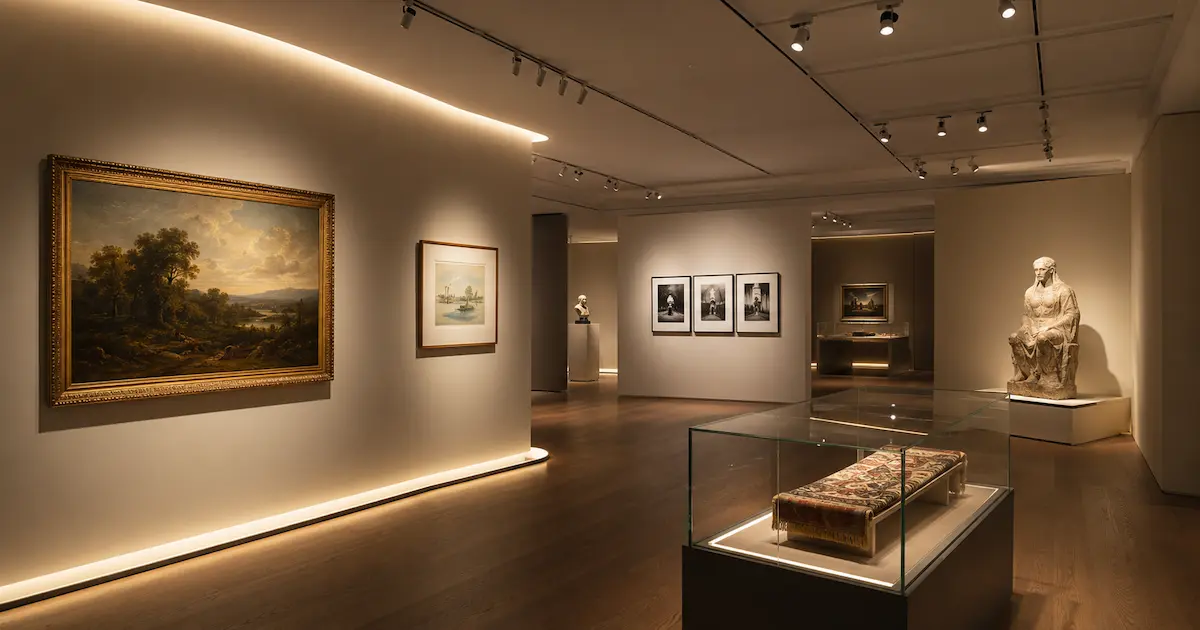
The Canadian Conservation Institute’s guidance on LED lighting in museums and art galleries explains how spectral output, colour quality, light exposure, ultraviolet radiation, and lamp selection should be evaluated when illuminating sensitive collections. But there’s a catch. A bad LED strip can still create too much heat in a sealed profile or produce poor spectral rendering that shifts reds, blues, and skin tones.
In our lab tests using integrating spheres, we compare CCT, CRI, R9, lumen output, and color drift before recommending a strip for display projects. For galleries, we normally suggest CRI 90+ as a baseline, CRI 95+ for fine art, and strong R9 values for warm pigments, wood, fabric, and portraits.
| Artwork Type | Suggested CCT | Suggested CRI | Light Level Range | Notes |
|---|---|---|---|---|
| Oil paintings | 3000K–3500K | 90–95+ | 150–300 lux | Watch glare on varnish |
| Watercolors | 2700K–3000K | 95+ | 50–150 lux | Limit exposure time |
| Photography | 3000K–4000K | 90–95+ | 100–200 lux | Avoid color shift |
| Textiles | 2700K–3000K | 95+ | 50–150 lux | Heat control is key |
| Sculptures | 3000K–4000K | 90+ | Depends on material | Grazing light can reveal texture |
The following Smithsonian museum-lighting presentation explains how colour temperature, colour rendering, light-source selection, and exposure affect the appearance and preservation of displayed artwork.
3. Which specifications matter most for gallery-grade LED profiles?
Gallery projects should not be purchased only by wattage or price per metre; buyers should review the available LED lighting product details for CRI, R9, CCT tolerance, SDCM, LED density, diffuser loss, driver ripple, bend radius, voltage, and thermal performance. The right data sheet tells you whether the system will look consistent after installation.
Key parameters include CCT tolerance, CRI, R9, lumen efficiency, LED density, bend radius, diffuser material, driver ripple, dimming compatibility, and the measured color rendering of light sources used to illuminate paintings, textiles, photographs, sculptures, and decorative finishes. We explain this specific binning process because ignoring it leads to visible color mismatch on long gallery walls.
Common Myth: Higher wattage always means better brightness.
Reality: Brightness depends on lumen efficiency, diffuser loss, profile depth, wall distance, and beam spread. A 10W/m strip with 110 lm/W can outperform a 14W/m strip with poor chips and a heavy diffuser. Higher wattage can also raise heat, shorten life, and create color shift.
When we tested this against a standard 12V strip, the 24V version held voltage better on longer runs and produced more uniform light near the far end. For a 15-meter cove around an exhibition hall, that difference can prevent rework.
| Specification | Preferred Range for Galleries | Why It Matters |
|---|---|---|
| CRI | 90–95+ | Accurate color rendering |
| R9 | 50+ for general, 80+ for premium | Better reds and warm tones |
| CCT tolerance | 3-step SDCM or better | Reduces batch color mismatch |
| LED density | 120–240 LEDs/m or COB | Reduces dot visibility |
| Driver ripple | Low ripple | Less camera flicker and eye fatigue |
| Profile temperature | Keep strip PCB cool | Longer service life |
4. Is flexible LED profile lighting better than rigid profiles or track lighting?
It depends on the gallery layout. A flexible LED profile is not a full replacement for track lighting. It is a different tool.
For framed artwork, adjustable track heads still give the curator more control over beam angle and focus. For curved display walls, signage, display cases, and coves, flexible profiles often win because they hide inside the architecture and support clean LED backlighting on art exhibits without introducing bulky visible fixtures.
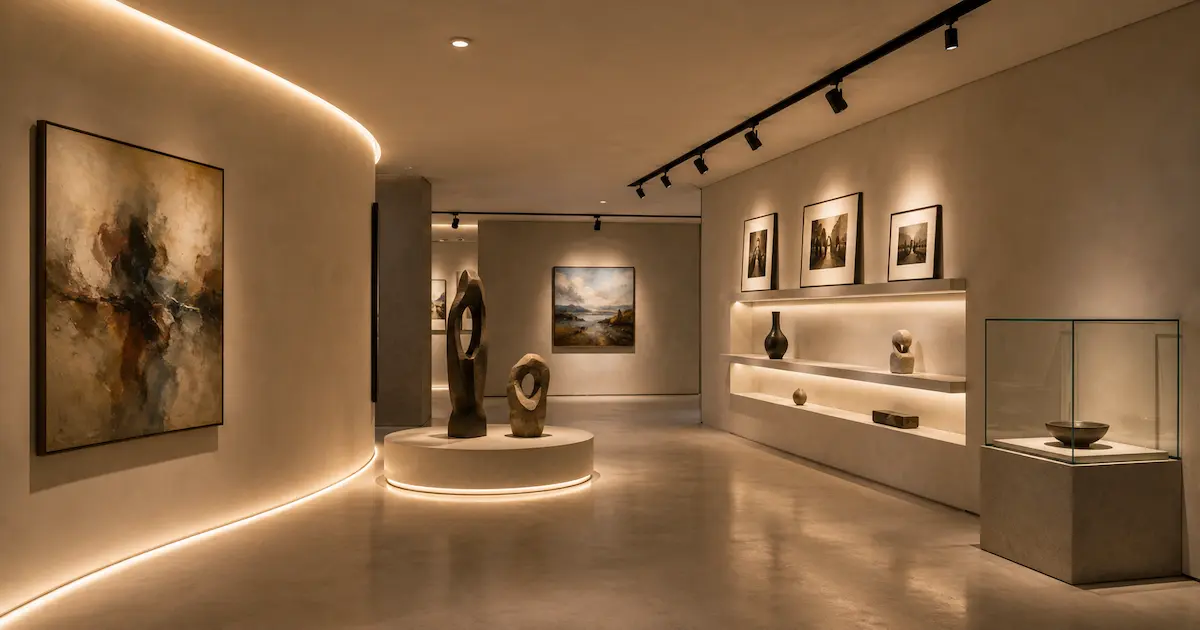
In contrast, rigid profiles are the safer option for straight shelves, cabinet lighting, and long linear wall lines where bendability has no value. Flexible profiles make sense when geometry demands them or when site labor costs would rise due to cutting many rigid sections.
| Feature | Flexible LED Profile | Rigid LED Profile | Track Lighting |
|---|---|---|---|
| Curved installation | Excellent | Poor | Good only via track layout |
| Visual appearance | Concealed, linear | Clean, straight | Fixture visible |
| Aiming control | Limited | Limited | Excellent |
| Heat dissipation | Medium, profile dependent | Strong | Fixture dependent |
| Installation speed on curves | Fast | Slow | Medium |
| Best role | Curves and coves | Straight architectural lines | Accent lighting |
Pro Tip from VST Technical Team: “Use flexible profiles for the architecture, and use track lights for artwork that changes often. This keeps the base lighting stable while giving curators control.”
5. How do voltage and driver choices affect long gallery runs?
Voltage drop is one of the fastest ways to ruin a clean gallery installation. The first meters look bright, and the far end looks dull or warmer. Your client may not see the calculation, but they will see the wall.
For long runs, 24V usually performs better than 12V. For very long architectural lines, constant current systems or segmented power feeds may be needed. Driver quality also matters. Low-cost drivers can create flicker, buzzing, poor dimming range, and early failure.
We once saw a project fail because a contractor powered a 20-meter curved cove from one end using thin cable and 12V strip. The far end dropped visibly. The fix required extra access holes, new cable routes, and night work after the gallery opened. That margin loss was avoidable.
| Option | 12V LED Strip | 24V LED Strip |
|---|---|---|
| Best run length | Short display cases | Medium to long coves |
| Voltage drop risk | Higher | Lower |
| Cable current | Higher | Lower |
| Cut interval | Often shorter | Often longer |
| Driver availability | Wide | Wide |
| Gallery use | Small cases, shelves | Main profile runs, curved walls |
Use DALI where a gallery requires addressable luminaires, repeatable dimming levels, configurable exhibition scenes, system monitoring, and integration with sensors or other control devices.
6. What diffuser and lens choices work best for artwork displays?
The diffuser controls dot visibility, glare, beam softness, and output loss. A profile can have excellent LED chips and still look poor if the diffuser is wrong.
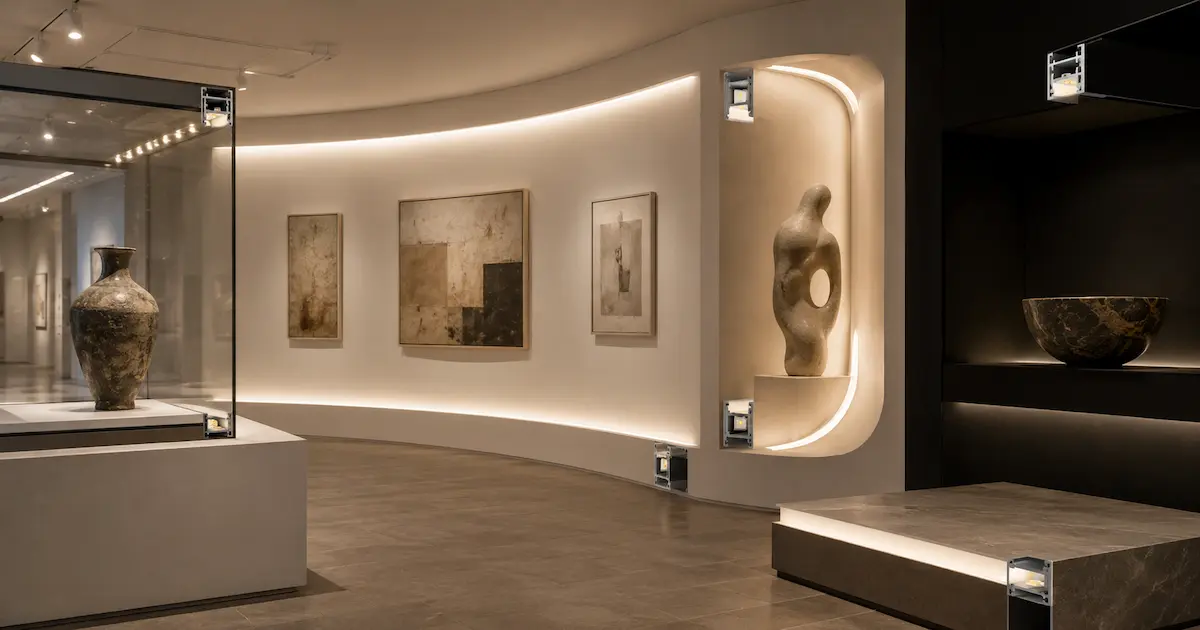
Opal diffusers create soft continuous lines but reduce lumen output, so designers should compare which flexible LED profiles provide the best diffusers for soft light before approving visible gallery coves, display edges, or sculpture niches. Clear diffusers pass more light, but they may show dots and cause glare. Frosted diffusers sit between these two. For shallow profiles, COB strip often produces the smoothest line because it has no visible LED points under normal viewing distance.
This is where it gets practical. In a glass display case, too much glare makes labels hard to read. In a matte sculpture niche, soft grazing can reveal surface detail. In a corridor gallery, a wide diffuser can reduce harsh contrast and create a premium feeling.
| Diffuser Type | Visual Effect | Light Loss | Best Gallery Use |
|---|---|---|---|
| Opal | Smooth, soft line | 25%–45% | Visible coves, curved light slots |
| Frosted | Balanced softness | 15%–30% | Shelves, wall grooves |
| Clear | High output, visible points | 5%–10% | Hidden indirect light |
| Black diffuser | Low glare, decorative | 35%–55% | Dark interiors and display edges |
| Silicone cover | Flexible, sealed | 20%–40% | Curved or damp locations |
A good rule: if visitors can see the profile directly, test a sample at real viewing distance before ordering the full batch.
7. How should heat dissipation be handled in flexible LED profile systems?
Heat is the silent failure point in LED profile lighting, and ENERGY STAR’s guidance to learn about LED lighting explains why the heat generated by LEDs must be transferred through an effective heat sink to prevent performance and reliability problems. It affects lumen maintenance, color stability, adhesive life, and driver load.
Rigid aluminum profiles generally dissipate heat better than silicone-only flexible channels. Some flexible systems use aluminium-backed structures or hybrid designs to improve thermal transfer, so project teams should compare which flexible LED profiles offer the best heat management for LEDs before installing higher-wattage strips inside sealed millwork or display niches. The higher the wattage per meter, the more you should care about thermal path.
Our Chief Engineer notes that heat dissipation is often ignored in display lighting because the light line looks small. “A narrow profile can still trap heat if it sits in wood, acrylic, or a sealed niche. Always test surface temperature after one hour at full output.”
From our manufacturing floor perspective, we recommend thermal testing on any gallery profile above 12W/m, especially inside millwork. In one retail art wall project, a 14.4W/m strip inside a tight wooden slot ran too hot. A lower wattage COB strip with a better diffuser achieved the same visual effect and extended life.
| Installation Condition | Heat Risk | Recommended Action |
|---|---|---|
| Open aluminum channel | Low to medium | Check profile temp after burn-in |
| Silicone flexible channel only | Medium | Limit wattage or use short runs |
| Sealed wooden slot | High | Use lower wattage and venting |
| Acrylic display case | High | Use remote driver and low-heat strip |
| Ceiling cove with airflow | Medium | Keep access for driver service |
8. What installation details prevent callbacks in art galleries?
Gallery installations often fail at the small details: uneven bends, poor solder joints, wrong adhesive, blocked access, mismatched batches, and drivers hidden where nobody can service them.
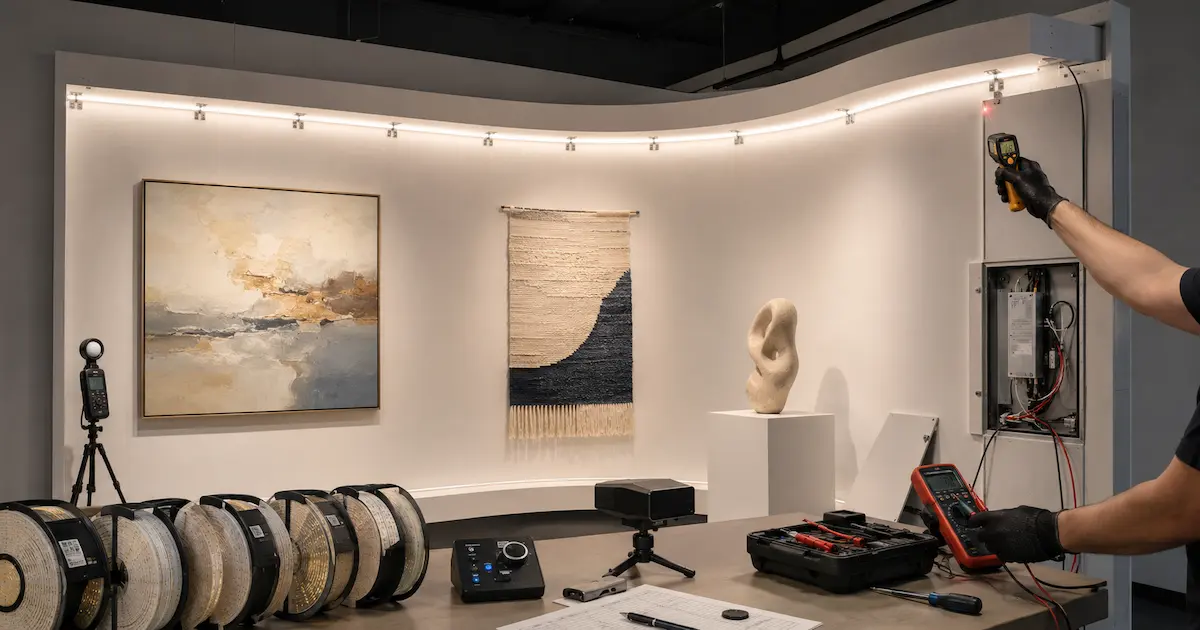
We often see installers struggle with flexible profiles at tight corners. If the bend radius is too small, the diffuser can buckle, the strip can lift, or the light line can show shadows. Pre-soldered leads, pre-cut lengths, and labeled reels can save time on site.
A practical checklist helps avoid project delays and reputation damage.
| Installation Checkpoint | What to Verify | Failure If Ignored | Field Fix |
|---|---|---|---|
| Bend radius | Meets profile data sheet | Cracked diffuser, shadow line | Use larger radius or corner part |
| Power feed | Both-end feed for long runs | Voltage drop | Add feed cable or split circuit |
| Batch code | Same CCT bin | Visible color mismatch | Replace affected run |
| Driver access | Serviceable location | Expensive ceiling opening | Move driver to access panel |
| Surface prep | Clean, dry, flat base | Strip detachment | Use clips or stronger tape |
| Dimming test | Full range tested | Flicker or buzzing | Change driver/control type |
For a new gallery, build a mock-up before final installation. A 2-meter sample on the real wall finish can reveal glare, color shift, and shadow problems early.
9. How does flexible LED profile lighting affect project cost and ROI?
Flexible LED profile lighting may cost more per meter than basic rigid channel. Yet the installed cost can be lower on curved or custom layouts because it reduces cutting, joining, finishing, and rework.
Project managers should compare total installed cost, not only unit price. That means profile cost, LED strip cost, driver cost, control cost, labor, access panels, replacement risk, and client satisfaction. Margin erosion usually comes from rework, not from buying a slightly better profile.
For example, a curved 30-meter gallery cove made from rigid channel may need many miter cuts, extra connectors, and filler work. A flexible profile can reduce joints and speed alignment. In a display case rollout across ten branches, pre-cut flexible kits can keep installation consistent. In a premium private gallery, high-CRI COB strips may cost more, but they reduce complaints about color rendering.
| Cost Factor | Low-Spec Choice | Gallery-Grade Choice | Business Result |
|---|---|---|---|
| LED strip | Low CRI, wide bin | CRI 95, 3-step SDCM | Fewer color complaints |
| Profile | Basic plastic channel | Flexible profile with stable diffuser | Cleaner finish |
| Driver | No-name dimmable unit | Certified low-flicker driver | Less buzzing and flicker |
| Labor | Cut on site | Pre-cut, pre-wired kits | Faster installation |
| Warranty risk | Limited testing | Aging and thermal checks | Fewer callbacks |
The real ROI is simple: fewer callbacks, cleaner handover, and better client trust.
10. When is flexible LED profile lighting not the right choice?
Flexible LED profile lighting is not always the best answer. For constantly changing exhibitions, track lighting gives better aiming and beam control. For very high ceilings, linear profiles may not provide enough punch on artwork. For conservation-heavy museums, light exposure planning may require advanced controls, sensors, and strict lux limits.
There are also mechanical limits. Some flexible profiles cannot make sharp inside corners. Some diffusers twist on vertical curves. Some silicone channels attract dust or yellow faster in harsh environments. If a gallery has heavy public traffic near the light line, impact resistance must be checked.
A balanced specification may use flexible LED profile lighting for ambient curves and coves, rigid profiles for straight display shelves, and track heads for artwork focus. That mixed system often gives the best result.
Before approval, ask three direct questions:
● Will visitors see the LED line directly?
● Does the exhibition layout change often?
● Can the driver and wiring be serviced without damaging the finished ceiling or wall?
If the answers reveal risk, adjust the design before procurement. The cheapest time to fix lighting is before production starts.
Conclusion
Flexible LED profile lighting is ideal for many art gallery installations, especially curved coves, display niches, sculptures, and clean architectural lines. The best results come from high-CRI strips, stable drivers, controlled heat, proper diffusers, and tested samples. It should work beside track lighting, not always replace it. If you are unsure about voltage drop, DALI or DMX dimming, lux targets, diffuser choice, profile temperature, or curved-layout details, contact our engineering team and send the gallery drawings for a manual technical review. We’ll review the layout and calculate it manually.
FAQ
Q1: Is flexible LED profile lighting safe for original artwork?
Yes, if you specify low-UV LED strips, control lux levels, manage heat, and use suitable CCT and CRI. Sensitive artwork such as paper, textile, and watercolor still needs limited exposure time and careful dimming scenes.
Q2: What CRI should I use for art gallery LED lighting?
Use CRI 90 as a minimum and CRI 95+ for fine art, portraits, fabric, wood, and premium exhibition areas. Check R9 too, because red rendering strongly affects warm colors and skin tones.
Q3: Should I choose 12V or 24V flexible LED profiles for gallery coves?
For most gallery coves and longer runs, 24V is better because it reduces voltage drop and cable current. Use 12V for short display cases or compact shelves where cut intervals matter more.
Q4: Can flexible LED profile lighting replace track lighting?
It can replace track lighting in coves, niches, and decorative linear areas, but it usually should not replace adjustable accent lights for changing artwork. Many galleries use both systems.
Q5: How can I avoid visible dots in flexible LED profiles?
Use COB strips or high-density SMD strips, choose the correct diffuser, and test the profile at real viewing distance. A deeper profile also helps create a smooth continuous line.
