
The better approach is to follow a practical buying guide for aluminium channel LED strip lighting and match the aluminum channel to the installation surface, wattage, viewing angle, IP rating, and diffuser style before production or bulk purchase. From our manufacturing floor perspective, most profile failures are not caused by bad aluminum alone. They come from poor selection, weak thermal planning, or missing accessories. This article gives you a clear technical way to select the right profile type for commercial lighting projects.
1. What Are Aluminum Profiles for LED Strips?
An aluminum profile for LED strip lighting is an extruded aluminum channel designed to hold flexible LED strips. They usually include a LED channel diffuser, end caps, mounting clips, and sometimes hanging wires or waterproof seals.
Their job is simple, but the effect is big.
They help with:
- Mechanical protection for the LED strip
- Heat dissipation through the aluminum body
- Cleaner visual finish for furniture, ceilings, shelves, and signage
- Light diffusion to reduce visible LED dots
- Faster installation with clips, screws, or recessed slots
Here’s the deal: a bare LED strip can work, but it often looks unfinished in professional projects. In a retail shelf, exposed solder joints reduce perceived product value. In a hotel corridor, visible LED dots can make the lighting look cheap. In a kitchen cabinet, grease and dust can shorten the strip life.
In our lab tests using integrating spheres, we often compare lumen output before and after placing LED strips inside profiles with different diffusers. A frosted diffuser usually reduces light output, but it improves visual comfort. That tradeoff matters for your client’s acceptance and your margin.
Aluminum profiles are typically produced through extrusion from 6000-series alloys for a balance of strength and profile-forming performance, with anodized or powder-coated finishes for corrosion resistance and aesthetics. Manufacturers also control extrusion tolerances and straightness to ensure consistent diffuser fit and seamless long runs. When buying, request T-sizes and tolerance tables; they help avoid onsite surprises.
| Profile Component | Function | Project Impact |
|---|---|---|
| Aluminum body | Holds strip and moves heat | Longer strip life |
| Diffuser cover | Softens light and hides dots | Better visual effect |
| End caps | Closes profile ends | Cleaner finish |
| Mounting clips | Fixes profile to surface | Faster service access |
| Screws or brackets | Strong mechanical fixing | Less risk of falling |
2. Which Surface-Mounted Profiles Fit General Projects?
Surface-mounted aluminum profiles are the most common choice for LED strip lighting, especially when installers need a simple process for how to install aluminium channel for LED strip lighting on cabinets, shelves, or retrofit surfaces. They sit on top of a surface and are fixed with clips, screws, or adhesive support. These are widely used under cabinets, display shelves, wardrobes, office coves, and machine lighting.
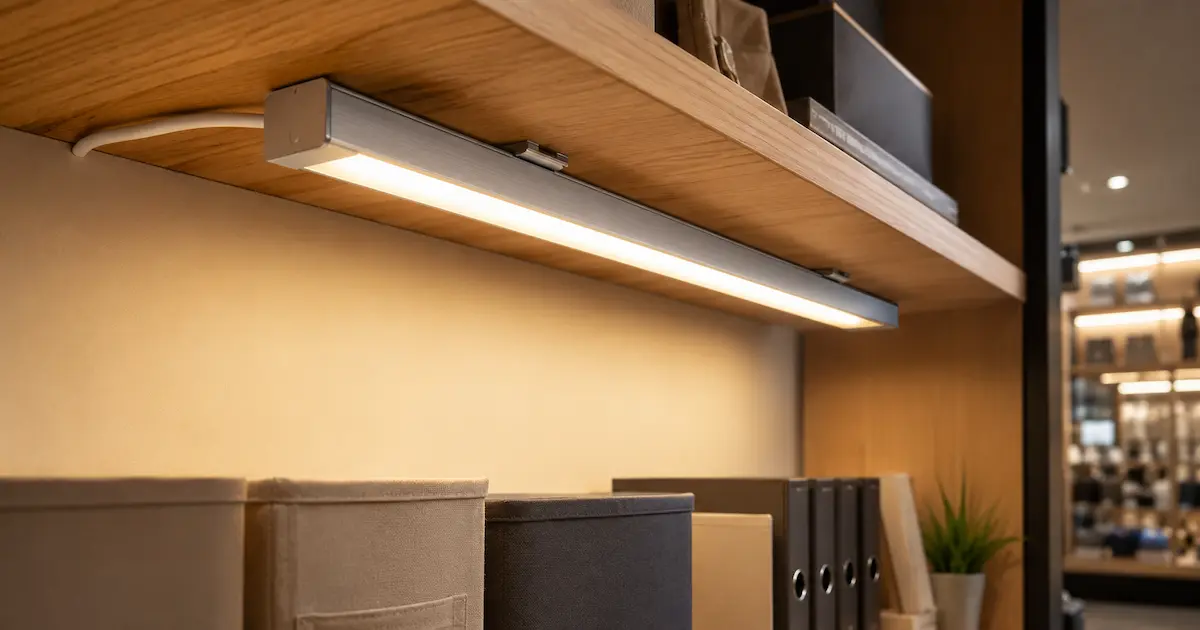
The main advantage is installation speed. Installers do not need to cut grooves into furniture or gypsum board. That saves labor and lowers risk on retrofit projects.
We often see installers struggle with adhesive-only LED strips on dusty wood, rough concrete, or painted metal. After a few months, the tape starts to release because of heat, humidity, or surface contamination. A surface profile with mechanical clips removes that risk.
Typical field examples:
- Retail shelves need fast service access when strips fail. A clip-mounted profile helps replacement.
- Office cabinets need a neat line of light without visible wiring. A slim profile works well.
- Factory equipment lighting needs a stronger aluminum body because workers may touch or hit the fixture.
For standard 9.6W/m to 14.4W/m LED strips, a medium surface profile is usually enough. For 19.2W/m or higher, choose a wider aluminum base. Heat transfer area and the thermal conductivity of metals and alloys directly affect LED junction temperature, which affects lumen maintenance.
Practical tips for surface mounting: use silane primers for improved tape adhesion on painted or lacquered surfaces, pre-clean the surface with isopropyl alcohol, and prefer mechanical clips where vibration or thermal cycling is expected. Where aesthetics matter, choose a profile with a recess that hides the mounting screws and offers a continuous look.
| Surface Profile Type | Typical Width | Best Use | Strip Wattage Range |
|---|---|---|---|
| Slim U-shape | 8–12 mm | Cabinets, shelves | 4.8–9.6W/m |
| Standard U-shape | 15–20 mm | Office, retail | 9.6–14.4W/m |
| Wide heat profile | 23–35 mm | High-output lines | 14.4–24W/m |
| Deep diffuser profile | 16–25 mm | Dot-free effect | COB or dense SMD |
3. When Should You Use Recessed LED Strip Profiles?
Recessed profiles sit inside a groove, slot, or routed channel. They are popular in furniture, drywall ceilings, wall panels, stairs, and architectural trim. The profile lip covers the cut edge and creates a flush finish.
This is where it gets practical. A recessed profile looks more premium, but it needs better coordination. The carpenter, drywall contractor, electrician, and lighting supplier must agree on profile width, cutting tolerance, diffuser access, and cable exit position.
We once saw a project fail because the furniture factory routed a 12 mm slot while the profile required 12.4 mm clearance. That 0.4 mm mismatch caused broken panels and delayed handover. Small drawings prevent large costs.
Use recessed profiles when:
- The client wants a flush, built-in light line
- The LED strip must be protected from direct touch
- The surface can be routed, milled, or pre-cut
- The project can control tolerances before installation
Recessed profiles also reduce glare because the light source sits lower than the surface. In a luxury hotel lobby, this can make the lighting feel controlled and calm. In stair nosing, it protects the strip from shoes and cleaning tools.
Installation sequence matters: route the groove to allow for thermal expansion, insert the profile and test the diffuser fit before final sealing, and plan cable exits to avoid structural reinforcements. It is good practice to leave service gaps or removable diffusers for maintenance access in long runs.
| Recessed Profile Feature | Recommended Check | Why It Matters |
|---|---|---|
| Outer width | Match routed groove | Prevents loose fit or cracking |
| Lip size | Cover cut edge fully | Hides workmanship errors |
| Diffuser removal | Front access preferred | Easier maintenance |
| Cable exit | Side, rear, or end | Avoids site drilling |
| Aluminum thickness | 1.0–2.0 mm common | Better rigidity |
4. How Do Corner Profiles Control Beam Direction?
A LED strip corner profile usually creates a 30°, 45°, or angled beam for cabinets, display shelves, and wall-ceiling intersections. They fit inside cabinet corners, wall-ceiling intersections, display cases, and under-shelf lighting. Their value is beam control.

A flat profile points light straight outward. A corner profile directs light toward the target area. That can reduce glare and improve usable illumination on worktops, signage, or merchandise.
Think about a jewelry display. If the LED strip is placed flat at the back of the shelf, part of the light may hit the customer’s eyes. With a 45° corner profile, the beam aims toward the product. The result is cleaner presentation and fewer complaints about glare.
Common field examples:
- Kitchen cabinets use 45° profiles to aim light toward countertops.
- Wardrobes use corner profiles to light hanging clothes from the front edge.
- Display shelves use angled profiles to reduce shadows behind products.
When we tested this against a standard 12V strip placed flat under a shelf, the angled profile produced more useful light on the target plane even though the strip lumen output was the same. The lesson is clear: wattage is not the only factor. Beam direction can change perceived brightness.
Selecting the right angle requires measuring the desired illumination plane and calculating the aim. Use mock-ups to confirm that reflections and specular surfaces do not introduce unwanted glare. For complex displays, consider dual-angle or custom extrusions to shape multiple beams from the same cavity.
| Corner Profile Angle | Light Direction | Typical Project |
|---|---|---|
| 30° | Narrow forward wash | Display shelves |
| 45° | Balanced task lighting | Kitchens, cabinets |
| 60° | Wider wall/corner spread | Decorative coves |
| Dual-angle custom | Special beam aim | OEM furniture lighting |
5. Are Suspended and Linear Profiles Right for Commercial Spaces?
Suspended aluminum profiles are larger channels used to create hanging linear lights. They often use high-density LED strips or linear LED modules, combined with opal diffusers and aircraft cables. Offices, supermarkets, meeting rooms, studios, and retail corridors use them often.
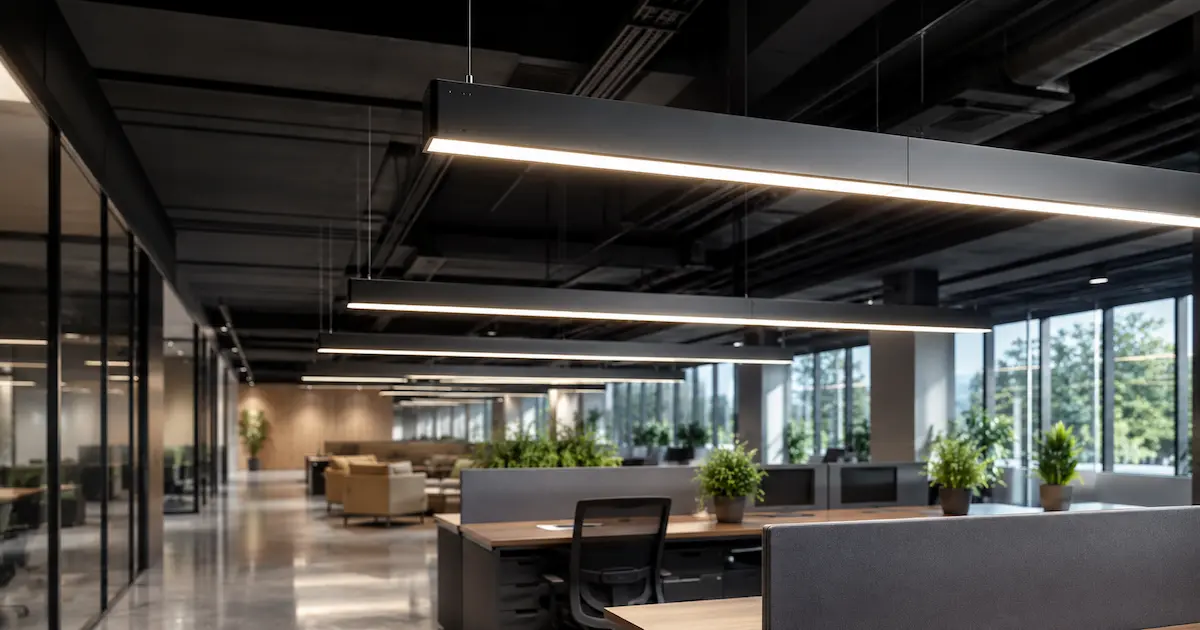
The catch is thermal load. A decorative profile may look similar to a suspended linear profile, but the aluminum mass and diffuser area may differ greatly. If you place a high-power strip into a small decorative channel, heat can build up fast.
From our manufacturing floor perspective, suspended profiles need tighter straightness control during extrusion and packing. Long lengths, such as 2 meters or 3 meters, can bend during transport if cartons are weak or profiles are not separated well.
Three project examples:
- Open-plan offices use suspended linear profiles for direct and indirect light.
- Supermarket aisles use long continuous lines to guide customers.
- Showrooms use black anodized profiles for a strong architectural style.
For these projects, ask about aluminum weight per meter, diffuser transmission, joining accessories, and suspension kits. Also check whether the profile can support continuous-row wiring. Poor joint alignment creates visible dark gaps, which clients notice right away.
Acoustic and electrical considerations matter: choose profiles with internal cavities for wiring and consider adding sound-damping inserts when installed in high-ceiling spaces. Also ensure suspension points are engineered to handle not only static loads but any dynamic loads during transport and installation.
| Suspended Profile Parameter | Common Range | Buying Advice |
|---|---|---|
| Profile length | 1m, 2m, 3m | Confirm cutting tolerance |
| Aluminum weight | 300–900 g/m | Higher power needs more mass |
| Diffuser transmission | 55–85% | Balance brightness and dot-free look |
| Cable suspension | 1–1.5 mm steel wire | Check load rating |
| Joint method | Straight connector | Needed for long runs |
6. What Is the Difference Between Shallow and Deep Diffuser Profiles?
The distance between LED chips and diffuser cover changes the visual result, which is why many premium projects use deeper profiles to achieve perfect light diffusion with aluminium channels. Shallow profiles are compact, but LED dots can show through unless you use COB strips or high LED density. Deep profiles give more mixing distance, so they create smoother light.
Common Myth: higher wattage always means better brightness. Reality: useful brightness depends on LED efficiency, diffuser loss, beam angle, profile depth, and surface reflectance. A 10W/m COB strip in a good deep profile may look smoother and more valuable than a 14.4W/m low-density strip with visible dots. For a practical visual comparison of LED diffuser channels, this video shows how profile depth, diffuser style, and mounting design affect the final light quality.
Pro Tip from the VST Technical Team: “If the buyer wants dot-free light with SMD strips, check LED density and diffuser distance together. A milky cover alone cannot hide large chip spacing.”
In our lab tests using integrating spheres, a clear diffuser showed higher lumen output but created sharp dots. A milky diffuser reduced measured output, yet users preferred it for hotel rooms and display cases. So the right choice depends on the space.
Material matters: polycarbonate (PC) diffusers offer impact resistance and can be very thin, while PMMA (acrylic) often has better optical clarity and is less prone to yellowing under UV if properly UV-stabilized. Check heat deflection temperatures too, especially with high-power strips that raise internal channel temperatures.
| Diffuser/Profile Type | Dot Control | Light Output | Best Use |
|---|---|---|---|
| Shallow + clear cover | Low | High | Hidden coves |
| Shallow + frosted cover | Medium | Medium | Cabinets |
| Deep + milky cover | High | Lower | Visible lines |
| Deep + COB strip | Very high | Medium-high | Premium interiors |
7. Which Waterproof Aluminum Profiles Suit Outdoor LED Strips?
Outdoor and wet-location projects need more than a nice aluminum shape, so buyers should compare the top aluminium channels for outdoor LED lighting before choosing profiles for facades, signage, or washdown zones. They need correct IP protection, sealed cable entries, UV-resistant covers, drainage planning, and suitable LED strips. A waterproof LED channel may use silicone seals, screw-fixed covers, or resin-filled LED strips inside the channel for outdoor and wet-location projects. They are common for facade outlines, garden steps, signage, marine-adjacent areas, and washdown zones.
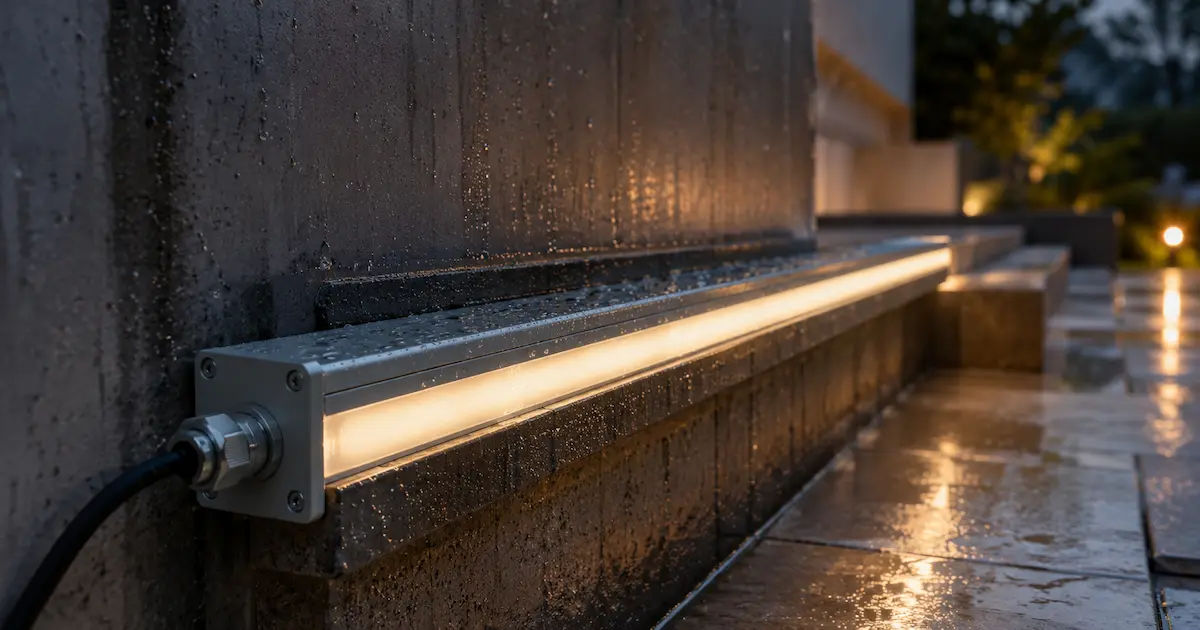
But here’s the kicker: IP rating alone does not solve poor installation. If the cable exit faces upward and water collects at the end cap, even a good profile can fail. If installers cut a silicone strip and do not reseal the end, moisture travels into the PCB.
Field examples:
- Outdoor facade lighting needs UV-stable diffusers and corrosion-resistant screws.
- Food processing areas need sealed profiles that tolerate cleaning spray.
- Bathroom mirror lighting needs moisture protection but also service access.
Choose proper cable glands, double-sealed end caps, and plan for condensation. For long outdoor runs, include drainage channels or plan for periodic inspection. Also consider galvanic corrosion if aluminum mounts directly to dissimilar metals in marine environments.
| Waterproof Choice | Protection Level | Suitable Area | Risk If Misused |
|---|---|---|---|
| Standard indoor profile | IP20 | Dry indoor | Dust and moisture entry |
| Silicone-covered strip in profile | IP65 | Splash areas | Weak cut-end sealing |
| Sealed aluminum profile | IP67 | Outdoor rain | Poor cable gland work |
| Resin-filled strip system | IP68-rated strip possible | Short immersion cases | Heat buildup if overloaded |
8. How Do Specialty Profiles Support Stairs, Floors, Furniture, and Shelves?
Specialty profiles solve project-specific installation problems. Stair profiles handle foot traffic and edge marking. Floor profiles resist pressure and abrasion. Wardrobe profiles may include sensor grooves. Shelf profiles may combine LED channels with structural support.
We often see installers struggle with standard U-shape profiles in furniture because the profile solves only lighting, not fixing, wire hiding, or service access. A specialty profile can reduce site labor by combining several functions into one extrusion.
Typical examples:
- Stair nosing profiles add safety marking and protect the LED strip from impact.
- Glass shelf profiles hold a shelf and light its edge at the same time.
- Wardrobe hanging-rail profiles place light near clothing while hiding wires.
For OEM furniture companies, specialty profiles can reduce assembly time. A pre-cut profile with pre-soldered wires, end caps, and a matched sensor can remove several manual steps from the production line. That matters to cost control.
Maintenance notes: floor and stair profiles should be specified with replaceable diffusers and easy access for cleaning. For glazed displays, choose profiles with anti-scratch finishes and consider adding protective trims between glass and aluminum to prevent chipping during assembly.
| Specialty Profile | Main Function | Common Buyer |
|---|---|---|
| Stair profile | Step marking and protection | Contractors, hotels |
| Floor profile | Walk-over light line | Retail, museums |
| Wardrobe rail profile | Lighting plus hanging rail | Furniture factories |
| Glass shelf profile | Support plus edge lighting | Display makers |
| Sensor-ready profile | PIR or door sensor space | Cabinet makers |
9. How Should You Compare 12V and 24V LED Strips Inside Profiles?
Voltage choice affects current, voltage drop, cable size, heat, and run length. For short cabinet runs, 12V may work well. For longer commercial runs, 24V is often easier to manage because current is lower for the same wattage. This matters to your bottom line because voltage drop calculator checks can help prevent uneven brightness in long LED strip runs. The client sees one end bright and the other end dim. Then the contractor gets a callback, even if the profile itself is fine. When we tested this against a standard 12V strip on a 10-meter run, the far end dimmed more than the 24V version under the same power class and cable setup. The profile helped heat, but it could not fix poor electrical planning.
Practical wiring tips: for runs over 5 meters, consider using 24V or feeding the strip from both ends. Use appropriate conductor sizes (check ampacity tables) and minimize in-line solder joints. Also account for voltage drop through connectors and dimmer devices which can add resistance.
| 12V LED Strip vs 24V LED Strip in Aluminum Profiles | 12V Strip | 24V Strip |
|---|---|---|
| Current at same wattage | Higher | Lower |
| Voltage drop risk | Higher on long runs | Lower on long runs |
| Best run length | Short sections | Medium to longer sections |
| Cutting interval | Often shorter | Often longer |
| Driver availability | Very common | Very common |
| Best use | Cabinets, small signs | Commercial coves, long shelves |
For long profiles, feed power from both ends or split runs into shorter sections. Also confirm the strip width. A 10 mm strip may not fit an 8 mm internal channel.
10. What Checklist Helps Buyers Select the Right Aluminum Profile?
A good selection process protects profit. It also reduces project risk. Before placing a bulk order, align the profile with strip wattage, voltage, installation method, diffuser style, IP rating, finish, accessories, packing, and compliance documents.
Here is a simple buyer checklist we use during technical review calls.
| Selection Item | What to Check | Failure Mode If Ignored | Quick Fix |
|---|---|---|---|
| Strip width | 5mm, 8mm, 10mm, 12mm PCB | Strip cannot fit channel | Confirm inner width drawing |
| Wattage per meter | 4.8W/m to 24W/m+ | Overheating | Use wider or heavier profile |
| Mounting method | Surface, recessed, suspended | Slow installation | Match clips and screws early |
| Diffuser type | Clear, frosted, milky, black | Dots or low output | Test sample before order |
| IP rating | IP20, IP65, IP67 | Moisture failure | Seal cable exits correctly |
| Finish | Silver, white, black, custom | Color mismatch | Approve sample finish |
| Accessories | End caps, clips, joints | Delayed install | Order spare accessories |
| Packing | Single or bulk pack | Scratches, bends | Use protective film and strong cartons |
Also verify certifications such as RoHS, CE, UL where applicable, and request material safety data sheets if the project requires special finishes or chemical resistance. For critical projects, run a 2-hour heat soak test at rated power in a mock-up profile to confirm junction temperature and diffuser color stability.
Ask for profile drawings before order. Check tolerance, inner width, diffuser removal method, and maximum continuous length. If the project uses DALI, 0-10V, TRIAC, or PWM dimming, profile selection still matters because dimming can reduce output but not always reduce heat linearly at all driver settings.
For large projects, request samples and run a heat test. A 2-hour bench test can save days of site repair.
Conclusion
Aluminum profiles types for LED strips are not just decorative channels. They control heat, light quality, safety, installation speed, and long-term service cost. Surface, recessed, corner, suspended, waterproof, and specialty profiles each serve different project needs. Select by wattage, voltage, diffuser, IP rating, and mounting conditions, not by appearance alone. If you are unsure about profile sizing, voltage drop, or diffuser choice, send our engineering team your drawings. We’ll calculate and review the details with you manually.
FAQ
Q1: What are aluminum profiles types for LED strips?
They are extruded aluminum channels designed for different LED strip installations, such as surface-mounted, recessed, corner, suspended, waterproof, floor, stair, wardrobe, and shelf lighting. Each type changes how the strip is mounted, cooled, protected, and viewed.
Q2: Do LED strips really need aluminum profiles?
Not every strip needs one, but most professional projects benefit from a profile. It improves heat dissipation, protects the PCB, hides wiring, reduces visible dots, and gives the installation a cleaner finish.
Q3: Which aluminum profile is best for dot-free LED strip lighting?
A deeper profile with a milky diffuser works best with high-density SMD or COB LED strips. The deeper channel gives more mixing distance, while the diffuser softens the beam.
Q4: Can one aluminum profile be used for both indoor and outdoor projects?
Only if the profile system, strip, cable exit, diffuser, end caps, and seals meet the required IP rating. Standard indoor profiles should not be used outdoors without proper sealing.
Q5: How do I choose between 12V and 24V LED strips for profiles?
Use 12V for short runs and compact projects. Use 24V for longer commercial runs because it reduces current and voltage drop. Always calculate cable length, wattage, and driver capacity before installation.
