
1. What should led strip lights for bakery display achieve?
Bakery lighting has one job that is both visual and commercial: make baked goods look fresh without creating glare or heat stress. A croissant needs warm highlights. A fruit tart needs clean red and green tones. A cream cake needs soft, even light so the surface texture looks natural.
Unlike general LED strip lights for supermarket shelving, bakery-display lighting must reproduce crust, chocolate, cream, fruit, and icing accurately from a much shorter viewing distance. The distance from light source to product is short, often 80–250 mm. That means glare, hotspots, and color shift become visible fast. In a refrigerated cake case, moisture and low temperature can also affect adhesive tape, solder joints, and driver behavior.
Good bakery display LED strip lighting should deliver:
- High color rendering, usually CRI 90 or higher
- Consistent color temperature across all shelves
- Low heat transfer toward food
- Smooth linear output without dotting
- Safe low-voltage operation
- Easy service access for future maintenance
| Display Area | Suggested CCT | Suggested CRI | Main Goal |
|---|---|---|---|
| Bread shelf | 2700K–3000K | CRI 90+ | Warm crust color |
| Cake counter | 3000K–3500K | CRI 90–95 | Cream and fruit accuracy |
| Chocolate display | 2700K–3000K | CRI 90+ | Rich brown tones |
| Refrigerated pastry case | 3000K–4000K | CRI 90+ | Clean, fresh look |
| Open front bakery rack | 3000K | CRI 90+ | Balanced visibility |
2. Which color temperature makes bread, cakes, and pastries look best?
Color temperature changes buying behavior more than many teams expect. Warm white light between 2700K and 3000K usually works best for bread because it supports golden crust tones. Cakes often look better at 3000K to 3500K, especially if the display includes cream, fruit, and white icing.
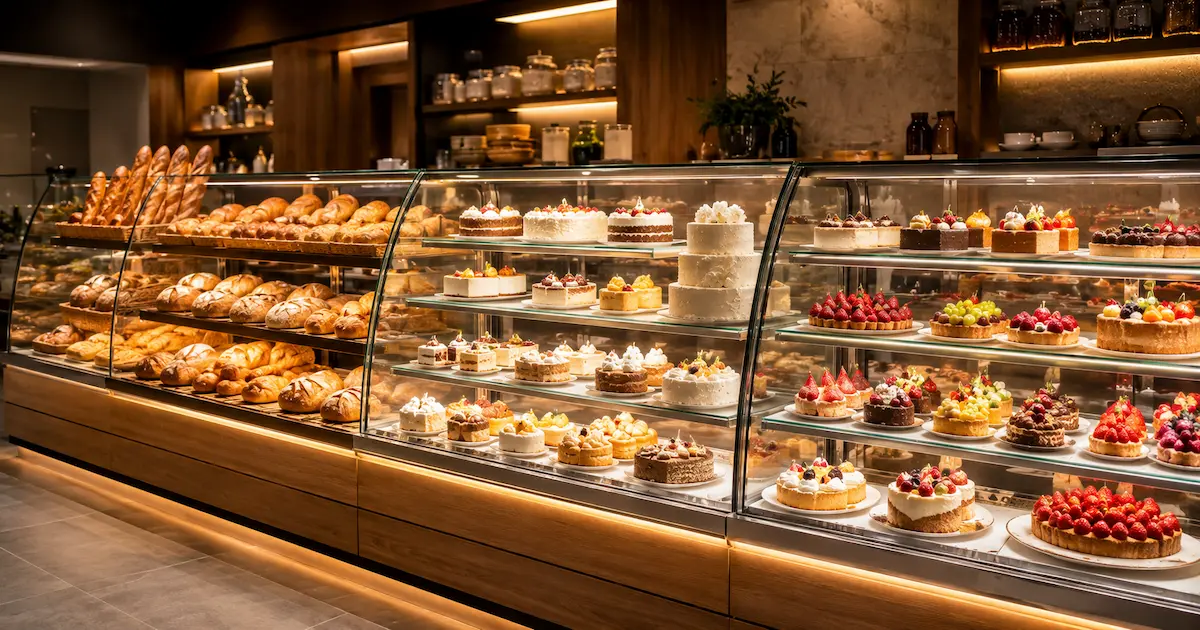
But there’s a catch. If a bakery uses mixed CCTs from different suppliers or different production batches, shelves can look uneven. One shelf may look warm and premium, while the next looks pale or gray. We once saw a chain bakery reject a full display retrofit because the top shelf was 3000K and the middle shelf measured closer to 3600K. The products were fine. The light made them look wrong.
In our lab tests using integrating spheres, we check actual CCT and color coordinates rather than trusting label data only. For chain stores, tighter color binning matters because customers compare displays across locations.
Pro Tip from the VST Technical Team: “For bakery projects, don’t select CCT only from a catalog photo. Ask for measured data and sample strips from the same LED bin planned for production.”
| Product Type | Best Visual Direction | Avoid This Mistake | Business Impact |
|---|---|---|---|
| Baguette, rolls | Warm, golden tone | Cool white over 4000K | Bread may look dry |
| Cheesecake | Neutral warm tone | Too yellow 2700K only | Cream may look aged |
| Fruit tart | High CRI neutral | Low R9 value | Red fruit looks dull |
| Chocolate | Warm directional light | Harsh cool light | Texture loses depth |
| Wedding cakes | Soft, even light | Visible LED dots | Premium look is reduced |
3. Why does CRI and R9 matter in bakery display lighting?
The color rendering of light sources describes how accurately illuminated objects appear compared with a natural or standard reference source, and CRI expresses that performance numerically. For bakery display, CRI 80 may pass a basic project spec, but CRI 90 or CRI 95 is usually the safer choice. The reason is simple: baked goods sell through color and texture.
R9 is the red rendering value. It affects strawberries, cherries, jam fillings, red velvet cake, and even warm brown crust. A strip can claim CRI 90 while still having weak R9 performance, so procurement teams should request full color data when the project is premium or repeated across many stores.
We often see installers struggle with complaints that sound subjective: “The cakes don’t look fresh,” or “The bread shelf feels cold.” Similar to LED strip lights for jewelry showcase applications, the root cause of a weak bakery presentation is often poor color rendering, glare, or optical placement rather than insufficient brightness. It is low color quality.
Common Myth: Higher wattage always means better display brightness.
Reality: Lumen efficiency, optical diffusion, mounting angle, and CRI decide the result. A 9.6W/m high-CRI strip inside a good aluminum profile can outperform a 14.4W/m low-efficiency strip that creates glare and heat.
| Metric | Recommended Level | Why It Matters for Bakery Displays |
|---|---|---|
| CRI Ra | 90+ | General color accuracy |
| R9 | 50+ minimum, 80+ preferred | Red fruit and warm pastry tones |
| SDCM | 3-step preferred | Batch-to-batch color match |
| Lumen output | Project dependent | Controls shelf brightness |
| Efficacy | Higher is better at same CRI | Less heat, lower power cost |
The following presentation from the Illuminating Engineering Society provides additional technical context on evaluating color quality and selecting light sources that reproduce products and materials accurately.
4. Should bakery displays use 12V or 24V LED strips?
Voltage choice affects wiring length, voltage drop, and service reliability. For short display modules, 12V can work well. For longer bakery shelves, 24V is usually more stable because it carries lower current for the same power. Lower current reduces voltage drop and helps maintain even brightness from one end to the other.
When we tested this against a standard 12V strip, a 5-meter run showed visible dimming at the far end under load. The 24V version performed better under the same wattage and cable size. That matters in long bread walls and multi-shelf bakery counters where inconsistent brightness creates a cheap appearance.
Field example: one contractor used 12V strips across long wooden bread shelves and powered each shelf from one side only. The customer later noticed that the right side of every shelf looked darker. The fix required extra wiring and labor that could have been avoided with 24V strip lights and dual-end feeding.
| Factor | 12V LED Strip | 24V LED Strip |
|---|---|---|
| Best use | Short shelves, small cases | Long shelves, chain store displays |
| Voltage drop | Higher risk | Lower risk |
| Cable current | Higher | Lower |
| Cutting interval | Often shorter | Often slightly longer |
| Driver availability | Very common | Very common in commercial work |
| Project risk | Acceptable for small runs | Better for longer runs |
5. Which LED strip type works best: SMD, COB, or high-density strip?
Bakery display projects often need smooth light, not just bright light. SMD strips are widely used and cost-effective. High-density SMD strips reduce visible dots. Understanding what a COB LED strip is helps explain why COB technology creates a continuous, dot-free light line that works well under glass shelves, near reflective stainless steel, and inside premium cake counters.
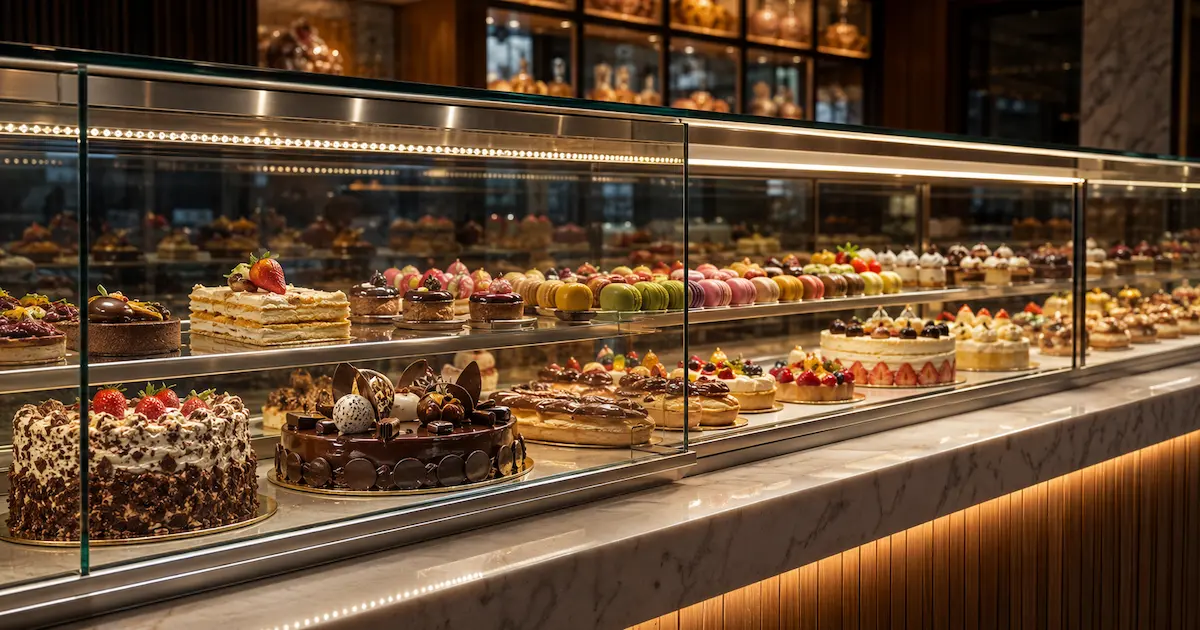
From our manufacturing floor perspective, the choice depends on viewing angle and mounting distance. As with LED strip lights for product display box projects, COB strips or properly diffused aluminum profiles are usually safer when customers can directly see the light source or its reflection in glass. If the strip is hidden behind a front lip and shines down onto bread, high-CRI SMD may be enough.
Three practical cases show the difference. A supermarket bakery bread rack can use 2835 SMD strips in aluminum profiles. A luxury cake counter with glass reflection often needs COB to avoid dot reflection. A refrigerated pastry case may use high-density SMD with silicone protection if moisture is present.
The real point is margin protection. Choosing the wrong type can lead to rework, wasted samples, and complaints that are hard to solve after installation.
| Strip Type | Strength | Weak Point | Best Bakery Use |
|---|---|---|---|
| Standard SMD | Good cost control | Possible dots | Hidden shelf lighting |
| High-density SMD | Better uniformity | More heat per meter | Bread and pastry racks |
| COB | Smooth line | Higher cost | Premium cake displays |
| Side-emitting strip | Tight spaces | Lower output options | Edge lighting in shelves |
| RGB/RGBW | Color scenes | Rarely needed for food | Branding accents only |
6. How should heat be controlled near bakery products?
Heat control affects food presentation, LED life, and warranty risk. Modern LED lighting runs cooler than halogen lamps, but LED strips still create heat at the PCB and LED junction. Applying the right solution to LED strip heat issues is essential because mounting the strip directly onto wood, acrylic, or painted metal without an effective thermal path can cause temperatures to rise quickly.
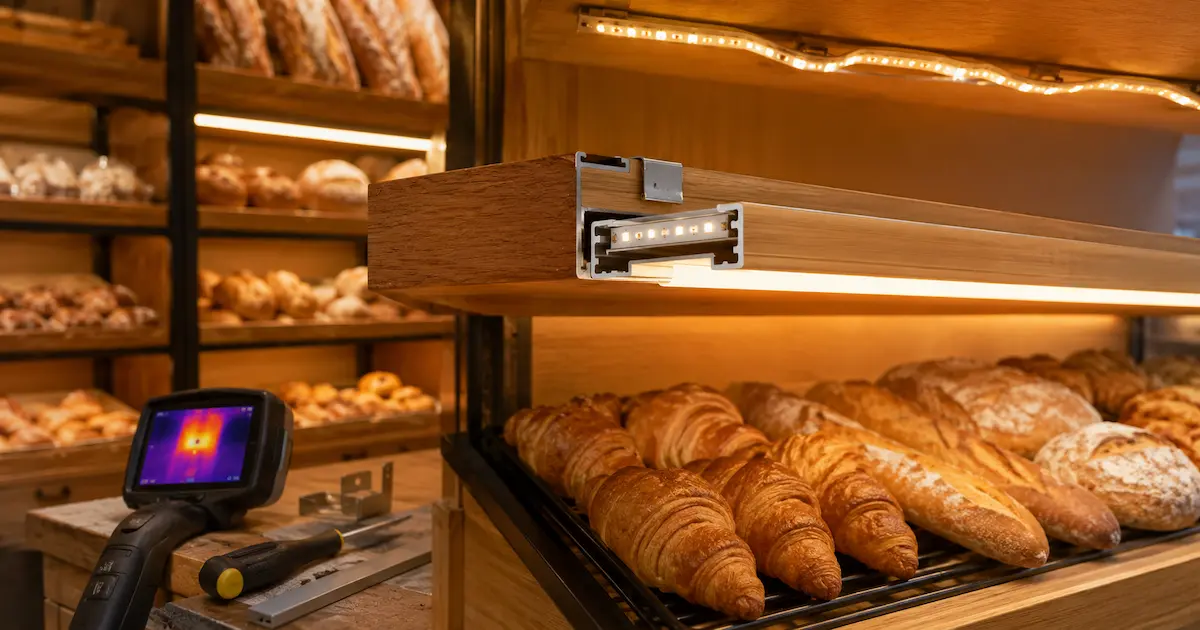
We use thermal imaging cameras to check the strip surface, profile temperature, and driver housing temperature during aging tests. The difference between bare tape mounting and aluminum profile mounting can be large, especially at 12W/m or above. Heat also weakens adhesive backing over time, which causes strips to sag inside displays.
A bakery case has special conditions. Warm bread shelves may trap heat under a wood canopy. Refrigerated cake cases create moisture and thermal cycling. Near ovens or proofing areas, ambient temperature can be higher than normal retail space.
Our Chief Engineer notes: “Heat dissipation is often ignored because the strip looks small. In practice, the aluminum profile is part of the electrical product, not just an accessory.”
| Wattage per Meter | Heat Risk Without Profile | Recommended Mounting |
|---|---|---|
| 4.8W/m | Low | Clean metal surface or slim profile |
| 9.6W/m | Medium | Aluminum profile recommended |
| 14.4W/m | High | Aluminum profile needed |
| 19.2W/m+ | Very high | Wider profile and thermal review |
7. What IP rating and protection are needed for bakery cases?
Bakery displays face crumbs, cleaning chemicals, steam, fingerprints, and sometimes condensation. Dry bread shelves may only need IP20 strips inside a covered aluminum profile. Refrigerated cake counters or humid pastry cases often need IP65 silicone coating or protected modules.
However, higher IP ratings are not always better for every bakery-display environment. A fully sealed strip can trap more heat, and silicone material can change light color slightly if low-grade materials are used. This is why IP selection should match the real environment, not a generic safety feeling.
For example, a dry baguette shelf behind a wood lip can use IP20 or IP33 if it is not exposed to cleaning spray. A cake display cleaned every night with wet cloths may need IP65. In combined bakery and LED strip lights for coffee shop environments, displays positioned near coffee-machine steam may require improved sealing around soldered leads, connectors, cable exits, and end caps.
Specifically, pay attention to cable exits, end caps, and solder joints. Many failures start there, not in the LED chips themselves. Transparent production photos and sample testing can reduce that risk before bulk orders.
| Environment | Suggested Protection | Notes |
|---|---|---|
| Dry bread shelf | IP20/IP33 | Use profile cover for dust control |
| Cake counter, dry | IP33/IP54 | Protect from wiping contact |
| Refrigerated case | IP65 | Check condensation path |
| Near coffee steam | IP65 | Seal wire exits carefully |
| Outdoor bakery kiosk | IP67 option | Review driver location too |
8. How do drivers, dimming, and controls affect display quality?
The driver is the part many people hide, but it decides flicker, dimming stability, electrical safety, and service life. For bakery display LED strip lights, constant voltage drivers are common, usually 12V or 24V. A proper LED profile driver calculation should include the total connected wattage, operating voltage, cable length, cabinet temperature, dimming method, and at least the required power headroom.
A 60W load should not run on a 60W driver in a warm cabinet. Use around 75W or higher, depending on driver specification and ventilation. If dimming is required, match the driver with the control method: PWM, 0-10V, DALI, TRIAC, or smart controller. Poor matching can create flicker or unstable low-end dimming.
In retail bakery projects, flicker can affect product videos, social media clips, and customer comfort. It may also cause complaints from staff working long shifts near the display.
We once saw a bakery chain mix dimmers from one supplier and drivers from another. The light worked at full power but flickered below 40%. The project needed driver replacement across several stores. That cost more than choosing matched components from the start.
| Control Need | Recommended Driver/Control | Risk if Mismatched |
|---|---|---|
| No dimming | Standard CV driver | Low risk if sized well |
| Manual dimming | PWM dimmer | Flicker if poor frequency |
| Building control | 0-10V or DALI | Compatibility checks needed |
| Warm ambience scenes | Tunable white system | More wiring and controller planning |
| Premium retail video | Low-flicker driver | Camera banding if ignored |
9. What installation details prevent callbacks?
Most bakery display lighting failures are not dramatic. They are small details repeated many times: weak adhesive, wrong cable size, overloaded driver, poor solder joint, no strain relief, or no plan for future service. These details directly affect profit because one callback can consume the margin from several shelves.
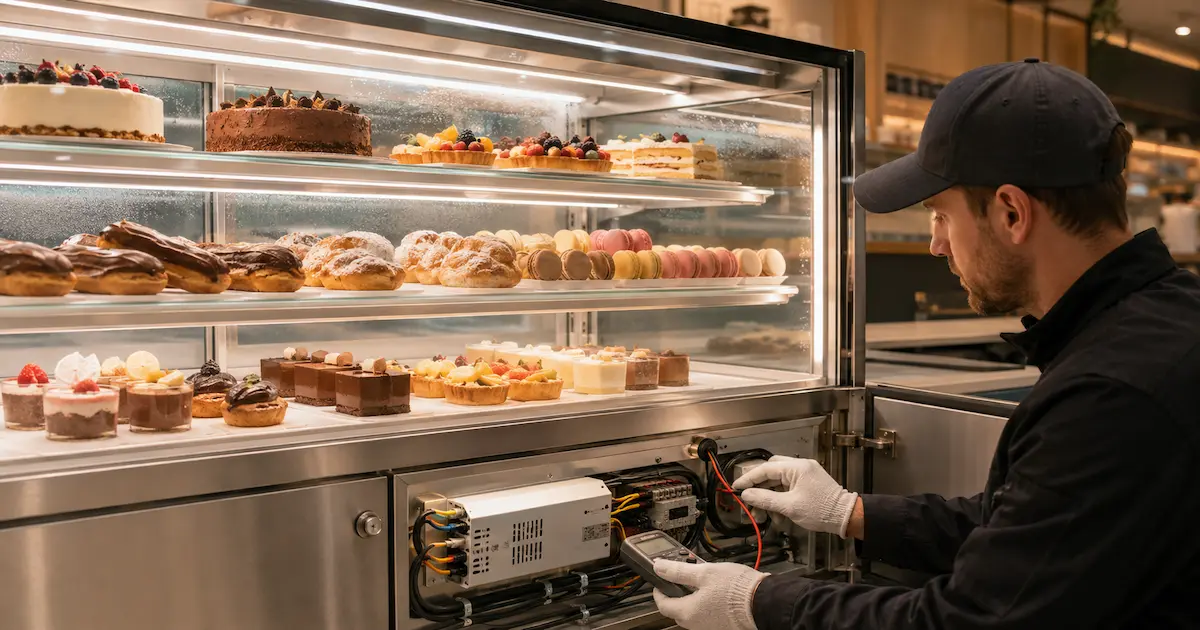
We often see installers struggle with tight corners in cake counters. Pre-soldered leads, custom cable lengths, and labeled connectors can save hours on site. This is especially useful for contractors working at night after a bakery closes.
Before installation, test every strip section for CCT, polarity, and brightness. Clean mounting surfaces with alcohol. Use aluminum profiles with mechanical clips rather than relying only on adhesive. A professional LED strip light wiring plan should use dual-end feeds or shorter parallel circuits where necessary to prevent voltage drop, uneven brightness, and overheated cables. Keep drivers away from heat and moisture.
Here is a quick reference checklist for field teams and project managers.
| Installation Step | Check Point | Why It Protects the Project |
|---|---|---|
| Measure shelf length | Confirm cut points | Avoid gaps and waste |
| Confirm voltage | 12V or 24V | Prevent driver mismatch |
| Calculate wattage | Add 20% driver headroom | Reduce overheating risk |
| Clean surface | Remove dust and oil | Better tape adhesion |
| Use profile clips | Mechanical support | Prevent sagging strips |
| Test before closing case | Check polarity and color | Avoid rework |
| Label circuits | Shelf and driver ID | Faster future service |
10. How should buyers specify led strip lights for bakery display?
A clear specification sheet prevents confusion between buyer, factory, contractor, and end customer. It should list voltage, wattage per meter, CCT, CRI, R9 target, IP rating, strip width, LED density, cut length, cable type, connector type, driver model, profile model, cover type, and packing method.
For repeat projects, also request batch control data and aging test records. In our aging racks, we run samples under load to check early failure risks and color shift. That does not make a product impossible to fail, but it reduces surprises before shipment.
A buyer for a bakery display manufacturer may need pre-cut lengths with 300 mm leads. A lighting distributor may prefer full reels and separate profiles. A contractor may need labeled kits per store. These are different supply formats, so the specification should match the business model.
Here’s the practical buyer checklist:
- Ask for measured CCT and CRI data
- Confirm SDCM tolerance for future orders
- Match strip wattage with profile heat capacity
- Review driver certification for your market
- Request samples built with the same materials planned for production
- Define packaging to avoid transport damage
| Specification Item | Recommended Detail | Commercial Benefit |
|---|---|---|
| CCT and bin | 3000K, 3-step SDCM | Consistent store appearance |
| CRI/R9 | CRI 90+, R9 stated | Better food color |
| Voltage | 24V for long shelves | Less voltage drop |
| Profile | Aluminum with diffuser | Lower heat and smoother light |
| Cable | Pre-soldered, labeled | Faster installation |
| Certification | CE, RoHS, UL/CB as needed | Easier local approval |
Conclusion
Led strip lights for bakery display should be selected as a full system: LED strip, profile, diffuser, driver, wiring, protection, and installation method. The best result comes from matching CCT, CRI, voltage, heat control, and IP rating to the real display environment. If you are unsure about voltage drop, driver sizing, or custom shelf lengths, send your drawings to our engineering team. We’ll review the layout manually and help you reduce project risk before production.
FAQ
Q1: What are led strip lights for bakery display?
They are low-voltage linear LED lights designed for bread shelves, cake counters, pastry cases, and refrigerated displays. They help show product color, texture, and freshness while fitting into narrow spaces.
Q2: What color temperature is best for bakery display lighting?
For bread, 2700K to 3000K usually works best. For cakes and pastries, 3000K to 3500K gives a clean but still warm appearance. Always test samples with real products before bulk order.
Q3: Is CRI 90 needed for bakery LED strip lights?
For commercial bakery displays, CRI 90 is strongly recommended. It gives better color accuracy for fruit, cream, chocolate, and crust. For premium displays, review R9 data too.
Q4: Are 24V LED strips better than 12V for bakery shelves?
For longer shelves, 24V is usually better because it reduces voltage drop and keeps brightness more even. Short display sections can still use 12V if wiring and driver sizing are correct.
Q5: Do bakery display LED strips need aluminum profiles?
Yes, in most professional projects. Aluminum profiles improve heat transfer, protect the strip, hold the diffuser, and reduce visible LED dots. They also make maintenance cleaner and more predictable.
