
Led strip lights for supermarket shelving are linear LED systems installed on shelf fronts, uprights, or under-shelf channels to make products easier to see, reduce dark zones, and support consistent merchandising across aisles, chillers, end caps, and checkout areas.
The problem is simple: many shelf lighting projects look fine during sampling but fail in daily store operation. Color shifts appear. Drivers hum. Adhesive fails. Installers lose time cutting and soldering on site. The cost is not only replacement parts. It is callbacks, store disruption, margin loss, and a damaged relationship with the retailer.
The solution is to specify shelf lighting as a system: LED strip, aluminum profile, diffuser, driver, wiring plan, mounting method, and testing standard. In our lab tests using integrating spheres, aging racks, and thermal imaging cameras, we see how small specification choices affect brightness, heat, and lifespan in real store conditions. A systems approach also helps procurement teams compare like-for-like offers rather than being swayed by a single low-cost component.
1. Why do supermarket shelves need dedicated LED strip lighting?
Supermarket shelving creates shadows. Overhead fixtures light the aisle, but products on lower shelves, deep gondolas, and vertical displays often sit in dark pockets. Properly planned under-shelf LED strip lighting solves that visibility gap by placing consistent illumination directly at product level.
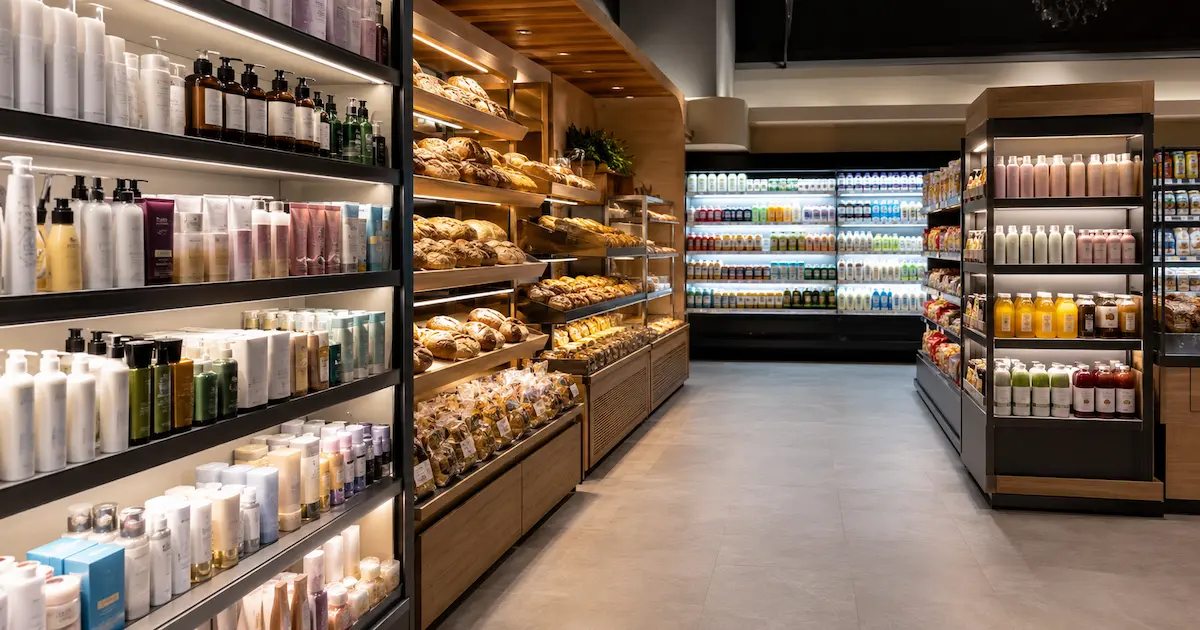
Understanding how to approach choosing lighting for retail spaces shows why shelf lighting is not only about making goods look brighter but also about product visibility, navigation, and brand presentation. It affects buying behavior, shelf navigation, and the way a retailer presents brand value. A dairy shelf needs clean, cool light. A bakery shelf may need warm, soft light. A cosmetics gondola needs high color rendering because packaging and skin-tone samples must look accurate.
We often see installers struggle with projects where only ceiling lighting was planned. The client later asks why the bottom rows look dull. Retrofitting after the shelves are stocked is slower, messier, and more expensive. Early coordination with merchandising and electrical teams avoids costly rework and keeps promotional programs on schedule.
Common shelf lighting use cases include:
- Fresh food displays with CRI 90+ strips
- Beverage shelves with cool white linear lighting
- Health and beauty aisles with slim aluminum profiles
- LED strip lights for checkout counter impulse racks using compact 24V systems for brighter product visibility and cleaner installation
- Promotional end caps needing fast installation
| Supermarket Area | Lighting Goal | Suggested Strip Type | Typical CCT |
|---|---|---|---|
| Dairy shelves | Clean product appearance | 24V SMD strip in profile | 4000K–5000K |
| Bakery racks | Warm and fresh feeling | High CRI warm strip | 2700K–3000K |
| Cosmetics shelves | Accurate packaging color | CRI 90+ strip | 3500K–4000K |
| Beverage gondolas | Bright label visibility | High-efficiency strip | 5000K–6500K |
| End caps | Promotional focus | Easy-cut strip system | 3000K–5000K |
2. What specifications matter most for supermarket shelf lighting?
The main specifications are voltage, wattage per meter, lumen output, color temperature, CRI, LED density, PCB width, IP rating, and dimming method. Each affects cost, installation time, and long-term reliability.
A common mistake is comparing only watts. That is risky. Two strips rated at 12W/m can deliver very different lumen output due to LED chip efficiency, PCB copper thickness, and thermal design. The National Institute of Standards and Technology’s overview of photometry explains how visible light quantities such as luminous flux, luminous intensity, illuminance, color temperature, and chromaticity are measured.
For led strip lights for supermarket shelving, I recommend starting with the shelf depth and product type. Narrow snack racks and other LED strip lights for display shelves applications may need moderate brightness, while deeper gondolas and chilled displays usually require more delivered lumen output. Deep freezer shelves need more output because glass doors and colder ambient conditions change the visual result. Also consider viewing distance and shopper sightlines — a strip that looks sufficient at 50cm may feel weak at 1.5m.
Use these baseline ranges:
- ● 6–10W/m for accent and light-duty shelf displays
- ● 10–14W/m for standard supermarket shelves
- ● 14–18W/m for high brightness display areas
- ● CRI 80+ for general packaged goods
- ● CRI 90+ for fresh food, cosmetics, and premium retail
| Specification | Recommended Range | Why It Matters |
|---|---|---|
| Voltage | 24V preferred | Lower voltage drop on long shelf runs |
| Wattage | 8–16W/m | Balances brightness and heat |
| CRI | 80–95 | Better color accuracy for goods |
| LED Density | 120–240 LEDs/m | Reduces visible dots with diffusers |
| PCB Width | 8–12mm | Matches slim profiles and heat needs |
| CCT Tolerance | 3-step or 5-step SDCM | Reduces visible batch mismatch |
The following educational video provides a practical overview of the main factors to consider when selecting LED strip lighting for professional applications such as supermarket shelf illumination.
3. Should you choose 12V or 24V LED strips for shelves?
For most supermarket shelves, 24V is the safer commercial choice. It handles longer runs with less voltage drop, needs fewer power injection points, and reduces the chance of uneven brightness across gondolas.
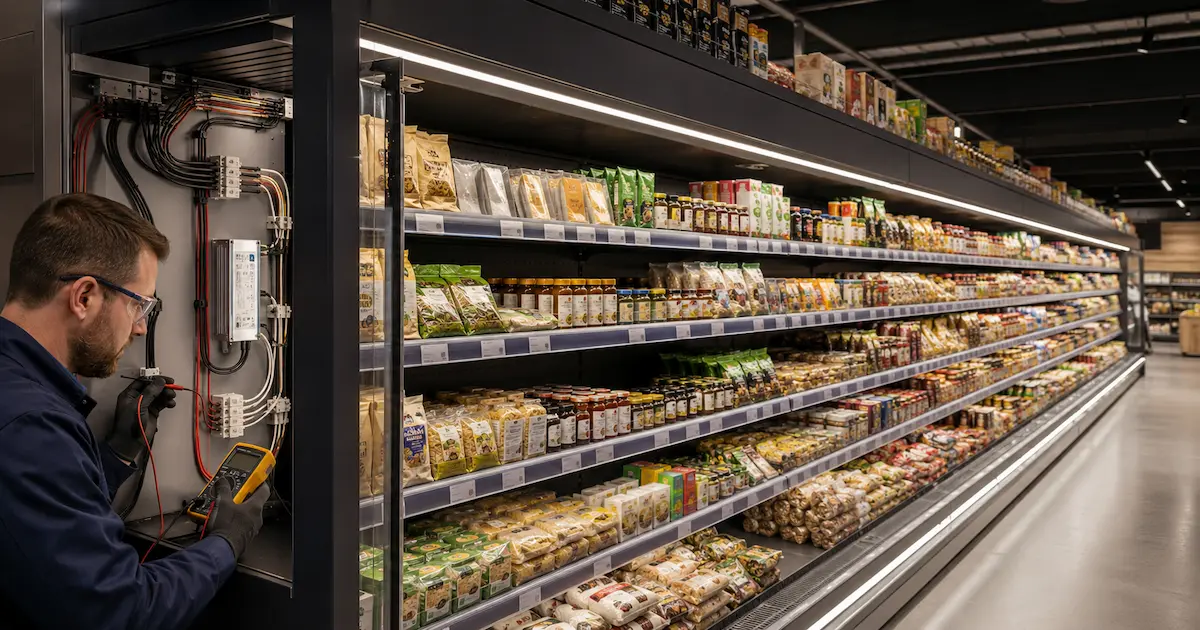
When we tested this against a standard 12V strip, the difference became visible after longer runs. On a 10-meter shelf layout, the end of a 12V run often looked dimmer unless we fed power from both ends. A 24V strip performed better with the same cable layout.
That said, 12V still has a place. It works well for short displays, small branded racks, compact furniture, and battery-linked systems. But for supermarket chains, 24V usually reduces labor and service calls.
What’s the real story? The strip voltage is not about brightness by itself. It is about power distribution, which is why a professional LED strip light wiring plan should define cable size, feed locations, run length, and circuit loading before installation. Poor power distribution leads to inconsistent shelf presentation, and inconsistent presentation leads to retailer complaints.
| Feature | 12V LED Strip | 24V LED Strip |
|---|---|---|
| Best use | Short displays, small racks | Long supermarket shelves |
| Voltage drop | Higher | Lower |
| Cable load | Higher current | Lower current |
| Power injection | More frequent | Less frequent |
| Installer time | More wiring points | Cleaner wiring plan |
| Project risk | Higher on long runs | Lower on long runs |
Pro Tip from the VST Technical Team: “If one shelf row exceeds 5 meters, review voltage drop before approval. Saving a small amount on strip price can create larger labor cost later.”
4. Which color temperature and CRI should you specify?
Color temperature shapes how shoppers perceive products. CRI controls how accurately colors appear. The U.S. Department of Energy’s guide to lighting principles and terms provides a neutral explanation of lumens, efficacy, color temperature, color rendering, glare, and accent lighting. Meat that looks gray, bread that looks pale, or cosmetics that look wrong can hurt product confidence.
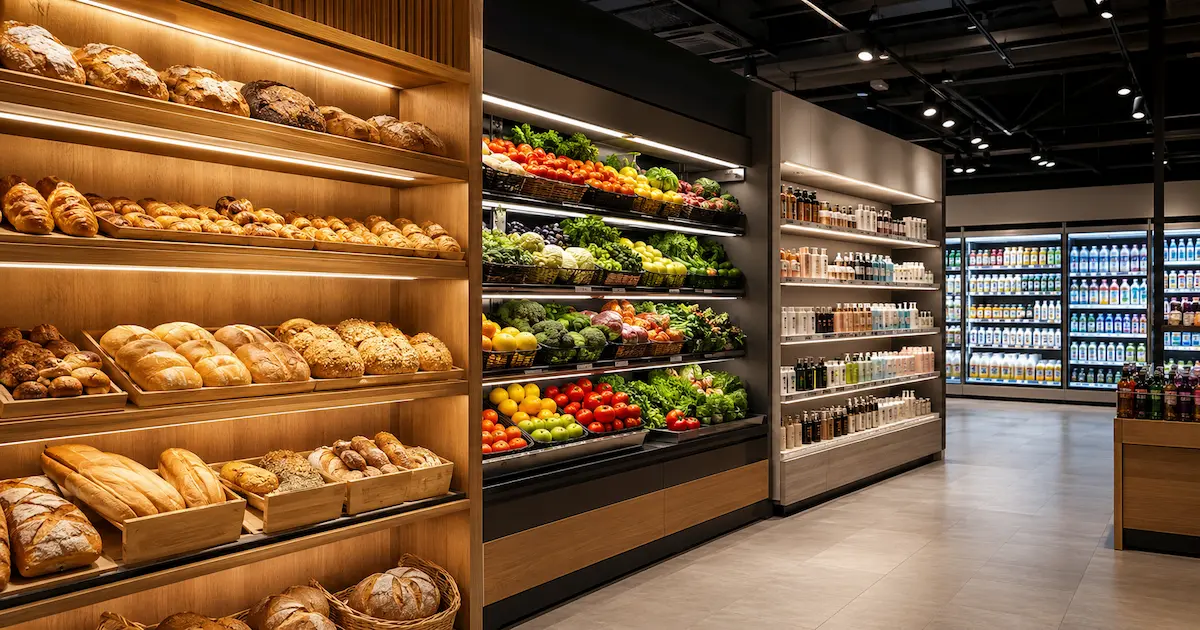
For general packaged goods, 4000K is a balanced choice. It feels clean without looking too cold. For fresh produce, 3500K–4000K with high CRI often works well. For frozen foods and beverages, 5000K can make labels and packaging look crisp.
Common Myth: Higher wattage always means better brightness. Reality: brightness depends on lumen efficiency, optical design, diffuser loss, and mounting surface temperature. A 12W/m strip at 120lm/W can outperform a 16W/m strip at 80lm/W while producing less heat.
We explain this because ignoring color consistency leads to visible mismatch across aisles. A retailer may reject a project if one shelf row looks greenish and another looks pinkish. Use the same binning standard and ask for SDCM data before bulk order. It’s also helpful to request sample strips from the same production batch to check uniformity across runs.
| Product Category | Suggested CCT | Suggested CRI | Visual Purpose |
|---|---|---|---|
| Bread and bakery | 2700K–3000K | 90+ | Warm, fresh appearance |
| Fruit and vegetables | 3500K–4000K | 90+ | Natural color rendering |
| Dairy and chilled goods | 4000K–5000K | 80+ | Clean shelf presentation |
| Cosmetics | 3500K–4000K | 90–95 | Accurate color judgment |
| Beverages | 5000K–6500K | 80+ | Bright label contrast |
5. How do profiles, diffusers, and heat control affect lifespan?
LED strips dislike trapped heat. Supermarket shelves often run 12 to 18 hours per day, so thermal control directly affects lumen maintenance and failure rate. Understanding why LED strips need aluminium profiles is important because these profiles are not merely decorative accessories; they spread heat, protect the PCB, improve alignment, and support easier replacement. They help move heat away from the PCB and protect the strip from physical contact.
From our manufacturing floor perspective, many strip failures start with poor mounting. A high-power strip stuck directly to painted steel may work, but adhesive can loosen if the surface has oil, dust, or uneven coating. A profile gives cleaner alignment, better heat spreading, and faster replacement.
Diffusers matter too. A milky diffuser reduces dot visibility but can reduce light output by 10–35%, depending on material and thickness. Clear covers keep more brightness but show LED points. For premium supermarket shelving, COB strips or high-density SMD strips paired with opal diffusers give a smooth line.
Use profiles when:
- ● The strip runs more than 10W/m
- ● Shelves operate long daily hours
- ● Staff may touch or clean near the strip
- ● The retailer wants a clean linear look
- ● Replacement access matters
| Profile Choice | Heat Performance | Visual Effect | Best Use |
|---|---|---|---|
| Bare strip | Low | LED dots visible | Low-cost short racks |
| Slim aluminum profile | Medium | Cleaner line | Standard shelves |
| Deep profile with diffuser | High | Smooth line | Premium gondolas |
| Recessed profile | High | Flush finish | Custom furniture shelves |
| Angled profile | Medium-high | Forward product focus | Under-shelf lighting |
6. What IP rating is needed for dry aisles, chillers, and freezers?
The International Electrotechnical Commission’s guide to IP ratings explains how electrical enclosures are classified according to their protection against solids, dust, and water ingress. Dry aisles usually use IP20 strips inside profiles. Chillers, fresh-food counters, and freezer shelves need stronger protection, and following proper methods for wiring waterproof LED strip lights helps protect solder joints, cut ends, connectors, and copper pads from condensation.
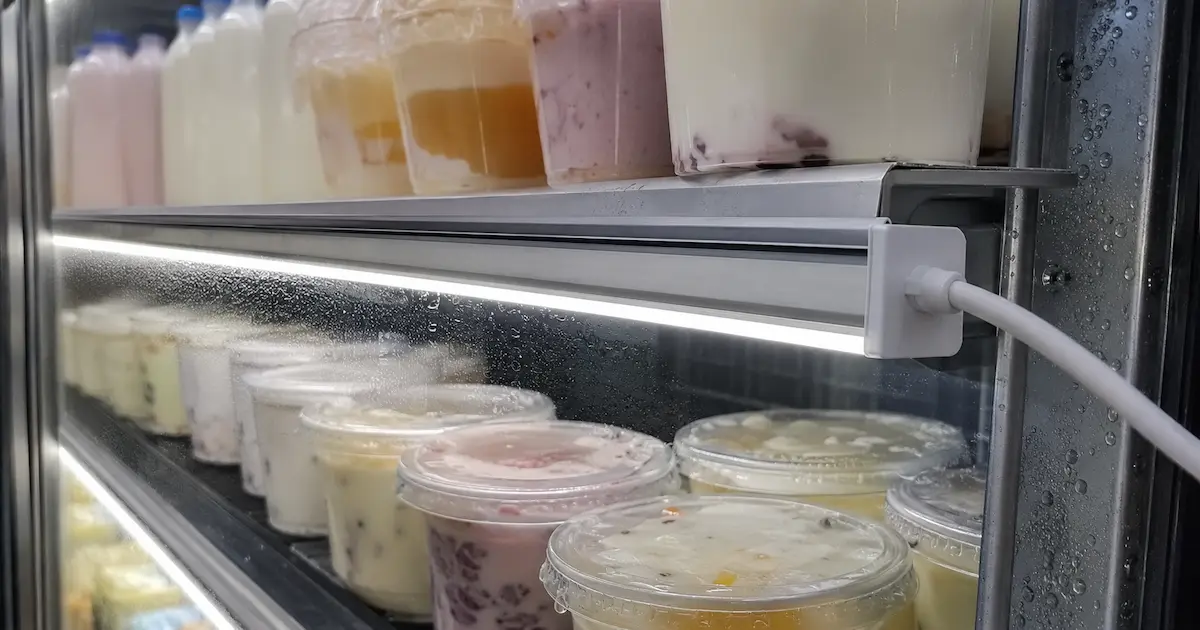
For led strip lights for supermarket shelving in refrigerated areas, don’t treat silicone coating as a cure-all. Silicone helps against moisture, but trapped condensation, poor end sealing, and repeated temperature cycling can still create failure points. We once saw a chiller project fail because the strip was IP65 but the cut ends were sealed with weak glue. Water entered from the end cap, not the front surface.
IP67 or IP68 can be useful in damp zones, but thicker coating changes heat dissipation and flexibility. That means you may need lower wattage or better mounting. For freezer applications, check the working temperature of the strip, adhesive, wire, connector, and driver.
| IP Rating | Protection Level | Shelf Application | Notes |
|---|---|---|---|
| IP20 | No moisture protection | Dry packaged goods aisles | Use inside profile |
| IP54 | Dust and light splash | Semi-protected racks | Check cleaning routine |
| IP65 | Silicone coated splash resistance | Chillers and fresh counters | Seal all cut ends |
| IP67 | Temporary immersion resistance | Wet service areas | Watch heat buildup |
| IP68 | High moisture exposure | Special sealed systems | Needs project review |
7. How should drivers and dimming be planned?
A shelf lighting system is only as stable as its power supply. Drivers must match total load, input voltage, safety rules, and dimming needs. A driver running near full load for long store hours will run hot and may fail early.
A practical rule is to load drivers at about 80% of rated capacity. For example, if the shelf system needs 80W, use a 100W driver rather than an 80W driver. This gives thermal margin and reduces stress.
Dimming can reduce energy use and give retailers control across dayparts. Common options include 0–10V, PWM, Triac, and DALI, a standardized digital lighting-control protocol suited to scalable commercial lighting networks, although every strip, driver, and controller combination still requires compatibility testing. Poor dimming creates flicker, noise, or uneven response across shelf rows.
We often see installers struggle with hidden driver placement. If drivers are buried behind fixed shelving, service becomes painful. Place drivers in accessible channels, service cabinets, or top sections where technicians can reach them without unloading half the aisle. Label driver locations and circuit IDs to speed troubleshooting and avoid accidental disconnection during store refits.
| Planning Item | Recommended Practice | Business Impact |
|---|---|---|
| Driver Load | Use around 80% of capacity | Lower heat and longer life |
| Power Factor | PF 0.9+ for commercial use | Cleaner electrical performance |
| Dimming | Match driver and control protocol | Less flicker and fewer complaints |
| Access | Keep drivers serviceable | Faster maintenance |
| Certification | CE, RoHS, UL, CB where needed | Easier local approval |
8. What installation details reduce callbacks?
Installation details decide whether the project looks professional after six months. The strip may be good, but poor surface prep, weak connectors, undersized cables, and messy routing can still create failures.
Before mounting led strip lights for supermarket shelving, clean the surface with a suitable alcohol-based cleaner. Remove dust, oil, and powder coating residue. For long runs, don’t rely on adhesive alone. Use aluminum profiles, clips, or mechanical fixing.
Field example: a cosmetics aisle used adhesive-only strips on painted metal shelves. After summer store temperatures rose, several strips sagged. The product was blamed, but the root cause was mounting method. A clipped profile solved the issue.
Another field example involved push connectors in a high-traffic aisle. Shelf movement loosened several connections. Pre-soldered leads with strain relief would have saved labor and avoided callbacks.
Small installation details add up: use cable ties and adhesive channels to keep wiring tidy, label both ends of each run, and include a short installation guide with each batch of profiles. These modest steps reduce errors and speed handover to store operations.
| Installation Checklist | Pass Criteria | Risk if Ignored |
|---|---|---|
| Surface cleaned | No dust, oil, or moisture | Adhesive failure |
| Cable sized correctly | Current rating fits load | Heat and voltage drop |
| Power injected as planned | Even brightness end to end | Dim shelf ends |
| Cut ends sealed | No exposed copper in damp zones | Corrosion failure |
| Driver accessible | Service without shelf removal | Long repair time |
| Polarity checked | Correct + and – connection | Non-working segments |
9. How do you test samples before bulk shelf lighting orders?
Sample testing protects margin. A sample should not only light up on a desk. It should be checked under realistic operating hours, mounting conditions, diffuser type, and cable length.
In our lab tests using integrating spheres, we measure lumen output, CCT, CRI, and power draw. Then we run aging tests to see early failures. Thermal imaging helps show hot spots on PCB traces, resistors, solder joints, and profiles.
For a supermarket project, ask for sample data before bulk approval. Check the strip in the actual shelf profile and diffuser. Measure brightness at the start and end of the run. Confirm that the light line is smooth from normal shopper distance, not just from a close-up photo.
A simple sample test plan can include:
- ● 24-hour burn-in before visual review
- ● 48–72-hour thermal check for high-output strips
- ● CCT comparison across multiple samples
- ● Voltage drop check on the longest planned run
- ● Cleaning resistance check for exposed areas
| Test Item | Tool or Method | Acceptable Result |
|---|---|---|
| Lumen output | Integrating sphere | Matches datasheet tolerance |
| CCT and CRI | Photometric test | Within approved bin range |
| Surface temperature | Thermal camera | Within material limit |
| Aging test | Powered rack | No flicker or dead sections |
| Voltage drop | Long-run mockup | No visible dimming |
10. How do you control cost without risking store reliability?
Cost control does not mean buying the cheapest strip. It means choosing the right system for the shelf, the store schedule, and the maintenance model. Cheap strips can erase margin through rework, delayed openings, and client complaints.
Start with a tiered specification. Use standard CRI 80 strips for packaged goods, CRI 90 strips for fresh or cosmetic areas, and higher protection only where moisture demands it. Don’t pay for IP67 in a dry cereal aisle. Don’t use IP20 in a chiller.
From our manufacturing floor perspective, customization often saves money. Pre-cut lengths, pre-soldered leads, labeled cables, and matched drivers reduce installer time. On one retail fixture project, pre-soldered 300mm leads helped the contractor avoid on-site soldering across hundreds of shelves. The strip price was slightly higher, but labor savings were much higher.
Also review packaging. Shelf lighting parts can get damaged during transport if profiles and diffusers are packed poorly. Broken diffusers delay installation and create emergency shipments.
| Cost Control Method | Where It Helps | Risk Level |
|---|---|---|
| Use 24V for long rows | Less wiring labor | Low |
| Match CRI to product type | Avoid overspecification | Low |
| Use profiles only where needed | Controls hardware cost | Medium |
| Pre-solder leads | Faster installation | Low |
| Avoid weak connectors | Fewer callbacks | Low |
| Test before bulk order | Reduces rejection risk | Low |
Conclusion
Led strip lights for supermarket shelving work best when specified as a full system, not a loose component. Voltage, CRI, CCT, profiles, IP rating, drivers, installation, and testing all affect the retailer’s visual result and your margin. If you’re unsure about voltage drop, driver loading, or profile selection for a store layout, send our engineering team your shelf drawings. We’ll calculate it manually and help you avoid problems before installation. We can also provide a short checklist for onsite teams to verify correct mounting and power distribution during first-fit installs.
FAQ
Q1: What are led strip lights for supermarket shelving?
They are low-voltage linear LED lighting systems mounted on or under supermarket shelves to improve product visibility. A complete setup usually includes LED strip, profile, diffuser, wiring, driver, and mounting accessories.
Q2: Are 12V or 24V LED strips better for supermarket shelves?
For most supermarket shelving, 24V is better because it reduces voltage drop on longer runs. 12V can work for small branded racks or short displays, but it needs more power injection on long shelf rows.
Q3: What color temperature should I use for supermarket shelf lighting?
Use 2700K–3000K for bakery, 3500K–4000K for produce and cosmetics, 4000K–5000K for dairy, and 5000K–6500K for beverages. Match CCT to the product category and store design.
Q4: Do supermarket shelf LED strips need aluminum profiles?
Most commercial shelf lighting projects benefit from aluminum profiles. They improve heat dissipation, protect the strip, create straighter installation, and make replacement easier.
Q5: How can I reduce failures in shelf LED strip projects?
Choose the right voltage, use suitable IP protection, size drivers with headroom, seal cut ends in damp areas, test samples under real conditions, and use mechanical fixing rather than adhesive alone for demanding shelves.
