
Commercial signage demands reliable, bright, and cost-effective lighting solutions that can operate continuously while maintaining consistent performance. This LED Strip Lights for Commercial Signage Guide explains what many business owners overlook: choosing the wrong LED strip lights can lead to premature failures, uneven illumination, and costly replacements that ultimately harm brand visibility and credibility.
LED strip lights for commercial signage offer superior energy efficiency, extended lifespan, and flexible installation options compared to traditional lighting methods. But there’s more to consider. This comprehensive guide covers everything from technical specifications to installation best practices, helping you make informed decisions for your commercial lighting projects.
1. What Makes LED Strip Lights Ideal for Commercial Signage?

Commercial signage requires lighting solutions that perform reliably under demanding conditions while maintaining visual appeal throughout extended operating hours. The truth about commercial applications: standard residential LED strips often fail within months when subjected to commercial use patterns.
LED strip lights designed for commercial signage feature enhanced thermal management systems, higher-grade components, and robust construction materials. These strips typically operate at 24V systems rather than 12V, providing better voltage stability across longer runs without significant voltage drop.
Enhanced Durability Features
Commercial-grade LED strips incorporate several durability enhancements that residential versions lack. Silicone coating protects against moisture, dust, and temperature fluctuations common in outdoor signage applications. Metal backing channels provide superior heat dissipation, preventing thermal stress that causes premature LED failure.
Consistent Color Temperature
Color consistency becomes critical when multiple LED strips illuminate large signage installations. Here’s where quality matters most: premium LED strips maintain color temperature within 3-step MacAdam ellipses, ensuring uniform appearance across entire installations. Cheaper alternatives can show noticeable color variations that appear unprofessional.
Extended Operating Life
Commercial LED strips rated for 50,000+ hours operation significantly reduce maintenance costs compared to traditional lighting. The bottom line: quality LED strips can operate continuously for over 5 years before requiring replacement, making them ideal for always-on commercial signage applications.
| Feature | Commercial Grade | Standard Grade |
|---|---|---|
| Operating Life | 50,000+ hours | 25,000 hours |
| Voltage Rating | 24V | 12V |
| Color Consistency | ±3 SDCM | ±7 SDCM |
| IP Rating | IP65/IP67 | IP20/IP44 |
| Operating Temperature | -20°C to +60°C | 0°C to +40°C |
2. How Do Different LED Strip Types Perform in Signage Applications?

Choosing appropriate LED strip types significantly impacts both initial costs and long-term performance in commercial signage installations. What most installers overlook: matching LED characteristics to specific signage requirements prevents common performance issues.
SMD (Surface Mount Device) LEDs represent the most common technology in commercial strip lights, with 2835, 3528, and 5050 configurations offering different brightness and power characteristics. Each type serves specific applications based on spacing requirements, brightness needs, and thermal constraints.
SMD 2835 Configuration
SMD 2835 LEDs provide excellent efficiency ratings, typically achieving 160-180 lumens per watt in quality implementations. These compact chips allow high-density configurations, making them suitable for applications requiring smooth, continuous illumination without visible hotspots.
The performance advantage: 2835 chips generate less heat per lumen compared to larger configurations, allowing closer spacing without thermal issues. This characteristic makes them ideal for enclosed signage applications where heat dissipation may be limited.
SMD 5050 High-Output Options
SMD 5050 LEDs contain three chips per package, providing higher output per installation point but generating more heat. These strips work well for applications requiring maximum brightness with fewer installation points, such as large outdoor signage visible from significant distances.
COB (Chip-on-Board) Technology
COB LED strips offer seamless light output without visible individual LED points, creating smooth, uniform illumination ideal for premium signage applications. Here’s the trade-off: COB strips typically cost 30-50% more than equivalent SMD strips but provide superior visual quality.
| LED Type | Lumens/Watt | Heat Generation | Cost Factor | Best Application |
|---|---|---|---|---|
| SMD 2835 | 160-180 | Low | 1.0x | General signage |
| SMD 5050 | 120-140 | Medium | 1.2x | High-brightness needs |
| COB | 140-160 | Medium | 1.5x | Premium applications |
| High-CRI | 120-140 | Medium | 1.3x | Color-critical displays |
3. What Power Requirements Should You Plan for Commercial Installations?
Power planning forms the foundation of successful commercial LED signage installations, affecting both initial infrastructure costs and ongoing operational expenses. The reality check: inadequate power planning leads to voltage drops, reduced LED lifespan, and potential safety hazards.
Commercial LED strip installations typically require 24V DC power systems to minimize voltage drop across longer runs common in large signage applications. Power consumption calculations must account for total strip length, LED density, and desired brightness levels while including safety margins for reliable operation.
Power Consumption Calculations
Accurate power calculations prevent oversized power supplies that waste energy and undersized units that cause performance issues. Calculate total power by multiplying strip wattage per meter by total installation length, then add 20% safety margin for reliable operation.
The critical factor: ambient temperature affects power consumption, with higher temperatures increasing current draw by 10-15% compared to rated specifications. Factor this increase into calculations for outdoor installations or enclosed signage with limited ventilation.
Power Supply Sizing
Commercial installations benefit from multiple smaller power supplies rather than single large units. This approach provides redundancy, easier maintenance access, and better load distribution across the installation.
Voltage Drop Considerations
Voltage drop becomes significant in runs exceeding 5 meters, causing brightness variations and color shifting toward warmer temperatures. Here’s the solution: use 24V systems with appropriate wire gauges or implement power injection points every 5-7 meters to maintain consistent performance.
| Strip Length | Wire Gauge (AWG) | Voltage Drop (24V) | Brightness Loss |
|---|---|---|---|
| 0-3 meters | 18 AWG | <1V | <5% |
| 3-5 meters | 16 AWG | <1.5V | <8% |
| 5-10 meters | 14 AWG | <2V | <12% |
| >10 meters | Power injection required | <1V | <5% |
4. How Should You Approach Installation Planning and Design?

Proper installation planning prevents common problems that plague commercial LED signage projects while ensuring optimal performance and longevity. What separates successful installations: thorough planning that addresses thermal management, mounting methods, and maintenance accessibility from the design phase.
Installation design must consider environmental factors including temperature extremes, moisture exposure, vibration, and UV radiation that affect LED strip performance and lifespan. Proper planning also addresses future maintenance requirements and potential expansion needs.
Thermal Management Strategies
Heat management represents the most critical factor affecting LED strip lifespan in commercial applications. The physics reality: every 10°C temperature increase reduces LED lifespan by approximately 50%, making thermal design crucial for long-term reliability.
Aluminum channels provide excellent heat dissipation while protecting LED strips from physical damage and environmental exposure. Channel selection should match LED strip width and provide adequate thermal mass for heat dissipation under maximum load conditions.
Mounting and Support Systems
Commercial installations require robust mounting systems that maintain LED strip positioning under wind loads, thermal expansion, and vibration. Flexible mounting allows thermal expansion without creating mechanical stress that can damage solder joints or LED chips.
Environmental Protection
Outdoor signage installations demand IP65 or higher protection ratings to prevent moisture ingress and corrosion. The installation detail that matters: proper sealing at connection points and cable entries prevents moisture problems that cause premature failures.
Maintenance Accessibility
Design installations with maintenance accessibility in mind, providing safe access to power supplies, controllers, and LED strips for routine maintenance and eventual replacement. Plan for lifting equipment access or permanent maintenance platforms for elevated installations.
| Installation Factor | Indoor Rating | Outdoor Rating | Critical Considerations |
|---|---|---|---|
| IP Protection | IP40 minimum | IP65 minimum | Connection sealing |
| Operating Temp | 0°C to +40°C | -20°C to +60°C | Thermal management |
| UV Resistance | Not required | UV-rated materials | Material degradation |
| Wind Loading | Minimal | Structural analysis | Mounting strength |
5. Which Control Systems Work Best for Commercial Signage?
Control systems determine operational flexibility, energy efficiency, and maintenance requirements for commercial LED signage installations. The strategic consideration: selecting appropriate control capabilities during initial installation prevents costly retrofits when operational requirements change.
Modern LED strip control systems range from simple on/off switching to sophisticated networked systems with scheduling, dimming, and remote monitoring capabilities. Control selection should match current operational requirements while providing expandability for future needs.
Basic Switching Controls
Simple switching controls work well for applications requiring only on/off operation with manual or timer control. These systems offer lowest initial cost and highest reliability but provide limited operational flexibility.
The limitation factor: basic controls cannot adjust brightness levels or implement energy-saving strategies during low-traffic periods, potentially missing operational cost savings.
PWM Dimming Systems
Pulse Width Modulation (PWM) dimming provides precise brightness control while maintaining color consistency across the dimming range. PWM systems allow scheduled dimming for energy savings and can respond to ambient light sensors for automatic brightness adjustment.
Advanced Network Controls
Networked control systems enable remote monitoring, scheduling, and group control across multiple signage installations. The operational advantage: network systems can detect failures, track energy consumption, and provide maintenance alerts that reduce service costs.
Advanced systems integrate with building management systems, allowing coordinated control with other facility systems and providing detailed operational data for optimization.
Wireless Control Options
Wireless controls eliminate control wiring requirements, reducing installation costs and complexity in retrofit applications. Modern wireless systems provide reliable communication with mesh networking that maintains connectivity even if individual nodes fail.
| Control Type | Cost Factor | Features | Best Application |
|---|---|---|---|
| Basic Switch | 1.0x | On/off only | Simple signage |
| PWM Dimming | 1.5x | Brightness control | Variable lighting needs |
| Network/DMX | 2.5x | Full programming | Complex installations |
| Wireless | 2.0x | Remote control | Retrofit applications |
6. What Are the Real-World Cost Considerations?
Total cost of ownership for commercial LED signage extends well beyond initial equipment purchases, encompassing installation, energy consumption, maintenance, and replacement costs over the system lifecycle. The financial reality: focusing solely on initial costs often results in higher long-term expenses.
Cost analysis should evaluate equipment costs, installation labor, ongoing energy expenses, and maintenance requirements over the expected system lifespan. Quality LED strips with higher initial costs frequently provide better total value through reduced maintenance and energy consumption.
Initial Equipment Costs
LED strip prices vary significantly based on quality, features, and certifications. Commercial-grade strips typically cost 50-100% more than residential versions but provide substantially longer service life and better performance reliability.
The cost breakdown reality: LED strips represent only 30-40% of total installation costs, with power supplies, controls, mounting hardware, and labor comprising the majority of project expenses.
Installation Labor Factors
Installation costs depend on complexity, accessibility, and local labor rates. Simple installations may require 2-4 hours per 10 meters, while complex installations with extensive control systems can require 8-12 hours per 10 meters.
Operating Cost Analysis
Energy costs for LED signage depend on total power consumption, operating hours, and local electricity rates. LED strips typically consume 10-20 watts per meter, resulting in annual energy costs of $50-150 per 10 meters for continuous operation at typical commercial rates.
Maintenance and Replacement
Quality LED strips require minimal maintenance beyond occasional cleaning and connection inspection. The maintenance advantage: good LED strips can operate 5-7 years without requiring replacement, while cheaper alternatives may need replacement every 2-3 years.
| Cost Component | Percentage of Total | Typical Range | Lifespan Impact |
|---|---|---|---|
| LED Strips | 30-40% | $20-80/meter | 5-10 years |
| Power Supplies | 15-25% | $2-8/watt | 10-15 years |
| Controls | 10-20% | $100-1000/zone | 15-20 years |
| Installation | 25-35% | $50-200/meter | One-time |
| Annual Energy | Variable | $5-15/meter | Ongoing |
7. How Do You Ensure Proper Installation and Avoid Common Mistakes?
Successful LED strip installation requires attention to detail and adherence to best practices that prevent common failures. The installation truth: most LED strip failures result from installation errors rather than component defects.
Proper installation techniques ensure reliable connections, adequate thermal management, and protection from environmental factors. Following manufacturer guidelines and industry standards prevents warranty issues and ensures optimal performance.
Connection Methods and Quality
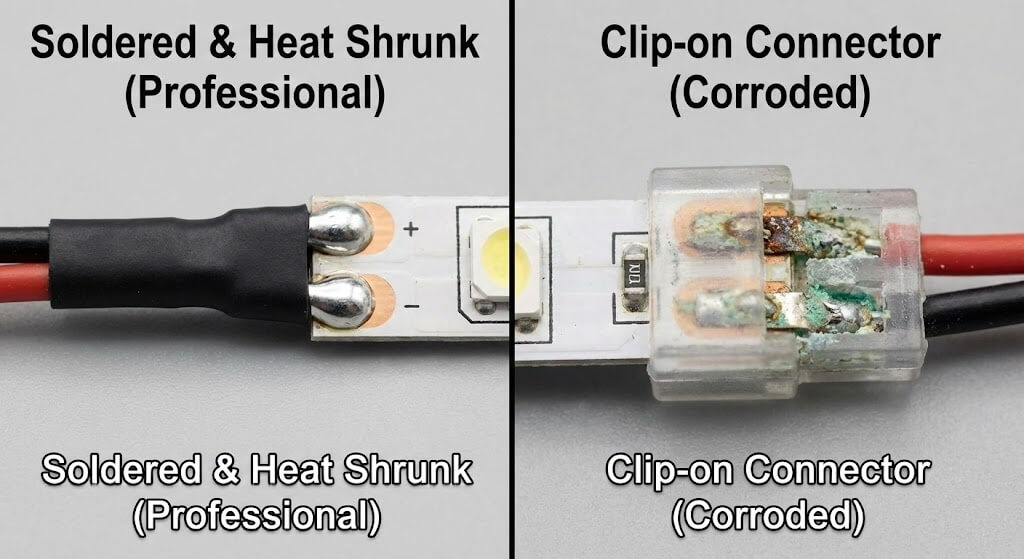
Soldered connections provide the most reliable electrical contact for commercial applications, offering lower resistance and better mechanical strength compared to clip-on connectors. The reliability factor: poor connections cause voltage drops, heat generation, and intermittent operation.
Use flux-core solder and proper soldering techniques to create strong, low-resistance joints. Protect all connections with heat-shrink tubing or silicone coating to prevent moisture ingress and corrosion.
Proper Strip Cutting and Preparation
Cut LED strips only at designated cutting points to avoid damaging circuits. Clean cut surfaces thoroughly before making connections, removing any residue that could interfere with electrical contact.
Heat Dissipation Requirements
Mount LED strips to aluminum channels or heat sinks to dissipate heat effectively. The thermal management rule: LED strips should never operate above 80°C junction temperature to maintain rated lifespan.
Use thermal interface materials between LED strips and mounting surfaces to improve heat transfer. Avoid mounting strips to plastic or wood surfaces that provide poor thermal conductivity.
Environmental Sealing
Seal all connections and cable entries to prevent moisture ingress in outdoor installations. Use appropriate gaskets, sealants, and strain relief to maintain IP ratings under all operating conditions.
Testing and Commissioning
Test all circuits before final installation to identify wiring errors or defective components. Measure voltage at multiple points along each run to verify adequate power distribution and identify potential voltage drop issues.
8. What Maintenance Practices Maximize LED Strip Lifespan?
Regular maintenance extends LED strip lifespan and maintains optimal performance while identifying potential issues before they cause failures. The maintenance reality: proactive maintenance costs significantly less than emergency repairs and replacement.
Maintenance programs should include visual inspections, cleaning, connection checks, and performance monitoring. Establishing regular maintenance schedules prevents gradual degradation that reduces light output and color quality.
Visual Inspection Procedures
Monthly visual inspections can identify loose connections, physical damage, and environmental issues before they cause failures. What to look for: discoloration, flickering, uneven brightness, and signs of moisture ingress.
Document inspection results to track gradual changes that might indicate developing problems. Use thermal imaging cameras to identify hot spots that suggest connection problems or inadequate heat dissipation.
Cleaning Requirements
Regular cleaning maintains light output and prevents heat buildup from accumulated dust and debris. Use appropriate cleaning methods that won’t damage LED components or protective coatings.
Clean LED strips quarterly in normal environments, monthly in dusty conditions. Use compressed air for routine cleaning, avoiding direct contact with LED chips.
Connection Maintenance
Inspect all electrical connections annually for signs of corrosion, loosening, or heat damage. The connection priority: power supply connections and strip-to-strip joints represent the highest failure risk points.
Retighten connections as needed and replace any showing signs of corrosion or heat damage. Apply dielectric grease to connections in humid environments to prevent corrosion.
Performance Monitoring
Track light output and color quality over time to identify gradual degradation. Use light meters to measure illumination levels and compare to baseline measurements taken during initial installation.
Monitor power consumption to identify efficiency changes that might indicate developing problems. Sudden increases in power consumption often indicate connection issues or LED degradation.
| Maintenance Task | Frequency | Time Required | Critical Points |
|---|---|---|---|
| Visual Inspection | Monthly | 15-30 min | Connections, damage |
| Cleaning | Quarterly | 30-60 min | Dust removal |
| Connection Check | Annually | 60-120 min | Tightness, corrosion |
| Performance Test | Annually | 120-180 min | Output, consumption |
9. Which Quality Standards and Certifications Matter for Commercial Use?

Quality certifications and standards provide assurance that LED strips meet safety and performance requirements for commercial applications. The certification importance: using uncertified products can void insurance coverage and create liability issues.
Relevant certifications include UL listing for North American markets, CE marking for European applications, and IP ratings for environmental protection. Understanding certification requirements helps ensure regulatory compliance and product reliability.
UL Certification Requirements
UL certification verifies that LED strips meet safety standards for electrical products in North American markets. UL-listed products undergo rigorous testing for electrical safety, fire resistance, and component quality.
The UL advantage: UL-listed products typically exhibit better build quality and reliability compared to uncertified alternatives. Many commercial installations require UL listing for insurance and code compliance.
CE Marking and European Standards
CE marking indicates compliance with European Union safety and electromagnetic compatibility directives. Products sold in European markets must carry valid CE marking with supporting documentation.
IP Rating System
IP (Ingress Protection) ratings specify protection levels against dust and moisture ingress. Commercial outdoor applications typically require IP65 or higher ratings for reliable operation.
The IP rating breakdown: First digit indicates dust protection (0-6), second digit indicates moisture protection (0-8). IP65 provides complete dust protection and protection against water jets.
Energy Efficiency Standards
Energy efficiency certifications like ENERGY STAR help identify products that meet stringent efficiency requirements. High-efficiency LED strips reduce operating costs and may qualify for utility rebates.
Color Quality Metrics
Color Rendering Index (CRI) and color temperature consistency specifications ensure appropriate light quality for signage applications. The color consideration: applications requiring accurate color representation need CRI values above 80.
| Certification | Region | Requirements | Commercial Importance |
|---|---|---|---|
| UL Listed | North America | Safety testing | Insurance compliance |
| CE Marking | Europe | EU directives | Market access |
| IP Rating | Global | Environmental protection | Reliability |
| ENERGY STAR | North America | Efficiency standards | Operating costs |
| RoHS | Global | Material restrictions | Environmental compliance |
10. How Do LED Strips Compare to Alternative Commercial Signage Lighting?
LED strips compete with several alternative lighting technologies for commercial signage applications, each offering different advantages and limitations. The technology comparison: understanding relative strengths helps select optimal lighting solutions for specific applications.
Alternative technologies include neon tubing, fluorescent fixtures, metal halide lamps, and newer OLED panels. Each technology offers different characteristics regarding efficiency, lifespan, color quality, and installation requirements.
Traditional Neon Comparison
Traditional neon tubing provides smooth, continuous illumination with excellent visual appeal but requires high-voltage operation and specialized installation expertise. The neon reality: traditional neon consumes 3-5 times more energy than equivalent LED strips while requiring more frequent maintenance.
LED neon flex products combine LED efficiency with neon-like appearance, offering 80% energy savings with significantly longer lifespan. LED neon flex eliminates high-voltage requirements and fragility issues associated with glass neon tubing.
Fluorescent Fixture Alternatives
Fluorescent fixtures offer lower initial costs but provide poor dimming capabilities, shorter lifespan, and higher maintenance requirements. The fluorescent limitation: fluorescent lamps lose 20-30% light output over their lifespan while LED strips maintain 90%+ output.
Fluorescent lamps also contain mercury, creating disposal complications and environmental concerns not present with LED technology.
Metal Halide Comparison
Metal halide lamps provide high light output suitable for large signage but consume significantly more energy and generate substantial heat. Lamp replacement costs and labor requirements make metal halide systems expensive to maintain.
OLED Technology
OLED panels offer excellent color quality and ultra-thin profiles but currently cost 5-10 times more than equivalent LED solutions. OLED technology works well for premium applications where cost is secondary to visual quality.
The emerging technology note: OLED costs continue declining, making this technology increasingly competitive for high-end applications.
| Technology | Efficiency (lm/W) | Lifespan (hours) | Maintenance | Initial Cost |
|---|---|---|---|---|
| LED Strips | 120-180 | 50,000+ | Very Low | Medium |
| Traditional Neon | 30-50 | 15,000 | Medium | High |
| Fluorescent | 80-100 | 10,000 | High | Low |
| Metal Halide | 80-120 | 8,000 | High | Medium |
| OLED | 100-150 | 30,000 | Low | Very High |
Conclusion
LED strip lights for commercial signage represent a mature, reliable technology that delivers exceptional value through reduced energy consumption, extended operational life, and flexible installation options. Successful implementations require careful planning that considers technical specifications, environmental factors, and long-term maintenance requirements.
The key to maximizing LED strip performance lies in selecting appropriate components for specific applications, implementing proper thermal management, and following industry best practices during installation. Quality LED strips with professional installation typically provide 5-8 years of reliable operation while consuming 75-80% less energy than traditional lighting alternatives.
Investment in commercial-grade LED strips and professional installation yields superior returns through reduced maintenance costs, lower energy consumption, and enhanced signage visibility that supports business objectives. As LED technology continues advancing, early adopters benefit from improved efficiency and expanding feature sets that enhance operational flexibility.
The strategic advantage: businesses that implement quality LED signage systems gain competitive benefits through reduced operating costs, improved brand visibility, and enhanced environmental responsibility that resonates with modern consumers and stakeholders.
FAQ
Q1: What IP rating do I need for outdoor commercial signage LED strips?
Outdoor commercial signage requires IP65 or higher rated LED strips for reliable protection against dust and water ingress. IP65 provides complete dust protection and guards against water jets from any direction. For applications with potential submersion risk, consider IP67 rated strips that can withstand temporary immersion. Always ensure that connection points maintain the same IP rating as the strips themselves through proper sealing and enclosure methods.
Q2: How long do commercial-grade LED strips typically last in signage applications?
Commercial-grade LED strips typically operate for 50,000 to 70,000 hours in properly designed installations, translating to 5-8 years of continuous operation. Actual lifespan depends on operating temperature, current levels, and environmental conditions. Premium strips with better thermal management and higher-grade components can exceed 100,000 hours. Proper installation with adequate heat dissipation significantly extends operational life compared to strips operating at elevated temperatures.
Q3: What power supply considerations are critical for commercial LED signage?
Commercial LED signage power supplies should be rated at least 20% above calculated load requirements to ensure reliable operation and accommodate startup surges. Use 24V systems for runs longer than 5 meters to minimize voltage drop effects. Select power supplies with appropriate IP ratings matching installation environment requirements. Consider redundant power supply configurations for critical signage applications where downtime causes significant business impact.
Q4: Can LED strips be dimmed without affecting color quality?
High-quality LED strips maintain consistent color temperature when dimmed using PWM (Pulse Width Modulation) dimming methods. PWM dimming rapidly switches LEDs on and off at frequencies above human perception, maintaining color consistency across the entire dimming range. Avoid analog dimming methods that reduce voltage, as these can cause color shifting toward warmer temperatures. Most commercial-grade LED strips support dimming to 1% of full output while maintaining color stability.
Q5: What are the most common installation mistakes that cause LED strip failures?
The most common installation mistakes include inadequate heat dissipation, poor electrical connections, and insufficient protection from environmental factors. Mounting strips without proper thermal interface materials causes overheating and premature failure. Using clip-on connectors instead of soldered joints creates high-resistance connections that generate heat and cause intermittent operation. Failing to properly seal connections in outdoor installations allows moisture ingress that leads to corrosion and electrical failures. Exceeding maximum run lengths without power injection causes voltage drop and uneven illumination.
