
Event lighting looks simple from the guest side. Behind the scenes, poor strip selection can cause voltage drop, color mismatch, driver overload, heat issues, callbacks, and project delays. For contractors, rental companies, lighting distributors, and solution providers, that means margin erosion and reputation damage. The solution is not just buying brighter strips. You need a clear specification process based on field conditions, control needs, safety rules, and installation labor. From our manufacturing floor perspective, event decor projects succeed when the design team treats LED strips like engineered lighting, not disposable tape.
1. What roles do LED strip lights play in event decor?
LED strip lights for event decor usually serve three roles: visual guidance, atmosphere creation, and brand presentation. Each role needs a different technical choice. A gala dinner may use warm white strips under tables and stair noses. A product launch may need RGBW LED strip lights for stage lighting to create dynamic backdrops, logo walls, and controlled visual effects. A wedding venue may need soft indirect light behind floral structures, arches, and ceiling fabric.
Here’s the deal: many failures start when one strip type is used everywhere. We once reviewed a banquet hall setup where the installer used the same high-output strip for table edges, bar shelves, and a photo booth. The result was glare on camera, hot aluminum channels, and visible dots through translucent acrylic.
Common event decor applications include:
| Event decor area | Typical lighting goal | Suggested strip type | Risk if specified poorly |
|---|---|---|---|
| Stage backdrop | Dynamic color effects | RGBW or pixel strip | Uneven color, controller lag |
| Bar counter | Clean product glow | 24V COB or high-CRI SMD | Visible LED spots |
| Stair edge | Safety guidance | Low-watt single color | Glare or adhesive failure |
| Booth signage | Brand color accuracy | Tunable white or RGBW | Wrong brand tone |
| Outdoor facade | Weather resistance | IP65/IP67 strip | Water entry, short circuit |
For professional work, start with the event story, then match the strip. A luxury hotel lobby does not need the same LED behavior as an outdoor music festival entrance.
2. How should you choose brightness for event scenes?
Brightness should match distance, surface reflectance, camera exposure, and viewing angle. Higher wattage is not always better. In our lab tests using integrating spheres, we measure luminous flux, color temperature, and efficiency rather than trusting wattage labels alone. This matters because two 14.4W/m strips can produce different visible brightness if chip quality, PCB copper, and phosphor mix are different.
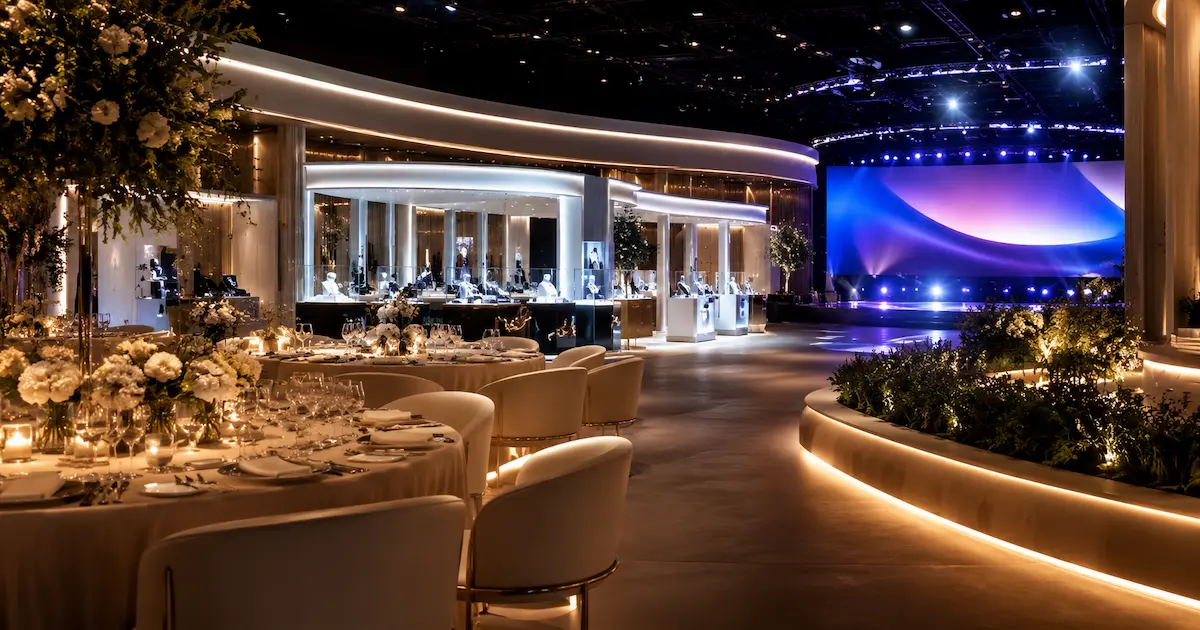
For a dinner event, soft indirect light at 300-600 lm/m often feels refined. For professional LED strip lights for exhibition booths, 800-1200 lm/m may be needed because trade show halls often have high ambient light. For stage edges or ceiling coves, 1000+ lm/m can work, but only when heat dissipation is planned.
Common Myth: Higher wattage always means better brightness. Reality: lumen efficiency, LED density, optics, and thermal management decide real output. A strip running too hot may lose brightness faster, which hurts rental inventory value.
| Event scene | Practical brightness range | Color suggestion | Notes for profit protection |
|---|---|---|---|
| Wedding table glow | 200-500 lm/m | 2700K-3000K | Avoid glare in photos |
| Hotel ballroom cove | 600-1000 lm/m | 3000K-3500K | Use aluminum profile |
| Exhibition booth shelf | 800-1200 lm/m | 4000K or custom CCT | Check CRI for products |
| Concert accent line | 500-1500 lm/m | RGBW | Confirm controller capacity |
| Outdoor entrance arch | 800-1300 lm/m | RGBW or white | Pick correct IP rating |
We explain brightness this way because over-lighting wastes power and creates heat, while under-lighting leads to client rejection during the final walkthrough.
3. Should you use 12V or 24V LED strips for events?
For most professional event decor, 24V strips are the safer default because they reduce current for the same wattage and control voltage drop better over longer runs. 12V still has value for short props, battery-powered decor, vehicle displays, and small modular pieces.
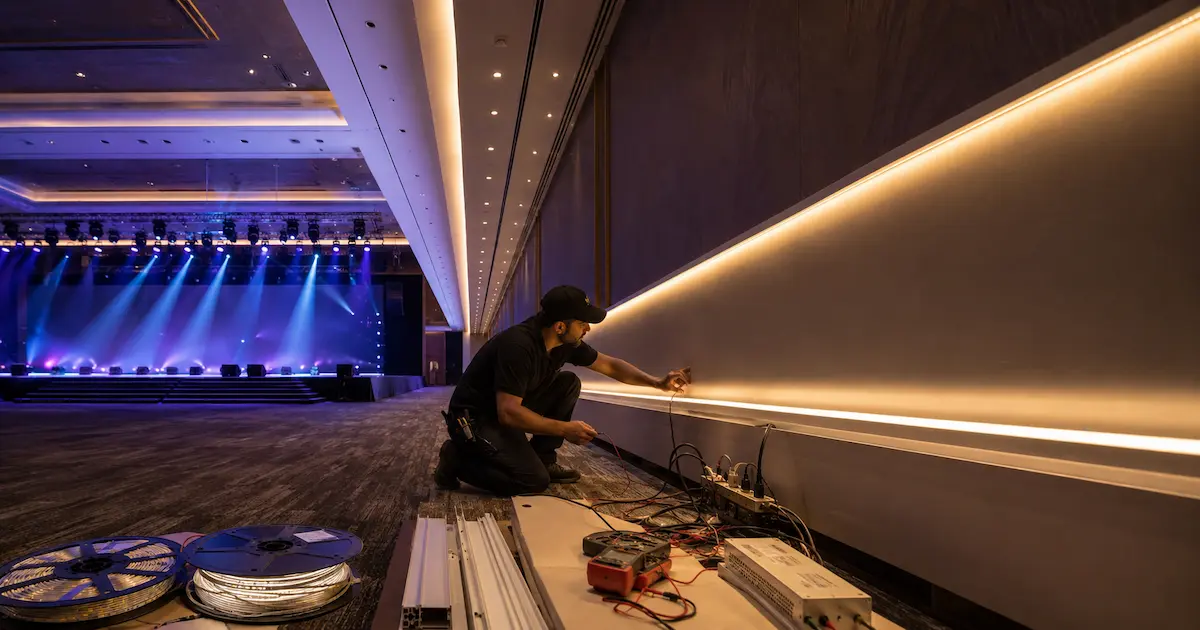
When we tested this against a standard 12V strip, a 24V strip showed less visible dimming at the far end because longer LED runs are more vulnerable to voltage drop. That difference matters on a 20-meter ceiling line or a long exhibition booth edge. A guest may not notice the calculation, but they will notice one side looking dull.
| Factor | 12V LED strip | 24V LED strip |
|---|---|---|
| Best use | Short props, small signs, mobile setups | Long coves, stages, booth lines |
| Voltage drop | Higher risk on long runs | Lower risk on long runs |
| Cut length | Usually shorter cut units | Usually longer cut units |
| Driver current | Higher current | Lower current |
| Cable size need | Often thicker for same power | Easier cable planning |
| Project risk | Good for compact decor | Better for large layouts |
Pro Tip from the VST Technical Team: “If a run is longer than 5 meters, calculate voltage drop before quoting. If you skip it, the labor cost of re-feeding power can exceed the strip cost.”
For event companies, this calculation protects schedule and margin. It also keeps installers from improvising under pressure.
4. Which IP rating is right for indoor and outdoor event decor?
The IP code indicates how well an electrical enclosure or protected lighting product resists intrusion from solids and water. Indoor dry decor may use IP20, especially inside aluminum profiles or behind furniture. Semi-outdoor areas, bar zones, floral walls, and entrance arches often require waterproof LED strip lights, commonly with IP65 protection or higher depending on actual water exposure. For wet floors, rain exposure, or poolside decor, IP67 or IP68 may be needed.
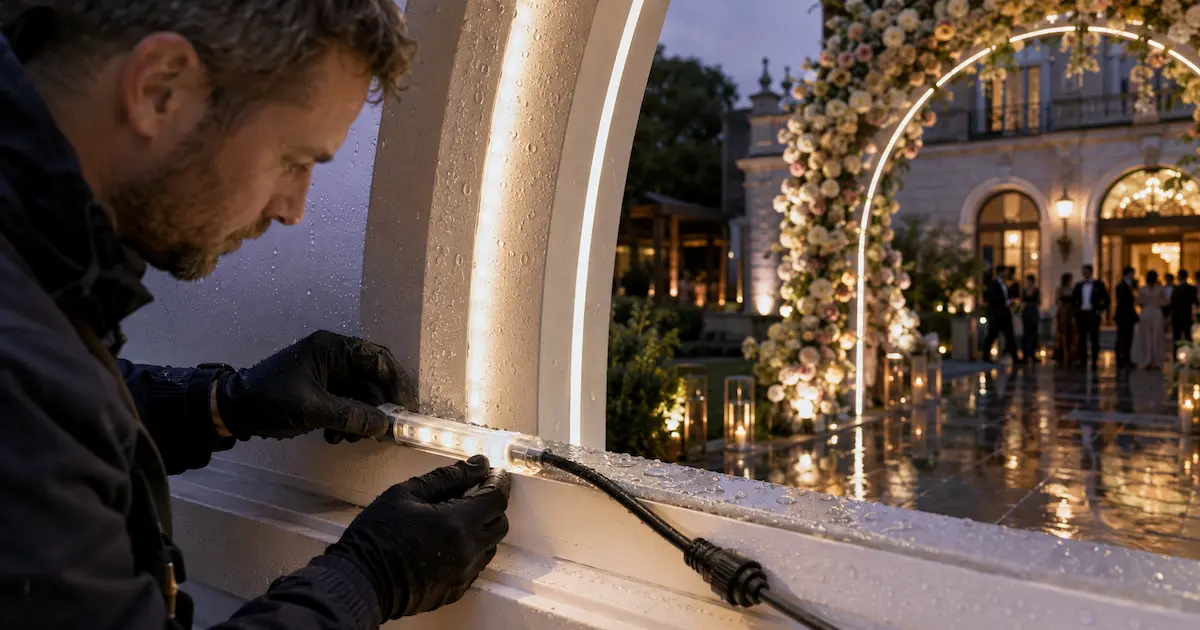
But there’s a catch. Higher IP protection can reduce heat release. Silicone sleeves and full encapsulation trap more heat than bare PCB. If you use a high-watt IP67 strip inside a sealed channel, the LEDs may age faster. That creates future replacement cost and rental stock loss.
| IP rating | Protection level | Suitable event use | Caution |
|---|---|---|---|
| IP20 | Indoor dry area | Ceiling cove, stage trim, booth shelving | Needs protection from touch and dust |
| IP44 | Light splash zone | Temporary bar decor | Not for rain |
| IP65 | Silicone coated, splash resistant | Outdoor entrance, floral wall | Seal cut points carefully |
| IP67 | Short-term water exposure | Wet facade, floor-adjacent decor | Heat must be checked |
| IP68 | Continuous water-rated designs | Fountain or pool feature | Use only certified matched system |
We often see installers struggle with cut-end sealing. A clean strip can fail after one rainy evening if the end cap is rushed. Learning how to waterproof LED strip connections correctly means using proper silicone, sealed end caps, suitable connectors, and strain relief at vulnerable cable exits. Water damage is not just a product issue. It is a process issue.
5. How do control systems affect event lighting results?
Control choice affects color accuracy, show timing, dimming smoothness, and setup time. Simple single-color dimming may only need a PWM dimmer. Professional RGB installations, especially those using an RGBW LED strip with a dedicated white channel, need properly matched controllers, amplifiers, power supplies, and signal planning. For animated effects, addressable LED strips require proper data protocols, pixel addressing, signal planning, and backup thinking before the event begins.
For a corporate product launch, a poorly planned DMX512 lighting-control setup can cause delayed or inconsistent color changes that look unprofessional on video.
For a wedding, flicker during dimming can ruin camera footage. For a rental company, controllers that are hard to configure increase labor cost every time the kit goes out.
| Control need | Common solution | Best use | Watch point |
|---|---|---|---|
| Single-color dimming | PWM dimmer | Banquet, cove, table lines | Match voltage and current |
| RGB color change | RF/DMX controller | Bars, arches, booths | Check channel load |
| RGBW scene control | DMX512 | Stage and live events | Needs trained setup |
| Pixel animation | SPI controller | Concert, media wall, effects | Data distance and addressing |
| Building integration | 0-10V, DALI, DMX gateway | Venue semi-permanent decor | Confirm driver compatibility |
In our factory testing, we run dimming checks on aging racks because flicker and unstable channels show up under load. This information matters to your bottom line because control problems are often blamed on the installer, even when the root cause is a mismatched driver or controller.
6. What color quality should professional buyers specify?
Color quality is often the difference between premium decor and cheap-looking decor. For white strips, check CCT, color rendering index (CRI), R9, and binning before approving the lighting for photography, products, flowers, or fashion displays. For color strips, check RGB consistency, white channel quality, and controller calibration. In a hotel event, 2700K can feel warm and intimate. In a jewelry launch, 4000K with high CRI can make products look cleaner. In a fashion show, poor R9 can make reds look flat.
We explain this specific binning process because ignoring it leads to visible color mismatch across ceiling coves, wall lines, and photo areas. Batch consistency matters when a distributor supplies repeat orders for the same venue.
| Specification | Recommended target | Why it matters |
|---|---|---|
| CCT tolerance | 3-step or 5-step MacAdam | Reduces visible mismatch |
| CRI | 90+ for retail and photo areas | Better skin and product color |
| R9 | 50+ where red tones matter | Better flowers, food, fabric |
| RGBW choice | Dedicated white channel | Cleaner white than RGB mixed white |
| PCB color | White, black, or custom | Hidden finish for visible installs |
A field example: a luxury dinner used two batches of warm white strip from different suppliers. The ceiling looked half yellow and half pink. The fix required night work, new material, and a tense client meeting. Color data protects reputation.
7. How should mounting and heat management be planned?
Adhesive tape is not a mounting system for every event. It works for clean, flat, temporary surfaces with low heat. It does not work well on dusty truss, textured walls, fabric, cold metal, or hot outdoor structures. For professional event decor, use quality aluminum LED profiles, clips, mechanical brackets, or pre-assembled strip modules whenever possible instead of relying only on adhesive tape.
Heat management is tied to lumen maintenance. High-output strips need a heat path. Aluminum profiles also protect the strip from touch, impact, and uneven surfaces. In a stage stair application, a diffuser can reduce glare and protect the LEDs from shoe contact. In a bar shelf, a deep profile can hide LED dots. In an outdoor arch, a profile with drainage planning can reduce water pooling.
From our manufacturing floor perspective, we see many project photos where the strip itself is blamed, but the PCB was installed inside a foam channel with no heat release. The product ran outside its thermal comfort zone.
Use these practical rules:
- Clean surfaces with alcohol before temporary adhesive mounting
- Use profiles for strips above 10W/m where possible
- Add clips every 30-50 cm for overhead runs
- Avoid tight bends near solder joints
- Keep connectors accessible for service
Good mounting reduces failure risk and saves labor during teardown.
8. What power layout prevents voltage drop and overload?
Properly installing LED strips and power supplies safely starts with planning the power layout before purchase rather than improvising during event installation. Calculate total watts, add safety margin, split long runs, and feed power from both ends when needed. For a 24V, 14.4W/m strip over 20 meters, total load reaches 288W before margin. A single 300W driver may look sufficient on paper, but cable loss, driver derating, and inrush current can create trouble.
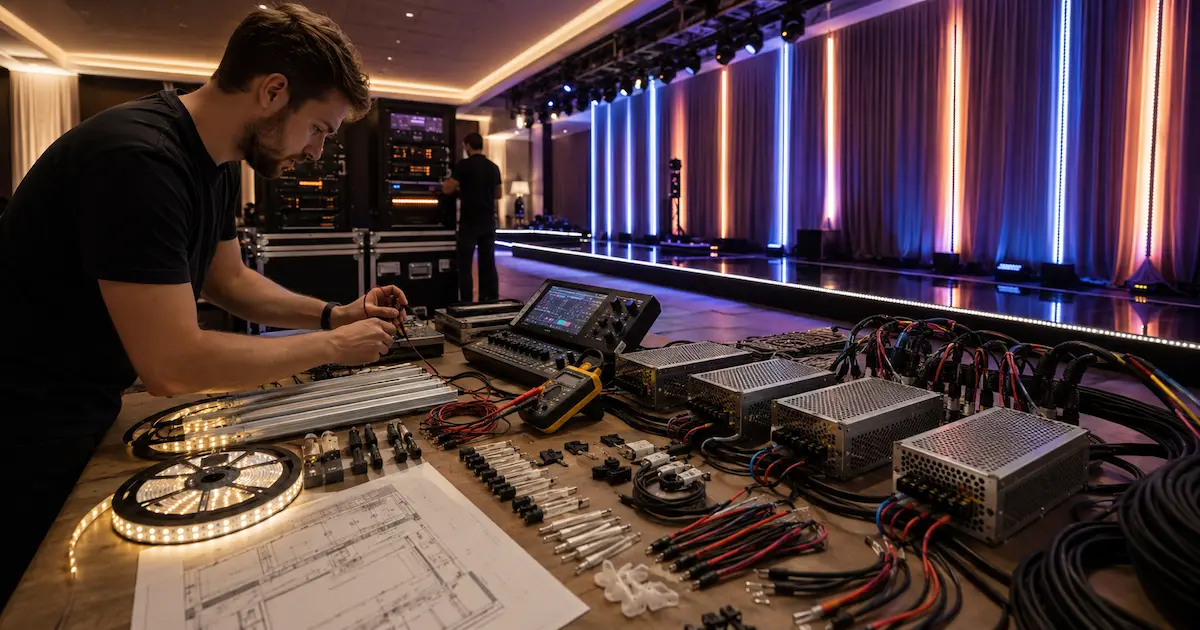
Use 20-30% driver headroom for many event setups. Keep drivers ventilated. Label zones. Plan cable routes so technicians can service the system without removing decor. For rental kits, use consistent connectors and color-coded cables.
| Installation checklist | Pass standard | Why it protects the job |
|---|---|---|
| Total wattage calculated | Strip W/m × length | Prevents driver overload |
| Driver margin added | 20-30% headroom | Reduces heat and shutdowns |
| Cable size checked | Based on current and length | Reduces voltage drop |
| Power injection planned | Long runs fed in sections | Keeps brightness even |
| Polarity labeled | + and – marked clearly | Prevents reverse wiring |
| Load tested before event | 30-60 minutes minimum | Finds weak joints early |
We once saw a booth project fail because all strips were connected from one corner. The far end looked 30% dimmer. A simple middle feed would have saved the night
Conclusion
Successful event lighting depends on more than choosing a bright LED strip. Professional LED strip lights for event decor should be selected as part of a complete system that includes the right voltage, brightness, color quality, IP rating, controller, driver, mounting method, and power layout.
For most larger installations, 24V strips make long runs easier to manage and help reduce voltage drop. Outdoor or moisture-exposed installations need suitable IP protection and properly sealed connections, while high-output strips should use aluminum profiles or another effective heat path. RGB, RGBW, and pixel systems also need controllers and power supplies that are properly matched to the load and the required lighting effects.
Before the event, test the complete setup under real operating conditions. Check brightness consistency, dimming, color matching, controller response, connector security, and driver temperature. A few extra minutes of planning and testing can prevent troubleshooting during setup, protect project margins, and deliver a cleaner, more professional result for the client.
FAQ
Q1: Are 12V or 24V LED strips better for event decor?
For most professional event installations, 24V LED strips are usually the better choice, especially for long stage edges, ceiling lines, exhibition booths, and architectural features. They generally handle voltage drop better and require less current for the same power level. However, 12V strips can still be useful for short props, small signs, battery-powered decorations, and compact installations.
Q2: What IP rating should LED strips have for outdoor events?
The correct IP rating depends on the amount of moisture exposure. IP20 is suitable for dry indoor installations, while IP65 is commonly used for outdoor entrances, floral walls, and areas exposed to occasional splashes. IP67 or IP68 may be required for locations exposed to rain, wet floors, fountains, or pool areas. Cut points, end caps, connectors, and cable exits must also be sealed correctly.
Q3: Which LED strip is best for weddings and event decorations?
Warm-white LED strips around 2700K–3000K work well for weddings, dinner events, and luxury hospitality settings because they create a softer atmosphere. RGB or RGBW strips are better when dynamic color changes are required for stages, arches, bars, or backdrops. For areas where people, flowers, food, or products will be photographed, choosing high-CRI lighting can improve color appearance.
Q4: How can voltage drop be prevented in long event LED strip runs?
Start by calculating total power and cable distance before installation. Use 24V strips for longer runs, choose the correct cable size, divide very long installations into multiple power zones, and add power injection when necessary. Feeding long runs from multiple points can help maintain more consistent brightness from one end to the other.
Q5: Why do LED strips fail during events?
Common causes include overloaded drivers, excessive voltage drop, poor connectors, incorrect waterproof sealing, inadequate heat dissipation, damaged solder joints, and incompatible controllers. High-output strips can also overheat when installed on insulating materials without an aluminum profile. Testing the complete system before the event is one of the best ways to identify these problems early.
