
Led strip lights for pop up shop projects are flexible linear lighting systems used to make temporary retail displays brighter, cleaner, and easier to install. They help highlight shelves, product walls, counters, signage, fitting zones, and checkout areas without heavy fixtures or complex ceiling work.
A pop up shop has one big challenge: it must look permanent while being temporary. Poor lighting makes products look cheap, creates dark corners, and can lead to callbacks, client complaints, or safety concerns. The fix is not simply buying the brightest strip. You need the right voltage, color temperature, CRI, driver, profile, dimming method, and wiring plan. From our manufacturing floor perspective, the best retail lighting plans start with how the shop will be assembled, used, moved, and removed. This article gives practical selection rules based on real production and field experience.
1. Why do pop up shops need planned LED strip lighting?
Pop up shops move fast. A brand may have only two days to install counters, shelves, graphics, POS systems, and lighting before opening, so understanding how to choose lighting for retail spaces helps the project team coordinate merchandise visibility, customer comfort, installation speed, and brand presentation. If lighting is treated as a last-minute accessory, the shop can look uneven even when the display furniture is well made.
Planned led strip lights for pop up shop layouts solve three problems: they add visual focus, reduce installation time, and keep the retail space safe. In a cosmetic kiosk, neutral white strips under shelves show true product colors. In a sneaker launch booth, higher-output strips in aluminum profiles create clean lines. In a jewelry pop up, warm white accent strips inside glass cases make metal and stones look richer.
Many pop up sites require CE, RoHS, UL, or local electrical compliance documents. If a strip overheats, flickers, or peels off after two days, replacement costs and reputation damage can follow. Planning also includes end-to-end logistics: how strips will be packed, labeled, and reinstalled at a different venue if the pop up is itinerant. Simple decisions like whether to use quick-disconnect connectors or soldered pigtails can change install speed and robustness.
| Pop Up Area | Lighting Goal | Recommended Strip Type | Business Impact |
|---|---|---|---|
| Product shelves | Even product visibility | 24V SMD or COB strip | Fewer dark spots, cleaner merchandising |
| Cash counter | Clear work lighting | High CRI neutral white strip | Faster checkout and fewer errors |
| Brand signage | Attention from walking traffic | RGBW or static white strip | Stronger storefront presence |
| Glass display case | Premium product focus | Low-heat high CRI strip | Better color rendering and lower risk |
| Fitting zone | Comfortable skin tone | 3000K-4000K CRI90+ strip | Better customer confidence |
2. Which LED strip type works best for temporary retail displays?
The right strip depends on product, material, mounting, and the desired effect. SMD strips are the workhorse with many power and CCT options. Understanding COB LED strip construction helps explain why these strips create a smooth, continuous light line that works well near mirrors, glass cases, glossy counters, and other reflective retail surfaces. RGB/RGBW suits activations and launches where color scenes matter.
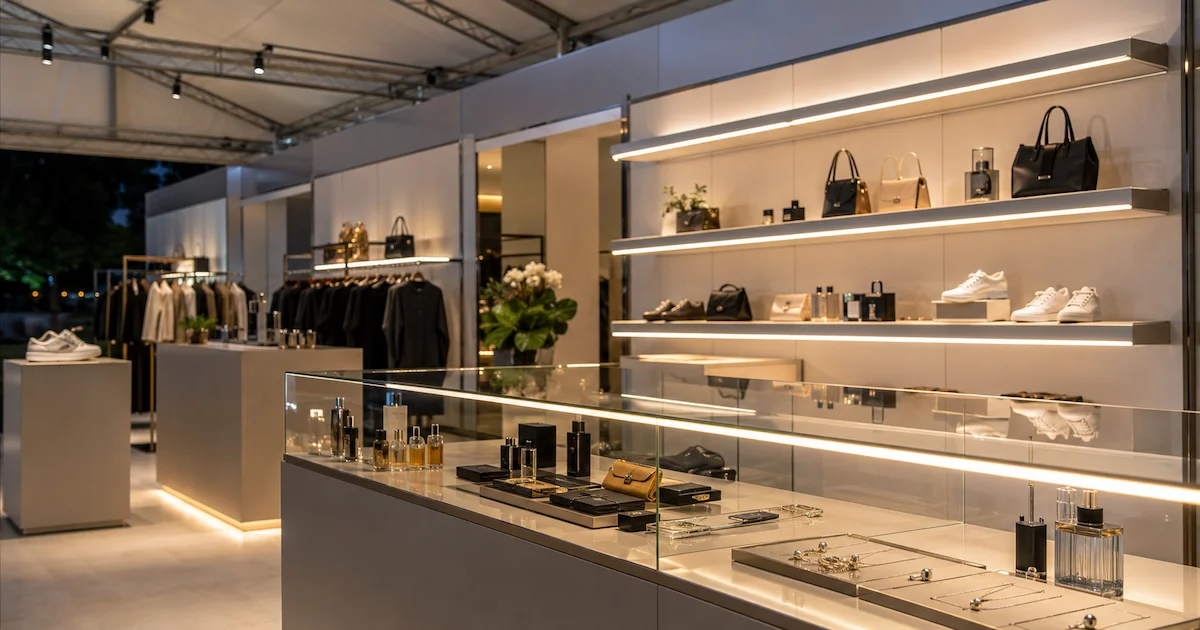
Common Myth: Higher wattage always means better brightness. Reality: lumen efficiency, LED density, optics, thermal path, and diffuser loss define installed brightness. We often see lumen-per-watt gaps of 20–35% between strips that look similar on paper.
When choosing, also consider maintenance and replacement speed. SMD strips are widely available and easy to swap, while COB often requires matching a specific PCB and profile to recreate the exact look. For short-lifecycle pop-ups, ease of replacement and cost per meter can outweigh marginal quality differences, while a premium COB LED strip light remains useful where a smooth visible light line is central to the display design.
| Strip Type | Best Use | Strength | Watch Point |
|---|---|---|---|
| SMD 2835 | Shelves, counters, display edges | Good efficiency and price | Dots may show without diffuser |
| COB | Visible lines, mirrors, glass cases | Smooth linear light | Needs reliable PCB and heat path |
| RGB | Events and color scenes | Strong visual effect | Poor white quality unless RGBW is used |
| RGBW | Brand zones with white task light | Color plus usable white | Needs 5-core wiring and controller planning |
| High CRI strip | Fashion, cosmetics, jewelry | Accurate product color | Usually higher cost per meter |
3. Should you choose 12V or 24V LED strips for a pop up shop?
Voltage affects wiring length, driver sizing, voltage drop, and installation speed. For professional pop-up work, a commercial-grade 24V LED strip system is often safer for medium and long runs because it carries lower current for the same wattage and helps reduce voltage drop.
12V remains appropriate for short runs inside display boxes, battery-powered cases, or compact signage. For retail counters, perimeter lines, wall bays, or modular shelf systems, 24V provides better consistency and fewer onsite fixes.
When planning, sketch the longest run and calculate voltage drop. As a simple rule: if you need more than 3–4 meters in a single run for a given strip, lean toward 24V or use parallel feeds. Also account for connector resistance and solder joints; two small JST connectors in series can produce noticeable drop on higher-current circuits.
| Feature | 12V LED Strip | 24V LED Strip |
|---|---|---|
| Best run length | Short modules and small boxes | Medium to long retail runs |
| Current draw | Higher at same wattage | Lower at same wattage |
| Voltage drop risk | Higher | Lower |
| Cutting interval | Often shorter | Often longer |
| Driver availability | Very common | Very common in commercial lighting |
| Recommended pop up use | Sample cases, small signage | Shelves, counters, wall displays |
4. What color temperature and CRI should you specify?
CCT and CRI shape product perception, and the U.S. Department of Energy’s LED basics resource gives useful background on LED color quality, color fidelity, efficacy, controllability, and lighting performance. Warm white (2700K–3000K) suits jewelry and premium corners; neutral white (3500K–4000K) is safe for cosmetics and apparel; cool white (5000K–6500K) fits electronics and technical displays.
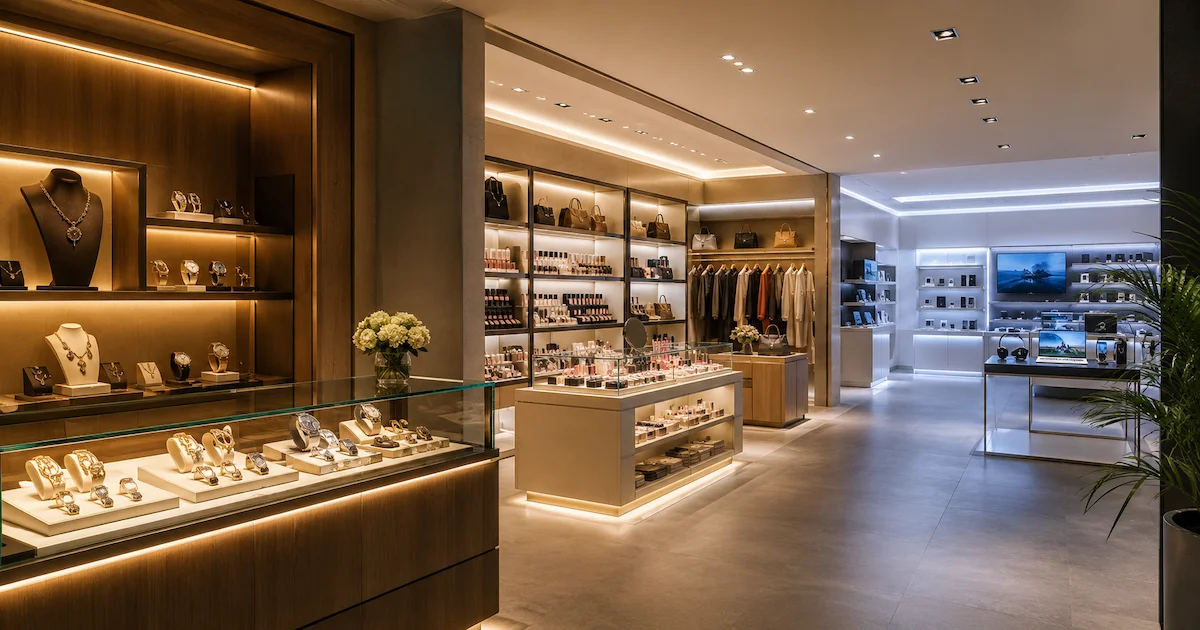
CRI influences color accuracy. CRI80 may be acceptable for general displays; CRI90+ is recommended for fashion, makeup, hair color, art, food, and jewelry.
Also consider binning and consistency across reels. A small visible tint between strips installed on adjacent panels can be distracting. Ask vendors for bin codes or, better, order the entire project and spares from the same production batch. If you mix manufacturers, verify visually during sample assembly.
| Product Category | Suggested CCT | Suggested CRI | Reason |
|---|---|---|---|
| Cosmetics | 3500K-4000K | CRI90+ | Better skin tone and shade accuracy |
| Fashion apparel | 3000K-4000K | CRI90+ | More accurate fabric color |
| Jewelry | 2700K-3500K | CRI90+ | Warmer premium look |
| Electronics | 4000K-6000K | CRI80-90 | Clean technical appearance |
| Food samples | 3000K-4000K | CRI90+ | Natural product presentation |
Pro Tip: request the same CCT bin for the full project and spares to avoid mismatched whites. If you need an exact match for brand colors, ask for spectral power distribution (SPD) data or a quick on-site mock-up test with the actual products. The following educational video provides a broader overview of how merchandise, store layout, daylight, and electric lighting should work together in a professional retail-lighting plan.
5. How much brightness does a pop up shop need?
Define zones by function. Strip powers between 8W/m and 14.4W/m commonly handle shelf and accent lighting. Use 18–24W/m for wall washing or wide diffused profiles, but only when thermal control is in place.
Remember that diffusers reduce visible light by 15–35% and dark surfaces absorb more light. Plan higher installed lumens for dark graphics or deep display bays. Also consider eye comfort; avoid mounting strips where the end-user will look directly into the LEDs—use diffusers or indirect mounting to control glare.
A quick approach: use basic photometry principles to set target lux levels for each zone, then calculate required lumens from fixture output, diffuser loss, surface color, and viewing distance. Use measured lumen values from datasheets rather than nominal power alone.
| Lighting Zone | Typical Target | Strip Power Range | Notes |
|---|---|---|---|
| Shelf accent | Product visibility | 8-12W/m | Use diffuser for softer lines |
| Hero product bay | Strong focus | 14.4-20W/m | Use aluminum profile |
| Counter task light | Clear working area | 10-18W/m | Avoid glare into eyes |
| Logo backlight | Brand visibility | 9.6-14.4W/m | Check spacing for even glow |
| Wall wash | Larger surface brightness | 18-24W/m | Needs heat management |
6. How do aluminum profiles protect the lighting and the display?
A suitable aluminum profile for LED strip lighting removes heat, protects the PCB, secures the diffuser, and provides a repeatable mounting method for temporary displays that must be transported and reassembled.
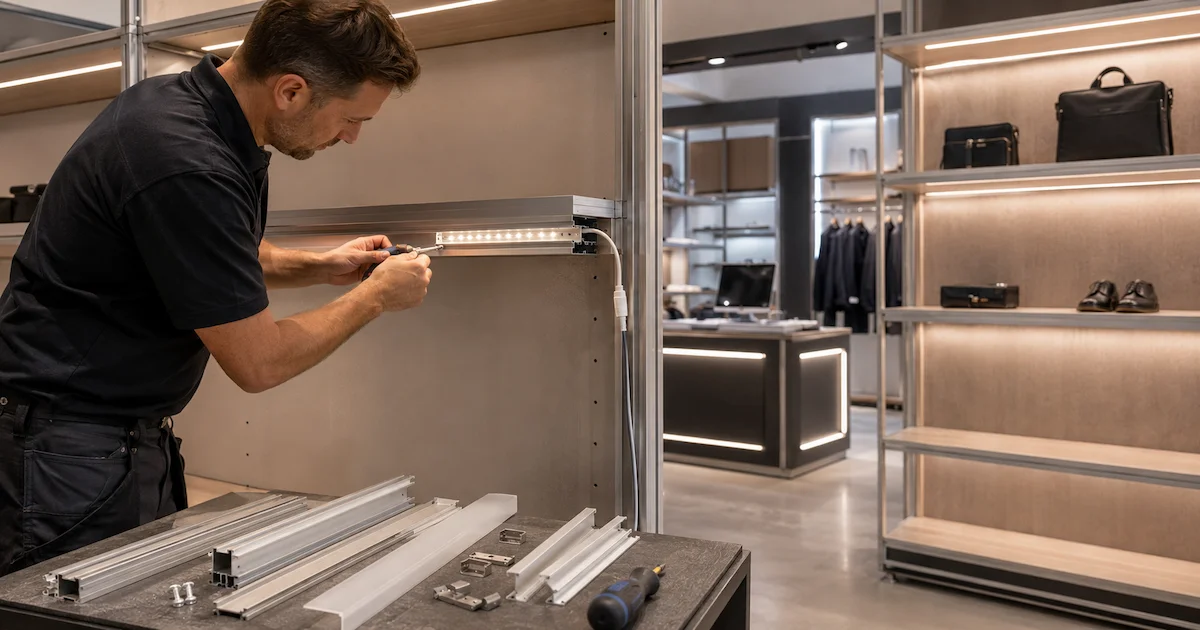
Profiles prevent peeling on dusty or textured surfaces and reduce sagging during transport, while the correct LED channel diffuser helps soften glare, conceal individual diode points, and create a cleaner retail light line. They also improve visual quality: opal diffusers hide dots; clear covers preserve output; deep profiles plus COB produce the smoothest lines.
When choosing profiles, match the profile width to the strip PCB width and allow space for thermal adhesive or thermal pads if the strip requires it. Consider pre-drilling mounting holes and providing small installation jigs with the kit, which saves time and ensures consistent alignment across several identical modules.
| Profile Type | Best Location | Main Benefit | Installer Note |
|---|---|---|---|
| Surface slim | Shelves and display edges | Fast mounting | Use clean screw points |
| Recessed | Counters and wall panels | Flush appearance | Plan groove depth early |
| Corner | Cabinet corners | Angled light direction | Good for shelves |
| Deep diffuser | Visible light lines | Dot-free effect | Lower output due to diffusion |
| Heavy heat sink | High power strips | Better thermal control | Use for 18W/m and above |
7. What IP rating and safety details matter for temporary stores?
Indoor pop up shops can use IP20 strips if protected in profiles, but project teams should understand IP ratings before specifying strips for food counters, beauty sinks, outdoor kiosks, or street-facing stalls. Food sampling counters, beauty sinks, outdoor kiosks, and street-facing stalls may need IP65 or higher.
Higher IP ratings add cost and can trap heat. Safety includes driver selection, cable sizing, polarity marking, strain relief, and flame-related material checks. Mains-side driver work must comply with local electrical rules.
For food or public-facing installations, add mechanical protection and verify materials are easy to clean and non-toxic. Test sample assemblies under expected environmental conditions (heat, humidity from food prep or beauty services) to check for performance degradation before mass deployment.
| Rating | Protection Level | Suitable Pop Up Use | Watch Point |
|---|---|---|---|
| IP20 | Indoor dry locations | Shelves, counters, displays | Needs protection from touch and dust |
| IP65 | Splash-resistant | Food counters, beauty areas | Coating can reduce heat release |
| IP67 | Stronger water resistance | Outdoor covered kiosks | Check sealed ends and connectors |
| IP68 | Wet or demanding sites | Special outdoor use | Higher cost and lower heat release |
8. How should drivers, dimming, and controls be planned?
Size drivers with headroom—run them at approximately 80–85% of capacity rather than 100%, and complete accurate LED driver capacity calculations for every shelf, counter, signage, and display zone. Place drivers where airflow exists rather than inside sealed fabric-lined boxes, and follow safe practices for installing LED strips and power supplies in temporary structures that may be assembled, transported, and reused.
Dimming must match control needs: PWM or 0-10V for single-color strips, DALI/DMX for larger or dynamic shows, and DMX for timed color scenes, while independent flicker research can help teams understand how driver behavior may affect shopper comfort, video recording, and low-level dimming. Label wiring and zones for repeatability across pop ups.
Also decide whether the lighting will be run from battery or mains, and whether wireless controls (Bluetooth, Zigbee) are needed for quick setup. For RGBW or tunable white systems, plan control wiring and remote mounting locations for controllers so installers can access them without dismantling displays.
9. What installation checklist prevents delays and callbacks?
Small missed details cause most failures: dirty surfaces, wrong polarity, one-end long feeds, overloaded drivers, loose connectors, and skipped burn-in tests. Test every reel and use factory pre-soldered leads when possible.
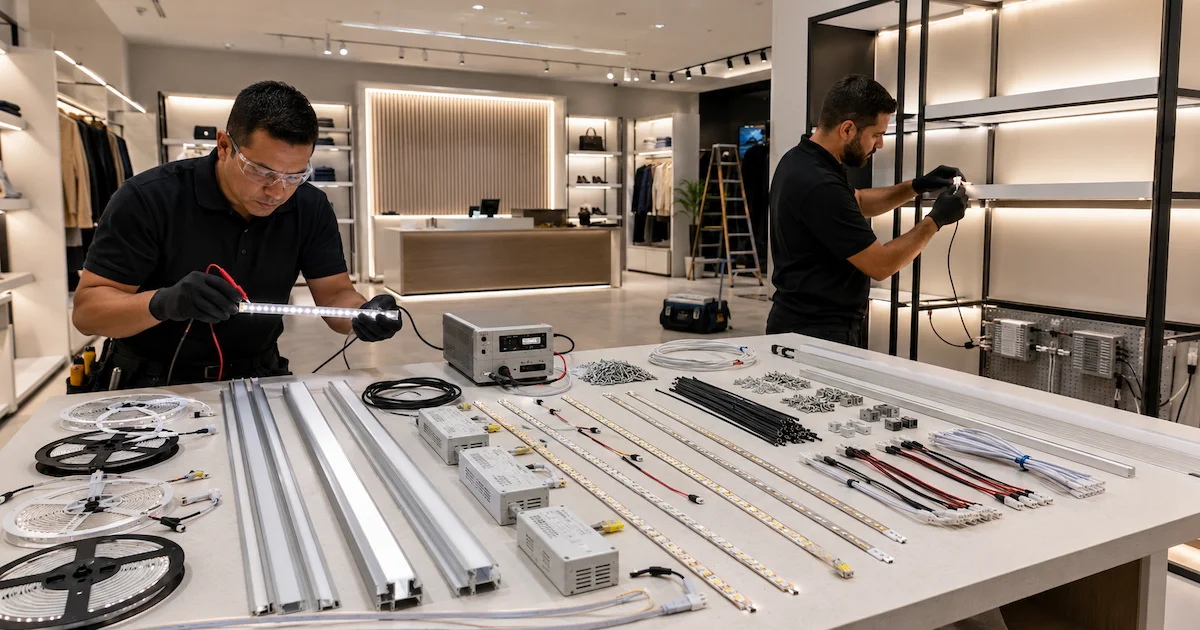
Include a written site plan and a labeled kit per module: lengths of strip, connectors, screws, profile pieces, and replacement LEDs. Train the installation crew on correct solder joints, how to measure for voltage drop, and where to place drivers for cooling.
| Step | Check Item | Why It Matters | Common Fix |
|---|---|---|---|
| 1 | Confirm voltage and driver output | Prevents strip damage | Match 12V/24V labels |
| 2 | Test strip before cutting | Finds defects early | Power each reel for inspection |
| 3 | Clean mounting surface | Stops peeling | Use alcohol wipe on metal/profile |
| 4 | Check feed length | Reduces voltage drop | Add parallel feeds for long runs |
| 5 | Use heat path | Protects LED life | Mount in aluminum profile |
| 6 | Label cables | Speeds maintenance | Use circuit tags |
| 7 | Run burn-in test | Finds weak joints | Test 2-4 hours before handover |
10. How should you source LED strip lights for pop up shop projects?
Good sourcing goes beyond price. Request datasheets with wattage, lumen output, CCT tolerance, CRI, LED quantity, PCB width, cutting length, IP rating, and warranty. Ask for integrating sphere results or sample tests for strict output needs.
Order spares from the same batch (3–5% allowance), and request pre-cut lengths, pre-soldered wires, JST connectors, waterproof end caps, and labeled kits to reduce onsite labor.
Three sourcing questions to ask:
- Can the supplier keep the same CCT bin for project quantity and spares?
- Can they provide CE, RoHS, UL, or CB documents for the market?
- Can they build kits that reduce installer work at the site?
If you work with an agency or contractor, include these specifications in the procurement tender and request photographic evidence of sample assemblies. For large rollouts, negotiate lead times, batch control, and penalty terms for mismatches.
Conclusion
Led strip lights for pop up shop work best when specified as a system: choose the right strip type, voltage, CCT/CRI, aluminum profile, driver with headroom, IP rating as needed, and clear wiring plans. Approve samples in the assembled or mock-up layout, order spares from the same bin, and use pre-wired kits to reduce setup time. If you need help with voltage drop, driver sizing, or kit design, send your layout to our engineering team for a practical review.
A final practical tip: build a single full-size mock-up module and run it for a full business day with all shop systems active (sound, POS, refrigeration if any). This catches glare, heat, and color issues before you roll out the rest of the pop up.
FAQ
Q1: What are led strip lights for pop up shop displays?
They are flexible linear LED products used to light shelves, counters, signage, glass cases, and brand displays in temporary retail spaces. They are thin, easy to hide, fast to install, and available in many brightness levels and color temperatures.
Q2: Is 12V or 24V better for a pop up shop?
For most medium and long retail runs, 24V is better because it lowers current and reduces voltage drop. 12V is suitable for short modules, compact signs, and small display boxes.
Q3: What color temperature should I use for retail products?
Use 2700K-3000K for warm premium displays, 3500K-4000K for general retail and cosmetics, and 5000K-6500K for technical or electronics displays. For color-sensitive goods, choose CRI90 or higher.
Q4: Do LED strips need aluminum profiles in temporary shops?
Yes, in most professional projects. Aluminum profiles help control heat, protect the strip, improve appearance, and reduce peeling risk during transport and operation.
Q5: How can I reduce installation time on pop up shop lighting?
Use pre-cut strips, pre-soldered leads, labeled connectors, matched drivers, and module-based wiring diagrams. Testing each kit before shipment also reduces site troubleshooting and opening-day stress.
