
Here’s the deal: led strip lights for spa room use must be specified like a technical system, not a decorative accessory. From our manufacturing floor perspective, the stable result comes from matching CCT, CRI, voltage, IP rating, heat path, dimming protocol, and batch control before the order is placed.
1. What mood should spa lighting create?
Spa zones need different light behavior
A spa room should feel calm, clean, and safe. That does not mean every area should use the same LED strip. A massage room may need 2200K to 2700K indirect lighting. A facial treatment room may need 3000K to 3500K with higher CRI so technicians can see skin tone accurately. A reception wall can accept slightly brighter accent lines to guide visitors.
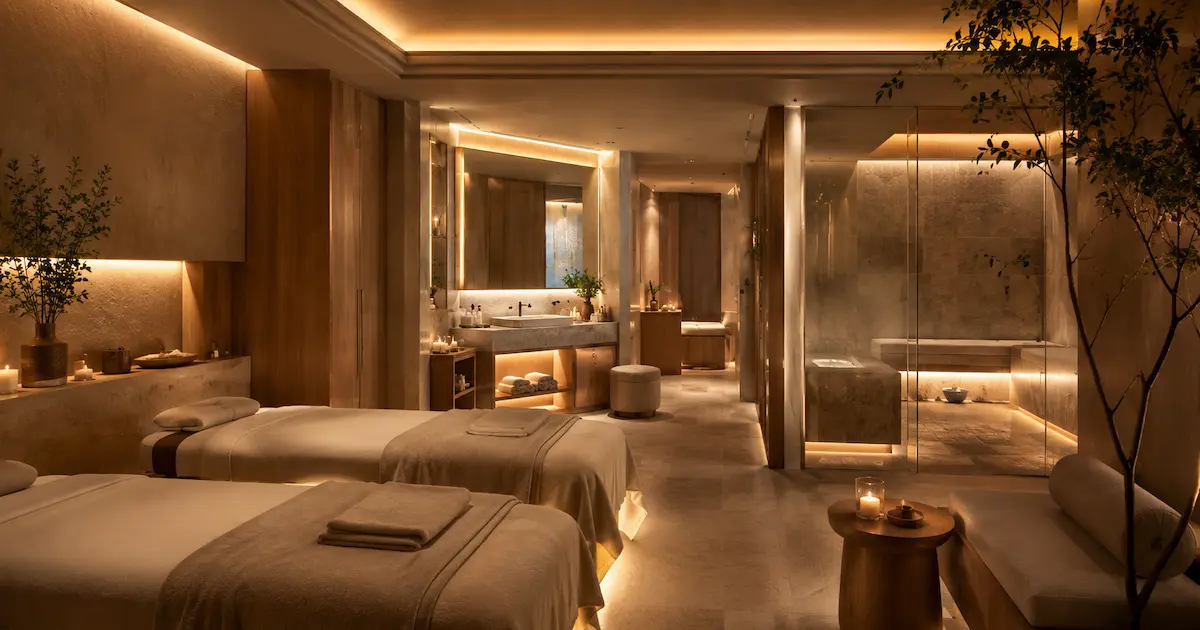
We often see installers struggle with one common issue: the client asks for “warm white,” but no one defines the exact CCT and tolerance. One batch at 2700K and another at 3000K can create a visible mismatch in a luxury hotel spa corridor. That means rework, extra labor, and margin loss.
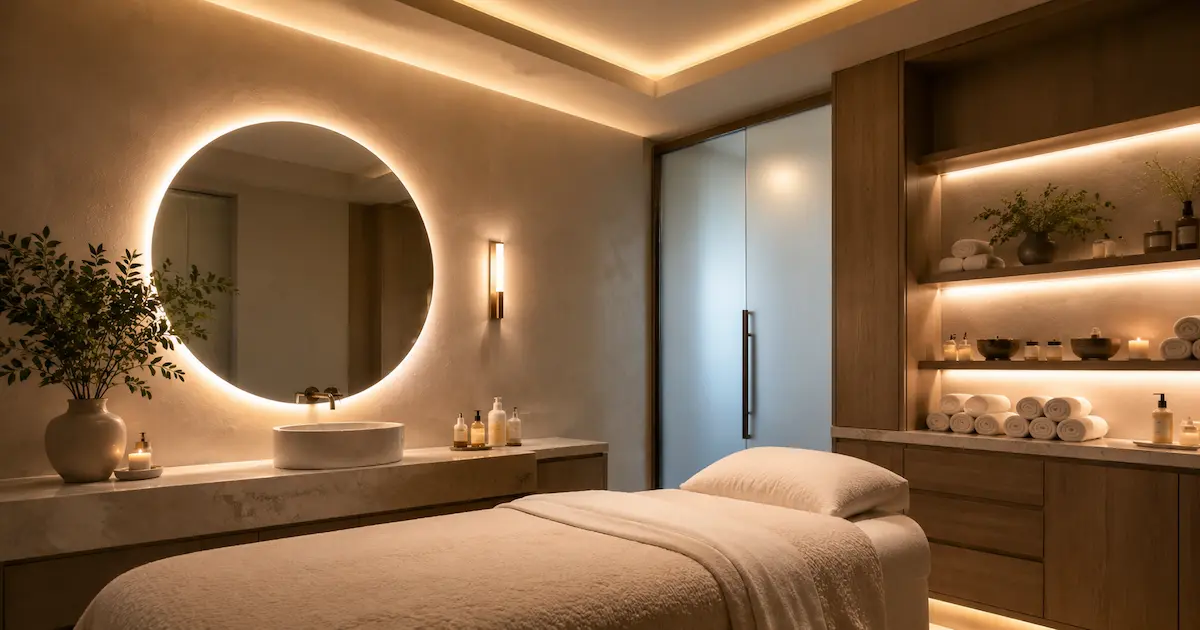
Use led strip lights for spa room designs with zone-based specs. In a steam-adjacent relaxation room, choose a sealed strip in an aluminum profile. In a dry ceiling cove, a high-CRI indoor strip may work better because it runs cooler and gives cleaner color.
| Spa Area | Suggested CCT | CRI Target | Lighting Style | Main Risk |
|---|---|---|---|---|
| Massage room | 2200K–2700K | 90+ | Indirect cove | Too bright or harsh |
| Facial room | 3000K–3500K | 90–95+ | Mirror/back wall | Poor skin color rendering |
| Reception | 2700K–3000K | 80–90+ | Accent/profile | Color mismatch |
| Wet relaxation zone | 2700K–3000K | 90+ | Sealed indirect | Moisture ingress |
2. Which LED strip type fits a spa room best?
SMD, COB, and tunable white strips
The best strip depends on the room’s visual target and installation distance. Standard SMD LED strips are cost-effective and flexible. They work well inside deep coves where LED dots are hidden. Understanding what a COB LED strip is helps explain why COB strips produce a continuous, dot-free line that suits visible shelves, mirrors, and shallow aluminum profiles. Tunable white strips allow staff to shift from warm relaxation light to clearer cleaning light after closing.
Common Myth: Higher wattage always means better brightness. Reality: lumen efficiency, optical loss, profile cover, dimming curve, and surface reflection decide the final effect. A 14.4W/m strip with poor efficiency can look weaker than a 10W/m strip with better LED chips and a suitable diffuser.
In our lab tests using integrating spheres, we check lumen output, color temperature, CRI, and consistency after warm-up. This matters because spa owners notice subtle color shifts on beige stone, wood panels, and cream walls. Poor binning may pass in a warehouse, but it fails in a spa room.
For spa-room projects, an experienced COB LED strip light manufacturer can provide dot-free COB strips for visible lighting, high-density SMD strips for hidden coves, and tunable-white solutions for multi-use treatment rooms.
| Strip Type | Best Use | Benefit | Watch Point |
|---|---|---|---|
| SMD 2835 | Ceiling coves | Good lumen per watt | Needs diffuser or hidden view |
| COB | Mirrors, shelves, shallow profiles | Dot-free line | Check heat and power density |
| Tunable white | Treatment rooms | Adjustable ambience | Needs compatible controller |
| RGBW | Feature walls | Color scenes | Avoid overuse in therapy areas |
The following independent electrical guide provides a practical overview of the main factors to consider when selecting LED strip lighting for professional architectural and spa applications.
3. How should you choose color temperature and CRI?
Color quality affects comfort and trust
Color temperature is one of the biggest decisions for led strip lights for spa room applications. Warm white supports relaxation. Neutral white helps task visibility. If you use cool white in massage or rest zones, the room can feel like a clinic. If you use very warm white in treatment work areas, staff may struggle to see details.
CRI also matters. The U.S. Department of Energy’s guide to lighting principles and terms provides a useful explanation of color temperature, color quality, lumen output, and the Color Rendering Index. CRI 80 may be accepted for many decorative jobs, but spa rooms with skin treatments, cosmetics, towels, stone finishes, and wood textures benefit from CRI 90 or above. R9 value, which relates to red rendering, should not be ignored for facial and beauty zones.
We once reviewed a field case where a contractor installed low-CRI strips behind mirrors. The client complained that faces looked dull and greenish. The strip was not defective. It was simply the wrong color quality for the task.
Pro Tip from the VST Technical Team: “For spa mirrors and facial treatment rooms, specify CRI 90+ and ask for a test sample on the actual wall finish. A lab report is useful, but the final surface reflection tells the real story.”
| Application | Recommended CCT | CRI | Reason |
|---|---|---|---|
| Relaxation room | 2200K–2700K | 90+ | Calm and warm feeling |
| Massage room | 2400K–3000K | 90+ | Soft light without fatigue |
| Facial treatment | 3000K–3500K | 90–95+ | Better skin tone visibility |
| Cleaning mode | 4000K optional | 80–90+ | Higher clarity after hours |
4. What voltage is better: 12V or 24V?
Voltage affects run length and labor cost
For professional spa projects, sourcing from a qualified 24V LED strip manufacturer is often the safer choice for longer coves, corridors, and ceiling runs where consistent brightness is critical. It reduces current, lowers voltage drop, and keeps brightness more consistent across the strip length. 12V can still work for short mirrors, small cabinets, and custom furniture pieces.
When we tested this against a standard 12V strip on a long cove run, the far end showed a visible brightness drop without multi-point feeding. The 24V version performed better under the same layout because the current was lower. This is exactly why voltage planning affects your bottom line. If installers must return to add feed wires after the ceiling is closed, the profit on that room can disappear.
Use 24V for long coves, corridors, ceiling lines, and large relaxation rooms. Use 12V where cut intervals, small modules, or short furniture details matter more than run length.
| Feature | 12V LED Strip | 24V LED Strip |
|---|---|---|
| Best run length | Short runs | Medium to longer runs |
| Voltage drop | Higher risk | Lower risk |
| Cut interval | Usually shorter | Usually longer |
| Current load | Higher | Lower |
| Best spa use | Mirrors, cabinets | Coves, corridors, feature walls |
| Installation cost risk | More feed points | Fewer feed points |
5. Which IP rating should spa rooms use?
Moisture level decides protection level
Spa rooms are not all wet rooms. A dry reception feature wall does not need the same strip protection as a steam room perimeter. Using too low an IP rating creates safety risk. The International Electrotechnical Commission’s guide to IP ratings explains how electrical enclosures are classified for their resistance to solid particles, dust, and water ingress. Using too high a protection level in a dry, hot cove can trap heat and shorten LED life.
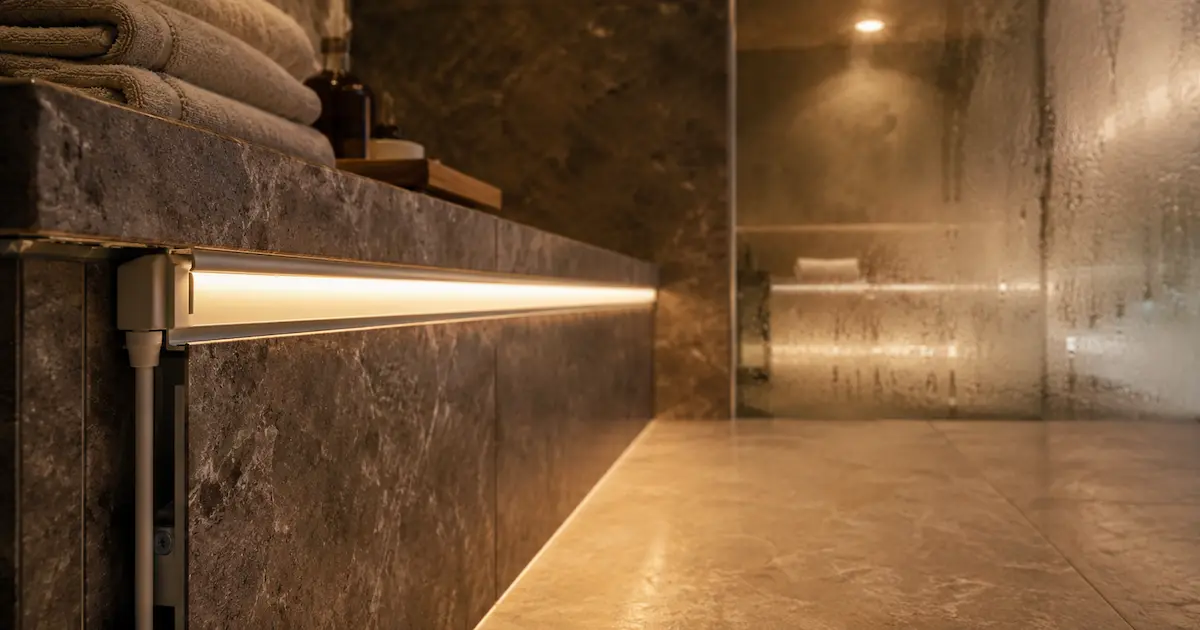
For led strip lights for spa room projects, classify each area before choosing the strip. Dry ceiling coves often use IP20 inside profiles. Splash zones may need IP65 silicone coating. Areas close to steam, water jets, or cleaning spray may require an IP67 system from a reliable waterproof LED strip manufacturer, including full silicone extrusion, sealed end caps, and protected cable exits.
But there’s a catch: IP rating is only as strong as the weakest point. Properly wiring waterproof LED strip lights is essential because cut ends, solder joints, connectors, cable exits, and driver boxes often fail before the sealed strip body. We have seen sealed strips installed with unsealed field cuts. Moisture entered from the end, traveled under the coating, and caused dark sections after a few weeks.
| IP Rating | Protection Level | Suitable Spa Location | Installation Note |
|---|---|---|---|
| IP20 | Dry indoor | Reception coves, dry shelves | Use profile cover for dust control |
| IP65 | Splash resistant | Vanity areas, wash zones | Seal cut points carefully |
| IP67 | Temporary water exposure | Steam-adjacent zones | Use molded or sealed ends |
| IP68 | Higher water exposure | Special wet details | Confirm driver and cable ratings too |
6. How do drivers and dimming affect spa comfort?
Flicker can ruin the client experience
A spa room is one of the worst places for flicker. Guests are lying still, eyes partly closed, and highly sensitive to visual disturbance. Cheap drivers, mismatched PWM dimmers, and overloaded circuits can create flicker, buzzing, or unstable low-end dimming.
Choose drivers with enough power margin. A practical rule is to load drivers at about 80% of rated capacity. For example, a 100W driver should carry around 80W of LED strip load, especially in warm ceiling spaces. This gives better thermal behavior and longer service life.
For control, match the dimming method to the project system. 0-10V is common in commercial work. DALI suits projects needing scene control and central management. Triac can work in smaller projects, but compatibility must be tested before bulk shipment.
We explain this specific driver matching process because ignoring it leads to callbacks. A strip that looks fine at full brightness may flicker badly at 10% output during a massage session, so installers should know how to fix LED strip lights flickering before commissioning the room.
| Dimming Type | Best Fit | Benefit | Risk |
|---|---|---|---|
| PWM controller | Simple strip systems | Smooth control if matched | Poor units may flicker |
| 0-10V | Commercial rooms | Widely accepted | Needs correct control wiring |
| DALI | Hotel/spa networks | Scene setting and grouping | Higher setup skill needed |
| Triac | Small retrofit jobs | Uses wall dimmer style | Compatibility issues common |
7. How should LED profiles and heat dissipation be planned?
Aluminum profile is part of the system
LED strip lights for spa room installations should rarely be stuck directly onto painted drywall or wood. The adhesive is not a heat sink. Understanding why LED strips need aluminium profiles is important because the profile removes heat, protects the strip, improves light diffusion, and makes future maintenance easier.
Our Chief Engineer notes that heat dissipation is often ignored in low-watt decorative jobs because the strip feels “not too hot” during a quick test. After several hours in a closed cove, the temperature can rise enough to reduce LED life and weaken adhesive. Thermal stress also affects silicone coating, solder points, and diffuser color over time.
Profile selection depends on visibility. A deep recessed LED profile works well for spa ceiling coves and wall slots because it hides the light source, improves diffusion, and provides a more effective heat path. Shallow surface profiles suit under-bench lighting. Corner profiles can wash stone walls softly. For wet zones, select profiles with proper covers and mechanical fixing rather than relying only on tape.
From our manufacturing floor perspective, we prefer to test strip and profile combinations together. A strip may pass power tests alone, yet run hotter in a narrow profile with a milky diffuser.
| Profile Type | Spa Use | Light Effect | Heat Performance |
|---|---|---|---|
| Recessed profile | Ceiling and wall slots | Clean architectural line | Good if enough depth |
| Surface profile | Under bench, cabinets | Easy access | Medium to good |
| Corner profile | Wall wash, shelves | Angled soft light | Good with metal contact |
| Flexible neon profile | Curved accents | Continuous glow | Check bend radius and heat |
8. What installation details reduce callbacks?
Small details decide project profit
Spa lighting failures often come from installation details, not the LED strip itself. Wrong cable size causes voltage drop. Poor soldering creates hot spots. Unsealed cuts allow moisture ingress. Drivers hidden in hot, inaccessible ceilings make service slow and expensive.
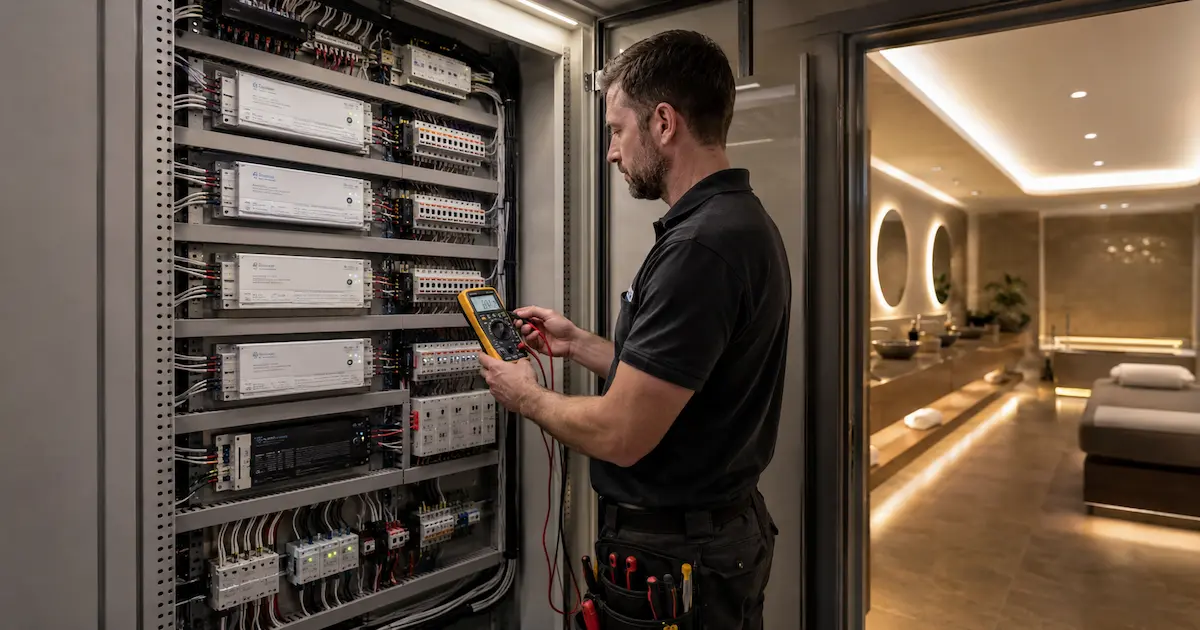
We often see installers struggle with long cove runs where the layout was not calculated before ordering. For example, a 20-meter perimeter at 12W/m needs 240W total power. That load should be split across drivers and feed points based on cable distance, driver location, and dimming zones.
Use pre-soldered leads where possible. Factory soldering gives cleaner joints and can save installers meaningful time on site. For repeated hotel spa rooms, custom lengths reduce waste and make the final look more consistent.
| Step | Checkpoint | Why It Matters | Field Fix |
|---|---|---|---|
| 1 | Confirm CCT and CRI sample | Prevents client rejection | Approve sample board |
| 2 | Calculate total watts | Avoids driver overload | Add 20% power margin |
| 3 | Plan feed points | Reduces voltage drop | Feed from both ends if needed |
| 4 | Seal cut ends | Stops moisture failure | Use silicone end caps and glue |
| 5 | Mount profiles mechanically | Prevents strip sagging | Use clips or screws |
| 6 | Test dimming at low level | Finds flicker early | Swap driver/controller if needed |
9. How do safety certifications and materials protect the project?
Compliance is tied to liability
Spa spaces mix low light, moisture, human contact, towels, oils, and cleaning chemicals. Safety compliance is not just paperwork. It reduces risk for contractors, wholesalers, and property owners. CE, RoHS, UL, and CB documents may be needed depending on the sales market and final installation rules.
Check more than the strip label. Review driver certification, cable rating, connector quality, flame resistance, and silicone material. The UL Solutions wire and cable application guide can help specifiers understand cable markings, insulation properties, and temperature ratings for dry, damp, and wet operating conditions. Some low-cost coatings yellow quickly or crack under heat. Poor PVC insulation can harden near warm coves. Weak adhesive may release from profiles after repeated humidity cycles.
In our lab tests using integrating spheres and thermal cameras, we connect photometric data with heat behavior. A strip that runs too hot may shift color or lose output faster. Burn-in testing also helps catch early failures before shipment.
| Item to Verify | Recommended Check | Business Risk if Ignored |
|---|---|---|
| LED strip certification | CE/RoHS or market-required docs | Failed inspection or rejection |
| Driver approval | UL/CE/CB where required | Electrical liability |
| Silicone quality | Anti-yellowing and flexible | Color shift and cracking |
| Cable rating | Proper size and insulation | Heat, drop, or failure |
| Batch color binning | 3-step or 5-step MacAdam | Visible mismatch |
10. How should you specify and purchase spa room LED strips?
A clear spec sheet avoids guesswork
The best purchasing process starts with a room schedule, not a product link. List each spa area, lighting purpose, run length, CCT, CRI, voltage, IP rating, profile type, driver location, dimming method, and required certification. This makes quotations easier to compare and reduces “cheap but wrong” offers.
For led strip lights for spa room orders, ask for test reports, batch binning details, sample pieces, and driver compatibility notes. If the project uses 0-10V or DALI, request a small mock-up before full production. If it uses wet-zone strips, request photos of sealed ends and cable exits.
A practical specification may look like this: 24V COB LED strip, 2700K, CRI 90+, 10W/m, IP65 for vanity zones, aluminum profile with opal diffuser, 0-10V dimmable driver, 20% power reserve, and factory pre-soldered leads at fixed lengths.
This is where it gets interesting: the lowest unit price is not always the lowest project cost. Custom lengths, stable color bins, and clear wiring drawings can save more money than a small strip price reduction.
| Spec Item | What to Define | Suggested Spa Standard |
|---|---|---|
| Voltage | 12V or 24V | 24V for longer runs |
| CCT | Exact Kelvin value | 2700K or 3000K common |
| CRI | Color rendering | 90+ for treatment zones |
| IP rating | Moisture protection | IP20 dry, IP65/IP67 wet areas |
| Control | Dimming system | 0-10V, DALI, or PWM |
| Delivery form | Reel or custom length | Custom cuts for repeat rooms |
Conclusion
LED strip lights for spa room projects need calm visuals, stable color, safe moisture protection, smooth dimming, and correct heat management. The best result comes from treating the strip, driver, profile, controller, and installation method as one system. If you are unsure about voltage drop, driver sizing, or IP rating for a specific spa layout, send our engineering team your drawings.
FAQ
Q1: What is the best color temperature for led strip lights for spa room use?
For most relaxation and massage zones, 2200K to 3000K works well. Facial treatment rooms may need 3000K to 3500K for clearer skin tone visibility. Always approve a real sample on the final wall or ceiling finish.
Q2: Are 12V or 24V LED strips better for spa rooms?
24V is usually better for longer coves and corridors because it reduces voltage drop. 12V can work for short mirrors, cabinets, and small furniture details where short cut intervals are useful.
Q3: What IP rating should I use near steam or water?
Use IP65 for splash-prone areas and IP67 for steam-adjacent or wetter zones. Dry coves can often use IP20 inside aluminum profiles. Seal cut ends, connectors, and cable exits carefully.
Q4: Why do some spa LED strips flicker when dimmed?
Flicker often comes from mismatched drivers, low-quality PWM controllers, overloaded power supplies, or incompatible Triac dimmers. Test the strip, driver, and controller together at low brightness before bulk installation.
Q5: Do LED strips in spa rooms need aluminum profiles?
Yes, in most professional installations. Profiles improve heat dissipation, protect the strip, create cleaner lines, and make servicing easier. They also reduce the chance of adhesive failure in warm or humid spaces.
