
LED strip lights for restaurant booth seating are flexible linear lighting systems used under seats, behind backrests, along toe-kicks, or inside booth dividers to create safe, comfortable, and brand-matched dining zones. The right choice depends on voltage, brightness, color temperature, dimming, heat control, IP rating, and installation method.
1. What makes restaurant booth LED strip lighting different from decorative lighting?
Restaurant booths need lighting that survives commercial use. This is not the same as a bedroom accent strip or a short retail display sample. A booth may run 10 to 16 hours per day, sit near food spills, face repeated cleaning, and operate in warm seating cavities with limited airflow.
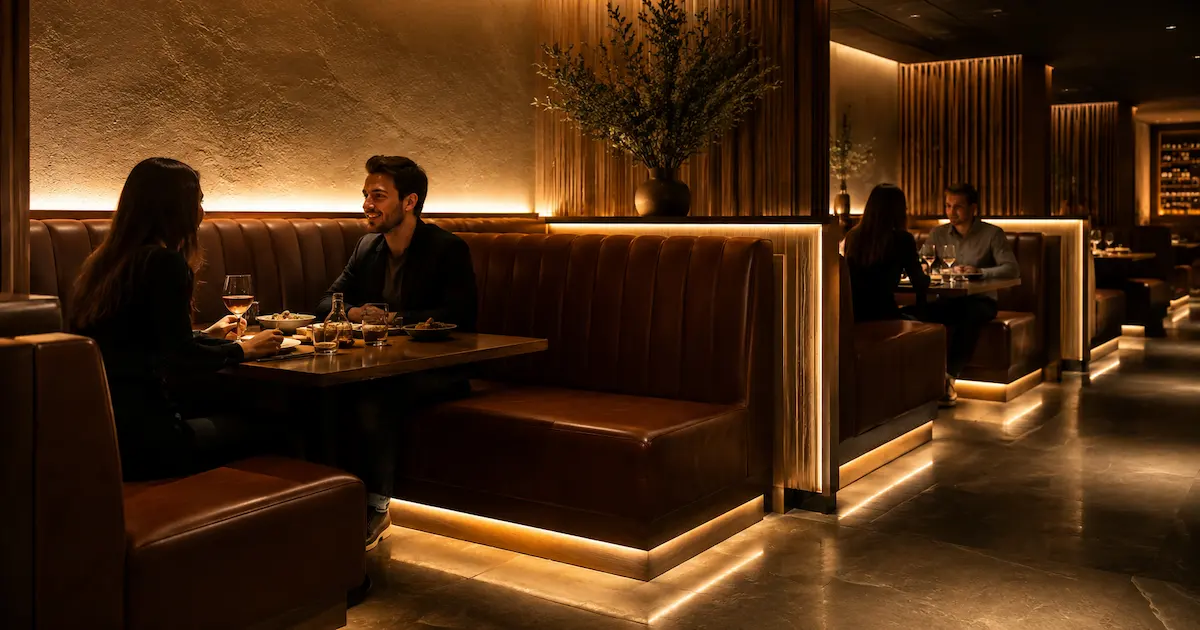
Here’s the deal: the hidden environment is harder than it looks. Applying the right solution to LED strip heat issues is especially important in under-seat cavities, where restricted airflow can trap heat and accelerate lumen loss, adhesive failure, and solder-joint fatigue. Backrest channels can pinch wires. Toe-kick zones collect mop water and dust. If the LED strip lacks proper copper thickness, adhesive strength, and thermal path, early lumen loss is likely.
For led strip lights for restaurant booth seating, the design goal is controlled ambience without service disruption. Three field examples show the difference:
- ● A casual dining chain may use warm 2700K strips under booths to guide customers safely at night.
- ● A sushi bar may place low-glare COB strips behind booth backs to create a soft wall glow.
- ● A hotel restaurant may require dim-to-warm control so breakfast, lunch, and dinner scenes feel different.
| Booth Lighting Zone | Typical Purpose | Recommended Strip Type | Risk If Poorly Specified |
|---|---|---|---|
| Under-seat edge | Safety and ambience | 24V low-watt strip in aluminum profile | Heat build-up and adhesive failure |
| Backrest cove | Indirect glow | COB or high-density SMD | Visible dotting and client rejection |
| Toe-kick | Wayfinding | IP65 strip with sealed profile | Moisture damage from cleaning |
| Booth divider | Brand effect | RGBW or tunable white | Controller mismatch and flicker |
This affects your bottom line because booth lighting failures usually require after-hours repair, causing labor, travel, and unhappy restaurant owners. The following educational case study shows how carefully layered hospitality lighting can improve restaurant atmosphere, visual comfort, and the overall guest experience.
2. Which voltage is better for restaurant booth strip lights, 12V or 24V?
For most restaurant booth projects, 24V is the safer commercial choice. It reduces voltage drop, supports longer runs, and allows cleaner wiring layouts. 12V can still work for short booth sections, but it becomes less efficient on larger floor plans.
When we tested this against a standard 12V strip, the difference showed up clearly on a 10-meter run. The 12V strip had visible brightness loss near the far end. The 24V strip held a more stable output with the same layout style. That matters in a row of booths because uneven brightness makes the installation look cheap, even if the strip itself is not defective.
Use 12V only when runs are short, power injection is easy, and the driver is close to the booth. Use 24V when the project has multiple booths, central driver locations, or dimming control panels.
| Specification | 12V LED Strip | 24V LED Strip |
|---|---|---|
| Best Run Length | Short runs, usually 2–5 m | Medium runs, usually 5–10 m |
| Voltage Drop Risk | Higher | Lower |
| Cable Current | Higher current for same wattage | Lower current for same wattage |
| Driver Placement | Needs closer driver | More flexible placement |
| Restaurant Booth Fit | Small custom booths | Most commercial booth layouts |
Pro Tip from VST Technical Team: “If one driver feeds several booths, start with 24V and calculate voltage drop before choosing cable size. It saves installers from late-stage rewiring.”
3. How bright should led strip lights for restaurant booth seating be?
Brightness should support comfort, safety, and the dining concept. More wattage is not always better. A booth is close to the guest’s eyes, legs, and table surface, so glare control matters more than raw lumen output.
The U.S. Department of Energy’s guide to lighting principles and terms explains how lumens, efficacy, glare, color temperature, and color rendering affect the quality and usefulness of illumination. Reality: lumen efficiency, LED density, diffuser quality, mounting angle, and surface reflectance decide the final visual result. A 10W/m strip with high efficiency can look cleaner than a 14.4W/m strip with poor diffusion and bad thermal control.
For ambient booth lighting, many projects use 300 to 800 lumens per meter, depending on placement. Under-seat strips can stay lower. Backrest cove strips may need higher output if the wall finish absorbs light. Similar to LED strip lights for lounge area projects, fine-dining booths usually require softer, glare-controlled illumination, while sports bars may use stronger accent levels to create a more energetic atmosphere.
From our manufacturing floor perspective, we also check LED binning and PCB consistency because two strips with the same wattage can look different if LEDs come from mixed bins.
| Application Area | Suggested Power | Suggested Output | Notes |
|---|---|---|---|
| Under-seat ambience | 4.8–9.6 W/m | 300–600 lm/m | Use diffuser to avoid dots |
| Backrest indirect light | 8–12 W/m | 500–900 lm/m | Aim light at wall or panel |
| Toe-kick safety light | 4.8–7.2 W/m | 250–500 lm/m | Keep glare low |
| Brand color feature | 10–14.4 W/m | Varies by color | Use RGBW for better white tone |
Why this matters: over-bright booths cause complaints. Under-bright booths make the restaurant look unfinished. Both can hurt repeat orders for contractors and suppliers.
4. What color temperature works best for restaurant booth ambience?
Color temperature shapes how food, skin tones, wood, leather, and wall finishes appear. For restaurant booths, warm white is the most common choice because it feels relaxed and supports hospitality design. In many projects, 2700K to 3000K is the sweet spot.
However, not every restaurant should use the same CCT. A steakhouse with dark timber booths may prefer 2400K to 2700K. In professional LED strip lights for coffee shop applications, a 3000K to 3500K color temperature can create a cleaner, fresher atmosphere while still preserving warmth around seating and food displays. A fast-casual restaurant with bright branding may use 4000K in select areas, but it can feel cold if placed near faces.
We explain binning because ignoring it leads to visible color mismatch across booth rows. In our lab tests using integrating spheres, we measure CCT, CRI, and lumen output before production approval. As with LED strip lights for bakery display installations, CRI 90+ is often worth the additional cost when booth lighting illuminates food, wood finishes, leather upholstery, or decorative surfaces.
| Restaurant Style | Suggested CCT | Suggested CRI | Visual Result |
|---|---|---|---|
| Fine dining | 2400K–2700K | CRI 90+ | Warm, intimate, premium |
| Casual dining | 2700K–3000K | CRI 80–90 | Friendly and comfortable |
| Café or bakery | 3000K–3500K | CRI 90+ | Clean, fresh food tones |
| Sports bar | 3000K–4000K | CRI 80+ | Brighter, energetic feel |
A small detail can become a large complaint. One mismatched batch in a booth row can force replacement of every meter in that zone.
5. Which LED strip type should you choose: SMD, COB, RGB, or RGBW?
The right strip type depends on viewing distance, diffuser depth, and lighting goal. SMD strips are cost-effective and available in many power levels. Understanding what a COB LED strip is helps explain why COB technology creates a smoother, more continuous light line with fewer visible dots in shallow booth coves and close-view applications. RGB strips offer color effects, while RGBW adds a dedicated white channel for better daily use.
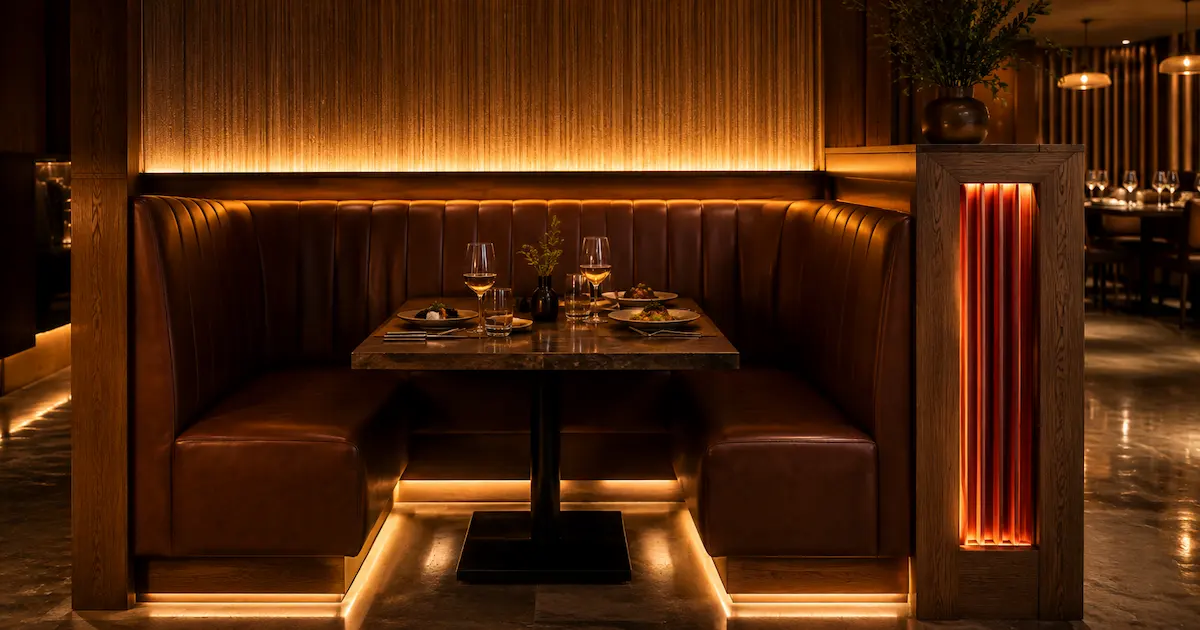
But there’s a catch. RGB alone often produces poor white light because it mixes red, green, and blue rather than using a real white LED. For restaurant booths that need both ambience and brand color, RGBW is usually a stronger option.
We often see installers struggle with dotting when the LED strip is mounted too close to a shallow diffuser. In that case, the problem is not only the strip. It is the combination of LED pitch, profile depth, diffuser opacity, and viewing angle.
| LED Strip Type | Best Use in Booths | Strength | Limitation |
|---|---|---|---|
| SMD 2835 | General warm white ambience | Good efficiency and cost | Dots may show in shallow profiles |
| SMD 5050 RGB | Color effects | Strong saturated colors | White quality is weak |
| RGBW | Brand scenes plus white light | Better control flexibility | Needs 5-core cable and controller |
| COB | Seamless indirect lines | Smooth, premium look | Usually higher cost |
For chain restaurants, standardization matters. If each location uses a different strip type, maintenance inventory becomes messy and profit margins shrink.
6. How do IP ratings and cleaning conditions affect booth strip selection?
Like LED strip lights for buffet table installations, restaurant-booth lighting must account for damp cleaning, food spills, chemical exposure, dust, and frequent contact even when it is positioned away from the kitchen. Staff may spray, wipe, mop, and use chemicals near seats every day. For led strip lights for restaurant booth projects, IP rating must match the cleaning method and mounting location.
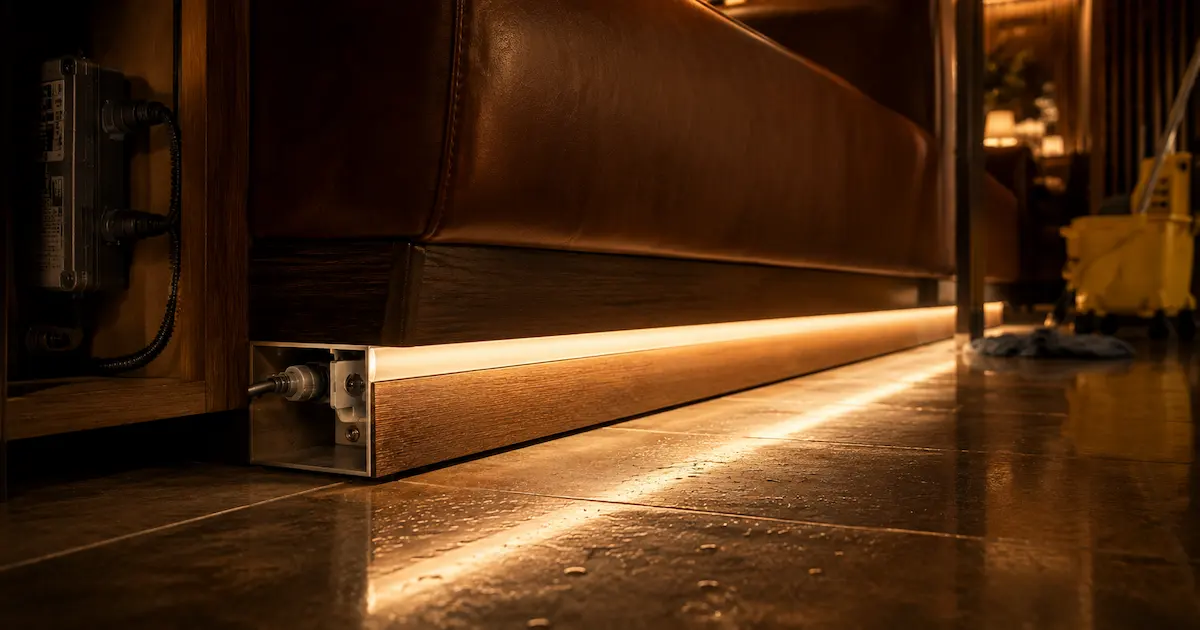
The International Electrotechnical Commission’s guide to IP ratings explains how electrical enclosures are classified according to their resistance to dust, solid objects, and liquid ingress. IP65 is safer for toe-kicks, under-seat edges, or areas exposed to damp cloths and light splashes. IP67 may be needed near heavy wash-down zones, but it can trap heat if used in enclosed channels without thermal planning.
A higher IP rating is not always better. Silicone coating improves moisture resistance, but it can reduce heat dissipation. If a high-wattage strip is sealed tightly into a small booth cavity, LED temperature rises and life span drops.
| IP Rating | Protection Level | Good Booth Location | Caution |
|---|---|---|---|
| IP20 | Dry indoor only | Hidden backrest cove | No splash resistance |
| IP65 | Dust and low splash | Toe-kick, under-seat | Check connector sealing |
| IP67 | Temporary water exposure | Damp custom zones | Watch heat build-up |
| IP68 | Extended water exposure | Rare for booths | Often unnecessary cost |
For safety and liability, match strip rating with the cleaning plan. Ask how staff clean booths before you quote the project.
7. What mounting method gives the longest service life?
Adhesive backing alone is not a commercial mounting method for restaurant booths. It helps during positioning, but it should not be the only support. ENERGY STAR’s guide to learn about LED lighting explains that the heat produced by LEDs must be transferred into a heat sink to prevent performance problems and support reliable operation.
The better approach is aluminum profile mounting with clips, screws, or concealed brackets. Understanding why LED strips need aluminium profiles helps explain how the channel spreads heat, keeps the strip aligned, protects it from impact, supports mechanical fixing, and improves the finished appearance. A milky diffuser also reduces dotting and glare.
We once saw a project fail because strips were stuck directly under booth seats on painted plywood. After three months, sections sagged, collected dust, and pulled on solder joints. The strip was blamed, but the root cause was mounting design.
| Mounting Method | Service Life Impact | Best Use | Risk Level |
|---|---|---|---|
| Adhesive only | Low for commercial use | Temporary mock-up | High peeling risk |
| Adhesive plus clips | Medium | Short hidden runs | Clip spacing must be tight |
| Aluminum profile | High | Most booth projects | Needs planning depth |
| Recessed channel | Very high | Premium custom furniture | Requires furniture coordination |
From our manufacturing floor perspective, pre-soldered leads and cut-to-length strips reduce site labor. They also reduce bad solder joints inside tight booth frames. That small factory step can save hours across a restaurant fit-out.
8. How should drivers, dimmers, and controls be specified?
Drivers and controls decide how stable the lighting feels. A good strip with a poor driver may flicker, buzz, dim unevenly, or fail early. For restaurants, constant-voltage drivers with the correct wattage reserve are the usual choice.
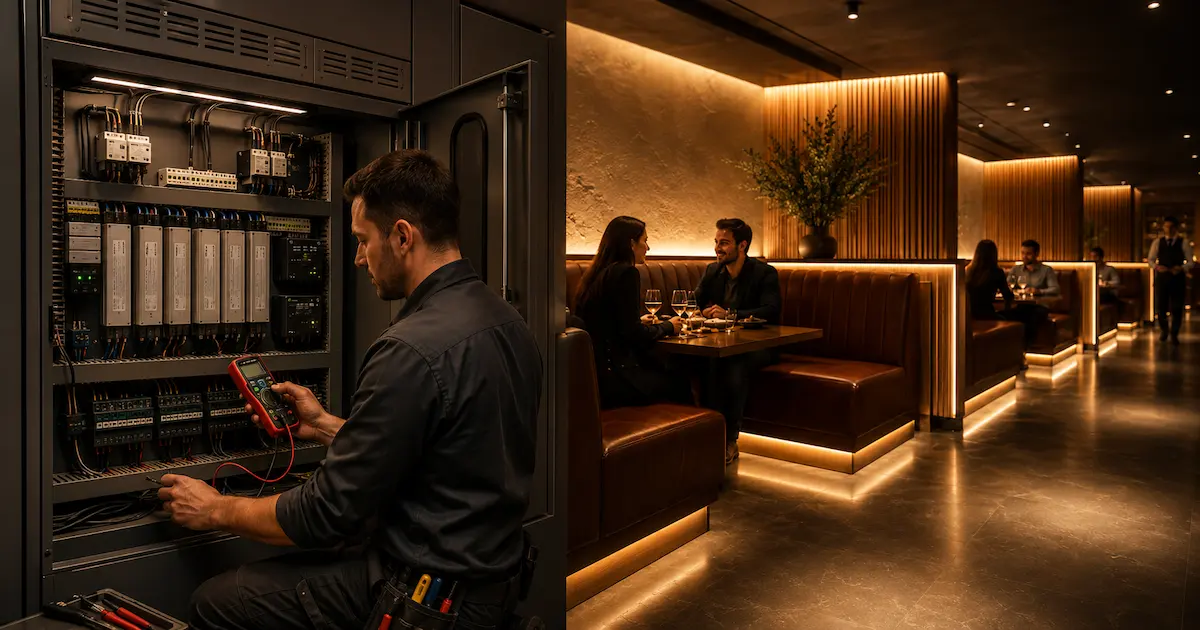
A practical rule is to load drivers at about 80% of rated capacity. For example, if the booth lighting load is 80W, specify a 100W driver rather than running an 80W unit at full load. This improves thermal margin and reduces stress.
The DALI Alliance’s overview of DALI protocol key features explains how standardized digital control provides accurate, repeatable adjustment of lighting levels in commercial systems. PWM dimming is common for LED strips, but low-quality controllers can create camera flicker or visible stepping. For higher-end restaurants, DALI, 0–10V, DMX, or TRIAC-compatible systems may be requested, depending on the site control platform.
| Control Type | Best Fit | Advantage | Watch Point |
|---|---|---|---|
| On/off driver | Simple booths | Lowest cost | No scene control |
| 0–10V dimming | Commercial dining | Stable central control | Needs compatible driver |
| DALI | Hotel and chain sites | Addressable zones | Higher setup skill needed |
| DMX | RGB/RGBW scenes | Strong color control | Needs commissioning |
| TRIAC dimming | Retrofit sites | Uses wall dimmers | Compatibility testing needed |
Why this matters to profit: control problems are hard to diagnose after furniture is fixed in place. Specify the driver and dimmer together, not as separate afterthoughts.
9. What installation checklist reduces callbacks and project delays?
A booth LED installation succeeds when electrical, mechanical, and visual checks happen before final handover. Following a professional LED strip light wiring plan helps prevent failures caused by reversed polarity, undersized cables, missing power-injection points, poor connections, and untested control compatibility.
We often see installers struggle with restaurant schedules because lighting is installed between furniture, flooring, and final cleaning. If the strip arrives without labels or pre-cut sections, the team wastes time matching lengths on site.
Use a checklist before the first booth is closed. Test one complete booth as a sample, approve color and brightness with the client, then repeat the approved method across the site. This protects schedule and reputation.
| Installation Checklist Item | Action | Why It Matters |
|---|---|---|
| Confirm strip length per booth | Measure after furniture mock-up | Prevents short or excess runs |
| Calculate total wattage | Add 20% driver reserve | Reduces overload risk |
| Check voltage drop | Test far-end voltage | Avoids dim ends |
| Clean mounting surface | Remove dust, oil, wax | Improves adhesion and profile seating |
| Use aluminum profile | Mount with clips or screws | Controls heat and alignment |
| Test dimming | Check low-end stability | Prevents flicker complaints |
| Label cables | Mark zones and polarity | Speeds future service |
A disciplined checklist is boring. That is exactly why it works. It removes guesswork when the site is busy.
10. How do you plan maintenance, safety, and sourcing for repeat restaurant projects?
Restaurant booth lighting should be planned as a repeatable system, not a one-time custom experiment. For chains, distributors, and contractors, the best outcome is a specification that can be produced, installed, and serviced in the same way across many locations.
Start with documentation. Keep records for strip model, CCT, CRI, wattage, driver model, control type, wiring diagram, cut lengths, and connector type. If a section needs replacement two years later, matching the original batch will be much easier.
Safety certifications also matter. CE, RoHS, UL, or CB requirements depend on the market and project type. Do not treat them as logos on a datasheet. They relate to legal access, inspection approval, and liability management.
| Common Failure Mode | Likely Cause | Field Fix | Better Prevention |
|---|---|---|---|
| Strip dims at far end | Voltage drop | Add power injection | Use 24V and correct cable size |
| Sections turn off | Loose solder joint | Reconnect or replace section | Use factory pre-soldered leads |
| Color mismatch | Mixed LED bins | Replace affected area | Specify binning tolerance |
| Flicker at low dim level | Driver or controller mismatch | Change dimmer setting or driver | Test full control chain early |
| Peeling strip | Heat or bad surface | Re-mount in profile | Use mechanical fixing |
For led strip lights for restaurant booth programs, sourcing consistency affects every future location. Request aging test data, photometric data, wiring diagrams, and real production photos when needed. It keeps the project transparent and reduces surprises.
Conclusion
LED booth lighting can make a restaurant feel safer, warmer, and more refined, but only when the strip, driver, profile, controls, and installation method work as one system. Choose 24V for longer runs, match CCT to the dining concept, control heat with aluminum profiles, and test dimming before handover. If unsure about voltage drop, IP rating, or custom lead lengths, send our engineering team your booth drawings for a layout review.
FAQ
Q1: What are led strip lights for restaurant booth seating?
They are flexible linear LED systems installed under seats, behind backrests, along toe-kicks, or inside booth details to provide ambience, safety lighting, and brand effects. Commercial booth strips should be specified for heat control, cleaning exposure, dimming, and long operating hours.
Q2: Are 12V or 24V LED strips better for restaurant booths?
24V is usually better for commercial booth layouts because it reduces voltage drop and supports longer runs with cleaner wiring. 12V can work for short sections where the driver sits close to the strip.
Q3: What color temperature is best for restaurant booth lighting?
Most restaurants use 2700K to 3000K for a warm and comfortable atmosphere. Fine dining may prefer 2400K to 2700K, while cafés may use 3000K to 3500K for a cleaner look.
Q4: Do restaurant booth LED strips need waterproof protection?
It depends on location and cleaning method. IP20 can work in dry, sealed channels, while IP65 is safer for toe-kicks and under-seat areas exposed to damp cleaning. IP67 should be used only when the heat design supports it.
Q5: How can contractors reduce callbacks on booth LED installations?
Use 24V strips where suitable, size drivers with spare capacity, mount strips in aluminum profiles, test dimming before handover, label wiring, and confirm CCT consistency before full installation.
