
LED Linear Profiles vs. Traditional Lighting compares modern aluminum LED channel systems with fluorescent tubes, halogen fixtures, incandescent lamps, and other legacy light sources. LED linear profiles usually offer better heat control, cleaner installation, longer service life, lower energy use, and more flexible optical design.
Many contractors, distributors, and project managers still face the same question: should a project stay with familiar traditional fixtures, or move to LED strip lights installed inside aluminum profiles, especially when comparing linear light vs profile light options for modern projects? The wrong choice can cause callbacks, uneven light lines, glare complaints, higher power bills, or project delays.
This article gives a practical comparison from a manufacturing and field application view. In our lab tests using integrating spheres, thermal imaging cameras, and aging racks, we see how small details like profile depth, diffuser material, LED density, and driver selection affect real installations.
1. What Are LED Linear Profiles and Traditional Lighting?
LED aluminum profiles are aluminum channels designed to hold LED strip lights, diffusers, end caps, clips, and sometimes suspension or recessed mounting accessories. They create a clean line of light while helping remove heat from the LED tape. You may see them in cabinets, retail shelves, hotel corridors, ceiling coves, stair edges, office partitions, and furniture lighting.
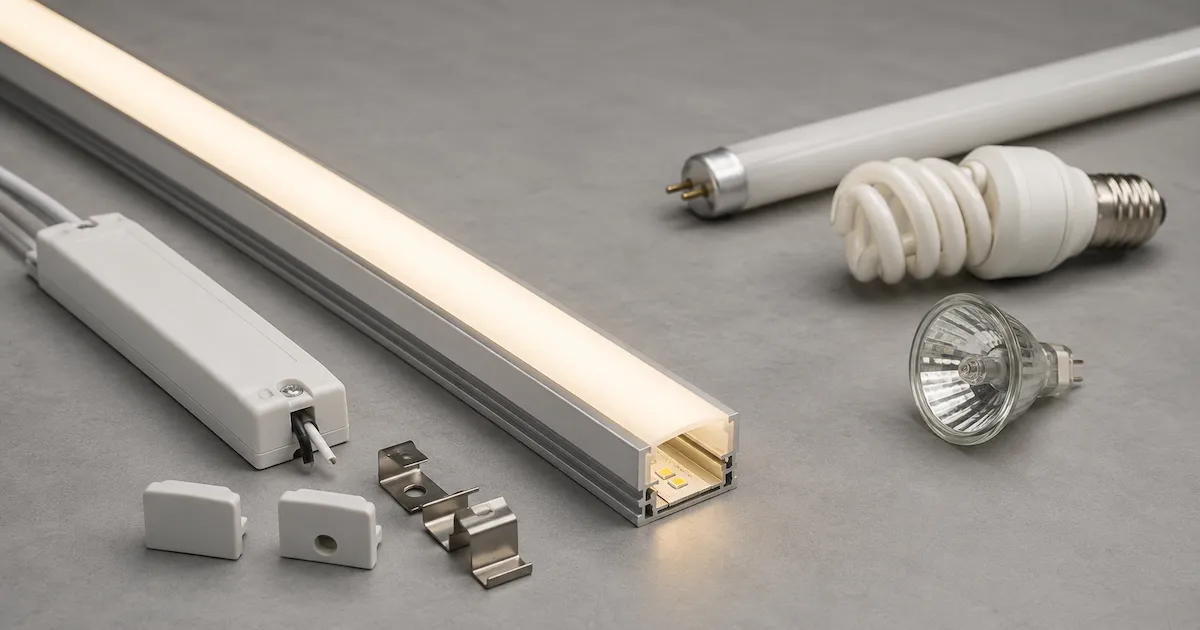
Traditional lighting covers older fixture types such as fluorescent tubes, incandescent lamps, halogen lamps, compact fluorescent lamps, and some bulky linear luminaires, so many buyers compare fluorescent vs LED before choosing a new system. These products can still work in many sites, but they often have limits in design flexibility, heat, dimming, and maintenance.
From our manufacturing floor perspective, the biggest difference is system thinking. A linear profile is not only a decorative channel. It combines mechanical support, thermal management, optical control, and installation convenience. Traditional fixtures are often sold as one fixed product with fewer ways to adapt length, beam softness, mounting style, or cable exit location.
| Lighting Type | Main Components | Typical Use | Key Limitation |
|---|---|---|---|
| LED linear profile | Aluminum channel, LED strip, diffuser, driver | Architectural lines, shelves, coves | Needs correct strip and driver match |
| Fluorescent tube | Tube, ballast, holder | Offices, warehouses, old ceilings | Flicker, mercury, ballast failure |
| Halogen lamp | Bulb, reflector, transformer | Accent lighting | High heat and short life |
| Incandescent lamp | Filament bulb, holder | Basic lighting | Low efficiency |
| CFL fixture | CFL lamp, ballast | Retrofits | Slow start and disposal concern |
2. How Do They Compare on Energy Use and Efficiency?
Energy use is usually the clearest business case. A good LED strip inside a profile can deliver high lumens per watt, while the aluminum body helps the LEDs run cooler. Traditional lamps convert more power into heat. That heat raises air-conditioning load in hotels, shops, and offices.
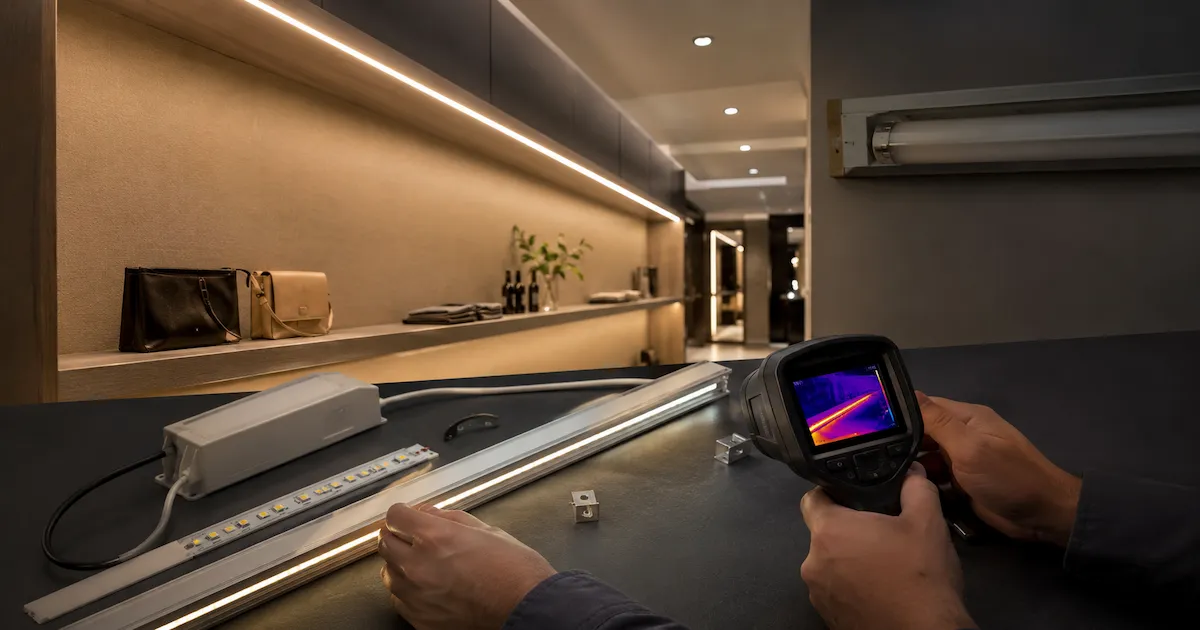
For example, a 14.4W/m LED strip in an aluminum profile may replace a fluorescent tube line or a group of small halogen lamps in a display area, making a practical LED vs fluorescent comparison useful before retrofit planning. If a retail chain has 200 shelves, even a small wattage reduction per shelf becomes real monthly savings. In a hotel corridor, the savings are larger because the lights may run 12 to 24 hours per day.
In our tests, a strip without enough aluminum contact showed faster surface temperature rise and reduced lumen maintenance.
| Parameter | LED Linear Profile System | Traditional Fluorescent | Halogen / Incandescent |
|---|---|---|---|
| Typical efficiency | 80–140 lm/W, depending on strip | 50–90 lm/W | 10–25 lm/W |
| Heat output | Lower, spread through aluminum | Moderate | High |
| Power supply loss | Driver dependent | Ballast dependent | Transformer or direct loss |
| Useful for long run time | Strong choice | Acceptable but aging tech | Poor choice |
| Energy cost impact | Low to medium | Medium | High |
In our tests, a strip without enough aluminum contact showed faster surface temperature rise and reduced lumen maintenance.
3. Which Option Gives Better Light Quality and Visual Comfort?
Light quality decides whether the finished project looks professional. LED linear profiles can create dot-free, soft lines when the correct strip density and diffuser are used. Traditional tubes can provide broad light, but they often lack clean integration in furniture, display shelves, and narrow architectural details.

We often see visible LED dots caused by shallow profiles paired with low-density tape. A deeper profile, opal diffuser, or COB strip can solve this. Color rendering matters: high-CRI LED strips (CRI90/95) show materials more accurately than many old fluorescent tubes.
| Light Quality Factor | LED Linear Profiles | Traditional Lighting | Project Impact |
|---|---|---|---|
| Glare control | Good with diffuser and recess depth | Mixed | Comfort and visual acceptance |
| Dot-free effect | Good with dense strip or COB | Usually continuous tube light | Cleaner architectural finish |
| CRI options | CRI80, 90, 95 possible | Varies by lamp | Better product and material color |
| CCT control | Tight binning possible | Batch variation possible | Less visible mismatch |
| Dimming feel | Smooth with correct driver | Can flicker with old ballast | Lower complaint rate |
4. Which System Handles Heat and Lifespan Better?
Heat is the silent reason many lighting projects fail early, especially when LED strip lights overheating is caused by weak profiles, poor contact, or enclosed cavities.
LEDs dislike excess junction temperature. LED linear profiles use aluminum to pull heat away from the strip and spread it across a larger surface.
In lab tests, a strip mounted on bare wood or plastic ran hotter than the same strip inside a properly sized aluminum profile and lost light faster. Early lumen loss causes callbacks and extra work.
| Heat Factor | Good LED Profile Practice | Poor Practice | Result |
|---|---|---|---|
| Aluminum contact | Full strip contact with clean surface | Strip placed on dusty surface | Better heat transfer |
| Profile size | Matched to strip wattage | Too small for high power | Lower temperature rise |
| Driver loading | 80–90% load range | Driver pushed to limit | Longer driver life |
| Ventilation | Air gap where possible | Sealed hot cavity | Less color shift |
| Adhesive support | Mechanical clips or groove support | Tape only in hot area | Lower failure risk |
5. How Do Installation Time and Labor Cost Compare?
Labor cost often decides project profit. Traditional fixtures may look simple at quotation, but site work can be slow if ceilings, brackets, ballasts, and holders need adjustment. LED linear profiles can be cut, pre-wired, suspended, recessed, surface mounted, or supplied in project-specific lengths.
Factory pre-soldered profile kits with marked input wires save hours across rollouts. For a project with many short pieces, a few minutes saved per piece adds up quickly.
| Installation Item | LED Linear Profile | Traditional Fixture | Practical Note |
|---|---|---|---|
| Length adjustment | Cuttable to project size | Usually fixed length | Better fit for cabinets and coves |
| Wiring | Can be pre-soldered | Site wiring often needed | Lower labor risk |
| Mounting | Clips, recessed slots, suspension | Brackets, holders, housings | More design freedom |
| Replacement | Strip or module service possible | Lamp or ballast change | Depends on access design |
| Site cleanliness | Less drilling in some cases | More hardware work | Useful in finished interiors |
6. Which Option Gives Better Design Flexibility?
Design flexibility is a strong point for LED profiles. You can create straight lines, corner lighting, edge lighting, recessed slots, pendant linear lights, wall washers, stair guidance, and shelf illumination. Traditional lighting covers general illumination but can be bulky in slim furniture or modern interiors.
Flexible strip inside profiles can achieve continuous lines and precise placement, but plan feeding and wiring to avoid voltage drop and mismatched brightness.
| Design Need | LED Linear Profile Solution | Traditional Lighting Limit |
|---|---|---|
| Slim furniture integration | 6–20 mm profile widths available | Fixtures often too large |
| Continuous light lines | Long runs with proper feeding | Tube joints visible |
| Curved or corner areas | Flexible strip with corner accessories | Hard to bend or hide |
| Recessed ceiling slot | Trimless or flange profiles | Larger housings needed |
| Custom color temperature | Project-specified CCT | Stock lamp limits |
7. How Do Maintenance and Replacement Costs Differ?
Maintenance includes access, labor, downtime, transport, and client disruption. Traditional fluorescent fixtures may need tube and ballast replacement. Halogen lamps fail sooner and create heat marks. LED profile systems usually have longer service life when specified and installed correctly.
A well-designed LED profile places the driver in an accessible location, saving service time. The most common field issues are wiring mismatches, under-sized wire, overloaded drivers, poor soldering, or inadequate heat path.
| Common Failure Mode | Likely Cause | Field Fix | Prevention |
|---|---|---|---|
| Dim far end | Voltage drop | Add power injection | Use 24V or shorter runs |
| Flicker | Driver mismatch or overload | Replace driver | Check load and dimming type |
| Strip peeling | Heat or dirty profile | Clean and replace strip | Use clips or better adhesive |
| Color mismatch | Mixed bins or batches | Replace affected run | Specify bin control |
| Dead section | Solder or cut damage | Reconnect section | Use correct cutting points |
8. What Are the Safety and Compliance Differences?
Traditional lighting has known risks: hot halogen near materials, glass tube breakage, mercury in fluorescents, and ballast failures. LED profile systems use low-voltage DC in many applications, which can reduce shock risk at the light point, but the driver, wiring, and installation must meet local codes.
Check the complete system: LED strip, driver, wire rating, profile material, diffuser flame rating, and packaging labels. A safe LED strip installed poorly can still be unsafe—for example, a high-power strip sealed in a narrow wooden groove with no heat path can exceed safe operating temperature.
| Safety Point | LED Linear Profile System | Traditional Lighting | Buyer Check |
|---|---|---|---|
| Operating temperature | Lower when designed well | High for halogen | Verify thermal data |
| Hazardous material | RoHS options common | Fluorescent contains mercury | Check disposal rules |
| Voltage at light point | Often 12V/24V DC | Mains voltage common | Match local code |
| Fire risk | Depends on driver and heat path | Higher near halogen | Review mounting surface |
| Certification | CE, RoHS, UL, CB possible | Varies by lamp | Request valid reports |
9. Which Has Better Total Cost of Ownership?
Purchase price can mislead. A traditional fixture may cost less at the start, but energy use, lamp changes, ballast service, and downtime can raise lifetime cost. LED linear profiles may cost more per meter but can lower energy bills, reduce maintenance, and improve the perceived value of the finished project.
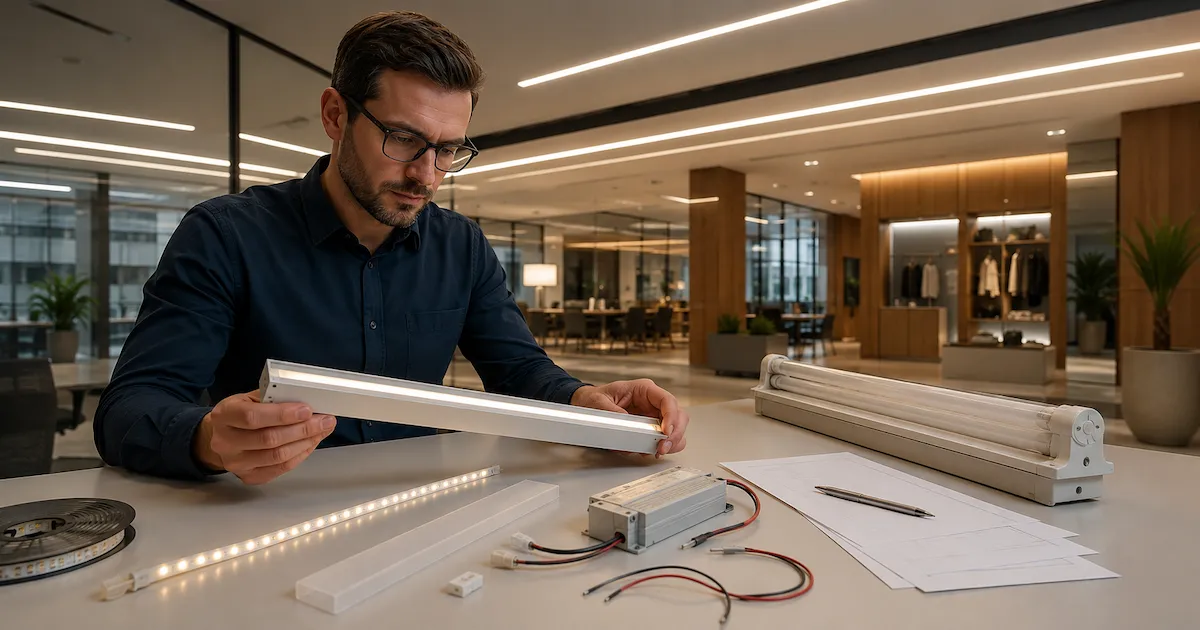
For low-hour storage spaces, traditional fixtures can be acceptable. For hotels, retail, offices, and furniture programs, LED profiles often deliver faster payback due to hours of operation and the value of appearance.
| Cost Category | LED Linear Profiles | Traditional Lighting | Business Effect |
|---|---|---|---|
| Initial product cost | Medium to high | Low to medium | Higher upfront budget |
| Energy cost | Low | Medium to high | Lower monthly expense |
| Labor during install | Low to medium if prebuilt | Medium | Less site time with kits |
| Maintenance | Low if designed well | Medium to high | Fewer callbacks |
| Visual value | High | Medium | Better client acceptance |
| ROI profile | Strong in long-run projects | Weak in long hours use | Better lifetime margin |
10. How Should You Choose Between LED Linear Profiles and Traditional Lighting?
The right choice depends on application, run time, visual standard, service access, certification needs, and budget. LED linear profiles are usually stronger for architectural lines, retail shelves, hospitality, furniture, office coves, signage, and projects where clean appearance matters. Traditional lighting can still work for utility rooms, temporary sites, or replacement jobs with tight initial budgets.
Before ordering, ask for lumen output, CRI, CCT tolerance, wattage per meter, voltage drop guidance, driver recommendations, diffuser transmission, thermal test photos, and aging test results.
| Selection Question | If Yes, Choose | Reason |
|---|---|---|
| Is the light visible as a design feature? | LED linear profile | Cleaner appearance |
| Is the run longer than 5 meters? | LED profile with 24V plan | Better voltage control |
| Is the site hot or enclosed? | Larger LED profile | Better heat path |
| Is the project temporary? | Traditional may work | Lower initial spend |
| Is maintenance access difficult? | LED profile with remote driver | Less service risk |
| Is high CRI required? | LED profile system | More CCT and CRI choices |
Conclusion
LED linear profiles outperform traditional lighting in many professional projects where appearance, efficiency, heat control, and service life matter, which explains why LED is better than fluorescent in long-run commercial applications. Traditional fixtures remain useful for simple, low-use, or temporary applications. Request detailed test data and installation guidance before specifying to avoid costly site surprises.
FAQ
Q1: What is the main difference between LED linear profiles and traditional lighting?
LED linear profiles combine LED strips, aluminum channels, diffusers, and drivers into a flexible light-line system. Traditional lighting uses fixed lamps or tubes. Profiles offer better custom length, heat control, and visual integration.
Q2: Are LED linear profiles more expensive than traditional lighting?
Initial cost can be higher, but lower energy use, reduced maintenance, and faster installation can lower lifetime cost in hotels, retail, offices, and furniture projects.
Q3: Can LED linear profiles replace fluorescent tube lights?
Yes, in many applications. Check lumen output, beam spread, mounting method, driver location, and local electrical rules before replacement.
Q4: Do LED linear profiles need heat dissipation?
Yes. The aluminum profile helps transfer heat away from the LED strip. Without a proper heat path, the strip may lose brightness faster, shift color, peel, or fail early.
Q5: Which projects benefit most from LED linear profiles?
Retail displays, hotel interiors, office coves, cabinets, furniture, stair lighting, signage, and architectural lines gain the most value from LED profiles.
