
Pet owners constantly seek ways to improve their furry companions’ living conditions. LED Strip Lights for Pet House: Complete Setup Guide offers an innovative solution that combines functionality with safety. These versatile lighting systems provide adequate illumination while maintaining energy efficiency and pet-friendly operation. Professional lighting contractors and pet accessory manufacturers increasingly recommend LED strips for outdoor kennels, indoor pet enclosures, and custom-built animal shelters.
Modern pet housing demands more than basic shelter – it requires thoughtful lighting design that supports animal welfare while meeting practical needs. LED strip technology addresses these requirements through customizable illumination that adapts to different pet species, behavioral patterns, and environmental conditions. From simple backyard dog houses to sophisticated indoor cat towers, LED strips offer solutions that traditional lighting cannot match.
The growing trend toward smart pet care includes advanced lighting systems that monitor animal behavior, support natural circadian rhythms, and provide security features for outdoor installations. These technological advances make LED strip lights essential components of contemporary pet housing design.
1. Why Choose LED Strip Lights for Your Pet’s Living Space?
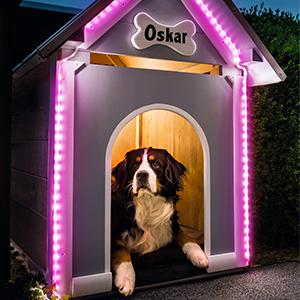
Pet safety remains paramount when selecting lighting solutions for animal enclosures. Here’s what makes LED strips special: they operate at significantly lower temperatures compared to traditional incandescent bulbs, reducing burn risks for curious pets.
Energy Efficiency Benefits
LED technology consumes 75% less energy than conventional lighting options. A typical 5-meter LED strip draws only 24 watts while producing equivalent light output of a 150-watt incandescent bulb. This efficiency translates to substantial electricity savings over time.
Extended operation hours in pet facilities make energy efficiency particularly valuable. Outdoor security lighting, overnight comfort illumination, and 24/7 monitoring systems benefit significantly from LED power consumption characteristics. Commercial pet boarding facilities report 60-80% lighting cost reductions after LED strip conversions.
Low Heat Generation
Unlike halogen or incandescent alternatives, LED strips generate minimal heat during operation. Surface temperatures typically remain below 40°C (104°F), making them safe for pets that might come into direct contact with lighting fixtures.
This low heat output prevents overheating in enclosed spaces where ventilation might be limited. Small pet houses, travel carriers, and indoor enclosures maintain comfortable temperatures without requiring additional cooling systems. Heat-sensitive animals like rabbits and birds particularly benefit from LED installations.
Durability and Longevity
Quality LED strips offer operational lifespans exceeding 50,000 hours. This longevity means fewer replacements and reduced maintenance costs for pet house owners. Solid-state construction makes LEDs resistant to vibrations and impacts from active pets.
Pet environments present unique challenges including moisture, temperature fluctuations, and physical abuse from animal activity. LED strips withstand these conditions better than traditional lighting while maintaining consistent performance throughout their operational life.
| LED Strip Feature | Benefit for Pet Houses |
|---|---|
| Low voltage operation | Enhanced safety |
| Flexible installation | Fits any enclosure shape |
| Dimmable options | Adjustable brightness |
| Color variety | Customizable ambiance |
| Weather resistance | Outdoor durability |
2. What Safety Considerations Should You Know?
Pet behavior patterns require specific safety measures when installing LED lighting systems. Safety comes first, always. Pets naturally investigate new additions to their environment through chewing, scratching, and general exploration.
Voltage Requirements
Low-voltage LED strips operating at 12V or 24V DC provide inherent safety advantages. These voltages pose minimal risk to pets even during accidental contact. Higher voltage AC systems require additional protection measures and professional installation.
Pet curiosity often leads to investigation of new installations through biting, clawing, or general manipulation. Low-voltage systems reduce injury risks while maintaining adequate light output for most applications. Battery-powered options eliminate electrical connections entirely for maximum safety in temporary installations.
Protective Housing Options
Aluminum profiles and plastic channels shield LED strips from direct pet contact while improving heat dissipation. These protective housings prevent damage from claws, teeth, and weather exposure while maintaining optimal light distribution.
Diffusion lenses integrated into protective channels create smooth, even lighting while hiding individual LED points that might attract animal attention. Impact-resistant materials withstand normal pet activity while providing easy access for maintenance and cleaning.
Cable Management
Proper cable routing prevents pets from accessing electrical connections. Use conduit systems or cable guards to protect power supplies and connection points. Secure all loose wiring away from pet reach using appropriate fasteners.
Strategic cable routing through walls, under floors, or within ceiling spaces eliminates exposure while maintaining installation aesthetics. Flexible conduit systems accommodate expansion and modifications without requiring complete reinstallation.
GFCI Protection
Ground Fault Circuit Interrupter protection becomes essential for outdoor pet house installations. GFCI devices automatically shut off power when detecting electrical faults, preventing shock hazards in wet conditions.
Pet washing areas, outdoor kennels, and facilities near water sources require GFCI protection regardless of local electrical codes. Portable GFCI devices provide protection for temporary installations or locations without permanent GFCI circuits.
3. How Do You Select Appropriate IP Ratings?

Environmental protection ratings determine LED strip suitability for different pet house applications. Water and dust protection matter tremendously when dealing with outdoor animal enclosures that face weather exposure.
Indoor Pet Enclosure Requirements
IP20 or IP33 ratings typically suffice for indoor pet spaces with minimal moisture exposure. These ratings protect against solid objects larger than 12mm while providing basic water splash protection.
Indoor applications include bird cages, small animal habitats, and climate-controlled pet rooms where environmental conditions remain relatively stable. Higher protection ratings provide insurance against unexpected moisture sources like water bowl spills or cleaning activities.
Outdoor Kennel Specifications
Outdoor installations require minimum IP65 ratings for adequate weather protection. IP65-rated strips resist water jets and complete dust ingress, handling rain, snow, and cleaning procedures effectively.
Extreme weather conditions may require IP67 protection for maximum reliability. Coastal installations face salt spray challenges requiring specialized coatings beyond standard IP ratings. Desert environments demand protection against fine sand infiltration.
Washdown Areas
Pet washing stations and frequently cleaned areas need IP67 or IP68 protection levels. These ratings enable temporary submersion and high-pressure washing without compromising LED functionality.
Veterinary facilities, grooming stations, and commercial kennels require frequent sanitization using high-pressure cleaning equipment. IP68-rated systems withstand these procedures while maintaining electrical safety and operational reliability.
| IP Rating | Protection Level | Suitable Applications |
|---|---|---|
| IP20 | Basic dust protection | Indoor dry areas |
| IP33 | Light water protection | Covered outdoor spaces |
| IP65 | Jet water resistance | General outdoor use |
| IP67 | Temporary submersion | Wet cleaning areas |
| IP68 | Continuous submersion | Water features |
4. Which Installation Methods Work Best?
Proper installation techniques ensure long-term reliability and optimal performance of LED strip lighting systems. Installation quality determines everything regarding system longevity and pet safety.
Surface Mounting Techniques
Adhesive backing provides quick installation for temporary or semi-permanent applications. Clean surfaces thoroughly with isopropyl alcohol before applying strips to ensure proper adhesion. Avoid mounting on rough or porous surfaces that compromise adhesive effectiveness.
Surface texture significantly affects adhesive performance. Smooth materials like metal, glass, and painted surfaces provide optimal bonding. Textured surfaces require mechanical fasteners or specialized adhesive systems designed for irregular surfaces.
Aluminum Profile Installation
Aluminum channels offer superior protection and professional appearance. These profiles improve heat dissipation while providing mechanical protection against pet damage. Mounting clips secure profiles to various surface materials including wood, metal, and plastic.
Profile selection depends on LED strip width, required protection level, and aesthetic preferences. Standard profiles accommodate most strip sizes while specialized profiles provide enhanced features like adjustable beam angles or emergency lighting capabilities.
Recessed Mounting Options
Recessed installation completely protects LED strips from pet contact while providing clean, integrated lighting. Route shallow channels in wood surfaces or use purpose-built recessed fixtures for permanent installations.
Recessed mounting requires careful planning during construction or renovation phases. Depth requirements, wire routing, and access for maintenance must be considered before finalizing installation designs. Modular systems enable future modifications without major reconstruction.
Corner and Angle Considerations
Pet houses often feature complex geometries requiring careful planning for continuous lighting coverage. Use appropriate connectors and flexible sections to navigate corners without creating dark spots or installation stress points.
Flexible connectors accommodate movement and thermal expansion while maintaining electrical continuity. Rigid corner pieces provide mechanical strength for high-stress installations while maintaining clean appearance transitions.
5. What Power Supply Options Should You Consider?
Power supply selection directly impacts system reliability, safety, and performance characteristics. Power supplies are the heart of every LED system and require careful consideration based on total load requirements and environmental conditions.
Calculating Power Requirements
Determine total wattage by multiplying strip length by per-meter power consumption. Add 20% safety margin to account for voltage drops and future expansions. A 5-meter strip consuming 4.8W per meter requires approximately 29W power supply capacity.
Accurate calculations prevent overloading while ensuring adequate capacity for reliable operation. Factor in controller power consumption, especially for smart systems with wireless connectivity and advanced features. Temperature derating may reduce available capacity in hot environments.
Indoor vs Outdoor Power Supplies
Indoor installations accommodate standard desktop power adapters with basic protection features. Outdoor applications require weatherproof enclosures with appropriate IP ratings matching environmental exposure levels.
Outdoor power supplies cost more but provide essential protection against moisture, temperature extremes, and physical damage. Ventilation requirements balance weather protection with heat dissipation needs for optimal performance and longevity.
Dimming Compatibility
Dimmable power supplies enable brightness control for day/night cycling and behavioral management applications. PWM (Pulse Width Modulation) dimming provides smooth brightness transitions without color temperature shifts.
Dimming protocols vary between manufacturers requiring careful matching between power supplies and controllers. Universal dimming systems provide flexibility for future upgrades while specialized protocols offer enhanced features for specific applications.
Multiple Zone Control
Large pet facilities benefit from multiple power supplies enabling independent zone control. This approach provides redundancy and allows customized lighting schedules for different areas within the same facility.
Zone control enables energy optimization by operating only required areas while providing backup lighting during maintenance or failures. Smart zone systems automatically adjust based on occupancy, time of day, and environmental conditions.
| Power Supply Type | Advantages | Best Applications |
|---|---|---|
| Desktop adapter | Low cost, easy replacement | Small indoor setups |
| Weatherproof driver | Outdoor durability | External installations |
| Dimmable driver | Brightness control | Behavioral lighting |
| Multi-output driver | Zone control | Large facilities |
6. How Can You Implement Color Temperature Control?

Color temperature affects pet behavior, circadian rhythms, and overall well-being. Color matters more than you might think for animal comfort and health maintenance.
Warm White Applications
Warm white (2700K-3000K) creates relaxing environments suitable for resting areas and nighttime illumination. This color temperature mimics sunset conditions, promoting natural sleep cycles for diurnal animals.
Rest areas, sleeping quarters, and evening feeding zones benefit from warm white lighting that reduces stress and encourages natural behaviors. Puppies and kittens particularly respond well to warm lighting that simulates maternal warmth and security.
Cool White Benefits
Cool white (4000K-5000K) provides excellent visibility for feeding areas and active zones. This neutral color temperature supports natural daytime activities without causing eye strain or behavioral disruption.
Task lighting for grooming, training, and veterinary examinations requires neutral white temperatures for accurate color perception and detailed visibility. Cool white also enhances security camera performance in monitoring applications.
Daylight Simulation
Daylight-balanced (5500K-6500K) strips simulate natural sunlight conditions beneficial for vitamin D synthesis and seasonal affective disorder prevention in indoor pets. These applications particularly benefit birds and reptiles requiring specific light spectrums.
Full-spectrum lighting supports natural behaviors and physiological processes in animals with limited outdoor access. Indoor cats, birds, and exotic pets require daylight simulation for optimal health and psychological well-being.
Tunable White Systems
Advanced tunable white strips enable automatic color temperature adjustment throughout the day. Programmable controllers gradually shift from warm morning light to bright midday illumination, then back to warm evening tones.
Circadian lighting systems support natural hormone production and sleep-wake cycles in both pets and their owners. These systems prove particularly valuable for animals recovering from illness or experiencing behavioral problems related to lighting conditions.
7. What Controller Options Enhance Functionality?
Smart controllers expand LED strip capabilities beyond basic on/off operation. Automation brings convenience and consistency to pet care routines while reducing manual intervention requirements.
Basic Dimmer Controls
Simple rotary or slide dimmers provide manual brightness adjustment for different activities and times of day. These cost-effective solutions work well for small installations with straightforward lighting needs.
Manual controls offer reliability and simplicity for basic applications. Analog dimmers provide smooth adjustment without digital complexity while maintaining long-term reliability in harsh environments.
Timer-Based Controllers
Programmable timers automate lighting schedules, ensuring consistent daily routines regardless of owner availability. Multi-program timers accommodate different weekend and weekday schedules.
Astronomical timers automatically adjust for seasonal daylight changes, maintaining consistent lighting periods throughout the year. These features particularly benefit animals sensitive to daylight duration variations.
Smart Home Integration
WiFi-enabled controllers connect LED strips to smart home ecosystems including Alexa, Google Home, and Apple HomeKit. Voice control and smartphone apps provide remote monitoring and adjustment capabilities.
Smart integration enables complex automation scenarios involving multiple devices and environmental sensors. Pet owners can monitor and adjust lighting remotely while receiving alerts about system status and environmental conditions.
Sensor-Activated Systems
Motion sensors and light sensors create responsive lighting that activates when pets enter areas or adjusts based on ambient light levels. These systems conserve energy while ensuring adequate illumination when needed.
Occupancy-based lighting reduces energy consumption while providing safety illumination for nighttime activities. Light sensors prevent unnecessary operation during daylight hours while ensuring adequate illumination during overcast conditions.
| Controller Type | Features | Best Use Cases |
|---|---|---|
| Manual dimmer | Simple brightness control | Basic installations |
| Programmable timer | Automated schedules | Routine lighting |
| Smart controller | Remote control, scheduling | Tech-savvy owners |
| Sensor controller | Automatic activation | Energy conservation |
8. How Do You Address Waterproofing Requirements?

Moisture protection prevents electrical failures and ensures safe operation in pet environments prone to water exposure. Water and electricity don’t mix well – proper waterproofing protects both pets and equipment.
Silicone Coating Applications
Silicone-coated LED strips provide basic moisture protection suitable for humid environments. This coating protects against water splashes and condensation while maintaining flexibility for installation around curves and corners.
Silicone coatings vary in thickness and durability depending on application requirements. Thin coatings maintain flexibility while thicker applications provide enhanced protection against mechanical damage and environmental exposure.
Heat Shrink Protection
Heat shrink tubing creates waterproof seals around connections and cut points. Use marine-grade heat shrink with adhesive lining for maximum moisture protection in challenging environments.
Proper heat shrink application requires appropriate sizing and heating techniques for reliable seals. Multiple layers provide redundant protection while strain relief prevents mechanical stress at connection points.
Potting Compound Solutions
Two-part potting compounds completely encapsulate connections and control electronics. These compounds cure to form permanent waterproof barriers resistant to temperature cycling and mechanical stress.
Potting compound selection depends on operating temperature ranges, chemical exposure, and mechanical requirements. Flexible compounds accommodate thermal expansion while rigid formulations provide maximum protection against physical damage.
Drainage Considerations
Proper drainage prevents water accumulation around electrical components. Install fixtures with slight downward angles and provide drainage channels or weep holes where water might collect.
Drainage system design must accommodate normal water sources while handling exceptional conditions like heavy rainfall or flooding. Backup drainage provisions prevent system failure during primary drainage blockages.
9. What Maintenance Practices Ensure Longevity?
Regular maintenance prevents failures and extends LED strip lifespan in demanding pet environments. Maintenance prevents problems before they start and ensures consistent performance over time.
Cleaning Procedures
Gentle cleaning with mild soap solutions removes accumulated dirt, hair, and debris without damaging LED components. Avoid harsh chemicals or abrasive materials that might compromise protective coatings.
Cleaning frequency depends on environmental conditions and pet activity levels. High-traffic areas require more frequent attention while protected installations may need only periodic maintenance. Document cleaning schedules for warranty compliance.
Connection Inspection
Periodically inspect all electrical connections for corrosion, looseness, or damage. Tighten connections and apply dielectric grease to prevent moisture intrusion and oxidation.
Connection inspection should include power supplies, controllers, and strip terminations. Look for discoloration, corrosion, or mechanical damage that might indicate developing problems requiring immediate attention.
Performance Monitoring
Monitor light output levels and color consistency to identify aging components before complete failure. Gradual dimming or color shifts indicate LED degradation requiring replacement.
Performance documentation helps identify patterns and predict maintenance needs. Record light output measurements, color temperature readings, and power consumption data for trend analysis and preventive maintenance scheduling.
Environmental Assessment
Regularly evaluate installation environment for changes that might affect LED performance. Temperature fluctuations, increased moisture, or physical damage require prompt attention to prevent system failures.
Environmental changes may require system modifications or upgrades to maintain optimal performance. New construction, landscaping changes, or facility modifications can impact lighting system operation and efficiency.
10. How Do You Troubleshoot Common Issues?

Systematic troubleshooting quickly identifies and resolves LED strip problems. Problems have solutions when you know where to look for common failure modes and their symptoms.
Dim or Flickering Output
Voltage drop causes dim or flickering LEDs, typically resulting from inadequate wire gauge or excessive strip length. Measure voltage at strip endpoints and add power injection points if readings fall below specifications.
Flickering may also indicate incompatible dimming systems or failing power supplies. Systematic voltage measurements help isolate problems and determine appropriate solutions for optimal system performance.
Partial Strip Failure
Section failures often indicate cut-point problems or connector issues. Inspect solder joints and connector terminals for proper contact and mechanical integrity.
Partial failures may result from manufacturing defects, mechanical damage, or environmental exposure. Replacement of affected sections often provides more reliable solutions than field repairs in critical applications.
Color Inconsistency
Color variations between sections suggest quality control issues or thermal stress. Replace affected sections and verify proper heat dissipation through aluminum profiles or improved ventilation.
Color consistency problems may indicate counterfeit products or mixing of different production batches. Source all components from reputable suppliers and maintain consistent specifications throughout installations.
Premature Failure
Early failures typically result from overheating, moisture intrusion, or voltage problems. Verify installation environment, power supply ratings, and protection measures meet application requirements.
Premature failures often indicate systemic problems requiring comprehensive evaluation of installation practices, component selection, and environmental conditions. Address root causes rather than symptoms for long-term reliability.
| Problem | Likely Cause | Solution |
|---|---|---|
| Dim output | Voltage drop | Add power injection |
| Flickering | Poor connections | Tighten/replace connectors |
| Section failure | Cut point damage | Re-solder connections |
| Color shift | Overheating | Improve heat dissipation |
| Moisture damage | Inadequate sealing | Upgrade protection rating |
Conclusion
LED strip lights transform pet houses into comfortable, well-illuminated spaces that benefit both animals and their owners. Proper selection, installation, and maintenance ensure years of reliable operation while enhancing pet safety and well-being. Energy efficiency and long lifespans make LED strips cost-effective solutions for any pet housing application.
Successful implementations require attention to safety considerations, environmental protection, and appropriate power supply selection. Smart controllers and automation features add convenience while ensuring consistent lighting schedules that support natural pet behaviors.
Whether upgrading existing pet facilities or designing new installations, LED strip lights offer flexibility and performance advantages that traditional lighting cannot match. Professional installation and quality components provide the foundation for systems that reliably serve pets and their families for many years.
FAQ
Q1: Are LED strip lights safe for pets?
Yes, LED strip lights are generally safe for pets when properly installed. They operate at low voltages (12V or 24V DC) and generate minimal heat compared to traditional bulbs. However, use protective aluminum profiles or channels to prevent direct contact and potential chewing damage. Always choose pet-safe installation methods with appropriate voltage ratings.
Q2: What IP rating do I need for outdoor pet houses?
Outdoor pet houses require minimum IP65 rating for adequate weather protection. This rating provides complete dust protection and resistance to water jets from any direction. For areas subject to frequent cleaning or washing, consider IP67 or IP68 ratings that withstand temporary submersion and high-pressure washing.
Q3: How do I calculate power requirements for my pet house LED strips?
Multiply the total strip length by the per-meter wattage consumption, then add 20% safety margin. For example, 10 meters of 4.8W/meter strips require (10 × 4.8 × 1.2) = 57.6W power supply capacity. This margin accounts for voltage drops and allows future expansion without overloading the power supply.
Q4: Can LED strips be dimmed for day/night cycles?
Yes, dimmable LED strips with compatible controllers enable brightness adjustment throughout the day. Use PWM dimming controllers for smooth brightness transitions without color temperature changes. Smart controllers can automate dimming schedules to simulate natural daylight cycles, supporting healthy circadian rhythms for pets.
Q5: How long do LED strips last in pet house applications?
Quality LED strips typically last 50,000+ hours in normal operating conditions. In pet house applications with proper protection and maintenance, expect 8-12 years of reliable operation. Factors affecting lifespan include operating temperature, humidity levels, power supply quality, and protection from physical damage. Regular cleaning and inspection extend operational life significantly.
