
Selecting appropriate aluminum profiles for LED strip installations can make or break your lighting project’s success. Here’s what you need to know: Why Choose V-Shape Profiles for LED Lighting Projects—these angular aluminum housings represent one of the most versatile and effective solutions for modern LED lighting applications. They provide unique benefits that standard flat profiles simply cannot match.
Professional lighting contractors and distributors increasingly turn to V-shape profiles because they solve common installation challenges while delivering superior light distribution. But that’s not all. These profiles offer enhanced thermal management, simplified mounting options, and remarkable design flexibility that transforms ordinary LED strips into professional-grade lighting systems.
1. What Makes V-Shape Profiles Different from Standard LED Profiles?
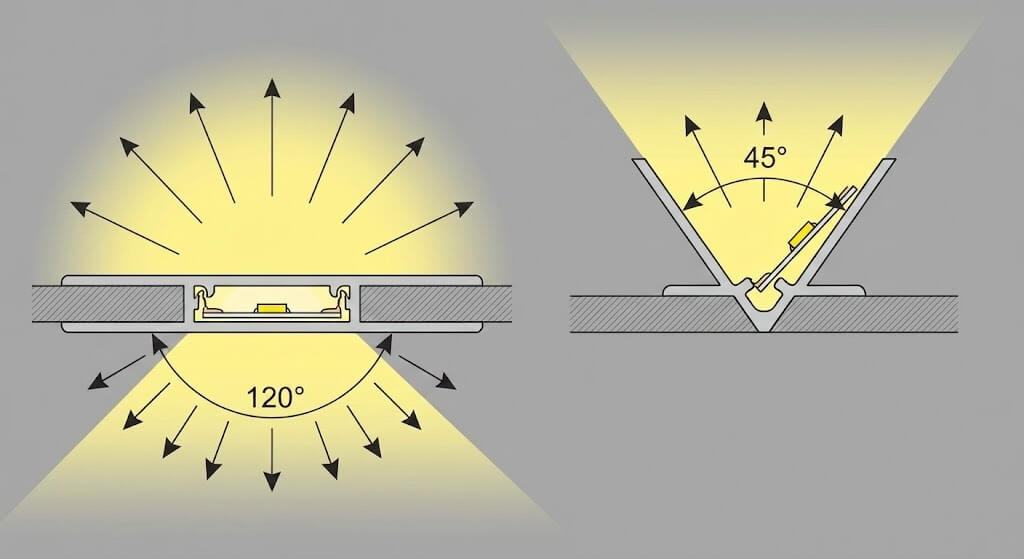
V-shape profiles feature a distinctive angular design that sets them apart from conventional rectangular or round aluminum housings. Here’s where things get interesting: This unique geometry creates specific advantages that address real-world lighting challenges.
The angular construction allows for precise light direction control, making these profiles ideal for accent lighting, cove installations, and architectural applications. Unlike flat profiles that distribute light uniformly in all directions, V-shape designs focus illumination exactly where you need it.
Structural Design Benefits
The V-shaped cross-section provides exceptional structural rigidity compared to flat alternatives. This enhanced strength means longer spans between mounting points and reduced sagging over time. Professional installers appreciate this durability, especially in commercial applications where long-term reliability matters.
The angular walls also create natural heat dissipation channels that improve thermal performance. And here’s the best part: This design feature extends LED lifespan while maintaining consistent color temperature throughout operation.
Installation Advantages
V-shape profiles offer multiple mounting orientations that flat profiles cannot accommodate. You can install them as corner extrusions, wall washers, or even suspended linear fixtures. This versatility reduces inventory requirements while expanding design possibilities.
The angular design also provides natural cable management channels, keeping power connections hidden and maintaining clean aesthetic lines. This feature proves especially valuable in architectural applications where wire visibility would compromise the overall design.
| Feature | V-Shape Profile | Flat Profile | Round Profile |
|---|---|---|---|
| Light Direction Control | Excellent | Good | Limited |
| Structural Rigidity | Superior | Standard | Good |
| Mounting Options | Multiple | Limited | Standard |
| Heat Dissipation | Enhanced | Standard | Good |
| Cable Management | Integrated | External | External |
2. How Do V-Shape Profiles Improve Light Distribution?

Ready for the technical details? V-shape profiles create controlled light patterns that eliminate common distribution problems found with standard housings. The angular walls act as reflective surfaces that direct and focus LED output.
This controlled distribution reduces light spillage and hot spots while creating smooth, even illumination across target surfaces. Professional lighting designers value this precision because it allows for accurate photometric calculations and predictable results.
Reflective Surface Optimization
The angled walls in V-shape profiles function as integrated reflectors, bouncing light in predetermined directions. This eliminates the need for separate reflector components while improving overall system efficiency. What does this mean for you? Higher lumen output per watt consumed and reduced glare for improved visual comfort.
The angle of these reflective surfaces can be customized during manufacturing to achieve specific beam patterns. Standard angles include 45°, 60°, and 90° configurations, each optimized for different applications and mounting heights.
Beam Angle Control
V-shape profiles naturally narrow the beam angle compared to exposed LED strips or flat profiles. This focused output proves ideal for task lighting, display illumination, and architectural accent applications where precise light placement matters.
But here’s what’s really impressive: The controlled beam angle also reduces light pollution in outdoor applications and minimizes unwanted reflections in retail environments.
Uniformity Improvements
The angular design creates better light mixing, reducing the visible LED point sources that can create uncomfortable viewing conditions. This improved uniformity makes V-shape profiles suitable for close-viewing applications where individual LED visibility would be problematic.
The reflective walls also help blend different color temperatures when using tunable white LED strips, creating smoother transitions and more consistent color rendering across the entire installation.
3. What Installation Advantages Do V-Shape Profiles Offer?
This is where V-shape profiles really shine: Their unique geometry provides installation flexibility that standard profiles cannot match. The angular design accommodates corner mounting, wall washing, and suspended applications with equal effectiveness.
Professional installers report significantly reduced installation time when using V-shape profiles because of their self-aligning properties and multiple mounting options. The angular walls naturally guide the profile into corner installations without requiring precise alignment measurements.
Corner Installation Capabilities
V-shape profiles excel in corner applications where two surfaces meet at various angles. The angular design accommodates both inside and outside corners without requiring special corner pieces or complex cutting procedures. Here’s the practical benefit: Reduced material waste and faster installation times.
The profiles can be mounted directly into corner joints using standard mounting clips, eliminating the need for special brackets or custom fabrication. This simplification reduces both material costs and labor requirements for complex architectural installations.
Suspended Mounting Options
The V-shape design provides natural mounting points for suspension cables or rods. The angular geometry distributes suspension loads evenly across the profile structure, reducing stress concentrations that could cause mounting failures.
What’s even better? The angular walls hide suspension hardware, maintaining clean sight lines and professional appearance in exposed ceiling applications.
Wall Washing Applications
V-shape profiles create excellent wall washing effects when mounted at appropriate distances from vertical surfaces. The controlled light distribution eliminates scalloping and hot spots common with other profile types.
The focused beam angle allows for greater mounting distances while maintaining uniform wall illumination. This flexibility proves valuable in high-ceiling applications where profile accessibility might be limited.
| Installation Type | Difficulty Level | Time Required | Special Hardware |
|---|---|---|---|
| Corner Mounting | Easy | 30% faster | None required |
| Wall Washing | Moderate | Standard | Standard clips |
| Suspended | Easy | 20% faster | Suspension cables |
| Cove Lighting | Easy | 25% faster | Standard brackets |
4. How Do V-Shape Profiles Handle Thermal Management?
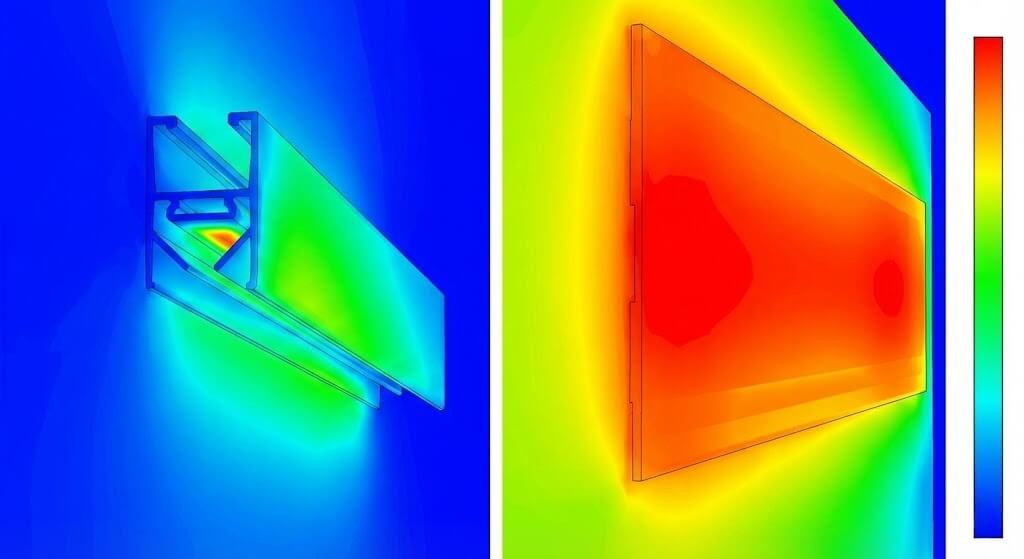
Here’s something most people don’t consider: Thermal management often determines LED system longevity more than initial component quality. V-shape profiles address this critical factor through enhanced heat dissipation design that outperforms standard alternatives.
The angular walls create natural convection channels that promote air circulation around the LED strips. This improved airflow reduces operating temperatures and extends LED lifespan while maintaining consistent light output over time.
Heat Sink Effectiveness
The increased surface area provided by angular walls improves heat transfer compared to flat profiles. More aluminum surface contact with ambient air means better thermal conductivity and lower LED junction temperatures. The bottom line? Longer LED life and maintained efficiency throughout the installation’s service life.
The V-shape geometry also creates thermal chimneys that encourage natural convection currents. Hot air rises through these channels while cooler air enters from below, creating continuous thermal circulation without requiring forced ventilation.
Temperature Distribution
V-shape profiles distribute heat more evenly along their length compared to flat alternatives. This even distribution prevents hot spots that could cause premature LED failure or color shifting. Professional installations benefit from this thermal uniformity through consistent performance across entire lighting runs.
The angular design also isolates heat zones, preventing thermal buildup in confined spaces. This isolation proves especially valuable in recessed applications where natural ventilation might be limited.
LED Junction Temperature Control
Lower junction temperatures directly translate to longer LED lifespan and maintained lumen output. V-shape profiles typically achieve 10-15°C lower operating temperatures compared to flat profiles under identical conditions.
What this means practically: LED strips in V-shape profiles can maintain 90% of initial lumen output after 50,000 hours, compared to 80-85% for strips in standard housings.
Thermal Expansion Management
The angular design accommodates thermal expansion more effectively than rigid flat profiles. The V-shape allows for slight flexing that relieves thermal stress without compromising structural integrity or electrical connections.
This flexibility reduces the risk of solder joint failures and maintains consistent electrical contact throughout temperature cycling.
5. What Design Flexibility Do V-Shape Profiles Provide?
The design possibilities are remarkable: V-shape profiles adapt to architectural requirements that would challenge or eliminate other profile options. Their angular geometry complements modern design aesthetics while solving practical lighting challenges.
Architects and lighting designers increasingly specify V-shape profiles because they integrate seamlessly with contemporary architectural elements. The clean lines and geometric precision align with current design trends while providing superior functional performance.
Architectural Integration
V-shape profiles naturally complement angular architectural features common in modern construction. They can follow roof lines, integrate with structural elements, or create dramatic accent lighting that enhances rather than conflicts with building design.
The profiles work equally well in residential, commercial, and industrial applications. Here’s why this matters: Single profile types can serve multiple project types, reducing inventory complexity and procurement costs.
Customization Options
Manufacturers offer V-shape profiles in various angles, sizes, and finishes to match specific project requirements. Standard angles include 30°, 45°, 60°, and 90° configurations, each optimized for different applications and aesthetic preferences.
Custom angles and dimensions are available for large projects with specific requirements. This flexibility allows designers to achieve exact lighting effects without compromising on performance or appearance.
Aesthetic Versatility
The angular design creates visual interest even when the LEDs are not illuminated. This aesthetic value proves important in applications where the lighting system remains visible during daylight hours.
But there’s more: The geometric form can become an architectural feature itself, adding design value beyond the lighting function.
Color and Finish Options
V-shape profiles are available in standard aluminum finishes, anodized colors, and powder-coated options. This variety allows for seamless integration with existing architectural elements or creation of contrasting design features.
Special finishes like brushed aluminum or black anodizing provide premium appearances suitable for high-end applications where fixture visibility matters.
| Design Aspect | Options Available | Applications |
|---|---|---|
| Angles | 30°, 45°, 60°, 90° | Various mounting needs |
| Sizes | 10mm to 50mm | Different LED strip widths |
| Finishes | Natural, Anodized, Powder-coated | Aesthetic matching |
| Lengths | 1m, 2m, 3m, Custom | Project requirements |
6. How Do V-Shape Profiles Compare in Cost-Effectiveness?
Let’s talk numbers: While V-shape profiles might cost slightly more initially than basic flat alternatives, their total cost of ownership often proves lower due to reduced installation time, better performance, and longer service life.
The enhanced functionality eliminates the need for additional components like separate reflectors, corner pieces, or special mounting hardware. This integration reduces overall system costs while simplifying procurement and inventory management.
Initial Investment Analysis
V-shape profiles typically cost 15-25% more than equivalent flat profiles, but this premium is often offset by reduced accessory requirements and faster installation times. The angular design eliminates many supplementary components needed with standard profiles.
Consider this: Reduced installation time can save 20-30% on labor costs, making the total project cost competitive or even lower than alternatives requiring more complex installation procedures.
Long-term Value Proposition
The superior thermal management provided by V-shape profiles extends LED lifespan, reducing replacement costs and maintenance requirements. Professional installations using these profiles often achieve 50,000+ hour LED life compared to 35,000-40,000 hours with standard housings.
The enhanced light distribution also means fewer fixtures required to achieve target illumination levels. This efficiency can reduce overall system costs while improving performance.
Maintenance Cost Reduction
V-shape profiles require less frequent maintenance due to their superior thermal performance and protected LED mounting. The reduced dust accumulation in the angular channels means longer intervals between cleaning cycles.
The practical result? Lower ongoing maintenance costs and reduced disruption to building operations during service intervals.
Energy Efficiency Benefits
The improved thermal management allows LEDs to operate at higher efficiency levels throughout their service life. Cooler operation means maintained lumen output and consistent color temperature, reducing the need for over-design to compensate for depreciation.
This efficiency translates directly to lower energy costs over the installation’s lifetime, improving the overall return on investment.
7. What Applications Best Suit V-Shape Profiles?

The application range is extensive: V-shape profiles excel in situations requiring controlled light distribution, architectural integration, or challenging mounting conditions. Their versatility makes them suitable for numerous professional lighting applications.
From retail display lighting to architectural accent systems, V-shape profiles provide solutions for applications where standard profiles would compromise performance or aesthetic requirements.
Retail and Commercial Lighting
V-shape profiles create excellent display lighting with controlled beam angles that minimize glare while highlighting merchandise effectively. The focused light distribution reduces spill light that could interfere with adjacent displays or create uncomfortable viewing conditions.
The profiles work particularly well for jewelry displays, artwork illumination, and product showcases where precise light control matters. Here’s the advantage: Better color rendering and reduced glare improve customer experience while enhancing product presentation.
Architectural Accent Lighting
The angular design naturally complements modern architectural features, making V-shape profiles ideal for building facades, interior accent lighting, and structural highlighting. They can follow building lines, emphasize geometric features, or create dramatic lighting effects.
The controlled light distribution prevents unwanted light pollution while creating striking visual effects. This precision proves especially valuable in outdoor applications where light trespass must be minimized.
Residential Applications
V-shape profiles work excellently for under-cabinet lighting, cove installations, and architectural details in residential settings. The focused light output provides effective task lighting while the angular design adds contemporary aesthetic appeal.
What homeowners appreciate most: The clean installation appearance and effective light control that enhances rather than overwhelms living spaces.
Industrial and Warehouse Lighting
The robust construction and excellent thermal management make V-shape profiles suitable for demanding industrial environments. They can provide focused task lighting or general illumination in challenging conditions.
The reduced maintenance requirements and extended LED life prove especially valuable in industrial settings where accessibility might be limited and downtime costly.
| Application | Key Benefits | Typical Mounting |
|---|---|---|
| Retail Display | Controlled beam, reduced glare | Surface/recessed |
| Architectural | Design integration, precise control | Various angles |
| Residential | Clean appearance, effective lighting | Under-cabinet/cove |
| Industrial | Durability, low maintenance | High-bay/task |
8. How Do You Select the Right V-Shape Profile Specifications?
Specification selection determines success: Choosing appropriate V-shape profile dimensions, angles, and features requires understanding both the LED strips being used and the intended application requirements.
Professional lighting designers consider multiple factors including LED strip specifications, mounting conditions, thermal requirements, and aesthetic preferences when selecting V-shape profile configurations.
Dimensional Requirements
The profile internal dimensions must accommodate the LED strip width with adequate clearance for heat dissipation and wire management. Standard profiles accommodate strips from 8mm to 20mm width, with custom sizes available for special applications.
Critical consideration: Allow minimum 2mm clearance on each side of the LED strip for proper thermal management and easy installation.
Angle Selection Criteria
The V-shape angle determines light distribution pattern and mounting flexibility. Narrow angles (30-45°) provide focused beams suitable for accent lighting, while wider angles (60-90°) offer broader distribution for general illumination.
Mounting location also influences angle selection. Corner installations typically use 90° profiles, while wall washing applications might require 45° or 60° configurations for optimal light distribution.
Length and Joining Considerations
Standard profile lengths range from 1 meter to 3 meters, with longer custom lengths available for specific projects. Consider thermal expansion, transportation limitations, and installation access when selecting lengths.
Professional tip: Use continuous lengths wherever possible to minimize joints and maintain uniform appearance. Plan joint locations carefully to align with architectural features or natural break points.
Accessory Requirements
V-shape profiles require end caps, mounting clips, and potentially diffusers depending on the application. Verify accessory availability and compatibility when selecting profiles to avoid procurement complications.
Some applications might require custom accessories or special mounting hardware. Plan these requirements early in the design process to ensure availability and proper integration.
Thermal Considerations
Higher power LED strips require profiles with enhanced thermal capacity. Consider the total wattage per meter and ambient operating conditions when selecting profile thermal specifications.
Remember: Proper thermal management extends LED life and maintains performance, making it worth investing in adequate thermal capacity.
9. What Are the Quality Standards for V-Shape LED Profiles?
Quality matters significantly: Professional V-shape profiles must meet specific standards for materials, manufacturing tolerance, and performance to ensure reliable long-term operation in demanding applications.
Reputable manufacturers follow international standards for aluminum quality, surface finishes, and dimensional accuracy. These standards ensure consistent performance across different production batches and suppliers.
Material Quality Requirements
Professional-grade V-shape profiles use 6063-T5 aluminum alloy, which provides optimal strength, thermal conductivity, and corrosion resistance. This alloy offers excellent extrudability while maintaining structural integrity under thermal cycling.
The aluminum purity affects thermal performance and longevity. High-quality profiles use aluminum with minimal impurities that could create thermal barriers or corrosion initiation points.
Manufacturing Tolerances
Precision manufacturing ensures consistent fit with LED strips and accessories. Standard tolerances for professional profiles are ±0.1mm for critical dimensions, ensuring reliable assembly and consistent performance.
Why this precision matters: Tight tolerances ensure proper thermal contact between LED strips and profiles while maintaining consistent light output across installations.
Surface Finish Standards
Anodizing thickness should meet minimum 10-micron standards for outdoor applications and 5-micron for indoor use. Proper anodizing provides corrosion protection while maintaining thermal conductivity.
Powder coating, when specified, must be applied over proper surface preparation to ensure adhesion and durability. Quality coatings resist UV degradation, thermal cycling, and normal cleaning chemicals.
Certification Requirements
Professional profiles should carry relevant certifications including RoHS compliance, REACH conformity, and applicable electrical safety standards. These certifications ensure material safety and environmental compliance.
International standards compliance: Look for profiles manufactured according to ISO 9001 quality systems and tested to relevant electrical and thermal standards.
| Quality Aspect | Standard Requirement | Professional Grade |
|---|---|---|
| Aluminum Alloy | 6063-T5 minimum | 6063-T5 certified |
| Dimensional Tolerance | ±0.2mm | ±0.1mm |
| Anodizing Thickness | 5-10 microns | 10-15 microns |
| Thermal Conductivity | >160 W/mK | >180 W/mK |
10. How Do You Properly Install V-Shape Profiles for Optimal Performance?
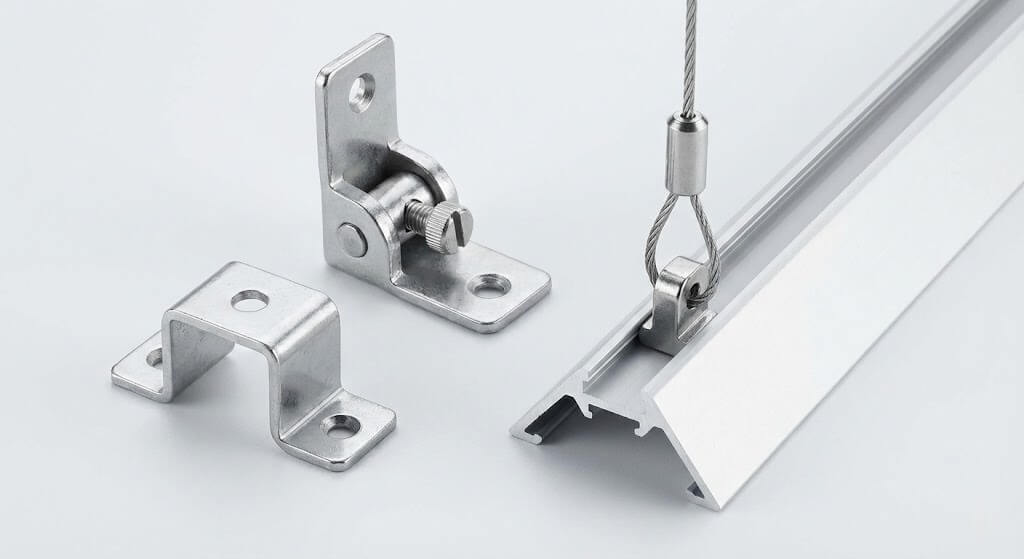
Installation technique determines results: Proper installation of V-shape profiles requires attention to mounting methods, thermal considerations, and electrical connections to achieve optimal performance and longevity.
Professional installers follow specific procedures to ensure proper thermal contact, secure mounting, and reliable electrical connections. These procedures maximize system performance while minimizing maintenance requirements.
Pre-Installation Planning
Plan the installation layout to minimize joints and optimize light distribution. Consider power supply locations, control equipment placement, and maintenance access requirements during the planning phase.
Critical step: Verify that mounting surfaces can support the combined weight of profiles, LED strips, and any suspended loads. Calculate load distribution and select appropriate fasteners.
Mounting Procedures
Use appropriate mounting clips spaced according to manufacturer recommendations, typically every 500-750mm depending on profile size and installation orientation. Ensure clips provide adequate thermal contact with mounting surfaces.
For suspended installations, distribute loads across multiple support points and use appropriate safety factors. Consider thermal expansion when determining support spacing and connection methods.
Thermal Interface Management
Ensure proper thermal contact between LED strips and profile surfaces. Use thermal interface materials when recommended by manufacturers, and avoid air gaps that could impede heat transfer.
Professional insight: Clean all surfaces before installation to ensure optimal thermal contact. Contaminants can create thermal barriers that reduce heat dissipation effectiveness.
Electrical Connection Best Practices
Plan wire routing to utilize the natural cable management features of V-shape profiles. Secure connections properly and protect against moisture ingress in appropriate applications.
Use appropriate wire gauges for the total circuit loads and consider voltage drop calculations for longer runs. Plan for easy access to connections for future maintenance or modifications.
Testing and Commissioning
Test all circuits before final installation completion. Verify proper operation, check thermal performance, and ensure all safety systems function correctly.
Final verification: Document the installation including circuit layouts, control settings, and maintenance requirements for future reference.
Conclusion
V-shape profiles represent a sophisticated solution for modern LED lighting applications where standard profiles fall short. Their unique angular design provides controlled light distribution, enhanced thermal management, and versatile installation options that address real-world lighting challenges.
The key advantages are clear: Better light control, improved thermal performance, installation flexibility, and design integration capabilities make V-shape profiles an excellent choice for professional lighting applications. While initial costs might be slightly higher than basic alternatives, the total cost of ownership often proves lower due to reduced installation time, better performance, and longer service life.
For lighting professionals seeking reliable, high-performance solutions that deliver consistent results across diverse applications, V-shape profiles offer proven benefits that justify their selection. Their combination of functional performance and aesthetic appeal makes them particularly suitable for projects where both lighting quality and visual appearance matter.
FAQ
Q1: What is the main difference between V-shape and flat LED profiles?
V-shape profiles feature angular walls that provide controlled light distribution and enhanced thermal management compared to flat profiles. The angular design focuses light output, reduces glare, and improves heat dissipation through increased surface area and natural convection channels. This results in better light control, longer LED life, and more installation flexibility.
Q2: How do V-shape profiles improve LED thermal management?
The angular walls create increased surface area for heat dissipation and natural convection channels that promote air circulation. This design typically achieves 10-15°C lower operating temperatures compared to flat profiles, extending LED lifespan and maintaining consistent light output. The thermal chimney effect created by the V-shape encourages continuous heat removal through natural convection.
Q3: Are V-shape profiles suitable for corner installations?
Yes, V-shape profiles excel in corner applications because their angular design naturally accommodates both inside and outside corners without requiring special corner pieces or complex cutting. The profiles self-align in corner joints and can be mounted using standard clips, reducing installation time and material costs while maintaining professional appearance.
Q4: What applications benefit most from V-shape profiles?
V-shape profiles work exceptionally well for retail display lighting, architectural accent systems, under-cabinet installations, and cove lighting where controlled light distribution matters. They’re particularly effective for applications requiring focused beams, reduced glare, or integration with angular architectural features. The profiles also suit industrial environments due to their robust construction and low maintenance requirements.
Q5: How do you select the correct V-shape profile angle?
Angle selection depends on the intended light distribution pattern and mounting application. Narrow angles (30-45°) provide focused beams for accent lighting, while wider angles (60-90°) offer broader distribution for general illumination. Corner installations typically use 90° profiles, wall washing applications often require 45-60° configurations, and suspended fixtures might use various angles depending on the desired light pattern and mounting height.
